👻 HAUNTED PLACE · EXP. Nº9476
ACTIVE
Castle of Mey
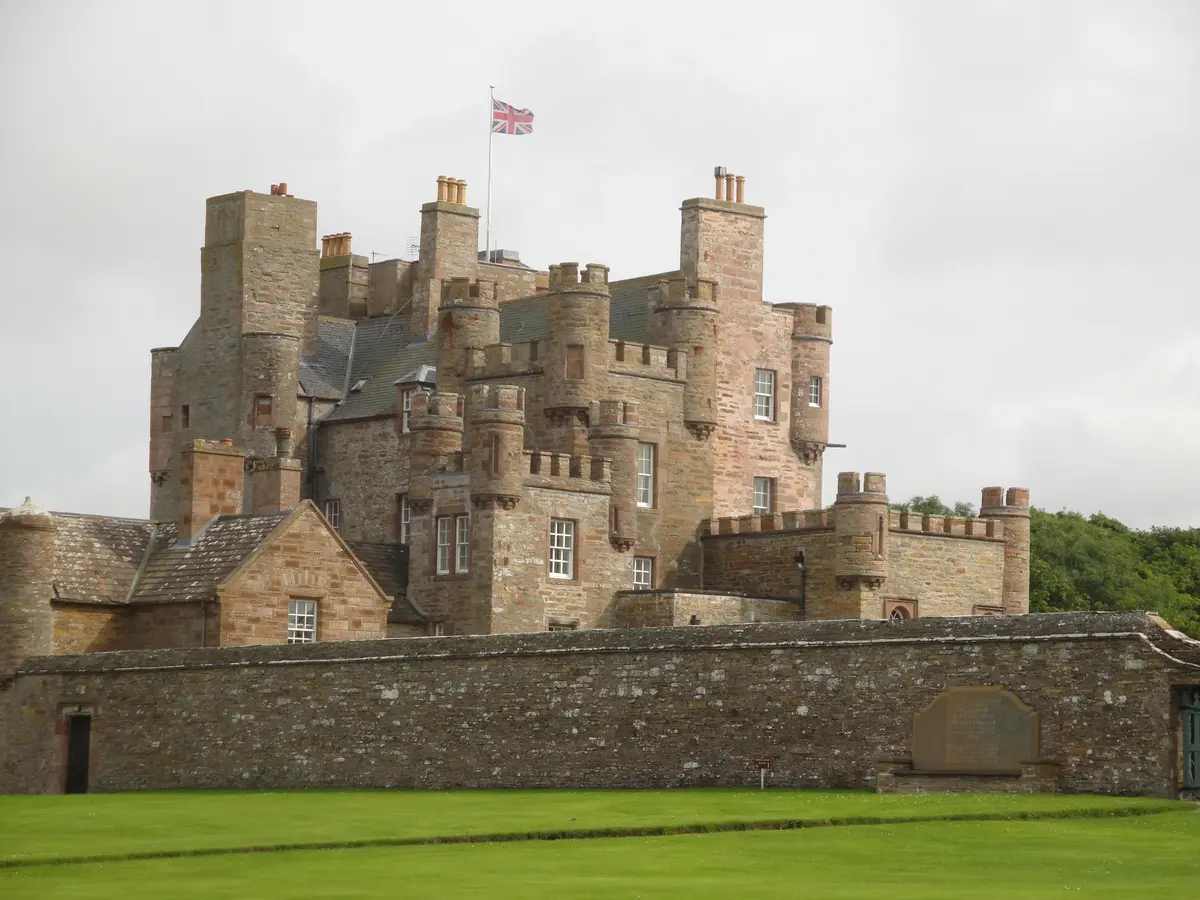
On the Caithness shore of the Pentland Firth, looking across to Orkney, the Castle of Mey was built by George Sinclair, 4th Earl of Caithness, in about 1566-72, renamed Barrogill, and bought as a wreck in 1952 by Queen Elizabeth The Queen Mother, who restored it in two years and kept it for fifty.
Where is Castle of Mey?
- Location
- Caithness, Scotland, United Kingdom
- Type
- Castle
- Coordinates
- 58.647, -3.225
- Last updated
LOCATION
Why is Castle of Mey said to be haunted?
It is famous for a Green Lady: a girl said to have been locked up by her father for loving beneath her and to have thrown herself from a tower. The room is real and old — a visitor in 1840 listed 'a haunted apartment' among the castle's contents, without a ghost, a name or a story. The name attached to it much later, and wrongly. Lady Fanny Sinclair existed and did die here, but she was the daughter of the 14th Earl, she was twenty-nine, the year was 1883, and the family genealogy records that she died 'after a very short illness' and lies in the churchyard at Canisbay. The folklorist who first printed the legend, in 1961, said in the same breath that the identification was a historians' mix-up.
What is the history of Castle of Mey?
The Castle of Mey sits on the Caithness shore of the Pentland Firth, six miles west of John o' Groats, looking across to Orkney. Historic Environment Scotland dates the fabric to about 1566-72 and lists it Category A (LB1797, designated 13 April 1971) as 'Castle of Mey and Garden Walls': a three-storey centre block with a five-storey square tower at the south-east corner and a two-storey dining-room wing.
It was built by George Sinclair, 4th Earl of Caithness. James Traill Calder, writing his 'Sketch of the Civil and Traditional History of Caithness' in 1861, noticed the evidence still fixed to the building and set it down in a footnote: a wood carving bearing the initials G.S. and E.G., one supporter a crane and the other a griffin, the mottoes 'Commit thy wish to God' and 'Ne oubhe' (Don't forget), and the arms of Montrose impaled with those of Caithness — the marriage, as Calder read it, of the 4th Earl and his Countess, Elizabeth Graham, daughter of William, Earl of Montrose.
What happened next is told slightly differently by the two authorities. The Queen Elizabeth Castle of Mey Trust says the castle was built for the Earl's second son, William Sinclair, who in 1573 was murdered at the family seat of Girnigoe by his elder brother John — John had been imprisoned there some six years by their father and was planning an escape; William found out and told him. John was killed in turn, and the castle went to the third son, George, who founded the Sinclairs of Mey. Historic Environment Scotland's list entry compresses this and says the castle 'passed to his 2nd son, William, who founded the line of Sinclair of Mey'. The Trust adds that it was a descendant of that line, succeeding to the Earldom in 1789, who changed the castle's name to Barrogill.
In 1819 the 12th Earl commissioned the architect William Burn to remodel it, adding the grand entrance and the dining room. Twenty-one years later the novelist Catherine Sinclair — a Caithness Sinclair herself, daughter of Sir John Sinclair of Ulbster — arrived on the northern circuit that became 'Shetland and the Shetlanders' (1840), and left the only eyewitness description of Burn's work in use. Barrogill was 'every way suitable for a nobleman of rank', she wrote, 'with all the internal elegance of a house in London, and all the exterior dignity of an ancient Highland residence'. She noted that 'the staircase, which was formerly outside, as high as the drawing-room floor, is now thrown into the house, while several windows have been thrown out, which were greatly wanted', and she listed what the castle contained: 'some first-rate pictures by the best masters, a haunted apartment, abundance of interesting family portraits, and a forest of the very best trees that Caithness can produce.' Off the shore she found 'a celebrated tide... called "The merry men of Mey", very noisy and obstreperous indeed, but no subject of merriment to vessels'.
The most conspicuous 19th-century occupant was James Sinclair, 14th Earl of Caithness, an inventor. Calder reports that he built a working steam carriage and drove it north to Barrogill, coming 'from Inverness to Wick, and thence to Barrogill Castle, a distance of some hundred and thirty miles' at seven or eight miles an hour, to be cheered through the burgh of Wick.
He is also the father of the real Lady Fanny. Roland William Saint-Clair's genealogy 'The Saint-Clairs of the Isles' (1898) records that the 14th Earl married in 1847 Louisa Georgina, youngest daughter of Sir George Philips of Weston House, and had by her one daughter and one son: 'Lady Fanny Georgina, born in 1854', and George Philips Alexander, Lord Berriedale, born 30 November 1858. Louisa died in 1870; the Earl married secondly, at Edinburgh on 6 March 1872, 'Marie, only surviving daughter of the late Senor Don Jose de Mariategui, and widow of His Excellency Conde de Medina Pomar', by whom there was no issue. The Earl himself died at the Fifth Avenue Hotel in New York on 28 March 1881 and was brought home embalmed for burial at Holyrood.
Of his daughter, Saint-Clair writes in one sentence: 'His sister Lady Fanny died at Barrogill Castle after a very short illness on the 11th October, 1883, greatly lamented. She was interred in the churchyard of Canisbay on the 17th of the same month.' She was twenty-nine. Her brother George, the 15th Earl, died suddenly at the Palace Hotel in Edinburgh on 25 May 1889 at the age of thirty — 'the last male of the senior branch of the Sinclairs of Mey'. The Barony of Barrogill became extinct and, in Saint-Clair's words, 'Barrogill Castle and the estates of the Mey family became estranged from the dignity.'
The Trust picks up the thread: the 15th Earl left the castle to his friend F. G. Heathcote on condition that he change his name to Sinclair; Heathcote's widow sold it to Captain F. B. Imbert-Terry, who sold it to Queen Elizabeth The Queen Mother in 1952.
That sale is the castle's second founding, and it happened fast. In 1952 the Queen Mother, newly widowed, was staying with her friends Commander and Lady Doris Vyner at the House of the Northern Gate on Dunnet Head, a few miles west, when she saw what was then Barrogill Castle. Godfrey Talbot's 1978 account adds the detail that decided it: she was told there was a possibility the old castle would be demolished. She bought it that year. Historic Environment Scotland's list entry, written while she still owned it, says 'purchased by H.M. The Queen Mother, c. 1953' — a year adrift from the Trust's date, and worth noting rather than smoothing over.
The restoration was not a lifetime's work, whatever is often written. The Trust dates it precisely: the castle, gardens and roughly thirty acres of policies were 'renovated and restored by Her Majesty between 1953 and 1955'. Much of Burn's 1819 Baronial porch was taken off again in the process. Hew Lorimer carved her crest above the first-floor dining-room window on the west side in about 1954. She restored the castle's original name, Barrogill becoming the Castle of Mey once more, and in 1958 bought the neighbouring Longoe Farm. For the next forty-odd years she came for three weeks each August and about ten days each October, and opened the gardens three days a year for Scotland's Gardens Scheme — a tradition the trustees still keep.
She made the arrangements for afterwards herself. The Queen Elizabeth Castle of Mey Trust was constituted by a Deed of Trust executed on 11 June 1996 (Scottish charity SC024983). Her last visit was in October 2001; she died in March 2002, and the castle opened to the public that year. Since 1 January 2019 the sole trustee has been The King's Foundation.
Timeline: the documented record of Castle of Mey
- c. 1566-1572 Historic Environment Scotland dates the fabric of the castle to about 1566-72, built by George Sinclair, 4th Earl of Caithness. In 1861 James Traill Calder recorded the carving that still identified him: initials G.S. and E.G., a crane and a griffin as supporters, and the arms of Montrose impaled with those of Caithness for his Countess, Elizabeth Graham.
- 1573 According to the Trust, William Sinclair — the son for whom the castle was built — is murdered at Girnigoe by his elder brother John, whose escape he had betrayed to their father. The castle passes to the third son, George, founder of the Sinclairs of Mey. Historic Environment Scotland's list entry instead credits William with founding that line.
- 1819 The 12th Earl commissions the architect William Burn to remodel Barrogill, adding the grand entrance and the dining room. Most of Burn's Baronial porch would be taken off again during the 1950s restoration.
- 1840 The earliest datable mention of a haunting here. Catherine Sinclair, visiting on her northern circuit, lists what Barrogill contains: 'some first-rate pictures by the best masters, a haunted apartment, abundance of interesting family portraits, and a forest of the very best trees that Caithness can produce'. No ghost, no name, no story. Elsewhere in the same book she jokes that at Glenlyon 'Mr. Burn should certainly be requested to supply the deficiency by building a haunted room'.
- 1861 James Traill Calder publishes his 'Sketch of the Civil and Traditional History of Caithness'. Barrogill appears four times and none of them concerns a ghost; the same volume discusses superstition fourteen times, fairies eight and witches five. The book that should have carried the local legend does not carry it.
- 11 October 1883 Lady Fanny Georgina Sinclair, born 1854, only daughter of James Sinclair, 14th Earl of Caithness, 'died at Barrogill Castle after a very short illness... greatly lamented', in the words of the family genealogy of 1898. She was buried in the churchyard of Canisbay on 17 October. She was twenty-nine, and she did not fall from a tower.
- 25 May 1889 George, 15th Earl of Caithness, Lady Fanny's brother, dies suddenly at the Palace Hotel in Edinburgh aged thirty — born 30 November 1858 — 'the last male of the senior branch of the Sinclairs of Mey'. The Barony of Barrogill becomes extinct and the castle leaves the family.
- 1952 Newly widowed, Queen Elizabeth The Queen Mother sees what was then Barrogill Castle while staying with Commander and Lady Doris Vyner at the House of the Northern Gate on Dunnet Head, and buys it that year. Godfrey Talbot reports she had been told the castle might be demolished. Historic Environment Scotland's list entry says 'c. 1953'.
- 1953-1955 The castle, gardens and some thirty acres of policies are restored — a two-year job, not the four decades often claimed. Hew Lorimer carves the Queen Mother's crest above the first-floor dining-room window in about 1954, and Barrogill formally becomes the Castle of Mey again.
- 1961 The earliest datable telling of the named legend: R. Macdonald Robertson's 'Selected Highland Folktales' notes that 'Barrogil is now the Scottish home of the Queen Mother' and that the room is called 'Lady Fanny's room' 'owing to some confusion by the historians in linking Lady Fanny Sinclair, sister of the 19th Earl of Caithness'. The first folklorist to record the name is the first to call it a mistake.
- 13 April 1971 The castle and its garden walls are listed Category A by the Scottish heritage authorities, entry LB1797. The gardens and designed landscape are separately inventoried on 30 June 1987.
- 1987-1999 The legend hardens in print and contradicts itself. Joan Forman (1987) has Lady Fanny fall for 'a good-looking groom in her father's employ' and throw herself 'from one of the windows'; Craig Brown and Lesley Cunliffe had already made her daughter of the 13th Earl (1982); John and Anne Spencer (1998) have her throw herself to her death; Martin Coventry (1999) adds that 'a stone is said to mark the spot where she hit the ground'.
- 11 June 1996 The Queen Elizabeth Castle of Mey Trust is constituted by Deed of Trust (Scottish charity SC024983). The Queen Mother's last visit is in October 2001; she dies in March 2002 and the castle opens to the public that year.
- 2003, revised 2017 Nick McCann's official guidebook devotes page 88 to 'The Legend of Lady Fanny Sinclair' and identifies her correctly as the only daughter of the 14th Earl, pointing readers to her grave at Canisbay. The Trust's website, by contrast, has carried nothing about a ghost in some 800 archived pages since April 2002.
- 1 January 2019 Stewardship of the castle passes to The King's Foundation, now the Trust's sole trustee. The 2026 season runs Wednesday to Sunday from 1 May to 30 September, closed completely from 24 July to 11 August while the family is in residence.
Is there a rational explanation for Castle of Mey?
The Green Lady of Mey can be dated, and dating her is more interesting than believing or dismissing her.
Start with what is documented. There was a Lady Fanny Sinclair, and she did die in this castle. Roland William Saint-Clair's family history of 1898 states that Lady Fanny Georgina Sinclair, born 1854, daughter of the 14th Earl of Caithness, 'died at Barrogill Castle after a very short illness on the 11th October, 1883, greatly lamented' and was buried at Canisbay six days later. That is a death from illness, at twenty-nine, in the reign of Victoria, recorded by a genealogist writing fifteen years afterwards with the family's own material in front of him. It is not a fall from a tower, and the woman it happened to was not a girl locked up by a 16th-century laird.
Now the room. The oldest reference I have been able to fix is Catherine Sinclair's, in 1840 — forty-three years before Lady Fanny died. Barrogill, she wrote, contained 'some first-rate pictures by the best masters, a haunted apartment, abundance of interesting family portraits, and a forest of the very best trees'. That is the whole of it: a haunted apartment, itemised among the amenities, with no ghost, no name, no story and no incident attached. Two hundred pages later the same author makes the joke that explains the genre — visiting Glenlyon and finding no ghost at all, she remarks that it is astonishing in so antique a Highland residence to hear nothing of one, and that 'Mr. Burn should certainly be requested to supply the deficiency by building a haunted room'. William Burn was the architect who had just remodelled Barrogill. In 1840 a haunted room was a feature of a Scottish country house, like a picture gallery.
Did the 19th century attach a story to Barrogill's room? Not in the local literature. James Traill Calder's 'Sketch of the Civil and Traditional History of Caithness' (1861) is exactly the book that would have carried it: a traditional history of the county. Barrogill appears in it four times — the carved arms, a tutor to the Earl's family, the steam carriage — and none of the four has a ghost in it. As a control on the same volume, Calder writes about superstition fourteen times, fairies eight and witches five, so this is not a book that shied away from the subject. The 1898 Sinclair genealogy is the same: not one occurrence of 'ghost' or 'Green Lady' in over two megabytes of text.
The named legend surfaces after the Queen Mother, not before her. The earliest telling I can date is R. Macdonald Robertson's 'Selected Highland Folktales' (Oliver & Boyd, 1961), nine years after the purchase, and Robertson himself flags the problem: the room, he writes, is called 'Lady Fanny's room' 'owing to some confusion by the historians in linking Lady Fanny Sinclair, sister of the 19th Earl of Caithness and the last to live' there. His own paragraph opens by noting that 'Barrogil is now the Scottish home of the Queen Mother, known as the Castle of Mey'. The folklorist who first records the name is also the first to say the name is a mix-up.
After that the detail multiplies, and it multiplies in incompatible directions. Whose daughter she was depends on the book: sister of the 19th Earl (Robertson, 1961); daughter of the 13th Earl (Craig Brown and Lesley Cunliffe, 'The Book of Royal Lists', 1982); only daughter of the 14th (the castle's own guidebook, which is the one that matches the grave); 'a daughter of the fifth earl' (Ewan McGregor and Charley Boorman, 'Long Way Down'); simply 'a 16th-century earl of Caithness' in the children's compilations. Joan Forman's 'Haunted Royal Homes' (1987) has her 'unwisely' falling 'in love with a good-looking groom in her father's employ' and throwing herself 'from one of the windows'. John and Anne Spencer's 'The Ghost Handbook' (1998) has her throwing herself to her death. Martin Coventry's 'Haunted Places of Scotland' (1999) adds that 'a stone is said to mark the spot where she hit the ground'. Dane Love's 'Scottish Ghosts' (1995) is the most honest of them, conceding that 'many stories link the ghost to the death of a young lover' — many stories, which is another way of saying no story.
Our previous entry also reported that the Queen Mother took the tale in stride and joked that she had no objection to sharing the house. I have not been able to find that remark, or any remark of hers about a ghost at Mey, in any source. Searches of a large full-text book corpus return nothing for it, while the same corpus returns dozens of hits for 'Castle of Mey' with 'Green Lady' and reproduces the contents page of the castle's own guidebook — so the search works. Repeating the query changed nothing. One near miss is worth naming, because it is how this kind of thing happens: Peter Eldin's children's collection does say a ghost 'has been seen by the Queen Mother amongst others', but that sentence is about Glamis, her childhood home, not about Mey. Words put in the mouth of a real and heavily documented person need a source; this one has none, and it is gone.
Finally, the incentive. If the Trust were selling the ghost, that would explain a good deal — but it isn't, at least not where most people would look. Across some 800 archived addresses of castleofmey.org.uk going back to April 2002, there is not one page about a ghost, a Green Lady or Lady Fanny; the only 'green' on the site is its Green Tourism award. The word appears nowhere in the current history, visitor, attraction or trust pages either. What the Trust does sell is a book: Nick McCann's official guidebook, first published in 2003 and revised in 2017, devotes page 88 to 'The Legend of Lady Fanny Sinclair', and it is the guidebook — not the ghost writers — that gets her parentage right and points the reader to her grave at Canisbay. That is an unusually careful way for an attraction to handle its own ghost, and it deserves saying.
Can you visit Castle of Mey?
The Castle of Mey stands on the Caithness shore of the Pentland Firth. Historic Environment Scotland lists the castle and its garden walls as a Category A building, entry LB1797, designated on 13 April 1971. The Queen Elizabeth Castle of Mey Trust, which runs it, gave its 2026 season on its opening-times page, read on 23 September 2026, as Wednesday to Sunday from 1 May to 30 September, with the site "closed completely from 24th July to 11th August inclusive". The castle opens at 11.00, with last admission at 15.00, and the route runs through seven rooms from the Front Hall and the Library to the Butler's Pantry and the Kitchen. Everything outside the castle, from the gardens to the tearoom and the Animal Centre, keeps longer hours, 10.30 to 16.00.
Tickets are sold on the day in the gift shop, and the visitor centre takes card and contactless payments only. On the same date the admission page priced an adult ticket to the castle, grounds and gardens at £18.30 and a family ticket at £47.85, with concessions at £14.50 and children at £9.35. For the grounds and gardens alone the prices were £11.45 for an adult and £29.10 for a family, with children at £6.25. The concession rate is for over-60s and students with ID. A child is 5 to 16 inclusive, and a family ticket covers two adults with up to four children.
The Trust's directions give the route from the east as the A99 from Wick to John o' Groats and then 6 miles on the A836, and from the west as 14 miles along the coast on the A836 from Thurso. Thurso station is about 14 miles away and Wick about 23; the Trust notes that a bus or car is needed from either, and that Stagecoach runs the buses. The car park in front of the visitor centre has disabled spaces close to the entrance and signposted bays for coaches, campervans and motorbikes. The castle is about 200 metres from the car park, and the Trust's access page states that "wheelchair access is not currently possible in the Castle"; visitors who have difficulty walking can ask at the ticket office to park nearer the entrance, and the tearoom, shop and toilets in the visitor centre are fully accessible. For visitors arriving on foot, the Trust gives the walk from the top of the drive as 15 to 20 minutes on flat ground. Coach and group visits are arranged through [email protected] or on 01847 851473.
The castle information sheet is available in eight languages besides English, Spanish among them. Dogs on a lead may be walked in the grounds but are not allowed in the castle, the Animal Centre or the Walled Garden, assistance dogs excepted.
The Trust's four visitor-information pages, read on 23 September 2026, say nothing about the Green Lady; the house tells the legend in its official guidebook, where Nick McCann gives "The Legend of Lady Fanny Sinclair" on page 88. Lady Fanny was buried in the churchyard at Canisbay. Canisbay Parish Church, at grid reference ND 34349 72853, stands about 5.4 km (3.4 miles) east of the castle in a straight line.
Sources consulted
- Roland William Saint-Clair, «The Saint-Clairs of the Isles: being a history of the sea-kings of Orkney and their Scottish successors of the sirname of Sinclair (death and burial of Lady Fanny Georgina Sinclair, 1883)» — H. Brett, Auckland, 1898 book
- Catherine Sinclair, «Shetland and the Shetlanders; or, The Northern Circuit (chapter 'Barrogill Castle')» — William Whyte & Co., Edinburgh, 1840 book
- James Traill Calder, «Sketch of the Civil and Traditional History of Caithness, from the Tenth Century» — Thomas Murray & Son, Glasgow, 1861 book
- Historic Environment Scotland, «Castle of Mey and Garden Walls — listed building record LB1797, Category A, designated 13 April 1971» — Historic Environment Scotland designations portal, 1971 report
- The Queen Elizabeth Castle of Mey Trust, «History — the Castle of Mey (building, Sinclair succession, the 1952 purchase and the 1953-55 restoration)» — castleofmey.org.uk, 2026 web
- The Queen Elizabeth Castle of Mey Trust, «Opening Times 2026 and Admission Prices (read 11 August 2026)» — castleofmey.org.uk, 2026 web
- R. Macdonald Robertson, «Selected Highland Folktales (Barrogil / 'Lady Fanny's room')» — Oliver & Boyd, Edinburgh, 1961 book
- Joan Forman, «Haunted Royal Homes (Castle of Mey, Caithness)» — Harrap, London, 1987 book
- Nick McCann, «The Castle & Gardens of Mey: The Queen Mother's Home in Caithness (official guidebook; 'The Legend of Lady Fanny Sinclair', p. 88)» — Heritage House (2003); Nick McCann Associates Ltd (revised edition), 2017 book
- Martin Coventry, «Haunted Places of Scotland (Castle of Mey)» — Goblinshead, Musselburgh, 1999 book
- John Spencer and Anne Spencer, «The Ghost Handbook (Castle of Mey)» — Boxtree, London, 1998 book
- Dane Love, «Scottish Ghosts ('many stories link the ghost to the death of a young lover')» — Robert Hale, London, 1995 book
- Craig Brown and Lesley Cunliffe, «The Book of Royal Lists (Lady Fanny Sinclair given as daughter of the 13th Earl)» — Routledge & Kegan Paul, London, 1982 book
- Godfrey Talbot, «The Country Life Book of Queen Elizabeth the Queen Mother (Barrogill threatened with demolition)» — Country Life Books, London, 1978 book
- Wikipedia contributors, «Castle of Mey (dating of the tower, listing, Trust and King's Foundation stewardship)» — English Wikipedia, 2026 web
Reviewed by V. Serrano on 2026-08-11 · How we verify our content
💬 Field testimonies (0)
No testimonies yet. Add the first.
Add your testimony
🔒 Log in to add a testimony