👻 HAUNTED PLACE · EXP. Nº9475
ACTIVE
Chillingham Castle
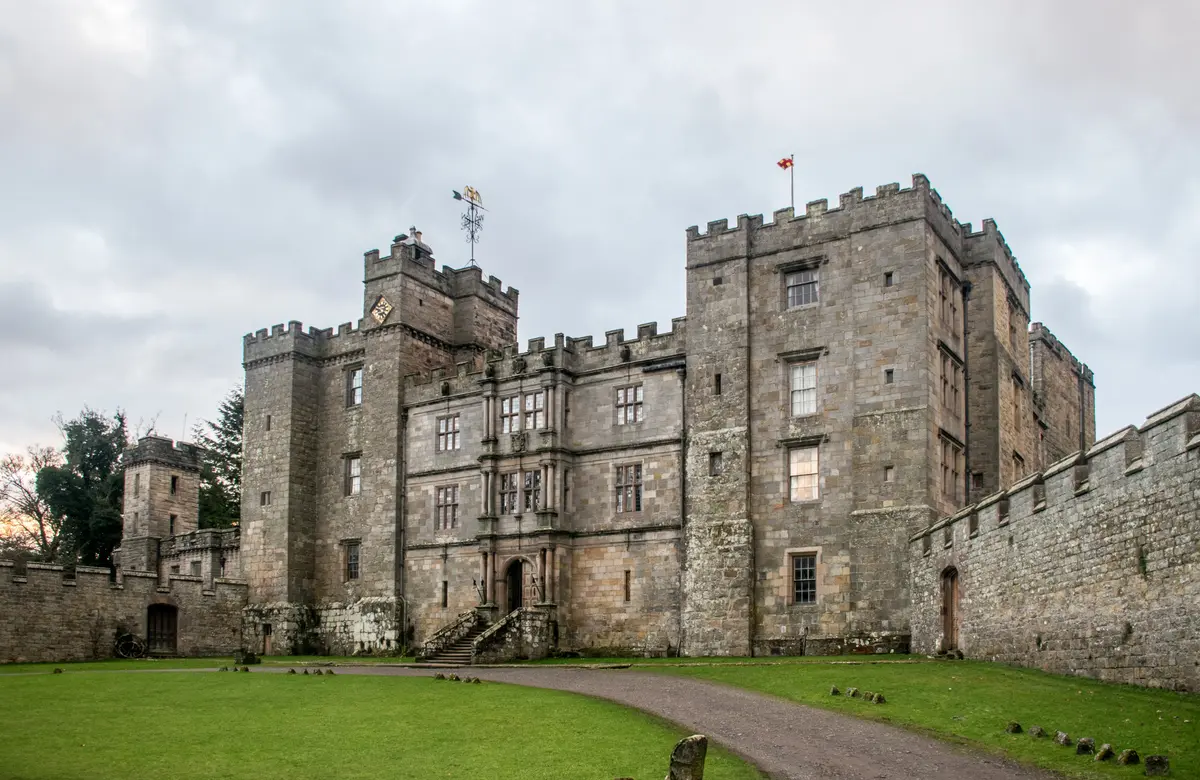
Chillingham Castle in Northumberland advertises itself as "Britain's most haunted", but the fame is not centuries old: the earliest recorded accounts come from Lady Leonora Tankerville, who arrived in 1895 and set them down in a booklet of 1925.
Where is Chillingham Castle?
- Location
- Northumberland, England, United Kingdom
- Type
- Castle
- Coordinates
- 55.526, -1.905
- Last updated
LOCATION
Why is Chillingham Castle said to be haunted?
The solid history is elsewhere. Edward I was here on 1 and 2 July 1298, and again that October — his own chancery rolls date documents from the place — and in 1344 Thomas of Heton was licensed to crenellate the house. The castle stood empty from 1933 and spent nearly half a century sliding towards ruin until the Wakefields bought it in 1981 and opened it: the visitor business, the torture chamber on display — which the castle itself does not claim as its own — and the "most haunted" label all date from then. Among its ghosts is the White Lady, identified with Lady Mary Berkeley, whose husband was at the centre of a real and prosecuted scandal in 1682: he eloped with her sister.
What is the history of Chillingham Castle?
Chillingham sells itself as the most haunted castle in Britain. The curious thing about that sentence is that almost everything hard and documented about the place has nothing to do with ghosts — and that the ghosts themselves have a shorter paper trail than the building does.
Start with the records. On 27 January 1344 a certain Thomas of Heton asked Edward III for a licence to fortify and battlement his manor of Chevelyngham with stone and lime and to make the same a castle or fortalice to be held by him and his heirs without impediment. The wording is quoted by John Goodall, architectural editor of Country Life, who adds that the original copy of that royal licence is still kept at the castle. The Chillingham Wild Cattle Association, which owns the park next door, notes that the same permission covered the enclosing of a deer park, and suggests it may be the moment the herd that still lives there was first corralled.
But the king had already been to Chillingham before the licence — and this is the part that turns out to be solid. Henry Gough's Itinerary of King Edward the First, compiled from the public records of England and published in 1900, places Edward I at Chillingham on 1 and 2 July 1298, dating documents there from five separate classes of record: Close Rolls, Fine Rolls, inquisitions, Patent Rolls and Scotch Rolls. On the 3rd he moved to Roxburgh, where his army was assembling; on 22 July he won the battle of Falkirk. And he came back. After dating from Jedburgh through the first half of October, he crossed to Wark on the 18th and 19th, returned to Jedburgh on the 19th, and was at Chillingham on the morrow — 20 October 1298. In a reign of thirty-five years, Gough's index lists Chillingham exactly twice, both times in 1298. The claim that Edward I ran a Scottish campaign through this castle is not a tour guide's flourish; it is in the chancery rolls.
The fabric is less romantic than the brochure and more interesting. The official list entry — Grade I, listed on 21 September 1951 — describes it flatly: Castle. C14 with C17, C18 and C19 alterations. John Patterson and Sir Jeffrey Wyatville did work in early C19. Quadrilateral, four corner towers and linking ranges around a central courtyard; an early-17th-century centrepiece with paired Tuscan columns on all three floors; six statues of Worthies on corbels in the courtyard; tunnel-vaulted basements, newel stairs in the towers, an early-17th-century ceiling with pendants and a fine early-18th-century white marble fireplace with satyr heads. And then, in the same official text, four words that explain the last century of Chillingham's story: Interior in poor repair.
The Greys held it and regularised the building into a quadrangle in the early 17th century, and it is a Grey who gives Chillingham its one genuinely documented scandal. On 23 November 1682, at the King's Bench bar, Ford, Lord Grey of Werke stood trial with five others on an information exhibited by the Attorney General. The charge was that on 20 August 1682, at Epsom, they had conspired the ruin of Lady Henrietta Berkeley, a younger daughter of George, Earl of Berkeley, then under eighteen and in her father's custody, and had carried her out of her father's house without his leave. The printed record spells out the aggravating circumstance in a single clause: the said Ford Lord Grey was then and long before, and yet, being the Husband of the Lady Mary, another Daughter of the said Rt. Honb. George Earl of Berkeley, and Sister of the said Lady Henrietta. Five of the defendants were found guilty.
That is the entire backstory of Chillingham's White Lady, and it is not folklore. It is an indictment. Ford Grey was created Earl of Tankerville in 1695, and Country Life dates the castle's passage to the Earls of Tankerville, by marriage, to that same year.
Then the long fall. Goodall records that from 1933, following the death of the 7th Earl of Tankerville and the sale of the contents, Chillingham stood empty for nearly half a century; an attempt to hand it to the National Trust failed, and the castle seemed set to fall into ruin. The estate came apart around it. Lord Tankerville bequeathed the wild cattle to the Chillingham Wild Cattle Association — formed in 1939 — in 1971; his son the 9th Earl died in 1980 and the remainder of the estate was sold; the park itself was acquired by the Sir James Knott Trust after the intervention of the 10th Duke of Northumberland, and the association was only able to buy it back in 2005.
The castle's rescue came in 1981, when Sir Humphry Wakefield and the Hon. Lady Wakefield — a descendant of the Grey family — bought it and began repairing the fabric. Country Life calls it an extraordinary achievement to have taken on this huge task and driven it forward with such determination, and the phrase to hold on to is Goodall's own: the castle was rescued. Nearly fifty years of empty rooms and stripped roof lead stand between the last Tankerville and the ticket office.
And the ghosts? The castle's own Ghosts page names four: a pale figure in white who asked a footman for water in the Inner Pantry and vanished when he remembered the door was locked; an unseen presence felt rather than seen in the chamber; two men's voices talking in the chapel, never intelligible, which stop if you try to trace them; and shadows in the moonlit courtyard. It opens with a verse of Longfellow and cites Tennyson. It does not mention a Blue Boy, a Radiant Boy, Lady Mary Berkeley or a castle torturer at all.
Timeline: the documented record of Chillingham Castle
- 1 and 2 July 1298 Edward I is at Chillingham, dating documents there from five classes of record — Close Rolls, Fine Rolls, inquisitions, Patent Rolls and Scotch Rolls — according to Henry Gough's Itinerary of King Edward the First, compiled from the public records of England. On 3 July he moves to Roxburgh, where his army is assembling; on 22 July he wins the battle of Falkirk.
- 20 October 1298 Returning south after the campaign, the king crosses from Jedburgh to Wark on 18-19 October and is at Chillingham on the 20th, before going on by Chester-le-Street and Durham. Gough's index records Chillingham exactly twice in Edward I's thirty-five-year reign, both times in 1298.
- 27 January 1344 Thomas of Heton obtains from Edward III a licence to 'fortify and battlement his manor of Chevelyngham with stone and lime and to make the same a castle or fortalice'. John Goodall reports in Country Life that the original copy of the licence is still kept at the castle. The Chillingham Wild Cattle Association notes that the same permission covered the enclosing of a deer park.
- 23 November 1682 Ford, Lord Grey of Werke is tried at the King's Bench with five others for conspiring, on 20 August 1682 at Epsom, to take Lady Henrietta Berkeley — under eighteen and in her father's custody — from her father's house. The information records that Grey was the husband of Lady Mary, another daughter of the Earl of Berkeley and Henrietta's sister. Five defendants are found guilty. This is the documented origin of the story attached to Chillingham's 'White Lady'.
- 1695 Ford Grey is created Earl of Tankerville. Country Life dates the castle's passage to the Earls of Tankerville, by marriage, to the same year; the Greys had already regularised the building into a quadrangle in the early 17th century.
- 8 September 1803 The best-documented English 'radiant boy' is seen — at Corby Castle in Cumberland, not at Chillingham. The Rev. Henry A., rector of Greystoke, reports a light in the middle of his room resolving into 'a beautiful boy, clothed in white, with bright locks, resembling gold', and leaves the house the next morning without explanation. The account, written up in a journal of the time and copied out at the castle on 22 December 1824, is printed by Catherine Crowe in 1848.
- 1895 Leonora arrives at Chillingham from the United States on marrying the Earl of Tankerville. The historian Eleanor Janega identifies her writings as the first recorded accounts of Chillingham's ghosts, and places them in the Victorian-Edwardian spiritualist revival.
- 1933 Following the death of the 7th Earl of Tankerville and the sale of the contents, Chillingham is left empty for nearly half a century. An attempt to pass it to the National Trust fails and the castle seems set to fall into ruin.
- 21 September 1951 Chillingham Castle is listed Grade I (list entry 1042387). The official description — 'C14 with C17, C18 and C19 alterations', with work by John Patterson and Sir Jeffrey Wyatville in the early 19th century — ends with the words 'Interior in poor repair.'
- 1971 Lord Tankerville bequeaths the wild cattle to the Chillingham Wild Cattle Association, formed in 1939. His son, the 9th Earl, dies in 1980 and the remainder of the estate is sold; the park is acquired by the Sir James Knott Trust after the intervention of the 10th Duke of Northumberland.
- 1981 Sir Humphry Wakefield and the Hon. Lady Wakefield, a descendant of the Grey family, buy Chillingham and begin repairing the fabric. Country Life calls the result 'an extraordinary achievement' and describes the castle as rescued. The paying visitor operation, the torture-chamber display and the year-round ghost tours all date from this era.
- 2005 The Chillingham Wild Cattle Association, helped by charitable trusts and local donors, buys back the park from the Sir James Knott Trust, reuniting the herd and its habitat under one ownership for the first time since the estate was broken up.
- 30 October 2024 In a History Hit article, Sir Humphry Wakefield describes the blue figure as an inherited problem: bones of a child found between the castle walls 'solved that problem', and yet guests in the restored room kept telling him there must be an electrical fault causing a flash of blue at the edge of the door — 'Well, there's no electric there at all. We must have left a toe bone.' The castle's resident ghost hunter Richard Craig puts the count at fifty ghosts.
- 2026 season The castle and gardens open from 30 March to 1 November, 11:00 to 17:00, with adult admission at £13.12 until 1 September. Ghost tours (£25, over-16s) and ghost hunts (from £50, over-18s) run all year and sell out months in advance.
Is there a rational explanation for Chillingham Castle?
The hypothesis we started with was that Chillingham's fame is modern and commercial — that a half-ruined castle restored from 1981 invented its ghosts along with its ticket office. That is half right, and the half that is wrong is worth stating first, because it is the more interesting half.
The ghosts are not a Wakefield invention. They are Edwardian. In the article History Hit published on 30 October 2024, the medieval historian Eleanor Janega makes the point plainly: unlike other medieval ghost stories, the first recorded accounts of Chillingham's ghost tales are much more recent, and they were written by Lady Leonora Tankerville, who came to Chillingham from the United States after marrying the Earl of Tankerville in 1895. Janega puts her in context — the Victorian and Edwardian decades were something of a golden age for ghost stories, a spiritualist revival running alongside the era's rationalism — and that context is the real explanation. Chillingham did not acquire its ghosts because it is old. It acquired them because a literary American countess with an interest in the occult moved in at the exact moment when British country houses were competing for hauntings. The tradition is roughly 130 years old, not 700.
The Blue Boy is inherited, and the current owner says so. In the same article Sir Humphry Wakefield describes the figure as a problem he found, not one he made: In the 18th century there was a figure who spent his time wailing and moaning and shimmering in blue, and he adds that excavations between the castle walls turned up the bones of a child, which solved that problem. Then comes the sentence that no invented ghost story would ever include: But when I restored that room, my guests kept saying, 'You must have an electric fault which is a flash of blue on the edge of the door.' Well, there's no electric there at all. We must have left a toe bone. It is a joke, told against himself, by the man selling the tours. It is also the closest thing to an admission that the flashes of blue reported in that room look, to the people reporting them, like an electrical fault.
The luminous boy is a borrowed English motif, and its documented home is elsewhere. The classic British Radiant Boy is not at Chillingham. It is at Corby Castle in Cumberland, and it has a date and a witness. Catherine Crowe printed the account in The Night Side of Nature in 1848, copied — she says — from the handwriting of C. M. H., dated at the castle on 22 December 1824, and quoting a journal entry made at the time. On 8 September 1803 the Rev. Henry A., rector of Greystoke, was a guest; the next morning he ordered a post-chaise so violently that it knocked down part of the flower-garden fence, and left without explanation. The reason, given later in his own words, was that between one and two in the morning he had seen a glimmer in the middle of the room grow to a bright flame and resolve into a beautiful boy, clothed in white, with bright locks, resembling gold, who looked at him and glided away towards the chimney. He closed his statement: I declare this to be a true account of what I saw at C — Castle, upon my word as a clergyman. That is what a genuinely old radiant-boy tradition looks like — named house, named witness, dated journal, signed declaration. Chillingham has none of that apparatus. What it has is a similar figure, first written down a century later, by a countess.
The White Lady's grievance is real; her haunting is not documented. The 1682 trial establishes beyond argument that Ford, Lord Grey of Werke was married to Lady Mary Berkeley and was convicted of carrying off her younger sister. But the abduction happened at Epsom, in Surrey, and the trial in Westminster. Nothing in the record puts Mary at Chillingham at all, let alone pining in a corridor. The castle's own ghost page does not list her; the History Hit piece attributes her — a presence in the Great Hall, with a smell of roses and a wafting chill — to Richard Craig, described as the castle's resident ghost hunter, who reckons the building holds fifty ghosts. A real seventeenth-century humiliation has been re-housed, three centuries later, in the building the family happened to own.
The torture chamber does not claim to be Chillingham's own — read the wording. The castle's room-by-room text opens the section with a general observation, not a local one: All castles may have had such rooms. What follows is a list of objects — a stretching rack, cages, a bed of nails, a nailed barrel, a spiked chair, executioner's blocks, thumb screws, chains, leg irons, man traps and branding irons — with no provenance given for a single one, and no claim that any of them was ever used in this building. Among them is an Iron Maiden, and that item is diagnostic. As the medievalist Lorris Chevalier summarises the scholarship, the first known references to iron maidens appear only in the 19th century: museums and collectors eager to attract public attention often exhibited fabricated or heavily modified objects as 'medieval torture devices', and the specimens that survive are generally later coffins or cases retrofitted with spikes. An iron maiden in a medieval castle is not evidence of medieval torture. It is evidence of a nineteenth-century market in medieval torture, and of a twentieth-century collector buying into it. Sir Humphry Wakefield made his career in the antiques trade; the castle is furnished throughout with a collector's acquisitions, and it says so.
The child's bones have no excavation report. The castle states that a trap-door in the dungeon floor reveals the very genuine bones of a child in the vault below, and separately that two grinning skeletons were once found beneath the chapel floorboards and now lie in an ossuary. Wakefield's own account speaks of bones found between the walls. Three locations, no archaeological report, no dating, no inventory that we could consult. We are not saying there are no bones. We are saying that a claim of this kind, in England, would normally leave a paper trail, and we could not find one.
Finally, the label itself. The castle's website titles its home page Britain's Most Haunted historic castle while its body text hedges to one of the most haunted castles in England; the neighbouring Wild Cattle Association calls it England's most haunted castle; History Hit's headline asks why it is known as Britain's most haunted castle. Nobody awards this title, and no two sources phrase it the same way. In the same spirit, the castle describes itself as Grade 1 Star-listed, a category that does not exist in England: the official designation is Grade I. Tours run all year and were, at the time of writing, selling out months ahead at £25 and £50 a head. That is not a reason to disbelieve anybody's experience in a cold stone building at midnight. It is a reason to notice that the superlative is a product, and that the two firmest facts on the site — a king's chancery working here in July 1298, and a peer convicted in 1682 of seducing his wife's sister — are the ones nobody puts on the poster.
Can you visit Chillingham Castle?
Chillingham Castle is at Chillingham, Alnwick, Northumberland NE66 5NJ, about 17.7 km (11 miles) north-west of Alnwick; the telephone is 01668 215359 and the castle gives the what3words reference ///configure.sunbeam.headsets. Its visit page, consulted on 23 September 2026, gives the approach by car. From the A1 near Alnwick the instruction is to "Ignore first sign Chillingham/North Charlton and take the Chatton/Wooler road", a few hundred yards north of the Purdy Lodge/Bamburgh turn; the castle can also be reached from the A697 on the Wooler side. In bad weather the page advises checking for road closures and floods and names the B6346 Alnwick road as usually the best option. Parking at the main gates is free, with disabled parking beside the castle. Newcastle airport is 47 miles (76 km) away and Edinburgh 75 (121 km).
For 2026 the season runs from 30 March to 1 November, with the gates open 11:00 to 17:00, last admission at 16:00, and the tearoom open the same hours; the page lists Saturday 26 September 2026 as closed. Admission on the same page is £15 for adults, £14 for over-65s and £8 for children under 16, with under-fives free and a family ticket at £42. One carer enters free with each paying visitor, CPRE members pay half and Historic Houses members enter free. The guidebook costs £3.25. Private guided tours run from Easter to the end of October and must be booked in advance; they need at least ten people and cost £50 per guide, who takes up to twenty, on top of the group rate of £14 per adult.
Ghost tours and ghost hunts are sold year-round on the castle's ghost page: tours at £25 a person for over-16s, hunts from £50 for over-18s, and family ghost tours at £25 in school holidays. On 23 September 2026 the page showed evening tours, several of them from 19:00 to 21:00, and hunts from 22:00 to 02:00, with most October dates, Halloween included, marked sold out and dates still open in November and December. Bookings are non-refundable. Parties of ten or more can arrange their own date, and paranormal investigation teams can hire the venue. The castle warns that the tours are cold and dark and asks for "a torch, wrap up warm and wear sensible shoes".
The castle describes disabled access as "Very limited" and says it "may not be suitable for anyone with mobility difficulties, due to uneven floors and steep spiral staircases"; the toilets and tearoom are reached by spiral stone steps with a rope handrail. The ghost page adds that the tours "are not for anyone who may struggle with their mobility". Only assistance dogs are admitted, and the castle refers dog owners to a kennel in Alnwick.
The Chillingham Wild Cattle belong to a separate charity, the Chillingham Wild Cattle Association, at Chillingham, Alnwick NE66 5NP, telephone 01668 215 250, which bought the park in 2005. Its site says the herd has "never been touched by human hand" and receives no veterinary treatment. Visitors are met by the warden, carried by Land Rover trailer along a country track and then walk a short way into the park. There are four tours a day, seven days a week, each limited to 20 people, and the visitor centre opens from 9:30 to 14:00.
Sources consulted
- Historic England, «Chillingham Castle — official list entry 1042387, National Heritage List for England (Grade I, listed 21 September 1951): full statutory description, ending 'Interior in poor repair'» — National Heritage List for England (text republished under licence by British Listed Buildings), 1951 archive
- Henry Gough (of the Middle Temple, barrister-at-law), «Itinerary of King Edward the First throughout his reign, A.D. 1272-1307, extracted from the Public Records of England — vol. II, 1286-1307: Edward I at Chillingham, 1-2 July and 20 October 1298» — Alexander Gardner, Paisley, 1900 book
- Court of King's Bench (printed trial report), «The Trial of Ford Lord Grey of Werk … at the King's-Bench-Barr, on Thursday the 23d day of November, A.D. 1682, for unlawfully tempting and enticing the Lady Henrietta Berkeley — printed record of the information and verdict» — Eighteenth-century printing, digitised by the Internet Archive, 1682 archive
- John Goodall (Architectural Editor), photography by Paul Highnam, «Chillingham Castle: The place 'of imagination and beauty' where 'every room is filled with eye-catching objects' — the 1344 licence, the emptying of the castle from 1933 and the Wakefield rescue of 1981» — Country Life, 2024 newspaper archive
- Sir Humphry Wakefield & Partners Ltd (Chillingham Castle), «Inside the Castle — the owner's own room-by-room description: dungeon, Edward I Room and the licence to crenellate, chapel skeletons and ossuary, and the Torture Chamber ('All castles may have had such rooms')» — chillingham-castle.com, 2026 web
- Sir Humphry Wakefield & Partners Ltd (Chillingham Castle), «Ghosts — the castle's own list of its four named hauntings (the White Pantry Ghost, the Ghost in the Chamber, the Voices in the Chapel and the Ghosts in the Courtyard), tour prices and dates» — chillingham-castle.com, 2026 web
- Sir Humphry Wakefield & Partners Ltd (Chillingham Castle), «Your Visit — 2026 season dates, opening hours, admission prices, group tours, access warnings and directions» — chillingham-castle.com, 2026 web
- Kyle Hoekstra, «Why Chillingham Is Known as Britain's Most Haunted Castle — with historian Eleanor Janega on Lady Leonora Tankerville as the first recorded source, and Sir Humphry Wakefield quoted directly on the blue figure and the 'toe bone'» — History Hit, 2024 interview
- Catherine Crowe, «The Night Side of Nature, or, Ghosts and Ghost Seers — vol. II, chapter 'Spectral Lights': the radiant boy of C— Castle (Corby, Cumberland), from a manuscript signed C. M. H. dated 22 December 1824 and a journal entry of 8 September 1803» — T. C. Newby, London, 1848 book
- The Chillingham Wild Cattle Association (registered charity), «History — the Chillingham herd, the 1344 deer-park licence, the 1971 bequest, the death of the 9th Earl in 1980, the sale of the estate and the association's purchase of the park in 2005» — chillinghamwildcattle.com, 2024 report
- Lorris Chevalier (PhD, medieval literature), «The Iron Maiden Never Existed — But Louis XI's Medieval Prison Reforms Did: the first known references to iron maidens appear only in the 19th century, in museums and collections 'eager to attract public attention'» — Medievalists.net, 2025 web
Reviewed by V. Serrano on 2026-07-31 · How we verify our content
💬 Field testimonies (0)
No testimonies yet. Add the first.
Add your testimony
🔒 Log in to add a testimony