👻 HAUNTED PLACE · EXP. Nº9477
ACTIVE
Chute, Wiltshire
Chute, in eastern Wiltshire, is a scatter of hamlets on high chalk downland where a Roman road does something Roman roads almost never do: for four miles it abandons the straight line altogether, curving around the head of the Hippenscombe combe.
Where is Chute, Wiltshire?
- Location
- Wiltshire, England, United Kingdom
- Type
- Village / settlement
- Coordinates
- 51.283, -1.574
- Last updated
LOCATION
Why is Chute, Wiltshire said to be haunted?
That bend is the Chute Causeway, and a ghost story has been draped over it — a rector who talked plague-stricken villagers into camping on the hill in 1665, promised to bring them food, and left them to die. The documents will not carry it. The parishes involved had vicars, not rectors, and Vernham Dean was not even a separate living until 1871. The epidemic that is actually recorded here is of 1593, when forty-three people were buried at Hurstbourne Tarrant in a single July and a pest house was set up on Conholt Hill, inside Chute parish. The clergyman who died in it has a name, John Atkinson, and so did his wife and his two sons. The second ghost often given to Chute belongs to a village thirty kilometres away.
What is the history of Chute, Wiltshire?
Chute is not one village but a scatter of them. The civil parish sits on the eastern edge of Wiltshire, hard against the Hampshire border, and gathers Upper Chute, Lower Chute, Chute Cadley, Chute Standen, Conholt, Shaw and Mount Cowdown. The Victoria County History of Wiltshire, whose account of the parish fills pages 108 to 120 of volume 16 (edited by D. A. Crowley, 1999), notes that the epithet "Upper" was only added to the name Chute in the 20th century. The nearest town, Andover, is about six miles to the south-east and in a different county.
The parish is named for the wood. Chute Forest was a royal forest, and by the 13th century, the VCH records, the whole of this ground lay inside it. Domesday noted farmland here and a mill at Standen. It is high, dry chalk country with few streams, and the settlements are strung out along the lanes rather than clustered around a green.
What brought traffic across it was Roman. The road from Winchester to Cirencester runs straight for most of its length and then, for about four miles near Chute, does something Roman roads almost never do: it gives up the straight line altogether. Rather than plunge into the deep combe of Hippenscombe and climb out the other side — gradients that would have defeated a loaded wagon — the surveyors laid out a shallow, almost level arc of short straight sections around the head of the valley. The southern two and a half miles of that arc is the Chute Causeway. The VCH records the deviation as "the Causeway or Causeway Lane" on the tithe survey of 1841 and as Chute Causeway in 1997, and notes that it was still in use as a road. The name, in other words, is an engineering fact with a documented history of its own. Nothing about it needs a ghost, and the ghost arrived long after the name.
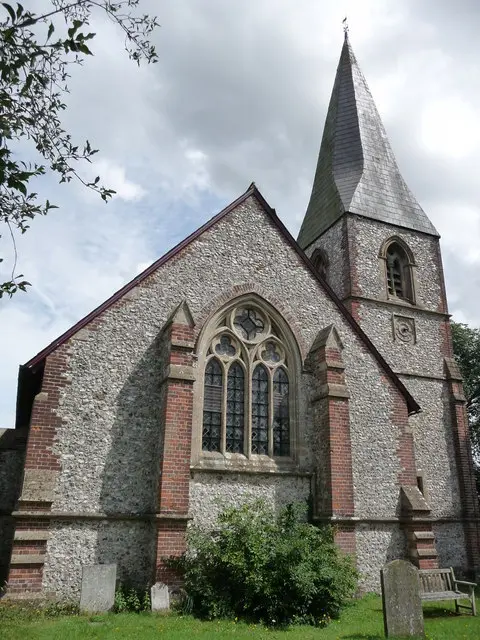
The church matters here for a reason that only becomes clear later. Chute's church is first mentioned in 1320, when a chantry was founded by Ralph of Barford; it was an endowment of the prebend of Chisenbury and Chute at Salisbury Cathedral. A vicarage had been ordained by 1386, and the king presented the vicar in that year. Chute, in short, has had vicars, never rectors. One of them, Richard Horwood, vicar from 1602, was accused of allowing laymen to conduct funerals. The medieval building — chancel, nave, south transept, porch and a timber bell turret — was almost wholly rebuilt between 1868 and 1872 to designs by J. L. Pearson, in knapped flint with prominent red-brick buttresses, a tower and a slated spire. It is dedicated to St Nicholas, and it is the building in the photograph on this page.
Of the parish's larger houses, Conholt Park survives and is listed Grade II* (National Heritage List entry 1035931): a late-17th-century core of red brick, partly demolished at its north-east end, with a seven-bay south wing of 1810–11 and later Victorian additions, standing in parkland where deer were kept until the 1850s. Standen House incorporates a late-17th-century range with an 18th-century brick addition and a wing with a ballroom built between 1879 and 1899. But the house our previous entry needed does not exist. What was called Chute Manor in 1897 — a house built in the late 17th century and altered in the earlier or mid 19th — was, in the VCH's flat phrase, "demolished in the mid 20th century".
The parish has never been large. There were about 129 poll-tax payers in 1377; 389 people in 1801; a peak of 571 in 1851; 275 in 1961; 309 in 1991.
And there was a plague. It is simply not the plague the ghost story tells.
Across the county boundary, Hurstbourne Tarrant in Hampshire was until 1871 a single living that included Vernham (Vernham Dean). A parish history of it — the Revd R. S. Arrowsmith's Short Historical Sketch of the Parish of Hurstbourne Tarrant, printed about 1914 for the organ fund at a shilling, and held by the Hampshire Record Office under 68M79/PZ113 — quotes the parish register directly. In 1593, in the single month of July, 43 people were buried in the churchyard, and the register's footnote reads: "All these died by ye visitation of ye plague." The vicar died; his wife died; his two sons died. Arrowsmith's own list of incumbents gives John Atkinson as vicar from 1575 to 1593, succeeded by William Richardson from 1593 to 1637 — the dates close exactly where the epidemic falls.
Arrowsmith adds one more sentence, and it is the one that matters: "A pest house was set up on Conholt Hill." Conholt is in Chute parish. If Arrowsmith is right, the isolation hospital of the 1593 epidemic stood on Chute's own high ground, a few hundred yards from the Roman causeway.
He also records the ghost — and he records it as a question. "Many have doubtless heard of the Conholt Ghost. It appears only in the month of July, the month in which these people died, and it takes the form of a man dressed as the clergy were dressed in those days." Then he wonders in print, with a question mark, whether it is the dead vicar, and whether the man had neglected the sick in the pest house and now walks there in remorse. The identification is Arrowsmith's speculation. The neglect is Arrowsmith's hypothesis. Everything published since has treated both as settled fact, moved the date forward by seventy-two years, changed the vicar into a rector, moved him to the next parish, and taken away his name.
One more death is documented on this ground, and it is modern. On 11 May 1964 an Avro Vulcan B.2, serial XH535, of the Aeroplane and Armament Experimental Establishment at Boscombe Down, entered a spin while a very low-speed, high-rate-of-descent handling case was being demonstrated, and came down on the parish's high ground. The two pilots ejected; the four crew in the rear compartment did not. The Wikipedia article on Chute cites The Times of 12 May 1964, page 12, for the deaths; I have worked from that citation and from the published accident summaries, not from the newspaper itself.
Timeline: the documented record of Chute, Wiltshire
- 1320 The church at Chute is first mentioned, when Ralph of Barford founds a chantry there; the church was an endowment of the prebend of Chisenbury and Chute at Salisbury Cathedral.
- By 1386 A vicarage had been ordained at Chute and the king presented the vicar. From this point the parish's documented incumbents are vicars — never rectors, the title the ghost story insists on.
- July 1593 Forty-three people are buried in one month in the churchyard of Hurstbourne Tarrant, across the Hampshire border. The parish register's footnote, quoted by the Revd R. S. Arrowsmith, reads: "All these died by ye visitation of ye plague." The vicar, his wife and his two sons are among the dead, and Arrowsmith records that a pest house was set up on Conholt Hill, inside Chute parish.
- 1593 John Atkinson's incumbency at Hurstbourne Tarrant ends, after eighteen years; William Richardson succeeds him and holds the living until 1637. Arrowsmith's own list of vicars is what dates the epidemic to a name.
- 1602 Richard Horwood becomes vicar of Chute. He was later accused of allowing laymen to conduct funerals — the only 17th-century clerical scandal the parish's documented record actually contains.
- 1841 The Roman deviation is recorded on the tithe survey as "the Causeway" or "Causeway Lane". The name is documented more than a century and a half before the plague legend attaches itself to it.
- 1871 Vernham (Vernham Dean), until then part of the living of Hurstbourne Tarrant, is made a separate living and its church a vicarage. Before this date the parish the legend blames had no incumbent of its own at all.
- c. 1914 The Revd R. S. Arrowsmith prints his Short Historical Sketch of the Parish of Hurstbourne Tarrant, sold at a shilling for the organ fund. It records "the Conholt Ghost", appearing only in July and dressed as the clergy of that time, and asks — as a question, with a question mark — whether it is the vicar who died in 1593, remorseful for having neglected the sick in the pest house. Everything later published treats the question as an answer.
- 11 May 1964 An Avro Vulcan B.2, XH535, of the Aeroplane and Armament Experimental Establishment at Boscombe Down enters a spin during a low-speed handling demonstration and comes down on the parish's high ground. The two pilots eject; the four crew in the rear compartment are killed. Wikipedia cites The Times of 12 May 1964, p. 12.
- 7 July 2002 The Wiltshire OPC Project's parish page for Chute, compiled by the volunteer Tracey Piper, carries the fully developed modern version: 1665, the reign of Charles II, the Rector of Vernham, the promise of food, the desertion and the villagers starving. No source is given — and the page is careful to place it at "the neighbouring village of Vernham", not at Chute.
- 26 December 2007 An editor adds a "Legend" section with the 1665 story to the Wikipedia article Chute, Wiltshire, without a single citation. This is the step that makes the ghost Chute's rather than Vernham Dean's, and it is the version our own previous entry repeated.
- 13 August 2008 Mysterious Britain & Ireland publishes its Vernham Dean page, dating the story to 1665 and adding that a field near the village said to hold Civil War burials "could actually be a plague pit". It is this page that Wikipedia's article on Vernham Dean would later cite.
- 22 December 2014 A Wikipedia editor attaches a footnote citing David Scanlan's Paranormal Hampshire (Amberley, 2013) to the legend paragraph — seven years after the paragraph was written and one year after the book appeared. The citation cannot be the source of the text it appears to support.
- Early 2017 The Cross Keys Inn at Upper Chute ceases trading. Permission to convert it to a dwelling follows in December 2019; a demolition scheme, PL/2023/00207, reaches committee on 7 September 2023 with a recommendation to refuse. The parish is left with no pub and no shop.
Is there a rational explanation for Chute, Wiltshire?
Take the legend apart clause by clause and almost nothing survives.
"A rector." There was no rector to be had. Chute's church has had a vicarage since 1386, presented that year by the king (VCH Wiltshire XVI). Hurstbourne Tarrant — the mother parish, which included Vernham until 1871 — was likewise a vicarage, its vicars appointed by the Canon of Salisbury and Prebendary of Hurstbourne Tarrant and Burbage down to 1847 (VCH Hampshire IV). Vernhams Dean itself was a dependent chapelry and did not become a separate living until 1871. In 1665 there was no such person as the Rector of Vernham Dean, and there was no such person in 1593 either. The one job title the story insists on is the one job title that did not exist.
"The reign of Charles II" / 1665. The documented epidemic here is of 1593, and it is documented in the way epidemics are: by a burial register. Forty-three burials at Hurstbourne Tarrant in one July, with the register's own footnote attributing them to plague. Nothing comparable is recorded for 1665. And note the tell that survived the move: the ghost of the older telling walks only in July — the month of the 1593 burials. Detached from 1593 the detail is meaningless, and the modern versions have quietly dropped it.
The broken promise and the starvation. These are not in Arrowsmith. He has a pest house, a dead vicar and a question. The promise of food, the failure of nerve, the desertion and the villagers starving to death appear later, on the web — the Wiltshire OPC Project's parish page for Chute, dated 7 July 2002 and compiled by the volunteer Tracey Piper, carries the fully developed 1665 version without a source, and is careful to say it happened at "the neighbouring village of Vernham", not at Chute.
How it became Chute's. On 26 December 2007 an editor added a "Legend" section to the Wikipedia article Chute, Wiltshire, with the 1665 story and no citation at all. Mysterious Britain published its version on 13 August 2008. On 22 December 2014 a Wikipedia editor renamed the section and attached a footnote to David Scanlan's Paranormal Hampshire (Amberley, 2013) — a book published six years after the text it was made to support, and about a different county. Whatever Scanlan's book says, it cannot be the source of a paragraph written in 2007. On 12 June 2019 an anonymous editor added a second version in which the clergyman falls ill before he can keep his word — the guilt quietly draining out of the story. I have not been able to consult Scanlan's book, so I cannot say whether the passage is in it or what it says.
The scene will not stay still. Arrowsmith puts it on Conholt Hill. The OPC page and Wikipedia put the camp on the Chute Causeway. The Modern Antiquarian's folklore note puts it at Fosbury Camp, an Iron Age hillfort three parishes away. A local variant puts the sick down in Hippenscombe bottom instead. A story whose scene moves this much has no scene; it has a landscape it is looking for a peg in. The peg it found was the Causeway, and the Causeway is a Roman engineering solution recorded as "Causeway Lane" in 1841 — the name explains the road, not the legend.
Where the shape comes from. A village that isolates itself in the plague year 1665, with a clergyman at the centre of the decision, is not an obscure story: it is Eyam, in Derbyshire, where 257 people died between September 1665 and October 1666 and where the rector William Mompesson entered every victim in the register and organised the cordon (Whittles and Didelot, Proceedings of the Royal Society B, 2016). Eyam's rector stayed. The Vernham Dean legend is the Eyam story with the clergyman's morals reversed, transplanted onto a real pest house that was a different epidemic seventy-two years earlier.
And the second ghost was never Chute's at all. Our previous entry opened with an elderly woman "decapitated after her burial by a dishonest man", still haunting "the manor house where she died". That is a garbled copy of a Paranormal Database entry for the manor house at Stanton St Bernard, some thirty kilometres away in the Vale of Pewsey: there, the lady of the manor was laid in her coffin wearing her rings, a corrupt sexton opened the coffin to cut off her fingers, and she — who had only been in a coma — woke up, whereupon the sexton fled and she walked home. Three things went wrong in the copying. The village is the wrong village. The fingers became a head. And the woman, whose whole point is that she lived, was killed off. Nor is it a local tale in the first place: it is Aarne–Thompson–Uther type 990, "Revived from Apparent Death", catalogued by D. L. Ashliman with English and Scottish instances — Lady Mount Edgcumbe, the parish clerk at Hutton Rudby, Margaret Halcro Erskine, who died on 14 January 1725. Finally, there is no manor house at Chute to haunt: Chute Manor was demolished in the mid 20th century.
Who profits. Nobody, and that is worth saying plainly, because the usual sceptical argument does not apply here. There is no ghost walk at Chute, no visitor centre, no attraction, no admission charge; the parish's one pub shut in 2017. Nothing is being sold. What carries this story is not a business but a chain of web pages copying one another, each one a little more confident than the last. The Paranormal Database's Wiltshire file, which runs to 398 entries and finds room for hamlets as small as Cadley, Coombe and Deane Water Bottom, has no entry for Chute, Chute Causeway or Conholt at all.
Can you visit Chute, Wiltshire?
Chute is a civil parish of scattered settlements, among them Upper Chute, Lower Chute, Chute Cadley and Chute Standen, on the Hampshire border and inside the North Wessex Downs National Landscape, the former AONB. Wiltshire Council's planning report of September 2023 on the former Cross Keys Inn places Upper Chute within a Conservation Area, about 4 km from Ludgershall. The pin, at 51.283, −1.574, lies on a lane in the parish (postcode SP11 9EQ in OpenStreetMap), about 10.6 km (6.6 miles) north-west of Andover, the nearest town, which has a railway station.
The Causeway. Chute Causeway is the stretch where the Roman road from Winchester to Cirencester leaves its straight line to swing round the head of the Hippenscombe valley; Wikipedia gives the length of the deviation as about 4 miles (6 km). The Victoria County History records it as "the Causeway or Causeway Lane" in 1841 and as Chute Causeway in 1997, when it was still in use as a road, running on the high ground near the parish's northern boundary.
The pest house and the camp. The pest house on Conholt Hill in 1593 comes from one sentence in the Revd R. S. Arrowsmith's parish history of about 1914, which gives no exact spot. A search of the Victoria County History's Chute chapter on British History Online, made on 23 September 2026, finds no mention of a pest house; the same text returns the Causeway and the Hatchet public house. Later versions of the story move the camp to the Causeway (the Wiltshire OPC Project page of 2002), to Fosbury Camp (The Modern Antiquarian) or down into Hippenscombe.
The houses. Conholt Park, listed Grade II* (entry 1035931), and Standen House are private houses. Chute Manor was, in the Victoria County History's words, "demolished in the mid 20th century".
The church. St Nicholas, Upper Chute, was rebuilt to designs by J. L. Pearson in knapped flint with red-brick buttresses, a tower and a slated spire. According to Wikipedia it belongs to the Savernake Team ministry and also serves Chute Forest parish.
The pubs. The Cross Keys Inn at Upper Chute ceased trading in early 2017, according to the council report, which records permission granted in December 2019 (19/09571/FUL) to convert it into a single dwelling; application PL/2023/00207, to demolish it and build a new house, went to committee on 7 September 2023 with an officer recommendation to refuse. CAMRA's WhatPub gives it as closed from 1 January 2017 and permanently closed since 5 October 2020, while the Wikipedia article on Chute, read on 23 September 2026, still ends the pub's story with its reopening in March 2006. The parish still has a pub. The Hatchet Inn at Lower Chute, SP11 9DX, was open as a public house in 1997 according to the Victoria County History, and CAMRA's guide listed it as open on 23 September 2026, as an Asset of Community Value, with a photograph dated 10 December 2025.
Sources consulted
- D. A. Crowley (ed.), «Chute» — A History of the County of Wiltshire: Volume 16 (Victoria County History), pp. 108-120, 1999 book
- R. S. Arrowsmith, «Short Historical Sketch of the Parish of Hurstbourne Tarrant (Hampshire Record Office 68M79/PZ113); read in the transcription published at stmarybournerevisited.co.uk» — Printed for the organ fund, price one shilling, 1914 book
- William Page (ed.), «Parishes: Vernhams Dean» — A History of the County of Hampshire: Volume 4 (Victoria County History), pp. 329-331, 1911 book
- William Page (ed.), «Parishes: Hurstbourne Tarrant» — A History of the County of Hampshire: Volume 4 (Victoria County History), pp. 319-324, 1911 book
- Historic England, «Conholt Park, Chute - list entry 1035931 (Grade II*)» — National Heritage List for England; first listed 4 June 1952, 1952 report
- Wiltshire Council, «Planning officer's report, PL/2023/00207: Cross Keys Inn, Upper Chute» — Eastern Area Planning Committee, 7 September 2023, 2023 report
- L. K. Whittles and X. Didelot, «Epidemiological analysis of the Eyam plague outbreak of 1665-1666» — Proceedings of the Royal Society B, 283(1830), 20160618, 2016 academic
- D. L. Ashliman, «Revived from Apparent Death by a Grave-Robber: folktales of Aarne-Thompson-Uther type 990» — University of Pittsburgh, folktexts, 2014 academic
- The Paranormal Database, «Wiltshire records (entry: Stanton St Bernard - Manor house)» — paranormaldatabase.com, 2026 web
- Tracey Piper, «Chute (parish page)» — Wiltshire OPC Project, 2002 web
- Wikipedia contributors, «Chute, Wiltshire - article and revision history (revisions of 26 Dec 2007, 22 Dec 2014 and 12 Jun 2019)» — English Wikipedia, 2026 web
- Ian Topham, «Vernham Dean» — Mysterious Britain & Ireland, 2008 web
- CAMRA, «Cross Keys, Chute - permanently closed» — WhatPub, 2020 web
Reviewed by V. Serrano on 2026-08-17 · How we verify our content
💬 Field testimonies (0)
No testimonies yet. Add the first.
Add your testimony
🔒 Log in to add a testimony