👻 HAUNTED PLACE · EXP. Nº0482
ACTIVE
Cock Lane Ghost House
Cock Lane Ghost House is a location reputed to be haunted in London, GB. Its reputation comes from reported apparitions, unexplained phenomena and eyewitness accounts gathered over time.
Where is Cock Lane Ghost House?
- Location
- London, GB
- Type
- House / mansion
- Coordinates
- 51.517, -0.102
- Testimonies
- 0
- Last updated
LOCATION
Why is Cock Lane Ghost House said to be haunted?
In 1762 a lodging house on Cock Lane, a narrow street beside London's Smithfield market and minutes on foot from St Paul's, produced the best-documented haunting of the eighteenth century — and the only famous one that ended in a criminal conviction. Three names carry the file: William Kent, who had run a post office in Norfolk; Richard Parsons, the officiating parish clerk of St Sepulchre's, who let him rooms; and Parsons's eleven-year-old daughter Elizabeth. Kent's wife, Elizabeth Lynes, had died in childbed about eleven months after their marriage of 1756, and canon law barred him from marrying her sister Frances, known as Fanny, because the child of that marriage had been born alive. He came to London alone; Fanny followed, and they lodged first near the Mansion House, then with Parsons in Cock Lane, then in Clerkenwell, where Fanny died of smallpox on 2 February 1760. Almost two years later, in January 1762, knocking and scratching began around Elizabeth Parsons's bed and answered questions by code — one knock yes, two no — accusing Kent of poisoning Fanny with arsenic. Crowds filled the lane; Horace Walpole came with the Duke of York and heard nothing. A committee convened with the Lord Mayor's approval, and including Samuel Johnson, tested the spirit in a Clerkenwell vault on the night of 1 February 1762 and reported that the child had "some art of making or counterfeiting particular noise". On 10 July 1762 Parsons, his wife, an interpreter and two associates were convicted of conspiracy before Lord Mansfield; Parsons was pilloried and jailed for two years.
What is the history of Cock Lane Ghost House?
Most eighteenth-century hauntings survive as hearsay. The Cock Lane affair survives as paperwork. It was reported month by month in the London magazines, investigated by a committee that met with the Lord Mayor's approval, written up by Samuel Johnson, versified by Charles Churchill and engraved by William Hogarth — and it ended not in a legend but in a courtroom, before the Lord Chief Justice and a special jury, with convictions, a pillory and prison sentences. Almost everything below can still be read in type that was set within months of the events.
The pamphlet nobody signed. The Mystery Revealed, "Printed for W. Bristow, in St. Paul's Church-yard", 1762, carries no author's name; it has long been attributed to Oliver Goldsmith, and it is the fullest early account of the background, told from the accused man's side. It reports that in 1756 Mr K— married "Miss E— L— of I— in the county of Norfolk"; they lived together some eleven months, and, shortly after he took the post office at a Norfolk town, she died in childbed. The child was born alive and died soon after — a detail that decided everything, because it meant that canon law would not allow him to marry his late wife's sister, who had been living with the couple as a companion. He came up to London alone, meaning to buy a place in a public office and hoping that "absence and dissipation" would end the attachment. It did not: she wrote that she would follow him "even on foot" if he did not find her "a more creditable conveyance", and a friend of his brought her up to town on the Yarmouth stage. In London they lived openly as husband and wife under his name.
How they came to Cock Lane. The Annual Register for 1762 tells it plainly. Richard Parsons, the officiating parish clerk of St Sepulchre's, saw "a genteel couple standing in the aisle" at early prayers, ordered them into a pew, and when the gentleman thanked him and asked about lodgings in the neighbourhood, Parsons "offered his own house". Kent lent his landlord money and afterwards sued him for it. The pamphlet returns to that debt more than once, and adds a second date: the dead woman's relations had filed a bill in Chancery against Kent in November 1761 — "just two months before this infernal agent appeared to strengthen their plea".
The first noises, and the death. They came while Kent was away in the country and Fanny, pregnant and unwilling to sleep alone, had taken Parsons's eleven-year-old daughter Elizabeth into her bed. The household blamed a neighbouring shoemaker, until Fanny got out of bed one Sunday night and called out to ask whether the shoemaker worked on Sunday nights too. The couple then moved to Bartlet Court, Clerkenwell. There she caught smallpox. According to the narrative published on 23 January 1762 by a Mr Brown of Amen Corner and summarised in the Gentleman's Magazine, she died on 2 February 1760, was buried in the vault under the church of St John, Clerkenwell, and her sister, who attended the funeral, was surprised to find no plate on the coffin and was not permitted to see the body.
January 1762. The knocking began again at Parsons's house around the first of January, this time around the child, who was "thrown into violent fits and agitations". A code was fixed — one knock for yes, two for no, scratching for displeasure — and the questions were put by the father and by a woman attendant. The Gentleman's Magazine printed a session verbatim on the night of 12 January, and its flatness is what unnerves: "Whether she was brought to an untimely end by poison? yes.—In what was the poison administered, beer or purl? purl.—How long before her death? three hours." And further on: "Whether she should be at ease in her mind if the man was hanged? yes." The magazine appended its own verdict in the same column: "As the impostor will probably soon be discovered, let this short detail suffice to shew the tendency of it; the whole of the nonsense would fill a magazine."
The town. Horace Walpole wrote to Sir Horace Mann on 29 January 1762 that "the reigning fashion is a ghost — a ghost, that would not pass muster in the paltriest convent in the Apennine. It only knocks and scratches; does not pretend to appear or to speak. The clergy give it their benediction; and all the world, whether believers or infidels, go to hear it." He went the next day, and described it to George Montagu on 2 February: "I went to hear it — for it is not an apparition, but an audition." He travelled from the opera in one hackney coach with the Duke of York, Lady Northumberland, Lady Mary Coke and Lord Hertford; "it rained torrents; yet the lane was full of mob, and the house so full we could not get in — at last they discovered it was the Duke of York, and the company squeezed themselves into one another's pockets to make room for us." Inside were fifty people, one tallow candle, washing lines strung overhead, and a child "whom they are murdering there by inches in such insufferable heat and stench". Nothing knocked. They were told, "as they would at a puppet-show", that it would not come till seven in the morning.
The committee. The plan of examination was printed in the papers and signed by "Ste. Aldrich, Rector of St John's, Clerkenwell" and "James Penn, Lecturer of St Ann's, Aldersgate", who recorded that they had acted "upon the approbation of the lord-mayor". The girl was to be brought to Aldrich's house without anyone connected with her, undressed and put to bed by a lady of character, with clergy, a physician, a surgeon, an apothecary and a justice of the peace present. On the night of 1 February 1762 the company assembled. They sat over an hour and heard nothing; when knocks and scratches were finally reported, the girl said she felt the spirit "like a mouse upon her back" and was required to hold her hands outside the bed, after which no evidence of any preternatural power appeared. At one in the morning they went into the church and down to the vault where Fanny lay, because the spirit had promised, by an affirmative knock, to strike her coffin. "The spirit was solemnly required to perform its promise, but nothing more than silence ensued." The report ends: "It is therefore the opinion of the whole assembly, that the child has some art of making or counterfeiting particular noise, and that there is no agency of any higher cause."
Who wrote that. The Gentleman's Magazine would only say that "this account was drawn up by a gentleman of veracity and learning". Boswell named him thirty years later, on the authority of Dr John Douglas, afterwards Bishop of Salisbury: after the examiners were satisfied of the fraud, "Johnson wrote in their presence an account of it, which was published in the newspapers and Gentleman's Magazine, and undeceived the world". Boswell adds that Johnson later "expressed great indignation at the imposture of the Cock-lane Ghost, and related, with much satisfaction, how he had assisted in detecting the cheat".
The end of it. On 25 February Kent went down to the vault with a clergyman, the undertaker, the parish clerk and sexton and two or three gentlemen, because it was being said that the coffin had been moved; the undertaker recognised it at once, "as there was no plate or inscription", and it was opened and the body found inside. Meanwhile the girl was moved from house to house and finally slung in a hammock with her hands and feet extended and tied; for two nights there were no noises. Told that if nothing were heard she and her parents would go to Newgate, she hid under her stays a board "about four inches broad, and six long" that was used to set the kettle on, and knocked on it. She was searched and caught. Richard Parsons, his wife Elizabeth, Mary Fraser (who had acted as interpreter between the ghost and its questioners), a clergyman and a tradesman were tried at Guildhall on 10 July 1762 before Lord Mansfield by a special jury and convicted of conspiracy against the life and character of William Kent; the trial lasted above twelve hours. Sentencing was deferred some seven months so that the parties might compound. The clergyman and the tradesman paid — the Gentleman's Magazine put the damages and costs at "580 l. and upwards" — and were dismissed with a severe reprimand. In February 1763 Richard Parsons was ordered to stand three times in the pillory in one month, once at the end of Cock Lane, and then to be imprisoned two years; his wife one year; Mary Fraser six months in Bridewell at hard labour. He appeared to be out of his mind on the first appointed day and it was put off; on the days he did stand, the crowd, which normally came to abuse, "took so much compassion of him, that instead of using him ill, they made a handsome collection for him".
Timeline: the documented record of Cock Lane Ghost House
- 1756 William Kent marries a Norfolk gentlewoman named in the pamphlet as 'Miss E— L—'. They live together about eleven months; she dies in childbed, and the child, born alive, dies soon after — which is why canon law will not let him marry her sister Frances.
- 2 February 1760 Frances 'Fanny' Lynes dies of confluent smallpox at Bartlet Court, Clerkenwell, and is buried in the vault under the church of St John, Clerkenwell, in a coffin with no plate. Her sister, who attends the funeral, is not permitted to see the body.
- November 1761 The dead woman's relations file a bill in Chancery against Kent over her will. The pamphlet that defends him dates the ghost's arrival 'just two months' later.
- c. 1 January 1762 Knocking and scratching resume at Richard Parsons's house in Cock Lane, now centred on his eleven-year-old daughter Elizabeth. A code is agreed — one knock yes, two no, scratching for displeasure — and the 'spirit' begins to accuse Kent of poisoning Fanny with arsenic in purl.
- 12-13 January 1762 The Gentleman's Magazine, in its Chronicle entry for Wednesday 13 January, prints a session verbatim, with two or three clergymen, about twenty other people and two black men in the room: 'In what was the poison administered, beer or purl? purl.—How long before her death? three hours.'
- 29-30 January 1762 Horace Walpole writes that 'the reigning fashion is a ghost' and goes the next night with the Duke of York; he finds fifty people, one tallow candle and washing lines over the child's bed, and hears nothing.
- Night of 1 February 1762 The committee assembles at the Rev. Stephen Aldrich's house in Clerkenwell, with the Lord Mayor's approval, and at one in the morning descends to the vault. Nothing knocks on the coffin. The report concludes 'that the child has some art of making or counterfeiting particular noise, and that there is no agency of any higher cause'.
- 25 February 1762 Because it is being said that the coffin has been moved, Kent goes down to the vault with a clergyman, the undertaker, the parish clerk and sexton and two or three gentlemen. The undertaker recognises it 'as there was no plate or inscription'; it is opened and the body is inside.
- Late February 1762 After two silent nights slung in a hammock with hands and feet tied, and told that otherwise she and her parents will go to Newgate, Elizabeth Parsons hides a board 'about four inches broad, and six long' under her stays and knocks on it. The witnesses note the noises 'had not the least likeness to the former noises'.
- March 1762 The Gentleman's Magazine prints Charles Churchill's burlesque of the descent into the vault, noting that the poet 'has celebrated the Heroes who descended, under the names of M——e, Plausible, and Pomposo' — Pomposo being Johnson.
- 10 July 1762 Not at the Old Bailey but in the Court of King's Bench sitting at Guildhall, before Lord Mansfield and a special jury, Parsons, his wife, Mary Frasier, a clergyman and a tradesman are convicted of conspiracy against the life and character of William Kent. The trial lasts above twelve hours.
- February 1763 Judgment, deferred seven months so the parties might compound. The clergyman and the tradesman pay Kent damages and costs of '580 l. and upwards' and are dismissed with a severe reprimand. Richard Parsons is to stand three times in the pillory in one month, once at the end of Cock Lane, then two years in prison; his wife Elizabeth one year; Mary Frasier six months in Bridewell at hard labour.
- 1763 — the pillory Parsons appears 'to be out of his mind' on the first day appointed and the pillory is deferred. On the days he does stand, the crowd 'took so much compassion of him, that instead of using him ill, they made a handsome collection for him'.
- 1859 Dickens opens A Tale of Two Cities by dating the England of 1775 against it: 'the Cock-lane ghost had been laid only a round dozen of years, after rapping out its messages'. The case had become shorthand for a credulous age.
- 23 January 1860 An order in Council on the coffins in the crypt of St John's, Clerkenwell, results in them being piled into the aisles and the doorways bricked up. The coffin that J. W. Archer had opened, and that the sexton's boy called 'scratching Fanny', is put away with the rest.
Is there a rational explanation for Cock Lane Ghost House?
There is nothing to defend here, and nobody at the time seriously tried to defend it after February 1762. The interesting question is not whether the Cock Lane ghost was a fraud — a jury settled that — but how much of the usual telling is actually supported, and what was never explained.
The strongest evidence is negative, and it is very strong. The ghost failed under every controlled condition anybody imposed. It went silent when the child was required to keep her hands outside the bedclothes. It went silent when she was tied in a hammock, hands and feet extended, for two nights running. It did not knock on the coffin it had promised, by its own affirmative knock, to strike. And the promise had been made in public, which is why the vault was visited at all.
The famous "confession" is weaker than it sounds. The board hidden under her stays is the image everyone remembers, and Hogarth turned it into a mallet. But the Annual Register's own account undercuts it twice. First, she was driven to it: she had been told that if the knockings were not heard again she, her father and her mother would be sent to Newgate, and was given half an hour to consider. Second, the two men who caught her — the master of the house and his friend — both stated that "the noises the girl had made that morning, had not the least likeness to the former noises", and the concurrent opinion of the gentlemen called in was "that the child had been frightened into this attempt, by the threats which had been made the two preceding nights". In other words, what she was caught doing was a bad imitation of something else. The mechanism of the original noises was never established. Johnson's report says only that the child "has some art of making or counterfeiting particular noise" — an admission that they had disproved the ghost without discovering the trick. The Annual Register records ventriloquism only as the suspicion of "the rational part of the town", which would not believe the affair honest "considering the known faculty many people, called Ventriloqui, have had of uttering strange noises"; the same sentence reports that wainscots and floorings had been torn away to detect an imposture, "to no purpose".
The motive is documented, and it is money. Kent had lent Parsons money and sued him for it; the pamphleteer of The Mystery Revealed lists that quarrel among the causes, together with a second landlord Kent had also arrested for debt, and above all the bill in Chancery filed against Kent by the dead woman's relations in November 1761 — two months before the knocking resumed. The same writer put his finger on the legal shape of the thing: a ghost that cannot speak can accuse nobody, so "the people therefore, to whom it appeared, kindly undertook to make the discovery themselves; and the ghost, by knocking, gave its assent to their method of wording the accusation". Nothing illegal was said out loud. That is exactly what the conspiracy verdict of 1762 punished.
The ghost also got things wrong. The pamphlet notes that it could not say where Fanny had dined on Kent's wedding day, nor how many of her relations were at the church, and that "she called her father John instead of Thomas — a mistake indeed a little extraordinary in a ghost".
Was Fanny poisoned? That was never tried. The indictment heard at Guildhall on 10 July 1762 was, in the Gentleman's Magazine's words, "for a conspiracy in the Cock Lane ghost affair, to injure the character, &c. of Mr Wm Kent". What survives on the medical side is the pamphlet's testimonials: a physician, Dr Cooper, had been engaged for her lying-in; he and the apothecary, Mr Jones, thought the symptoms of her eruptive fever favourable for four days; she had never had smallpox, and a clergyman attended her before she died. The Gentleman's Magazine added independently that "a worthy clergyman... declares, that the small pox with which she was seized, was of the confluent sort, and that the gentlemen of the faculty who attended her, had pronounced her irrecoverable some days before her death". The one later attempt to revive the poisoning story is worth naming precisely because it is so thin: the artist J. W. Archer, drawing in the crypt of St John's in the nineteenth century, was shown a coffin the sexton's boy called "scratching Fanny", opened it, found the body converted to adipocere with the face still "perfect, handsome, oval, with an aquiline nose", and asked, "Will not arsenic produce adipocere?" He offered nothing beyond the question, and conceded in the same paragraph that the charge "is understood to have been disproved". It rests on a churchwarden's belief that the coffin had "always been understood" to be hers.
Finally, the child. Elizabeth Parsons was eleven when the noises started and was never charged; the indictment named her father, her mother, Mary Fraser, a clergyman and a tradesman. Walpole, who was no friend of the affair, described her in the crowded room as being murdered "by inches" in the heat and stench. She was moved from house to house, tied up, threatened with prison, and made to perform before strangers for weeks. Whatever she did, she is the only person in the file who had no plausible motive of her own — and the crowd's decision to take up a collection for her father at the pillory, rather than pelt him, suggests that eighteenth-century London had already worked out that the case was sadder than it was sinister.
Can you visit Cock Lane Ghost House?
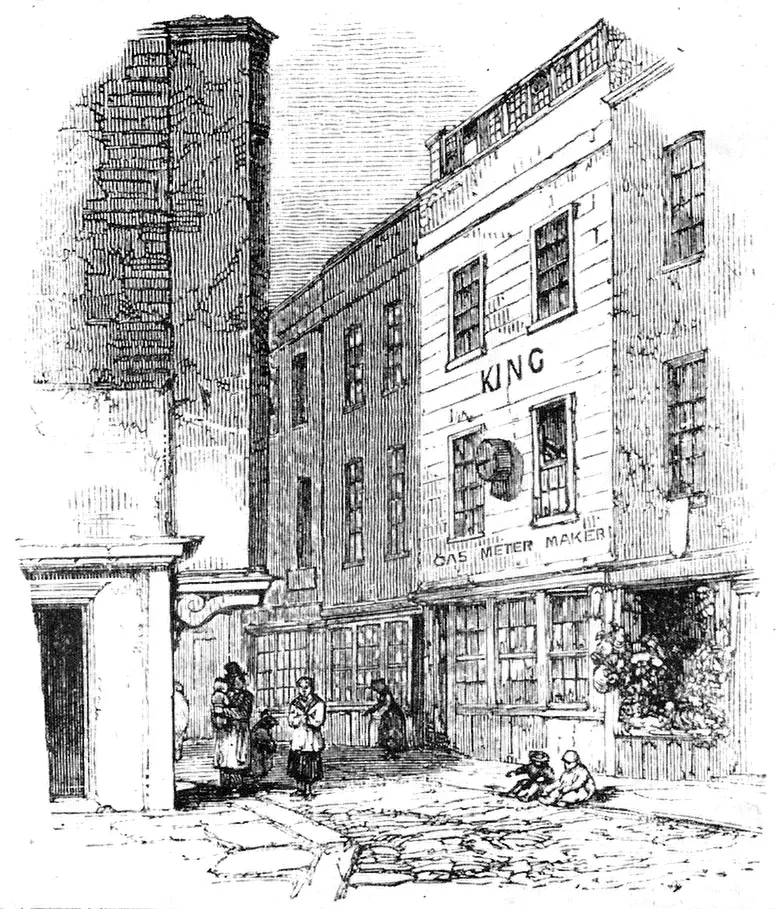
Cock Lane is a real street and you can walk it in three minutes, but be clear about what survives: the lodging house does not. Walter Thornbury's Old and New London printed an engraving captioned "The 'Ghost's' House in Cock Lane" in the nineteenth century, so a building was being pointed out then; today nothing on the lane is listed, and the City of London's own Smithfield Conservation Area appraisal describes "a number of substantial post-war office buildings" in the streets around Cock Lane and Hosier Lane, with the corner of Snow Hill and Cock Lane held by "a curved, appropriately proportioned 1980s building". There is no plaque and no house to see.
What is worth seeing on the lane itself. Cock Lane runs from Giltspur Street down to Snow Hill, in the City of London, EC1A, and it keeps the sinuous medieval alignment that the conservation area document singles out. Two views are formally protected by the City: the view along Cock Lane to the curved western end of the street, and the view of St Sepulchre without Newgate with the dome of St Paul's behind it, taken from the junction of Snow Hill and Cock Lane — worth standing still for, because it is close to what the crowds of January 1762 would have had in front of them. At the Giltspur Street end is Pye Corner, which the City describes as marking "the western extent of the Great Fire in the area", commemorated by the small gilded figure it calls both the Fat Boy and the Golden Boy; the City's schedule records it among the area's monuments at the corner of Cock Lane and Giltspur Street, and lists 1-4 Giltspur Street as Grade II. The street is public, free and always open. Nearest Underground stations are St Paul's and Farringdon; City Thameslink is on Holborn Viaduct at the foot of Snow Hill.
Richard Parsons's church. St Sepulchre without Newgate, now Holy Sepulchre London and known as the National Musicians' Church, is two minutes away at Holborn Viaduct, EC1A 2DQ — the church where Parsons was officiating clerk and where he first showed Kent and Fanny into a pew. Admission is free. Advertised building opening hours are Monday 11:00-15:00, Tuesday 08:30-14:30, Wednesday 08:30-18:30, Thursday 08:30-14:30, Friday 10:00-16:00 and Sunday 10:30-16:00, with Saturday varying; the parish asks visitors making a special journey to email first, since hours change with staffing.
Fanny's church, and the vault. The Priory Church of the Order of St John and its twelfth-century crypt stand in St John's Square, Clerkenwell, a fifteen-minute walk north. This is where Fanny Lynes was buried and where the committee went down at one in the morning on 2 February 1762. The Museum of the Order of St John, at St John's Gate, St John's Lane, EC1M 4DA, is free and open Wednesday to Saturday, 09:30-17:00, with the Cloister Garden open Monday to Saturday from 09:30 to dusk. The church and crypt, however, can only be seen on a guided tour: "The Lost Priory" (45 minutes, church and crypt) or "Knights, Revellers & Saviours" (60 minutes, church, crypt and the historic rooms in the gate). Tours cost £15, or £11.25 with an Art Pass or Blue Light Card, and £1 for Islington residents; they must be pre-booked through the museum's Eventbrite, with tickets released mid-month for the following month. Private groups from six people can be arranged on 020 7324 4005. Farringdon station is five minutes' walk. Do not expect to find the coffin: the crypt was tidied in 1860 by order in Council, the coffins piled into the aisles and the doorways bricked up.
A practical warning. Nothing here is a ghost attraction, and two of the three sites are working churches. The one thing this file can promise is that the sources are as close as the stones: the Gentleman's Magazine volume for 1762, the Annual Register for that year, The Mystery Revealed and Walpole's letters are all free to read on the Internet Archive, and Johnson's report of the night in the vault is two pages long.
Sources consulted
- Sylvanus Urban (ed.), «Historical Chronicle, January 1762, pp. 43-44 — the first full report of the noises at Parsons's house in Cock Lane, the account of Mr Brown of Amen Corner, and a verbatim interrogation of the 'spirit' on the night of 12 January (The Gentleman's Magazine, vol. XXXII, 1762)» — The Gentleman's Magazine, London; Internet Archive, 1762 newspaper archive
- [Samuel Johnson], unsigned, «An Account of the Detection of the Imposture in Cock-Lane, February 1762, pp. 81-82 — the committee's report of the night of 1 February and the descent into the vault of St John, Clerkenwell, printed as 'drawn up by a gentleman of veracity and learning' (The Gentleman's Magazine, vol. XXXII)» — The Gentleman's Magazine, London; Internet Archive, 1762 newspaper archive
- Edmund Burke (ed.), «A summary account of the proceedings in regard to some strange noises, heard the beginning of the year at a house in Cock-lane, West Smithfield — Chronicle, pp. 142-147: the whole affair, the Aldrich/Penn advertisement, the hammock tests, the board four inches by six, the trial of 10 July 1762 and the sentences (The Annual Register... for the year 1762, vol. V)» — The Annual Register, London; Internet Archive, 1762 book
- [Oliver Goldsmith], published anonymously, «The Mystery Revealed; containing a series of transactions and authentic testimonials, respecting the supposed Cock-Lane Ghost — the anonymous defence of William Kent, with the Norfolk marriage of 1756, the canon-law obstacle, the Chancery bill of November 1761 and a description of a Cock Lane sitting» — Printed for W. Bristow, St Paul's Church-yard, London; Internet Archive, 1762 book
- Sylvanus Urban (ed.), «Historical Chronicle, July 1762, p. 339 — the trial before Lord Mansfield in the Court of King's Bench at Guildhall on Saturday 10 July, by special jury, of Parsons, his wife, Mary Frasier, a clergyman and a tradesman, all found guilty; the trial 'lasted above 12 hours' (The Gentleman's Magazine, vol. XXXII)» — The Gentleman's Magazine, London; Internet Archive, 1762 newspaper archive
- Sylvanus Urban (ed.), «Historical Chronicle, February 1763 — judgment in the King's Bench: 'Richard Parsons and Elizabeth his wife, and Mary Frasier... brought to the King's Bench to receive judgment', the pillory three times in one month and two years' imprisonment, and the compromise of 580 l. and upwards paid by the clergyman and the tradesman (The Gentleman's Magazine, vol. XXXIII)» — The Gentleman's Magazine, London; Internet Archive, 1763 newspaper archive
- James Boswell, «The Life of Samuel Johnson, LL.D. — Boswell's refutation of the charge that Johnson believed the ghost, on the authority of Dr John Douglas, afterwards Bishop of Salisbury: Johnson 'wrote in their presence an account of it, which was published in the newspapers and Gentleman's Magazine'; and Johnson's own later account of 'detecting the cheat'» — London, 1791; Project Gutenberg, 1791 book
- Horace Walpole, «The Letters of Horace Walpole, Fourth Earl of Orford, vol. V (1760-1764), ed. Paget Toynbee — letter 801 to Sir Horace Mann, 29 January 1762; letter 802 to George Montagu, 2 February 1762 (the visit with the Duke of York); letter 809 to Mann, 25 February 1762 ('the girl made the noises herself')» — Clarendon Press, Oxford; Internet Archive, 1903 book
- Charles Churchill, «The Descent to the Vault in Clerkenwell; from The Ghost, a Poem, lately published — Poetical Essays, March 1762, pp. 138-139, with the editorial note that 'the Writer has celebrated the Heroes who descended, under the names of M——e, Plausible, and Pomposo' (The Gentleman's Magazine, vol. XXXII)» — The Gentleman's Magazine, London; Internet Archive, 1762 newspaper archive
- Sean Gaston (Brunel University London), «An Event Without An Object: The Cock Lane Ghost, London 1762-1763, The Literary London Journal, vol. 12, no. 1-2 — the Lord Mayor Sir Samuel Fludyer's order that no expense be spared in detecting the fraud, and the identification of Richard Parsons's eleven-year-old daughter Elizabeth Parsons» — The Literary London Journal, 2015 academic
- William J. Pinks (ed. Edward J. Wood), «The History of Clerkenwell, pp. 234-239 — the crypt of St John's, the order in Council of 23 January 1860 that bricked up the coffins, and J. W. Archer's note on opening the coffin the sexton's boy called 'scratching Fanny'» — Charles Herbert, London; Internet Archive, 1881 book
- Walter Thornbury, «Old and New London, vol. II, pp. 435-439 — the Cock Lane chapter, with the engraving captioned 'The "Ghost's" House in Cock Lane'» — Cassell, Petter & Galpin, London; Internet Archive, 1878 book
- City of London Corporation, Department of the Built Environment, «Smithfield Conservation Area Character Summary and Management Strategy SPD — the medieval alignment of Cock Lane, the post-war office buildings around it, the protected views from the junction of Snow Hill and Cock Lane, the Golden Boy at Pye Corner, and the schedule of listed buildings (which contains no entry on Cock Lane)» — City of London Corporation, 2021 report
- Museum of the Order of St John, «Planning your visit, and Guided tours — opening hours, free admission to the galleries, and the church-and-crypt tours of the Priory Church of the Order of St John, Clerkenwell» — museumstjohn.org.uk, 2026 web
- Holy Sepulchre London PCC, «Holy Sepulchre London (St Sepulchre without Newgate) — address, building opening hours and visiting notes for the church where Richard Parsons was officiating parish clerk» — A Church Near You (Church of England), 2026 web
- Charles Dickens, «A Tale of Two Cities, book I, chapter 1 — 'the Cock-lane ghost had been laid only a round dozen of years, after rapping out its messages'» — Chapman & Hall, London; Project Gutenberg, 1859 book
Reviewed by V. Serrano on 2026-08-01 · How we verify our content
📎 Source: Wikipedia (CC BY-SA)
💬 Field testimonies (0)
No testimonies yet. Add the first.
Add your testimony
🔒 Log in to add a testimony