👻 HAUNTED PLACE · EXP. Nº9476
ACTIVE
Comlongon Castle
Comlongon Castle stands a kilometre west of Clarencefield in Dumfries and Galloway, and it has been shut since April 2019, when the hotel that occupied it went into sequestration.
Where is Comlongon Castle?
- Location
- Dumfries and Galloway, Scotland, United Kingdom
- Type
- Castle
- Coordinates
- 55.007, -3.441
- Last updated
LOCATION
Why is Comlongon Castle said to be haunted?
Its ghost story is unusual in having a document behind it. On 17 October 1570 James VI granted away the lands of Marion Carruthers, co-heiress of Mouswald, because they had fallen to the Crown through her "wilfull slaying of hir self in leiping ovir the wall of the Castell touer and fortalice of Cullyngane" three weeks earlier. Marion was twenty-eight, and she had spent twenty-two years resisting a guardian — Sir James Douglas of Drumlanrig, who owned the gift of her marriage and wanted her barony. Comlongon was the house of the uncle who defended her, not a prison her family kept her in. The oldest printed folklore, published in 1888, amounted to a patch of ground on the battlements where the grass would not grow. The Green Lady, the smell of apples and the bookable haunted bedroom arrived four centuries after her death, with a castle hotel that sold them.
What is the history of Comlongon Castle?
Comlongon has been called a fifteenth-century castle for so long that the label has stuck to it in gazetteers and in the statutory listing. The documents point a little later. A licence recorded in the Register of the Privy Seal of Scotland, immediately after an entry dated 1501, gave leave "to big a towre and fortalice"; the building appears by its own name in 1508, as the turris ac fortalicium de Cunlungane. The likeliest builder is John Murray of Cockpool, who had succeeded his father in 1493. The Murrays had held the ground since the early fourteenth century, when Thomas Randolph, Earl of Moray, granted Comlongon to his kinsman William Murray of Cockpool.
The woman whose name the castle now carries was never its owner. Marion Carruthers was the younger of the two daughters of Simon Carruthers, tenth laird and fifth baron of Mouswald, a few miles east across the Lochar Moss. A retour expede at the court of Lochmaben on 13 March 1563 records that she had turned twenty-one at the feast of Saint Andrew last past, which fixes her birth at 30 November 1541. Her father was killed in July 1548 in a fight with the broken men of the Debatable Land, in the same season that carried off Lord Carlisle and the lairds of Kirkmichael, Kirkconnell and Logan, and he left no son. On 13 August of that year Queen Mary granted the ward and marriage of his two daughters, Janet and Marion, to Sir James Douglas of Drumlanrig.
That grant is the core of the story. The popular version has Marion pressed into marriage by her own family; she was six years old when the gift of her marriage became a piece of property belonging to a neighbouring laird who wanted the barony of Mouswald, and her family spent the next twenty-two years trying to get her out of his hands. On 21 March 1558 her three Murray uncles, Charles Murray of Cockpool, Archibald Murray and Cuthbert Murray, obtained letters from the Lords of Council commanding Sir James to produce Janet and Marion, then "now past tuttorie and 14 years of age complete", because he would not allow them the liberty to visit their friends. Janet gave way and married Thomas Rorison of Bardannoch, and by a contract of 14 March 1560 her half of Mouswald passed to Douglas, in exchange for a dowry, an infeftment in Glencairn, and two years' keep for her household.
Marion did not give way: in January 1563 she was in Edinburgh before Queen Mary and the Lords of Secret Council. On the 29th Sir James raised letters of restraint complaining that she had absolutely refused the husband he had offered and intended to marry whom she pleased. On the 30th he came to her in person and offered her John, son and heir of James McMath of Dalpeddar, requiring her to complete the contract in the kirk of Borthwick; the record notes that Marion refused, and "declarit that sche wald not be at the said James' byddin". Two days later she was placed with her kinsman John, Lord Borthwick, for forty days, and neither she nor Lord Borthwick was allowed to move her without notice to the Queen and Council, under a penalty of £2,000. That September her guardian tried a different lock. On 13 September 1563 Thomas Borthwick of Pryncado and Michael Borthwick of Glengelt entered a bond in the caution-book of the justiciary court binding themselves for a thousand pounds that "Marione Carutheris, ane of þe twa heretrices of Mowswald", should not marry "ane cheif tratour nor uþer brokkin man of þe cuntre". It is one of the few papers in the case that still survives in the original register, and both sureties signed it.
By 1564 Marion was at Comlongon, in the house of her uncle Charles Murray of Cockpool. On 24 June that year Queen Mary confirmed a charter making over her lands to him; the deed itself was executed at Comlongon, witnessed by William Somervell, vicar of Kirkbean, and Matthew Sadler, rector of Pennersax. It was a shield, and it did not hold: Douglas obtained letters of inhibition on 16 February 1565 arguing that his gift of ward and marriage barred her from disposing of her own heritage, and he won.
On 25 September 1570 Marion Carruthers died at Comlongon, aged twenty-eight. Twenty-two days later, on 17 October, King James VI granted the escheat of her lands to Sir William Douglas of Hawick, and the deed states why they had fallen to the Crown: "throw the said Marioun Carrutheris wilfull slaying of hir self in leiping ovir the wall of the Castell touer and fortalice of Cullyngane, upoun the twenty-five day of September last bipast, and thairthrow wilfullie breaking of hir awin craig and banis quhairof sche deit", craig being the neck. Suicide forfeited the estate to the Crown; the Crown gave it to a Douglas within three weeks. The family's own historians, writing in 1934, declined to choose between despair and murder, and so does this page.
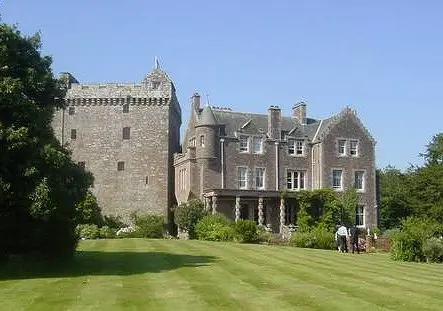
The tower outlived everyone in the case. A mansion was built beside it around 1610 and by 1624 the tower itself seems to have been abandoned as a dwelling; another house went up on the east side about 1730 for David Murray, 5th Viscount Stormont. In 1890 the Dumfries architect James Barbour designed a Scots baronial replacement, which was damaged by fire in the late nineteenth century and rebuilt around 1900 by Barbour with John McLintock Bowie. The new roof was heavy enough to push the old tower's walls outward, and oak bracing had to be inserted early in the twentieth century to hold them. From January 1942 until February 1952 the mansion was a Barnardo's home, first for children under five evacuated from the bombed cities and later a reception home and a training centre for nursery staff. In 1984 William Murray, 8th Earl of Mansfield, sold the estate to Tony Ptolomey, who spent seven years converting tower and mansion into a hotel and handed it to his son Philip in 1995. The hotel stopped trading in mid-April 2019; on 22 April Johnston Carmichael announced that the partnership behind it was applying to be declared bankrupt, and asked anyone holding one of its outstanding bookings to contact the firm. It has been shut ever since.
Timeline: the documented record of Comlongon Castle
- c. 1501–1508 A licence in the Register of the Privy Seal, entered immediately after a note of 1501, grants leave "to big a towre and fortalice"; the building is named in 1508 as the turris ac fortalicium de Cunlungane. The likeliest builder is John Murray of Cockpool.
- 13 August 1548 A month after Simon Carruthers of Mouswald is killed by the broken men of the Debatable Land, Queen Mary grants the ward and marriage of his daughters Janet and Marion to Sir James Douglas of Drumlanrig. Marion is six.
- 21 March 1558 Her uncles Charles Murray of Cockpool, Archibald Murray and Cuthbert Murray obtain letters from the Lords of Council ordering Douglas to produce the sisters, "now past tuttorie and 14 years of age complete", because he will not let them visit their friends.
- 30 January 1563 Douglas offers Marion in marriage to John, son and heir of James McMath of Dalpeddar, and requires her to complete the contract in the kirk of Borthwick. The record notes that she refused and "declarit that sche wald not be at the said James' byddin".
- 13 September 1563 Thomas Borthwick of Pryncado and Michael Borthwick of Glengelt sign a bond in the justiciary caution-book for a thousand pounds that "Marione Carutheris, ane of þe twa heretrices of Mowswald" shall not marry any traitor or broken man of the country.
- 24 June 1564 Queen Mary confirms a charter making over Marion's lands to her uncle Charles Murray of Cockpool. The deed is executed at Comlongon, before William Somervell, vicar of Kirkbean, and Matthew Sadler, rector of Pennersax — the first document that places her in the castle.
- 16 February 1565 Douglas obtains letters of inhibition setting the conveyance aside: his gift of ward and marriage, he argues, bars Marion from disposing of her own heritage. He wins, and her sister Janet and Janet's husband side with him.
- 25 September 1570 Marion Carruthers dies at Comlongon, in the house of the uncle who had defended her. She was twenty-eight; the retour of 1563 fixes her birth at 30 November 1541.
- 17 October 1570 Twenty-two days after her death, James VI grants the escheat of her lands to Sir William Douglas of Hawick. The deed says they fell to the Crown "throw the said Marioun Carrutheris wilfull slaying of hir self in leiping ovir the wall of the Castell touer and fortalice of Cullyngane… and thairthrow wilfullie breaking of hir awin craig and banis quhairof sche deit".
- 10 December 1888 John J. Reid reads his paper on the barony of Mouswald to the Society of Antiquaries of Scotland. He prints the escheat and adds the local tradition supplied by Charles Carruthers, born 1794, who was shown the spot on the battlements as a boy and told the grass never grew there. There is no ghost in the paper.
- January 1942 – February 1952 The mansion beside the tower serves as a Barnardo's home, first for children under five evacuated from the bombed cities and later as a reception home and a training centre for nursery staff.
- 1984 William Murray, 8th Earl of Mansfield, sells the estate to Tony Ptolomey, ending some six centuries of Murray ownership. Ptolomey spends seven years converting tower and mansion into a hotel and hands it to his son Philip in 1995.
- 30 October 2016 A BuzzFeed reporter spends a night in the castle on a guided ghost tour; the duty manager tells her he photographed a child invisible to the eye. The magazine puts the account to the neuroscientist Dean Burnett, who explains it as a fight-or-flight response in a person alone, in the dark and primed by ghost stories.
- 22 April 2019 Johnston Carmichael announce that the partnership running the castle hotel, which ceased trading just over a week earlier, is applying to be declared bankrupt with the firm as trustee to deal with its creditors; holders of outstanding bookings are asked to contact the firm. The castle has been closed to the public ever since.
- August 2026 Dumfries and Galloway Council approves structural works for the new owners — stabilisation and propping, removal of internal linings and security grilles against trespassing — described as required to secure the immediate future of the building.
Is there a rational explanation for Comlongon Castle?
Everything printed about the ghost of Comlongon can be traced to one afternoon: 10 December 1888, when John J. Reid, curator of the Museum of the Society of Antiquaries of Scotland, read his paper on the barony of Mouswald. Reid gave the escheat of 1570 in full, and then added where he had got the local end of the story. He had written to Charles Carruthers, born 1 October 1794 and by then ninety-four years old, formerly tenant of Mouswald Place, to ask whether the "Cullyngane" of the deed could be Comlongon. Carruthers replied that he had no doubt it was, and that it confirmed a story he had been told about the castle when he was a boy: that a lady had thrown herself over the wall of the tower, and that the grass never grew where she fell. He had been shown the exact spot, on the battlements at the east corner, close to the "look-out" tower from which watch was kept towards the English border.
That is the whole of the nineteenth-century folklore: Reid's paper runs to about 21,800 words, and the words ghost, haunt and apparition appear nought times in it, against six occurrences of murder and five of tradition, so the paper is perfectly willing to use the vocabulary of local legend when it has any to report. In 1888 the story attached to Comlongon was a patch of ground where the grass would not grow. Nobody had seen anything.
The quotation that circulates today differs from the deed. Jo-Anne Christensen's Haunted Hotels (2002) prints a sentence in which Marion did "take her own life by leaping from the lookout tower of Comlongon Castle" and "break her head and bones", and the hotel's own ghost page carried the same words in a capture of February 2003. The deed says she leapt "ovir the wall of the Castell touer" and broke her "craig", the neck, and her bones. The look-out tower comes from Reid, who wrote that the spot "whence she leaped" was shown to Carruthers on the battlements at the east corner, "close to the 'lookout' tower whence watch was kept on the English border". By 2002 the two sentences had been welded together and the join put inside quotation marks. The identification of the castle itself rests on a ninety-four-year-old man's recollection, which the 1508 charter name Cunlungane happens to support.
The apparition arrives with the hotel. From at least February 2003 the business ran a ghost page, and by 2006 a second page selling a Haunted Suite: sightings concentrated on one room, a figure in a long dress on the four-poster, jewellery and in particular watches and bracelets moved from one place to another, a smell of apples before the appearances, staff calling it "Marion's room", and the room formally renamed the Carruthers suite when new Jacuzzis were installed. The ghost was a bookable product with a tariff. Guided ghost tours followed; in October 2016 a BuzzFeed reporter spent a night in the castle on one, was told by the duty manager that he had photographed a child that was not visible to the eye, and had a bad few minutes alone in the Great Hall. The magazine put the question to Dr Dean Burnett, a neuroscientist at Cardiff University, who explained the episode as the ordinary fight-or-flight response of someone alone, in the dark, primed by an evening of ghost stories, filling in ambiguous stimuli.
The most useful check available now is what happened when the commercial incentive was removed. The hotel collapsed in April 2019 and the estate passed to new owners, who publish a detailed restoration site under the name Comlongon Estate Ltd: three phases of works, a project team, a masterplan for accommodation, a restaurant, performance space, a carpentry workshop and a kitchen garden. On 6 October 2026 neither its front page nor a search of the site's own content index returned a ghost, Marion Carruthers or the Green Lady. The apparition of Comlongon lasted almost exactly as long as the hotel that sold it.
Can you visit Comlongon Castle?
Comlongon Castle stands near the village of Clarencefield, in the parish of Ruthwell in Dumfries and Galloway. Historic Environment Scotland lists it as "Comlongon Castle and Mansion House", listed building LB17245, category A, added to the list on 4 November 1971, at national grid reference NY 07940 68950. The record, read on 24 September 2026, describes a fifteenth-century tower house of five storeys at the west end of a mansion of 1900-02 by the Dumfries architects James Barbour and J. M. Bowie. According to the owners' website, Historic Environment Scotland took the tower off the schedule of monuments in 2017, leaving the category A listing as its protection.
The hotel that occupied the tower and the mansion closed in April 2019. On 22 April 2019 the restructuring team of the accountants Johnston Carmichael announced that the partnership which owned the castle and traded the hotel had "ceased trading just over a week ago" after liquidity problems. The partnership was applying to be declared bankrupt, with the firm as trustee to deal with its creditors, and holders of outstanding bookings were asked to contact the firm. BBC News reported on 5 August 2026 that the castle had since been bought by David Thomson and Teresa Church, who brought the Annandale Distillery near Annan back into operation and revamped the Globe Inn in Dumfries.
The same report said that Dumfries and Galloway Council had approved structural work which a council report described as required to "secure the immediate future of the building". The approved work includes security grilles, after trespassers had raised concerns about fire damage and antisocial behaviour; it also covers the removal of some internal wall linings as well as stabilisation and propping. Council planning officials noted that some of the work had been carried out before consent was obtained. The website of Comlongon Estate Ltd, the owning company, states that the castle "although not currently operating as such, was last used as a guest house/hotel and events location", and that the estate "includes a number of private houses" besides it. The site, read on 24 September 2026, gives no date for a reopening.
Two sites in the care of Historic Environment Scotland are close by. The Ruthwell Cross, a carved stone cross 5.2 m tall made in the early 700s, has stood since 1887 in a purpose-built apse of Ruthwell parish church, on the B724. Historic Environment Scotland gives its grid reference as NY 100 682, about 2 km (1.4 miles) east-south-east of the castle, and states that it is free to visit; if the church is locked, the key is kept in a labelled box outside. Caerlaverock Castle, the moated triangular castle at Castle Road End, Dumfries DG1 4RU, lies about 6.4 km (4 miles) west-south-west of Comlongon at NY 025 656. On 24 September 2026 its page gave opening hours of 9.30am to 5pm daily from 1 April to 30 September and 10am to 4pm from 1 October to 31 March, with the last entry half an hour before closing. The adult ticket was £7.50, a price the page described as reduced while conservation work keeps the West Range and two of the towers closed.
Sources consulted
- John J. Reid, «The Barony of Mouswald and its Barons: a Page of Border History» — Proceedings of the Society of Antiquaries of Scotland, vol. XXIII, pp. 24–79 (read 10 December 1888), 1889 academic
- Robert Pitcairn, «Criminal Trials in Scotland, vol. I, p. *434 — bond of 13 September 1563 from the caution-book (Liber Plegiacionis)» — Bannatyne Club, Edinburgh, 1833 book
- A. Stanley Carruthers and R. C. Reid, «Records of the Carruthers Family, chapter on Carruthers of Mouswald, pp. 68–72» — Elliot Stock, London, 1934 book
- Comlongon Castle Hotel, «Comlongon Castle hotel: "The Ghost" and "Haunted Suite" pages (archived 2002, 2006 and 2009)» — comlongon.co.uk via the Internet Archive Wayback Machine, 2006 archive
- Donald McNaught, Head of Restructuring, «Comlongon Castle sequestration» — Johnston Carmichael, 22 April 2019, 2019 report
- Giancarlo Rinaldi, «Structural repair work helps safeguard 15th Century castle» — BBC News, South Scotland, 5 August 2026, 2026 newspaper archive
- Comlongon Estate Ltd, «Comlongon Castle: vision, restoration plan and project team» — Official site of the current owners, 2026 web
- Hilary Mitchell, «I Spent The Night In A Haunted Scottish Castle And It Was Terrifying» — BuzzFeed, 30 October 2016, 2016 newspaper archive
- Stravaiging around Scotland, «Comlongon Castle: castle record, dating, ownership and bibliography» — Scottish castles gazetteer, 2024 web
- Historic Environment Scotland, «Comlongon Castle and Mansion House, listed building LB17245 (category A, added 4 November 1971; NGR NY 07940 68950)» — Historic Environment Scotland Portal, 2017 report
- Historic Environment Scotland, «Ruthwell Cross: plan your visit and history (free entry, key box, NGR NY 100 682, apse of 1887)» — historicenvironment.scot, 2026 web
- Historic Environment Scotland, «Caerlaverock Castle: plan your visit (opening times, prices, NGR NY 025 656)» — historicenvironment.scot, 2026 web
- Jo-Anne Christensen, «Haunted Hotels (Comlongon Castle: 'take her own life by leaping from the lookout tower of Comlongon Castle and did break her head and bones')» — Ghost House Books, Edmonton, 2002 book
- Comlongon Castle Hotel, «Comlongon Castle hotel: ghost page carrying the welded quotation about the lookout tower» — comlongon.co.uk via the Internet Archive Wayback Machine, capture of 10 February 2003, 2003 archive
Reviewed by V. Serrano on 2026-08-17 · How we verify our content
💬 Field testimonies (0)
No testimonies yet. Add the first.
Add your testimony
🔒 Log in to add a testimony