👻 HAUNTED PLACE · EXP. Nº9476
ACTIVE
Craignethan Castle
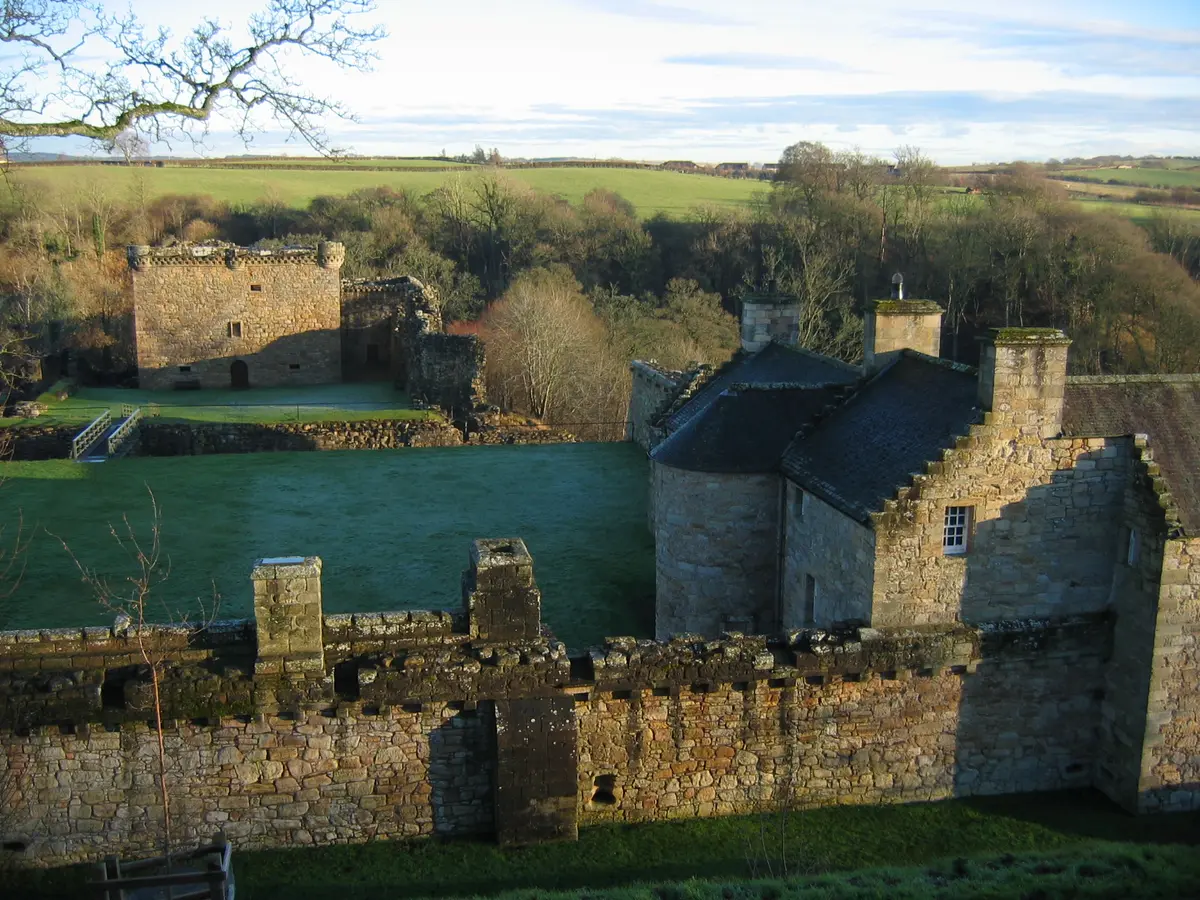
Craignethan Castle, above the River Nethan in South Lanarkshire, was built from about 1530 by Sir James Hamilton of Finnart, later master of works to James V, and is celebrated among students of fortification for its caponier: a roofed stone gun gallery at the bottom of the ditch, believed to be the earliest in Scotland and probably the first in Britain.
Where is Craignethan Castle?
- Location
- South Lanarkshire, Scotland, United Kingdom
- Type
- Ruin / ancient site
- Coordinates
- 55.697, -3.885
- Last updated
LOCATION
Why is Craignethan Castle said to be haunted?
The ditch was filled in when the castle was dismantled after 1579; the caponier was still accessible, though buried under rubble, in the nineteenth century, and was cleared in the excavation of 1962. Mary, Queen of Scots really was here: English intelligence reports of 6 and 12 May 1568 place her at Draffen, as the castle was then called, and the second adds that she had gone there "lyttle to her contentation", having been refused Dumbarton by her Hamilton hosts. For the night before the Battle of Langside, the best reconstruction of her itinerary puts her at Hamilton. Every source that reports the ghost hedges it. The oldest printing located, Dane Love's Scottish Ghosts (1995), speaks of a White Lady said to be Mary; the headless woman comes later, and neither the 1830 nor the 1887 standard account of the castle mentions a ghost at all. In September 2026 Historic Environment Scotland listed the site as closed for conservation work.
What is the history of Craignethan Castle?
Craignethan was not called Craignethan when it mattered most. In every sixteenth-century document about it the place is Draffane — or Draffen, or Nauthane — and that single fact is why so much of its history has been lost to people searching under the modern name.
The barony belonged to the Black Douglases until their forfeiture in 1455, after which it passed to the Hamiltons. A Great Seal confirmation of January 1538/39 covers an earlier charter of 15 May 1532 by Kelso Abbey granting Sir James Hamilton of Finnart "the castle and fortalice of Nauthane"; the charter says the castle was built by Sir James, which means building work was already under way before May 1532. Historic Environment Scotland dates the start to about 1530.
Finnart is the reason the place is famous among people who study fortification. Illegitimate eldest son of the 1st Earl of Arran, he became the effective head of Scotland's second family on his father's death in 1529, had lived abroad, and in 1539/40 was appointed Master of Works Principal to James V, in charge of all royal building — by then chiefly the new palace at Stirling. He had already worked at Linlithgow and Blackness. At Draffane he built for himself, and he built strangely.
The low, wide tower house stands inside a walled inner court whose west wall — the side overlooked by higher ground — was up to five metres thick, designed to take artillery on its head. Beyond it he cut a ditch, and at the bottom of the ditch he put a caponier: a roofed stone gallery pierced with gunloops, from which defenders could rake the ditch lengthwise. It is believed to be the earliest caponier in Scotland and probably the first in Britain. The ditch was filled in when the castle was dismantled after 1579. According to HES the caponier "had been accessible in the 19th century though buried under rubble"; it was cleared in the excavation of 1962, directed by Iain MacIvor, Inspector of Ancient Monuments, and dug largely by local labour under a government winter relief scheme.
The showpiece had a flaw, and a professional soldier put it in one sentence. Reporting to London in May 1570, Sir William Drury, governor of Berwick, called it "Draffin, a strong house of the Duke's, but situate in a hole, so that it is commanded on every part, and has no ordnance". Historic Environment Scotland's own assessment concedes the point and adds a second, drier one: the caponier would have filled with gunsmoke had it ever been used in earnest.
Finnart never got to find out. He fell from favour, was tried for plotting against James V and executed in 1540, and Craignethan became a royal castle with a captain, three gunners, two heavy cannon and five smaller pieces. The king did visit, though not — on the best evidence — for the celebrated wedding of Finnart's daughter Agnes to the Master of Somerville, a story HES traces to a much later Somerville family history and explicitly declines to treat as reliable. The visit that is documented is duller and firmer: entries in the Exchequer Rolls record eighteen hens delivered for the king's expenses at the castle of Craignethan, and stables repaired or newly built for the royal horses, some time between 1 September 1540 and July 1542.
The Hamiltons recovered the castle in 1542, when Finnart's half-brother James, 2nd Earl of Arran, became regent for the infant Mary. Arran added the large outer courtyard to the west, and visited often enough that his household books record the dates and the food.
Then came May 1568, the fortnight that made Craignethan a name in ghost books. Mary escaped from Lochleven on the evening of the 2nd, crossed the Forth and reached Hamilton before dawn on the 3rd. What happened over the next ten days is genuinely disputed, and the dispute is better than the legend. Her own secretary, Claude Nau, writing about ten years later, says flatly that she was at Hamilton from the 3rd to the 13th. But Sir William Drury, reporting English intelligence from Berwick, twice puts her at Draffane. On 6 May he tells Cecil that "the Queen continued still at Draffen among the Hamiltons, and all the dependers thereupon. She came thither accompanied with threescore horse, or somewhat more, and now increaseth". On 12 May — the eve of the battle — he adds a passage that nobody quotes and that changes the tone of the whole episode: "The Quene would willingly have gone for her more suerty to Dumbarton Castle; but the Ambletons wyll not therunto condescend… and she is now gone to Draffen, lyttle to her contentation". Little to her contentation: she did not want to be there.
The modern scholarly reconstruction, Edward Furgol's itinerary of Mary's Scottish movements published by the Society of Antiquaries of Scotland in 1988, resolves the contradiction by putting her at Craignethan on 4 May and again on the 10th and 11th, and back at Hamilton from the 12th until the morning of the 13th. On that reading Mary slept at Craignethan twice — and not on the night before Langside.
The battle on 13 May destroyed her cause in Scotland. She rode without stopping to Sanquhar, reached Terregles, spent the 15th at Dundrennan Abbey and crossed the Solway on the 16th. Craignethan and Cadzow were surrendered to the new regent, the Earl of Moray, who had all the guns removed; some of James V's household furnishings turned up in both houses.
The end came eleven years later. In May 1579 Regent Morton moved on the Hamilton strongholds; the siege train was small — two heavy battering pieces, a bastard and a moyen — and it never had to fire. The garrison of Craignethan fled in the night before the guns appeared. The Privy Council then ordered James Hamilton of Libberton to "dimolische and cast doun to the ground the inner barmkin of the said hous, and the tour upoun the south nuke of the samin, as alsua the tour upoun the north nuke at the entres, and the fowse thairof fillit". The work was still unfinished in June 1580 and was completed afterwards: the great west rampart went into its own ditch, and Finnart's tower — which the order left standing — has been looking at the gap ever since.
Afterwards the place became domestic and then literary. Duchess Anne sold it in 1659 to Andrew Hay, a Covenanting laird, who built a two-storey house in the south-west corner of the outer court; the date 1665 is carved on it. Archibald Douglas bought the ruin about 1730. Walter Scott came in 1799, was offered Hay's house as a summer residence and declined; after Old Mortality (1816) Craignethan was identified with his Tillietudlem despite Scott's denials, and in 1876 the railway company named a station after the fictional castle. The 12th Earl of Home repaired the masonry around 1900; the 14th Earl handed the place to the state in 1949.
Timeline: the documented record of Craignethan Castle
- 1455 The barony of Draffane, forfeited by the Black Douglases, passes to the Hamilton family. Draffane, not Craignethan, is the name used in sixteenth-century documents about the site.
- 15 May 1532 A charter of Kelso Abbey, later confirmed under the Great Seal, grants Sir James Hamilton of Finnart "the castle and fortalice of Nauthane" and states that the castle was built by Sir James — evidence that building work was already under way before this date.
- 1540 Finnart is tried for plotting against James V and executed. Craignethan becomes a royal castle, garrisoned with a captain, three gunners, two heavy cannon and five smaller pieces.
- 1 September 1540 – July 1542 Exchequer Roll accounts record eighteen hens delivered for the expenses of the king at the castle of Craignethan, and stables repaired or newly built for the royal horses. This, and not the often-repeated wedding of Finnart's daughter, is the documented royal visit; HES traces the wedding story to a much later Somerville family history and does not regard it as reliable.
- 6 May 1568 Sir William Drury, governor of Berwick, writes to Sir William Cecil that "the Queen continued still at Draffen among the Hamiltons, and all the dependers thereupon. She came thither accompanied with threescore horse, or somewhat more, and now increaseth". It is the earliest contemporary document placing Mary at Craignethan.
- 12 May 1568 Drury reports again: Mary "would willingly have gone for her more suerty to Dumbarton Castle; but the Ambletons wyll not therunto condescend… and she is now gone to Draffen, lyttle to her contentation". The dispatch describes a queen kept where she did not want to be, not a guest of honour.
- 13 May 1568 Mary's army is defeated at Langside. Her secretary Claude Nau, writing about ten years later, says she was at Hamilton from 3 to 13 May; Edward Furgol's reconstructed itinerary puts her at Craignethan on 4 May and on 10–11 May, and at Hamilton from the 12th until the morning of the battle. On that reading she never slept at Craignethan on the eve of Langside.
- May 1579 Regent Morton moves against the Hamilton strongholds. The garrison of Craignethan abandons the castle in the night before the royal siege train — two battering pieces, a bastard and a moyen — even appears before it. Its celebrated defences are never tested.
- After 3 July 1580 Sir James Hamilton of Libberton carries out the Privy Council's order to "cast doun to the ground the inner barmkin" and its corner towers and to fill the ditch. The great west rampart goes into its own ditch, burying the caponier; Finnart's tower house is deliberately left standing.
- 1665 Andrew Hay, the Covenanting laird who bought the castle from Duchess Anne in 1659, completes a two-storey house in the south-west corner of the outer court; the date is carved above its stair-turret door. This building, not the medieval castle, is where the poltergeist reports are set.
- 1830 John M. Leighton's description for Joseph Swan's Select Views on the River Clyde records Mary's stay, and notes that the castle's custodians "gravely" pointed out the window from Scott's Old Mortality — which Leighton says bears "not the most distant resemblance" to the one in the book. There is no ghost anywhere in the account.
- 1887 MacGibbon and Ross survey Craignethan over some 2,800 words in volume I of The Castellated and Domestic Architecture of Scotland, arguing the keep predates Finnart. Their account mentions neither Mary, nor Langside, nor any ghost, and warns that without attention "the whole of the castle will soon become a shapeless ruin".
- 1962 Excavation of the great ditch, directed by Iain MacIvor and dug largely by local labour under a government winter relief scheme, uncovers the caponier — buried under rubble, though HES notes it had been accessible in the 19th century — believed to be the earliest in Scotland and probably in Britain.
- 1988 The Society of Antiquaries of Scotland publishes Edward Furgol's day-by-day itinerary of Mary, Queen of Scots. It is the reconstruction that places her at Craignethan twice in May 1568 — and at Hamilton on the night the legend claims for Craignethan.
- 25 May 2003 The Paranormal Database opens its Craignethan entry (#4227), eight years after Dane Love's Scottish Ghosts (1995) had printed a White Lady at the castle. It reports a headless woman in the grounds who "could be Mary Queen of Scots, though her relationship with the building appears to be minimal", and a 1990s visitor who heard singing in the caponier while a second visitor nearby heard nothing.
- 2020 Historic Environment Scotland's Statement of Significance devotes one sentence out of 13,359 words to "supposed sightings of the headless apparition of Mary, Queen of Scots, and a bothersome poltergeist allegedly resident in Andrew Hay's House", filed under intangible values. The same document records 5,300 visitors in 2018. The castle closes that year and, as of August 2026, has not reopened.
Is there a rational explanation for Craignethan Castle?
Every source that reports the ghost of Craignethan hedges it.
The Paranormal Database entry for the site, first added on 25 May 2003 and last revised in February 2023, reads: "The headless woman reported in the castle grounds could be Mary Queen of Scots, though her relationship with the building appears to be minimal." Martin Coventry's castle gazetteers say the castle is haunted by "a headless ghost, perhaps the spirit of Mary, Queen of Scots". Historic Environment Scotland's Statement of Significance (2020) mentions "supposed sightings of the headless apparition of Mary, Queen of Scots, and a bothersome poltergeist allegedly resident in Andrew Hay's House". The operative words are could be, perhaps, supposed and allegedly: none of these sources identifies the figure, and all of them record that somebody else has guessed at it.
The two halves of the usual retelling also belong to different places. The headless woman is reported in the grounds; the poltergeist is reported in Andrew Hay's house of 1665, a building put up ninety-seven years after Mary was there. The Statement of Significance lists them as two items, and Coventry's gazetteer puts the "many manifestations" in "the later house in the courtyard, which contains the tearoom and toilets".
The printed story is older than the websites, and in its oldest located form the ghost is a different figure. A full-text search of the Internet Archive on 25 September 2026 finds it in Dane Love's Scottish Ghosts (London: Robert Hale, 1995), p. 123, which says that the castle "has a White Lady ghost" and reports the claim "that the ghost is of Mary Queen of Scots, who was beheaded in 1587", adding that "She did not stay at Craignethan, but is known to have passed through on occasion" — which the English dispatches of 6 and 12 May 1568 contradict. In his Scottish Spectres (Robert Hale, 2002) Love moved the story indoors: the custodian, Robert Sandilands, "tells visitors that he often gets a deathly chill when he enters the tearoom".
One of the reported episodes carries its own control. According to the Paranormal Database, a visitor alone in the caponier during the 1990s "could hear a woman singing, although another visitor nearby failed to hear anything". Of two people a short distance apart in a roofed stone gallery at the bottom of a ditch, one heard singing and the other heard nothing.
The headlessness has a chronology problem of its own. Mary was beheaded at Fotheringhay in Northamptonshire on 8 February 1587, nineteen years after her fortnight in Clydesdale and some 420 km (260 miles) away in a straight line. A headless queen is a portable motif that has been fastened onto a number of Scottish sites, and Love's printing of 1995 calls this one a White Lady.
Craignethan is state property, run by Historic Environment Scotland, and HES does not sell the ghost. On 25 September 2026 the two public pages HES keeps for the castle, the overview and "History and stories", contain none of the words ghost, haunted, spirit, apparition or Halloween, against seventeen occurrences of "castle"; the overview says that "This site is currently closed while we carry out vital conservation work". The single acknowledgement is one sentence in the roughly 13,300 words of the 2020 Statement of Significance, filed under "intangible values" and hedged twice in its own clause. When the castle was open it "received over 5,300 visitors in 2018", from April to September.
HES's public history page does repeat one story that its own technical document rejects. It says that "In 1536, when his castle was almost complete, Finnart entertained the king and his court at his daughter's wedding celebrations at Craignethan". The Statement of Significance dates that story to 1540, traces it to "a rather later and unreliable family history of the Somerville family" — its bibliography gives Memorie of the Somervilles, printed in 1815 — and says that it "is not regarded as a reliable source".
And the habit is old. In 1830, John M. Leighton's description of the castle for Joseph Swan's Select Views on the River Clyde records that "the persons who have the charge of the Castle" fondly cherished the idea that this was Scott's Tillietudlem, and that they would "gravely" point out the window by which Cuddie Headrigg made his escalade — a scene from a novel. Leighton, who had read the novel, notes that the window "has not the most distant resemblance to that described". Craignethan has been showing visitors things that are not there since at least 1830.
Finally, the silences, with their controls. Leighton's 1830 account runs to roughly 2,500 words, mentions Mary's stay explicitly and contains no ghost. MacGibbon and Ross devote about 2,800 words to Craignethan in volume I of The Castellated and Domestic Architecture of Scotland (1887); in that section the words ghost, haunted and spirit appear zero times, and so do Mary and Langside, while Hay, Finnart and Tillietudlem all appear.
Can you visit Craignethan Castle?
Craignethan Castle is closed: on 23 September 2026 the Historic Environment Scotland page for the castle carried the notice "This site is currently closed while we carry out vital conservation work" and gave no opening hours, admission prices or reopening date, and the separate getting-here and access pages for the site returned "not found". The closure dates from the 2020 season: archived copies of the same page read "closed until Spring 2021", and from at least May 2022 "currently closed for conservation works".
Some third-party listings still describe the pre-2020 arrangement, and on the same day Britain Express still stated that "the castle is open daily from spring to autumn, and on weekends in winter", with a line referring to the HES website for current details.
HES gives the address as Blackwood, Lesmahagow, Lanarkshire ML11 9PL, and takes general enquiries on +44 (0)131 668 8600; it has also listed a site telephone, 01555 860 364. The National Grid reference of the castle is NS 815 463. HES has warned that the postcode is correct but that satnav does not bring drivers to the castle, and it directed them off the M74 at junction 8 or 9, then to Blackwood and the brown tourist signs for the castle, and it recommended strong footwear.
While the castle was open, HES described the approach as about 85 m down a steeply sloping tarmac path from the car park, followed by some 25 m of bound gravel to the gate. The caponier, the stone-vaulted gun gallery across the ditch, was reached down a spiral stair of 31 steps only 70 cm wide, and the cellars and upper floors of the tower house by straight and spiral stairs of up to 38 steps. The season ran from April to September, and HES's Statement of Significance of 2020 counted a little over 5,300 visitors in 2018.
The castle was built around 1530 by Sir James Hamilton of Finnart on a promontory above the gorge of the Nethan Water, and HES notes that the gorge is designated a Site of Special Scientific Interest. Measured in a straight line from the castle, Bothwell Castle, also in the care of HES, is 18 km (11 miles) to the north-west, and Glasgow Cathedral is 29 km (18 miles) in the same direction. St Bride's Church at Douglas, which holds the Douglas mausoleum, is 16 km (10 miles) to the south.
Sources consulted
- Historic Environment Scotland, «Statement of Significance: Craignethan Castle (Property in Care PIC118)» — Historic Environment Scotland, 2020 report
- Edward M. Furgol, «The Scottish itinerary of Mary Queen of Scots, 1542-8 and 1561-8» — Proceedings of the Society of Antiquaries of Scotland, vol. 117, pp. 219-231 (with microfiche itinerary), 1988 academic
- David Hay Fleming, «Mary Queen of Scots, from her Birth to her Flight into England: a brief biography, with critical notes, a few documents hitherto unpublished, and an itinerary (note 112, p. 486; itinerary p. 543)» — Hodder and Stoughton, London, 1897 book
- Thomas Wright (ed.), «Queen Elizabeth and her Times: a series of original letters, vol. I, p. 270 — Sir William Drury to Sir William Cecil, Berwick, 12 May 1568» — Henry Colburn, London, 1838 archive
- Robert Keith, «History of the Affairs of Church and State in Scotland, vol. II, p. 802 — Letter from Sir William Drury to Sir William Cecil, 6 May 1568» — Spottiswoode Society, Edinburgh, 1845 archive
- John M. Leighton (text); engraved by Joseph Swan from drawings by John Fleming, «Select Views on the River Clyde, pp. 27-30: Craignethan Castle» — Joseph Swan, Glasgow, 1830 book
- David MacGibbon and Thomas Ross, «The Castellated and Domestic Architecture of Scotland, vol. I, pp. 255-264: Craignethan Castle» — David Douglas, Edinburgh, 1887 book
- Historic Environment Scotland, «Craignethan Castle: overview and History and stories (site currently closed for conservation work, consulted 25 September 2026)» — historicenvironment.scot, 2026 web
- The Paranormal Database, «Possibly Mary — Crossford, Craignethan Castle (record #4227, added 25 May 2003, revised 11 February 2023)» — paranormaldatabase.com, 2003 web
- Martin Coventry, «Craignethan Castle entry ("a headless ghost, perhaps the spirit of Mary, Queen of Scots"), online gazetteer of The Castles of Scotland, consulted August 2026» — Goblinshead / thecastlesofscotland.co.uk, 2026 web
- Dane Love, «Scottish Ghosts, p. 123: Craignethan Castle (“a White Lady ghost”)» — Robert Hale, London, 1995 book
- Dane Love, «Scottish Spectres: Craignethan Castle (the custodian and the tearoom)» — Robert Hale, London (large-print edition Ulverscroft, 2003), 2002 book
Reviewed by V. Serrano on 2026-08-17 · How we verify our content
💬 Field testimonies (0)
No testimonies yet. Add the first.
Add your testimony
🔒 Log in to add a testimony