👻 HAUNTED PLACE · EXP. Nº9476
ACTIVE
Culzean Castle
The caves under Culzean Castle are real: two systems in the cliff, one below the house and one below the stables, fortified in the 1660s as strongrooms and scheduled as an ancient monument in 2002.
Where is Culzean Castle?
- Location
- South Ayrshire, Scotland, United Kingdom
- Type
- Castle
- Coordinates
- 55.354, -4.79
- Last updated
LOCATION
Why is Culzean Castle said to be haunted?
The ghostly piper who walked into them and never came out is real too, but as a story rather than an event. Folklorists catalogue it — Baughman's motif E402.1.3(ca) — and in 1895 the Folk-Lore Society printed a whole section of pipers lost in caves in Northumberland, Berwickshire, Angus, Caithness, Galloway and Scilly. Culzean was not among them. Nor is the piper in the parish minister's 1794 account, which measures the six coves and states that no tradition whatever attaches to them, although the same minister writes a page on smuggling. The National Trust for Scotland, which has owned Culzean since 1945, now tells the tale and explains it in the same paragraph: ghost stories were useful for keeping the curious away from a cave full of untaxed brandy.
What is the history of Culzean Castle?
Culzean is a house built on top of a cave, and the cave came first.
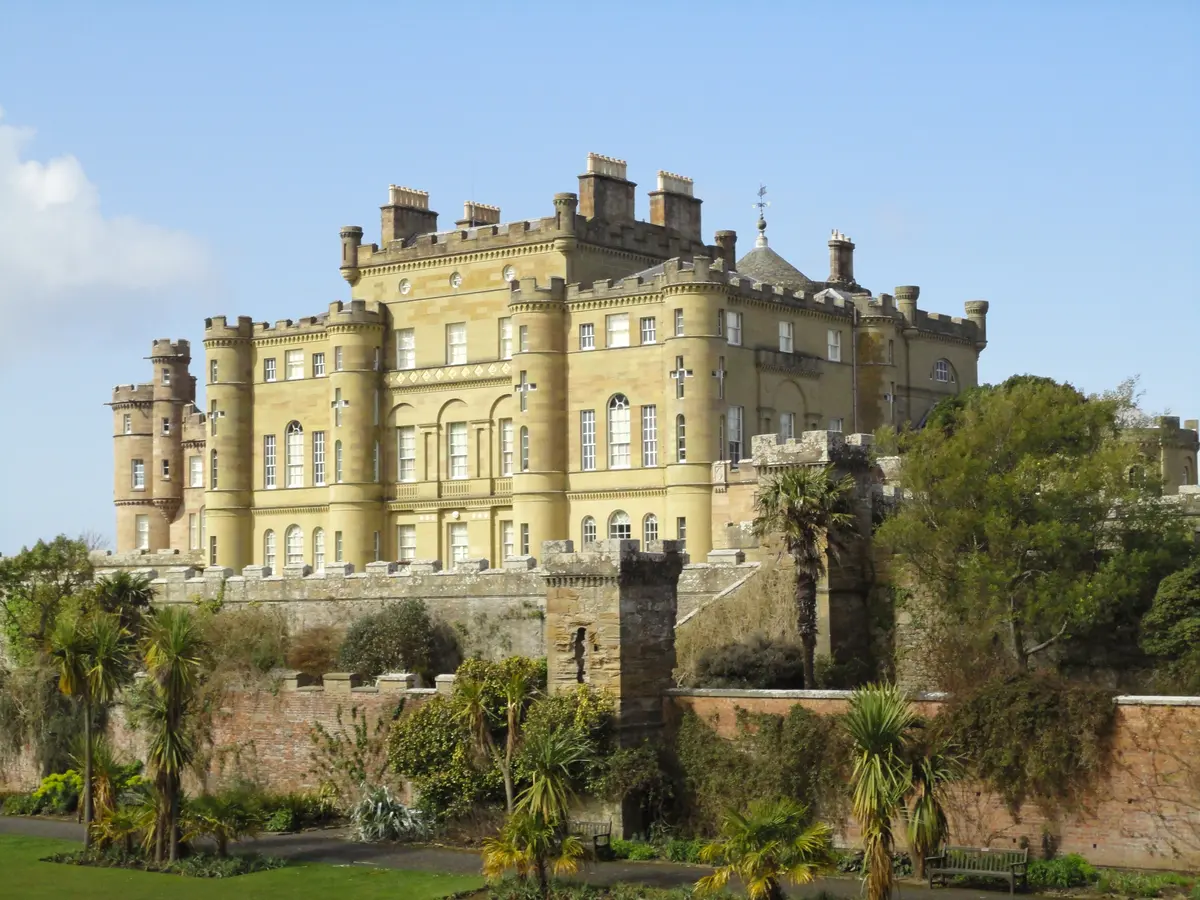
Historic Environment Scotland's listing (LB7595, category A, added 14 April 1971) records that the estate has belonged to the Kennedy family since the Middle Ages and that in 1569 Gilbert, 4th Earl of Cassillis, made it over to his brother Thomas Kennedy. What stood on the clifftop then was Castle Coif, an L-plan tower house. Its oldest surviving fabric is not above ground at all: the two cave systems in the cliff — one under the castle, one under the stable block — are the chief visible remains of that earlier building, and were scheduled as an ancient monument in their own right on 4 March 2002 (SM10364). The architectural work in them is chiefly sixteenth-century, and the scheduling record notes that early sources describe two wells inside. In the 1660s the barmekin around the tower was breached to make the terraced gardens, and the caves below were fortified to serve as secure stores.
The house became the principal Kennedy seat in 1759, when Sir Thomas Kennedy (1726–75) succeeded as 9th Earl of Cassillis. It was his brother David, the 10th Earl, who in 1776 commissioned Robert Adam. HES dates the building work 1777–1812 and states plainly what most accounts smooth over: Adam's transformation was carried out in stages and "appears to have only been finally completed by the 12th Earl in the second decade of the 19th century, when both the original patron and the architect were dead". Adam died in 1792. A second, less advertised campaign followed in 1877, when the 3rd Marquess of Ailsa brought in the Edinburgh architects Wardrop & Reid: they built the three-storey nursery wing on the west, added the east porch, knocked the Adam library through into a dressing room to make the present dining room, and copied Adam's Doric frieze round the enlarged entrance hall now called the Armoury.
While Adam was still working, the parish minister was writing the best surviving contemporary description of the place. The Reverend Matthew Biggar's account of Kirkoswald for Sir John Sinclair's Statistical Account of Scotland was printed in 1794, and Sinclair's editorial footnote records that it "was drawn up under all the disadvantages of blindness". Biggar dates the founding of "Cullean castle" to 1777, describes the stables, farm and approach bridge covering four acres, and then turns to what lies underneath: "the coves or caves of Cullean. These are six in number." Three to the west, the largest with its entry at high-water mark, a roof some fifty feet up and a passage running inwards about two hundred feet; three to the east, communicating with one another, "but their extent has not been precisely ascertained". Two and a quarter centuries later HES describes the same thing in different words: two systems, each of three main caverns.
The other economy of that coast runs through the same rock. The National Trust for Scotland's own account of Culzean's smuggling histories states that Sir John Kennedy, 2nd Baronet of Culzean, co-owned a boat seized by revenue officers in 1726 running contraband from the Isle of Man, that the 9th Earl's farm manager Archibald Kennedy (no relation) ran a wine-and-spirits business out of a castle bedroom, and that the house of Scipio Kennedy — an African brought to Culzean as an enslaved child and later freed — has been suggested as a meeting place for merchants in the trade. Biggar in 1794 says the same thing from the pulpit's side: smuggling "has considerably retarded the improvement of this parish", it came first from the Isle of Man and later from France, Ostend and Gothenburg, and although the characters of those engaged in it were "for the most part, in other respects good", it gave the people "a taste for luxury and finery".
The modern chapter is short. The 4th Marquess of Ailsa, childless and convinced the estate could not be run, opened talks with the young National Trust for Scotland and died in 1943 before anything was settled. In 1945 his widow, Lady Frances, did most of the negotiating that handed over the castle, the policies, the gardens and Home Farm. Two conditions were attached: that Lady Frances keep the use of the west wing for her lifetime, and that the top floor be converted into a flat for General Eisenhower — as the estate's own website later put it, "a gesture of Scottish thanks for America's support during World War II". Eisenhower was invited to take the tenancy in November 1945. In 1969 Culzean became, on HES's and the Trust's account, the first country park in Scotland.
Timeline: the documented record of Culzean Castle
- 1569 Gilbert, 4th Earl of Cassillis, makes Culzean over to his brother Thomas Kennedy. What stands on the clifftop is Castle Coif, a tower house whose chief surviving remains are the caves in the rock below it.
- 1636 William Brereton's travel diary describes the cave chamber that Historic Environment Scotland's scheduling record still calls "the closet": the earliest datable eyewitness description of the interior of the coves.
- 1660s The barmekin around the old tower is breached to create the terraced gardens, and the caves beneath the castle are fortified to serve as secure stores. This, and not smuggling, is the documented purpose of the stonework inside them.
- 1726 Revenue officers seize a boat co-owned by Sir John Kennedy, 2nd Baronet of Culzean, running contraband from the Isle of Man to Scotland — the National Trust for Scotland's own evidence that the family was inside the trade, not merely near it.
- 1776 David Kennedy, 10th Earl of Cassillis, commissions Robert Adam. HES records the building work as 1777–1812 and notes it was finally completed by the 12th Earl "when both the original patron and the architect were dead". Adam died in 1792.
- 1794 The Reverend Matthew Biggar, blind, publishes his account of Kirkoswald parish. He counts six coves under the castle, measures the largest, and writes that "no tradition whatever informs us" about their origin or purpose. There is no piper in it.
- 1877 The 3rd Marquess of Ailsa engages Wardrop & Reid, who build the west nursery wing and the east porch and remodel the interiors in Adam Revival style. Much of what a visitor reads as "Robert Adam" is a hundred years younger than Adam.
- 1889 William Robertson's "Historical Tales and Legends of Ayrshire" mentions Culzean four times — the Kennedy feud, a murder, a widow at Girvan church — and carries neither the caves nor a piper.
- 1895 The Folk-Lore Society prints "Cavern Stories and Pipers' Coves" in volume II of The Denham Tracts, listing the lost-piper legend at caves in Northumberland, Berwickshire, Angus, Caithness, Galloway and Scilly — with the dog that goes through and comes out hairless. Culzean is not among them.
- 1945 Lady Frances, widow of the 4th Marquess, negotiates the handover of the castle, policies, gardens and Home Farm to the National Trust for Scotland. Two conditions: she keeps the west wing for her lifetime, and the top floor becomes a flat for General Eisenhower. He is invited to take the tenancy in November 1945.
- 1966 Ernest W. Baughman catalogues the story as motif E402.1.3(ca), "Ghost of piper who died exploring underground cavern still plays pipes", immediately above the same tale told of a drummer.
- 1969 Culzean becomes the first country park in Scotland, according to Historic Environment Scotland's Inventory record and the Trust's own description of the estate.
- 4 March 2002 Culzean Coves are scheduled as an ancient monument (SM10364): two systems of three caverns each, chiefly sixteenth-century stonework, with a rubble-blocked tunnel and an opening that HES says probably leads to "unexplored passages and caves, the extent of which is not known".
- 2018 A National Trust for Scotland dig in the caves recovers smashed eighteenth-century wine bottles, identifies a medieval doorway into the Stable Cave, and records living quarters with a latrine in the Castle Caves.
- 22 March 2025 Earliest capture in the Internet Archive of the Trust page that tells the piper story — and that explains it in the same breath: "Also useful for keeping away the curious were the ghost tales associated with the caves at Culzean."
Is there a rational explanation for Culzean Castle?
The Culzean piper is a story type, and it has a catalogue number.
Ernest W. Baughman's "Type and Motif-Index of the Folktales of England and North America" (1966) lists it as E402.1.3(ca): "Ghost of piper who died exploring underground cavern still plays pipes." The entry directly beneath it, E402.1.3(da), is the same story with the instrument changed — "Ghost of drummer who died exploring underground cavern still beats drum" — and Baughman's own American reference for the piper motif is a Missouri version in which the man is a fiddler. Stith Thompson's Motif-Index carries the general form as E425.2.5, "Revenant as piper". A narrative that can swap its instrument, its country and its century without losing its shape is what folklorists call a migratory legend.
The best single demonstration of that is a book of 1895. "The Denham Tracts" (Folk-Lore Society, 1895), volume II, carries a section headed "Cavern Stories and Pipers' Coves" at pp. 217–20. It tells of Eelin's Hole in the Henhole ravine, where a piper's music was heard halfway to Cateran's Hole on Bewick Moor, his tune ending "I doubt, I doubt I'll ne'er win out"; and then adds, in a single sweep, that "such a legend we have attached to Windielaw Cove, near Redheugh, on the coast of Berwickshire; and also to some of the caverns near Montrose", to Pudding Gyve near Thurso, where a piper who ventured "too far ben" was heard playing "some four miles up the country", and to the Piper's Coe o' Cowend in the parish of Colvend in Galloway. It ends at the Piper's Hole on Peninnis in Scilly, which tradition says runs under the sea to Tresco, and where the strange stories include "dogs going quite through and coming out at Tresco with most of their hair off". The Culzean version told today has a dog in it too.
Against that, the local record is quiet, and it is quiet in a way that can be checked. The Reverend Matthew Biggar wrote up Kirkoswald parish for the Statistical Account in 1794. He describes the six coves under the castle at length, measures them, notices the fortified doorway with a window above it and the chamber from which anything could be dropped on an attacker — and then writes: "Whether these coves are natural or artificial, and if artificial, what has been their design, no tradition whatever informs us." The same account devotes a page to smuggling, names the Isle of Man, France, Ostend and Gothenburg, and elsewhere reports two ash mounds on the shore that Biggar supposes to be "the effects of barbarous superstition in times of idolatry", adding "tradition does not inform us whence these ashes came". A minister who records local superstition twice, and who says explicitly that no tradition attaches to the coves, is good evidence that in 1794 none did.
The same test in the nineteenth century gives the same result. William Robertson's "Historical Tales and Legends of Ayrshire" (1889) is a book of Ayrshire legends and it mentions Culzean four times — the Kennedy feud, the murder of Sir Thomas Kennedy, Lady Kennedy at Girvan church — with no piper and no caves. The Denham Tracts of 1895 sweep up piper caves in Berwickshire, Angus, Caithness, Galloway, Northumberland and Scilly, and do not have Culzean.
One more thing needs saying about the setting. Piper's Brae is a real place name inside the estate, and HES's Inventory record for the designed landscape (GDL00124) treats it as pure topography: the Laundrymaids' Walk "connects Piper's Brae to the shore and the castle, is thought to pre-date Adam's late 18th-century work and traces the route taken by staff as they carried linen to be bleached on the hill", and a 1993 landscape survey recorded uneven beech alignments "along Piper's Brae (the route from Ardlochan)". The same record says that before Adam's work the house was reached by "a coastal public road along Piper's Brae, which is depicted on Armstrong's 1775 map", a road now partly traced by the drive from Ardlochan. The first-edition Ordnance Survey six-inch map of Ayrshire, surveyed in 1857, letters "Piper's Knowe" on the knoll at the south-east end of Culzean Pond, beside that drive. The route is older than Adam's house, and a piper place-name was on the estate map by 1857.
Finally, the geography the story needs does not exist on the record. HES's scheduling of Culzean Coves describes a tunnel on the north side of the inner cavern "now blocked with rubble", which "may have been an additional exit", and an opening at the top of a clay bank in the stable caves that is "probably the entrance to unexplored passages and caves, the extent of which is not known, but which are referred to in several historical records and traditions". The designation gives no direction or length for those passages, and connects neither system to Piper's Brae.
As for who reports the music: nobody, by name. The Trust's smuggling page invites visitors to "listen out for the sound of ghost pipes near the caves or along Piper's Brae on a gloomy day", and supplies the deflating explanation in the same paragraph in which it tells the tale: "Also useful for keeping away the curious were the ghost tales associated with the caves at Culzean." A story that kept people away from a cave full of untaxed brandy had a job to do. That page's earliest capture in the Internet Archive is 22 March 2025, and the Trust's Culzean property page captured in April 2011 does not mention a ghost. The story was told inside the Trust's circle before that: on 18 January 2018 the National Trust for Scotland Foundation USA published an article by Alistair Fenn, a photographer on the Trust's Project Reveal at Culzean, with the piper and his dog sent into the caves, the pipes heard "on the eve of a Kennedy family wedding" and "a lone figure" seen "standing on Piper's Brae". Fenn took his count of seven ghosts from what he called "the general consensus (and by that I mean Wikipedia)".
Can you visit Culzean Castle?
Culzean Castle & Country Park, Maybole, South Ayrshire KA19 8LE; telephone 01655 884455, email [email protected]. The approach is off the A719, and the National Trust for Scotland owns and runs the whole estate. Historic Environment Scotland records the castle's national grid reference as NS 23265 10285, which places it 6.9 km (4.3 miles) due west of Maybole and 15 km (9.5 miles) south-west of Ayr in a straight line; the Trust gives the road distances as 4 miles and 12 miles respectively.
The castle is a category A listed building, first listed on 14 April 1971 under record LB7595, in the parish of Kirkoswald. The caves below it carry a separate designation: scheduled monument SM10364, scheduled on 4 March 2002, at NS 23283 10295. The scheduling covers two systems, the main caverns beneath the castle and the stables caves beneath the stable block, with three principal caverns in each; Historic Environment Scotland describes arched doorways, storage spaces and cut sanitation features surviving mostly from the sixteenth century, in what it records as the remains of Castle Coif, the Kennedys' twelfth-century predecessor to the present house. The designated area takes in the cliff face, the underground remains and the stretch of beach in front of them, and excludes the modern drainage works and the ground surface above.
Access to the caves is partial. The Trust's own account of Culzean's smuggling histories describes two things and no more: reaching the Stable Cave from the foreshore, and seeing the barred entrances of the Castle Caves in the cliff above from the beach. Under scheduled monument protection, digging, metal-detecting and removing material from the designated area are criminal offences, and the beach at the foot of the cliff falls inside the designation. A Trust excavation in 2018 found smashed eighteenth-century wine bottles, a medieval doorway into the Stable Cave, and in the Castle Caves the remains of living quarters with a latrine and cupboards cut into the wall beside an entrance.
The estate runs to more than 240 hectares, with about 17 miles of paths, 120 hectares of woodland, a five-hectare swan pond, a deer park, two play parks and a long beach. Piper's Brae, where the pipes are said to be heard, is the old approach from Ardlochan, inland of the shore. A waymarked trail map is handed out at the entrance and published for download. A volunteer-run buggy service links Home Farm and the castle when volunteers are available. Accessible toilets and baby changing are at Home Farm, the Swan Pond and the castle; the Trust publishes an accessibility guide and issues a complimentary ticket to personal assistants. Car parks stand at Home Farm, the Walled Garden and the Swan Pond, together with two 7 kW electric charging posts and bike racks. Dogs on leads are welcome outdoors, and only assistance dogs may enter buildings and playgrounds. Grazing livestock is kept away from the main visitor areas, there are beehives on site, and barbecues are not allowed.
The Trust's visitor page, as captured on 14 March 2026, set out the 2026 season as follows. The castle opens 21 March to 1 November, daily 10.30–16.00 with last entry at 15.30, and closes from 1 January to 20 March. The country park opens all year, daily 10.00–16.00 in winter and 10.00–17.00 from 21 March. The walled garden keeps the winter hours and closes at 16.30 in summer; the second-hand bookshop opens daily 11.00–15.00 all year; the Home Farm Kitchen and shop follow the country park. Castle and country park admission was listed at £22.00 adult, £16.50 concession, £11.00 child, £55.00 family, £33.00 one-adult family and £1.00 with a Young Scot card. Country park only was £16.00 adult from 21 March and £8.00 adult in the winter period. Trust members enter free, parking included.
Eight holiday properties are let on the estate, from the Brewhouse Flat in the castle basement to the Clocktower. The six-bedroom Eisenhower Apartment occupies the top floor of the castle and dates from the handover to the Trust in 1945; it is reached by the castle's 1920s lift.
Sources consulted
- Rev. Matthew Biggar, «Parish of Kirkoswald, in The Statistical Account of Scotland, vol. X, pp. 474-497 (the coves and the castle at pp. 494-95)» — Sir John Sinclair (ed.), William Creech, Edinburgh, 1794 book
- Historic Environment Scotland, «Culzean Castle Estate, Culzean Castle (LB7595), listed building record, category A» — HES Designations Portal, 1971 report
- Historic Environment Scotland, «Culzean Castle (GDL00124), Inventory of Gardens and Designed Landscapes» — HES Designations Portal, 2014 report
- Historic Environment Scotland, «Culzean Coves, caves (SM10364), scheduled monument record» — HES Designations Portal, 2002 report
- Michael Aislabie Denham, ed. James Hardy, «The Denham Tracts, vol. II: "Cavern Stories and Pipers' Coves", pp. 217-220» — The Folk-Lore Society, London, 1895 book
- Ernest W. Baughman, «Type and Motif-Index of the Folktales of England and North America (motif E402.1.3(ca), p. 166)» — Mouton, The Hague, 1966 book
- Stith Thompson, «Motif-Index of Folk-Literature, vol. II (motif E425.2.5, Revenant as piper)» — Indiana University Press, Bloomington, 1955 book
- William Robertson, «Historical Tales and Legends of Ayrshire» — Hamilton, Adams & Co., London, 1889 book
- National Trust for Scotland, «Culzean's smuggling histories» — nts.org.uk (earliest Internet Archive capture 22 March 2025), 2025 web
- National Trust for Scotland, «Culzean Castle & Country Park: planning your visit, opening times and entry prices for the 2026 season (archived 14 March 2026)» — nts.org.uk via the Internet Archive, 2026 archive
- Culzean Estate / National Trust for Scotland, «About Culzean: The Eisenhower Connection, and Accommodation at Culzean (official estate website, archived 8 February 2006)» — culzeanexperience.org via the Internet Archive, 2006 archive
- National Trust for Scotland, «Culzean Castle & Country Park property page (archived 21 April 2011): "Scotland's first country park", and no mention of a ghost» — nts.org.uk via the Internet Archive, 2011 archive
- Alistair Fenn (Project Reveal, National Trust for Scotland), «The Ghosts of Culzean Castle (the piper and his dog, the Kennedy wedding eve and the figure on Piper's Brae; earliest Internet Archive capture 20 August 2019)» — National Trust for Scotland Foundation USA, ntsusa.org, 2018 web
- Ordnance Survey, «Ordnance Survey six-inch to the mile, first edition, Ayrshire sheet XLIV (surveyed 1857): "Piper's Knowe" beside Culzean Pond» — National Library of Scotland, map images, 1857 archive
Reviewed by V. Serrano on 2026-08-11 · How we verify our content
💬 Field testimonies (0)
No testimonies yet. Add the first.
Add your testimony
🔒 Log in to add a testimony