👻 HAUNTED PLACE · EXP. Nº9476
ACTIVE
Duns Castle
Duns Castle is on lists of haunted Scottish houses because of one unsourced sentence and a Wikipedia category twenty-eight bytes long.
Where is Duns Castle?
- Location
- Berwickshire, Scottish Borders, Scotland, United Kingdom
- Type
- Castle
- Coordinates
- 55.782, -2.356
- Last updated
LOCATION
Why is Duns Castle said to be haunted?
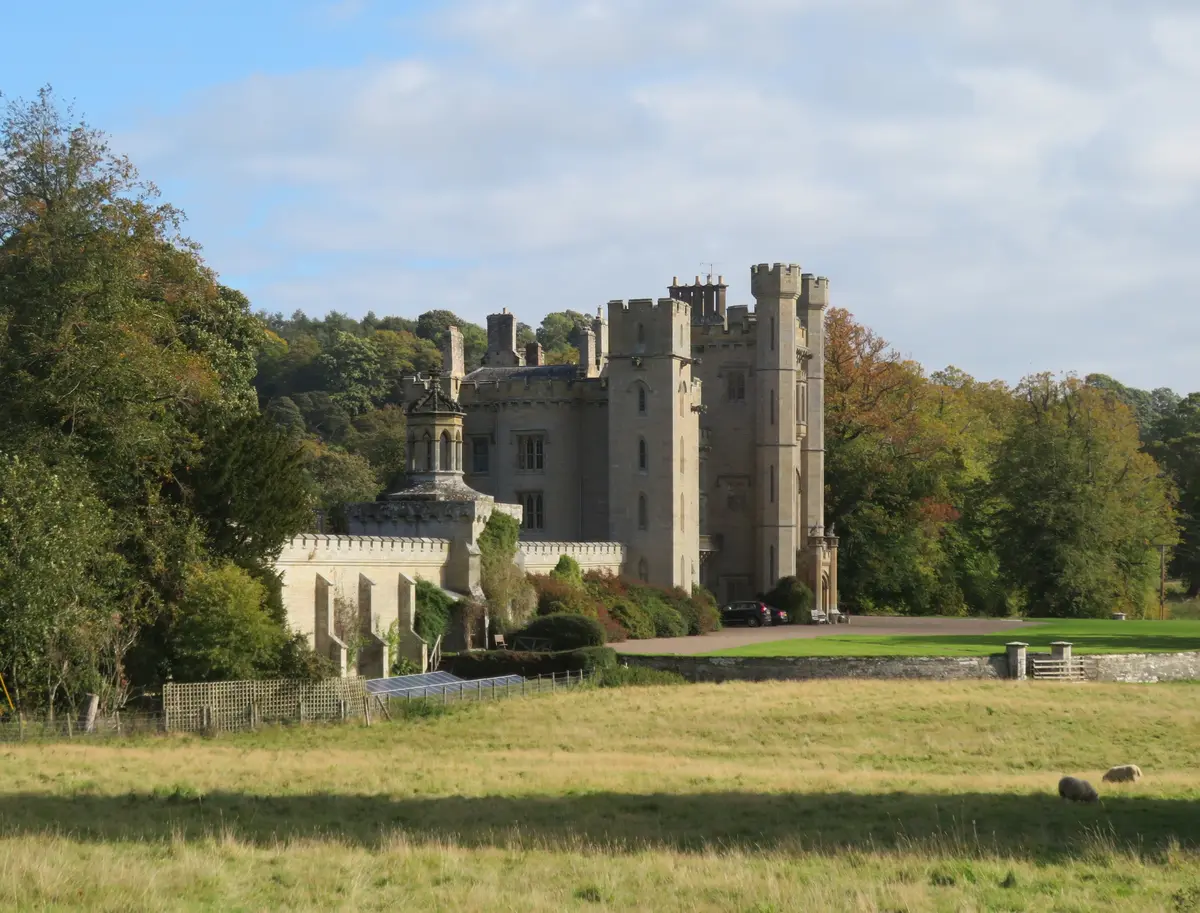
The sentence, online on a tourism site by 2001 and copied into Wikipedia in April 2010, said that Alexander Hay, killed at Waterloo in 1815, returns to the castle every now and then; an editor deleted it in February 2025 as unreliable and left the category behind, and that orphaned label is what keeps the castle on lists of haunted places. Alexander Hay, though, was real: Charles Dalton's Waterloo Roll Call records a cornet of that name in the 16th Light Dragoons, born on 6 September 1796, third son of the owner of Duns Castle, with a memorial at Waterloo. The house needs no ghost anyway. A keep granted by Robert the Bruce in 1320, a hill where a Covenanter army faced down Charles I in 1639, and a Gothick rebuilding of 1818-1822 that ruined the young laird who ordered it. It is still a private Hay family home, and the wooded walks around the Hen Poo are free.
What is the history of Duns Castle?
Duns Castle begins with a grant, not a building. In 1320 Robert the Bruce gave the lands of Duns to his nephew Thomas Randolph, 1st Earl of Moray, and a keep was raised on them. That is the date the house still advertises: on the east elevation there is a rectangular plaque carved "built 1320" — but Historic Environment Scotland's listing describes that plaque as a later addition, and notes that the early history of the building "is rather uncertain, having possibly been razed by the English in the 16th century". Duns itself was burned in 1545, during the Rough Wooing; the original town stood on the hill above, on Duns Law, and after the burning it was abandoned to what Francis Groome's gazetteer of 1884 calls "utter decay and extinction". The town below was refounded around 1588.
The estate's largest moment came in the spring of 1639, and it happened on the hill rather than in the house. General Alexander Leslie encamped a Covenanter army on Duns Law — contemporaries put it at anywhere between 12,000 and 30,000 men — while Charles I watched the hillside from Berwick through a telescope. Groome quotes the eyewitness account of Principal Robert Baillie: "Our hill was garnished on the top towards S and E with mounted cannon, well-nigh to the number of 40, great and small," with a standard before every captain's tent bearing, in golden letters, "For Christ's Crown and Covenant". The standoff ended in the Pacification of Berwick on 18 June 1639. The summit is a scheduled monument today, covering a prehistoric fort, cultivation terraces and the seventeenth-century Covenanters' camp. The estate's own website states that Leslie quartered in the castle itself.
Sir James Cockburn bought the estate from Hume of Ayton and had Duns made a burgh of barony in 1670. The Hay family came next, and have never left. On the date they arrived the sources split: Historic Environment Scotland and the estate itself say 1696; the English Wikipedia article and the Dunse History Society say 1698, the latter giving the price as £228,034 14s 3d Scots, or £19,002 17s 10d sterling. Successive Hays enlarged the place — John Baxter II's Pavilion Lodge in 1774–77 and his Gothic stable block with its spire in 1792–94, and a new walled garden built in 1802-07 under a contract with Walter Nicol of Edinburgh whose surviving papers require the keys to be delivered by 1 November 1807.
The castle that stands now is the work of one overspending young man. William Hay inherited in 1813 at the age of twenty-five, already carrying debts, and immediately hired the landscape designer Thomas White Jnr, whose plan for the policies is dated 1812, and then an architect. His first choice, Richard Crichton, left one drawing dated May 1817 and died that August; Hay turned to James Gillespie, later Gillespie Graham, who kept some of Crichton's ideas. The contract was signed in April 1818 and the final account reached Hay in 1822. The two Historic Environment Scotland records do not quite agree on the span — the listing says 1818–1822, the gardens inventory 1820–23. The bill was ruinous. "I have at last got a final settlement of my affairs," Hay wrote in 1829, "which, I am sorry to say, are as bad as possible."
Local tradition, recorded by the Dunse History Society, holds that the builder was William Waddell, that the stone was quarried at Putton Mill, and that the gargoyles — the work of John Anderson of Duns — were modelled on townspeople of the day.
Timeline: the documented record of Duns Castle
- 1320 Robert the Bruce grants the lands of Duns to his nephew Thomas Randolph, 1st Earl of Moray, and a keep is raised. Historic Environment Scotland records the date as circa 1320 and notes that the plaque on the east elevation reading "built 1320" is a later addition.
- 1545 Duns is burned to the ground during the Rough Wooing. The original town stood on Duns Law and was abandoned to "utter decay and extinction" afterwards. Historic Environment Scotland notes separately that the castle may have been razed by the English in the same century.
- Spring 1639, ending 18 June General Alexander Leslie encamps a Covenanter army on Duns Law while Charles I watches from Berwick through a telescope. Principal Robert Baillie, an eyewitness, describes some forty guns mounted on the summit and a standard before every captain's tent reading "For Christ's Crown and Covenant". The confrontation ends in the Pacification of Berwick.
- 1670 Sir James Cockburn, having bought the estate of Duns from Hume of Ayton, has the town constituted a burgh of barony.
- 1696 or 1698 The estate passes to William Hay of Drumelzier and has stayed in the family ever since. Historic Environment Scotland and the estate give 1696; Wikipedia and the Dunse History Society give 1698, the latter with a price of £228,034 14s 3d Scots (£19,002 17s 10d sterling).
- 6 September 1796 Alexander Hay is born, third son of Robert Hay of Drumelzier — the owner of Duns Castle, named as such on an estate plan of 1792 — and of Janet Erskine of Cardross.
- 1813 William Hay inherits the estate at twenty-five, along with his father's debts. In November of the same year his younger brother Alexander is commissioned cornet in the 16th (Queen's) Light Dragoons.
- May and August 1817 Richard Crichton produces a drawing for a Gothick remodelling of the house in May and dies that August. William Hay turns to James Gillespie, later Gillespie Graham, who keeps some of Crichton's ideas.
- April 1818 to 1822 The contract with Gillespie Graham is signed and the castle is rebuilt as the crenellated Gothick house that stands today; the final account reaches Hay in 1822. The two Historic Environment Scotland records disagree on the span, the listing giving 1818-1822 and the gardens inventory 1820-23.
- 1829 Ruined by the rebuilding, William Hay places his affairs in the hands of trustees: "I have at last got a final settlement of my affairs, which, I am sorry to say, are as bad as possible."
- 14 October 1881 A gale wrecks the trees of the estate, and above all the lime avenue at the castle. Many of the veterans had to be winched back upright and re-erected.
- 21 November 2001 The earliest datable appearance of the ghost claim: the Wayback Machine captures Rampant Scotland's "Haunted Scottish Castles" page, whose single unsourced sentence says Alexander Hay was killed at Waterloo and returns to the castle now and then. The paragraph is unchanged in every capture down to 2016.
- 5 April 2010 At 08:56 UTC a Wikipedia editor adds the category "Haunted houses" in a 28-byte edit with no explanation; at 08:58 the same editor adds the ghost sentence, citing a bare link to Rampant Scotland.
- 24 February 2025 An editor deletes Wikipedia's whole "Haunting" section, 286 bytes, with the summary "not a reliable source" — and leaves the haunted-locations category in place. Sixteen months later that orphaned label is what put Duns Castle into this catalogue.
Is there a rational explanation for Duns Castle?
This entry existed because of a Wikipedia category, and the ghost it described was our own invention. Both statements can be dated to the minute, so they are worth setting out.
Until August 2026 this file claimed that a White Lady haunted the shore of the Hen Poo, that a young woman had drowned there, and that estate workers and walkers had long reported a pale figure and an unexplained chill. None of it is true, and none of it came from anywhere. There is no drowned woman, no White Lady and no reported figure in any source consulted for this rewrite.
What does circulate is a different ghost. The claim originates on a Scottish tourism site, Rampant Scotland, whose "Haunted Scottish Castles" page carried a single sentence about Duns: "Alexander Hay was killed at the Battle of Waterloo in 1815 and is said to have returned to Duns Castle and makes a ghostly appearance every now and then." That page is preserved by the Wayback Machine from 21 November 2001, and the Duns paragraph is word-for-word identical in every capture down to May 2016. It cites nothing: no witness, no date, no informant. The domain is now parked — every path on it, including the site root, returns the same 114-byte redirect page.
On 5 April 2010 at 08:56 UTC a Wikipedia editor added the category "Haunted houses" to the Duns Castle article in a 28-byte edit with no explanation. Two minutes and fifteen seconds later the same editor added the sentence, sourced to a bare Rampant Scotland link, and misspelled "reputedly" as "reptedly"; he fixed the spelling nine minutes after that. The category was renamed twice and ended as "Reportedly haunted locations in Scotland". On 24 February 2025 a different editor deleted the whole "Haunting" section, 286 bytes, with the edit summary "not a reliable source" — and left the category behind. Our own harvester picked the article up by that orphaned label in July 2026, found an article with no ghost in it, and wrote one.
The older record is quiet, and it is quiet with the microphone switched on. Groome's 1884 gazetteer devotes some 1,780 words to Duns, the castle, its artificial lake and its hill, and mentions no ghost at all — while the same volume happily prints the ghost of "one Jacky Gordon" at Craig House on Craiglockhart Hill, the Ghost's Knowe in Stirlingshire and the ghost of Donald Gorm at Duntulm. The one supernatural episode Groome records at Duns is the "Dunse demoniac" of 1630, a poor woman the Earl of Lauderdale believed possessed, who "spoke better Latin even than the minister". The Dunse History Society's website runs to 79 pages and 70,527 words, uses the word "witch" 101 times, and uses "ghost", "haunted", "apparition" and "spectre" exactly zero times. The estate's own website — 46 pages, 18,485 words, with "castle" appearing 583 times — never mentions a haunting either. Duns Castle sells weddings, filming and exclusive-use stays; it does not sell a ghost.
Alexander Hay, though, was real, and that is the part worth rescuing. Charles Dalton's Waterloo Roll Call lists a Cornet Alexander Hay of the 16th (Queen's) Light Dragoons, commissioned on 11 November 1813, and annotates him: "Of Nunraw. Bn. 6th Sept., 1796. M.I. at Waterloo. 3rd son of Robert Hay of Drumelzier, by Janet, eldest dau. of James Erskine, of Cardross." Robert Hay of Drumelzier is the owner of this house: Historic Environment Scotland's bibliography cites a 1792 estate plan of "ground about Duns Castle, the property of Robert Hay of Drumelzier". So the young man in the legend is the laird's third son, born at the end of the eighteenth century and eighteen years old in June 1815. One caution: Dalton's key gives "M.I. = Monumental inscription", and Dalton marks his killed with a "K." — Captain John Phillips Buchanan of the same regiment carries one. Cornet Hay does not. What the roll establishes is a memorial to him at Waterloo, not the manner of his death.
Can you visit Duns Castle?
The castle is a private family home and is not open to the public. There are no tickets, no opening hours and no tours: the only way inside is to book it, and bookings are exclusive-use — weddings, corporate hospitality, private parties and stays, filming and photography. Alick and Aline Hay, the present owners, live in private quarters within the building and take an active part in running the estate. Enquiries go through the estate office at [email protected] or 01361 883211.
The grounds are a different matter, and they are the reason to come. A network of paths through the woods and around the Hen Poo, the long artificial loch immediately north of the house, is publicly accessible and free, reached on foot from Castle Street in the middle of Duns. The loch already existed by 1744 and was extended north and south in the first half of the nineteenth century; the estate's own site glosses its name as "the Heron Pool". The designed landscape covers 564 hectares (1,393 acres) and takes in the lime avenue first planted around 1690–1720, whose veteran trees had to be winched upright again after the gale of 14 October 1881, and the Colonel's path along the water. Duns Law rises to the east: a short, steep climb from the town to a grassy summit at about 700 feet, with the Covenanters' Stone — cleared and enclosed in 1878 after relic-hunters had chipped it almost to nothing — and a wide view over the Berwickshire Merse.
Two warnings. The area has been described for decades as a Scottish Wildlife Trust reserve, and Wikipedia still cites a Trust page archived in 2007; as of August 2026 a search of the Trust's own website for "Duns" returns no reserve page at all, while the same search for other reserves returns theirs, so that description should not be relied on. And the walled garden west of the castle, abandoned in the mid-twentieth century, is unmaintained and is not a visitor attraction.
Sources consulted
- Historic Environment Scotland, «Duns Castle, with Screen Walls and Sundial (LB4108)» — Statutory List of Buildings of Special Architectural or Historic Interest, 1971 archive
- Historic Environment Scotland, «Duns Castle (GDL00161)» — Inventory of Gardens and Designed Landscapes in Scotland, 1987 archive
- Francis H. Groome, «Ordnance Gazetteer of Scotland, vol. II: entry for Dunse» — Thomas C. Jack, Edinburgh, 1884 book
- Charles Dalton, «The Waterloo Roll Call, 2nd edition: 16th (or the Queen's) Regiment of Light Dragoons, p. 86 and note 25» — Eyre and Spottiswoode, London, 1904 book
- Rampant Scotland, «Haunted Scottish Castles (capture of 21 November 2001)» — Internet Archive Wayback Machine, 2001 archive
- Wikipedia contributors, «Duns Castle: revision history, edits of 5 April 2010 and 24 February 2025» — English Wikipedia, 2025 archive
- Dunse History Society, «Duns Castle» — Dunse History Society, 2026 web
- Duns Castle Estate, «The Gem of the Scottish Borders: Castle & Grounds» — Official site of Duns Castle, 2026 web
Reviewed by V. Serrano on 2026-08-20 · How we verify our content
💬 Field testimonies (0)
No testimonies yet. Add the first.
Add your testimony
🔒 Log in to add a testimony