👻 HAUNTED PLACE · EXP. Nº9476
ACTIVE
Duntrune Castle
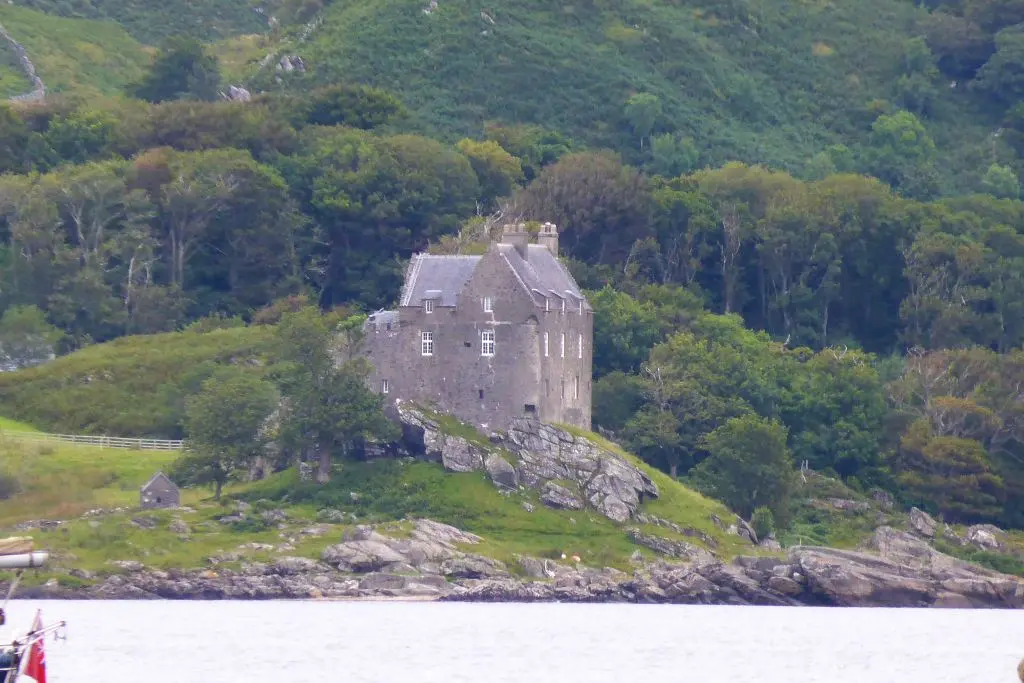
Duntrune Castle stands on a rock above Loch Crinan in Argyll, lived in by the same family since the 1790s, and its owners call their ghost a well-authenticated handless piper.
Where is Duntrune Castle?
- Location
- Argyll and Bute, Scotland, United Kingdom
- Type
- Castle
- Coordinates
- 56.102, -5.549
- Last updated
LOCATION
Why is Duntrune Castle said to be haunted?
The story they tell is that a piper serving Alasdair MacColla was left in the castle when his master sailed away, that the Campbells retook it and spared him for his skill, and that when the galley came back he warned it with a tune, Cholla mo run, seachain an dun, "Coll, my dear, shun the castle". His hands were cut off and he bled to death. In 1888, the family's account says, workmen found a handless skeleton under a floor of the castle. The tune is real and older than any of this: Donald Campbell printed it in 1862, and in that earliest version the castle is Dunaverty, the piper dies of a dirk thrust and nobody loses a hand. The fullest collection of Argyll tradition, published in 1885, does not mention Duntrune at all. This is the story of how a pibroch found a castle to belong to.
What is the history of Duntrune Castle?
Duntrune sits on a rocky promontory on the north side of Loch Crinan, where the loch narrows towards the Sound of Jura. Everything about the place is about watching the water: the Royal Commission's surveyors, who measured it with plane-table and alidade in May 1982, noted that it commands a wide prospect on every approach except the north and north-west, and that a low rocky spit below the walls served as a boat-landing in calm weather.
The building has two ages. A round-angled polygonal enclosure wraps the rock — the Royal Commission puts it in the late medieval period, closer in character to fifteenth-century Breachacha and Kisimul than to earlier enclosure-castles like Mingary or Tioram, while the statutory listing calls the high crenellated curtain thirteenth-century. Inside it, in the south angle, stands an L-plan tower house of about 1600, built against and over the top of the older wall. When David MacGibbon and Thomas Ross published their survey in 1887, working from plans and views prepared for them by James Edgar of Ri Cruin, Lochgilphead, they described a vaulted basement with kitchen and cellars, a hall on the first floor with a private room at one end and a bedroom in the wing, crow-stepped gables and a corbelled angle at the south-east corner.
The castle was long the seat of the Campbells of Duntroon. Martin Coventry's gazetteer records "Duntruyn Cat." on Blaeu's map of Lorn, John Campbell of Duntrune on record in 1587, a burning by the Earl of Argyll in 1685 and an oath of allegiance to George I signed by Patrick Campbell of Duntrune in 1715. The siege that carries the ghost story belongs to the wars of the 1640s, and the national record is careful about it: the Ordnance Survey note says only that the seat of the Campbells of Duntroon was "besieged by Colkitto or his son Alasdair in the 17th century". It does not choose between father and son.
Then the property changed hands, and the family that bought it is still there. The listing gives 1792 for the purchase from the Campbells of Duntroon and of Oib; the Royal Commission dates it to 1796, by Neil Malcolm of Poltalloch, and describes the restoration that followed. A coat of arms over the door is dated 1851. After Poltalloch House was abandoned, Col. George Malcolm modernised and extended the castle between 1954 and 1957 — a rainwater head carries the date 1957 — and the garden inland was formalised in the same decade.
One tenant deserves his own paragraph, because the ghost story runs through him. The Rev. Reginald J. Mapleton, of Kilmartin in the diocese of Argyll and the Isles, was a working antiquarian and a corresponding member of the Society of Antiquaries of Scotland. On 9 June 1873 the Society heard his "Note of a Bone Cave at Duntroon": he had examined a rock shelter on the estate where workmen breaking stones for roads uncovered a skull, and he reported a man buried to the shoulders by fallen rock and seated at his death, a woman and an infant a foot below him, the scattered remains of at least six more people, a hearthstone in ash and charcoal, a charred red-deer legbone and two flint scrapers. It is the account of a man who knew exactly what to do with human bones found on his own doorstep — worth holding in mind when you read what he is said to have done fifteen years later.
Timeline: the documented record of Duntrune Castle
- 1587 John Campbell of Duntrune is on record, per Martin Coventry's gazetteer, which also notes "Duntruyn Cat." on Blaeu's map of Lorn.
- c. 1600 The L-plan tower house is built in the south angle of the enclosure, against and over the older curtain wall — the date given by the Royal Commission after its 1982 survey and by the statutory listing.
- 1644 The siege. The Ordnance Survey note in the national record says only that the seat of the Campbells of Duntroon was "besieged by Colkitto or his son Alasdair in the 17th century"; Coventry dates it to 1644, during Montrose's ravaging of the Campbell lands.
- 1685 The castle is burnt by the Earl of Argyll, according to Coventry — a documented act of destruction at Duntrune that no version of the ghost story uses.
- 1792 (or 1796) The Malcolms of Poltalloch buy Duntrune from the Campbells of Duntroon and of Oib. The listing gives 1792; the Royal Commission dates the purchase by Neil Malcolm of Poltalloch to 1796.
- 1862 Donald Campbell prints the piper's warning, pp. 124-125. In this earliest datable printed version the castle is "Dun-a-verty", the piper is killed with a dirk, and nobody loses a hand.
- 9 June 1873 The Society of Antiquaries of Scotland hears the Rev. R. J. Mapleton's "Note of a Bone Cave at Duntroon", published in 1874: a careful account of human remains found on the estate.
- 1885 Records of Argyll appears: 167,839 words of Argyllshire tradition with a long section on Alasdair MacColla. "Duntroon" and "Duntrune" both return zero; controls in the same file: "piper" 22, "Dunaverty" 24, "tradition" 199.
- 1887 MacGibbon and Ross describe Duntroon Castle over two pages from sketches by James Edgar of Lochgilphead. No ghost and no legend: "ghost" appears 0 times in the volume against 2,728 for "castle".
- 1888 The alleged discovery. The Clan MacCallum-Malcolm Society's account says repairs uncovered a skull beneath a first-floor dressing room and then a handless skeleton, reburied on Dean Mapleton's orders, and that a great-granddaughter of his later wrote that it went into an unmarked grave at Kilmartin. No contemporary published record of the find has been located.
- 12 October 1889 Henry Whyte ("Fionn") treats the tune at length in the Oban Times, one year after the skeleton is said to have been found — and the passage he quotes is Donald Campbell's 1862 text, dirk and all.
- 1954-1957 Col. George Malcolm of Poltalloch modernises and extends the castle after Poltalloch House is abandoned; a rainwater head carries the date 1957 and the garden is formalised the same decade.
- 24 April 2007 The ghost enters Wikipedia: an editor adds two unsourced versions of the story, and in both the piper is a MacDonald and the Campbells cut off his hands. A "The Piper Of Duntrune" heading follows on 3 October, with the skeleton paragraph.
- 29 June 2020 An anonymous editor deletes the entire legend — 2,280 bytes — with the summary "Removal of fiction that actually related to Dunaobhaig Castle in islay." The category "Reportedly haunted locations in Scotland", added in July 2011, stays behind with nothing under it.
Is there a rational explanation for Duntrune Castle?
The tune is the oldest thing in this story and the part that can be dated. Donald Campbell printed it in his Treatise on the Language, Poetry, and Music of the Highland Clans (Edinburgh, 1862), pp. 124-125, with the Gaelic and an English rendering of all six parts: "Cholla, mo rùin, seachain an dùn… Tha sinne an làimh" — "Coll of my love, avoid the castle… We are in their hands." But Campbell's account is not the Duntrune story. In it the piper of Colla Ciotach lands with a party on Islay ahead of the expedition from Ireland with orders to take, as printed, "the castle of Dun-a-verty"; the Campbells ambush the party and hang everyone but the piper; the piper asks leave to play a lament, encodes the warning in it, and when the Campbell chieftain understands the sixth part he "plunged his dirk into him". No mutilation, no severed hands, and no Duntrune.
Two measurements matter more than any argument. Lord Archibald Campbell's Records of Argyll (1885) is 167,839 words of Argyllshire legend collected chiefly from the Gaelic, with a long section headed "Traditions of Alasdair MacDonald (MacCholla Ciotach)". Searched for this castle it returns zero: "Duntroon" 0, "Duntrune" 0, and the one hit for "Duntrun" is a genealogical note with no piper in it. The controls in the same file are healthy — "piper" 22, "Dunaverty" 24, "Campbell" 573, "tradition" 199 — so corpus and search are both working. And MacGibbon and Ross, describing the castle over two pages in 1887 from drawings by a man who lived eight miles off, mention no ghost and no legend: "ghost" appears 0 times in that volume against 2,728 for "castle".
The hinge is 1888. The account published by the Clan MacCallum-Malcolm Society and endorsed by Robin Malcolm as chief says that repairs that year uncovered a skull beneath a first-floor dressing room and then a shallow-buried skeleton with no hands, and that Dean Mapleton had it reburied outside the walls; a great-granddaughter of Mapleton later wrote to Robin Malcolm that her mother, five years old at the time, understood the remains went into an unmarked grave in Kilmartin churchyard, where the Malcolms themselves have a burial loft. That is a family tradition about a family tradition — and it is worth saying plainly that the antiquarian living in the house, who had published on human remains from the same estate fifteen years earlier, appears to have published nothing whatever about this find.
Where the bones lay is exactly the detail that will not hold still. The Malcolm account puts them under a first-floor dressing room; Wikipedia, from 2007 to 2020, said "under a stone path"; Martin Coventry's gazetteer has the piper "buried under the kitchen flagstones"; other retellings move the discovery to the 1954-57 works. Coventry's entry dates the piper's mission to 1615 while dating the siege, in the same paragraph, to 1644. A story whose central relic changes room, floor and century between tellings is being remembered, not recorded.
Henry Whyte ("Fionn"), the Gaelic journalist who did most to spread the tune, was explicit that the location was contested. In his notes to David Glen's Collection of Ancient Piobaireachd, issued in parts between 1880 and 1907, he wrote that the pibroch "has been associated with several ancient castles on the west coast of Argyllshire, such as Duntroon Castle opposite Crinan, Dunyveg, Islay, and Dunaverty, Kintyre, but the preponderance of evidence seems in favour of Duntroon". His version still has no severed hands. And when he treated the subject at length in the Oban Times on 12 October 1889 — the year after the skeleton is said to have been found — the passage he chose to quote was Donald Campbell's 1862 text, dirk and all.
Argyll has no shortage of pipers punished for the wrong tune. Records of Argyll itself gives Tom-a'-phiobair, the Piper's Hillock beside the Ath-dearg battlefield, where a Campbell piper played a lament for the MacDougalls he was supposed to be piping against, "and one of them ran where he was and chopped his head off", after which "the piper's fingers played three or four notes on the chanter while his head was toppling to the ground". Move the punishment from the head to the hands and the shape is identical. A narrative that migrates between castles and centuries is a legend, and saying so takes nothing from the pibroch, which is a real and difficult piece of music.
Two last things. The owners' own website says two things at once: that "our ghost is well-authenticated", and, five lines earlier, that Duntrune was "always a Campbell stronghold in those days" and "was never the scene of a major conflict". And on 29 June 2020 an anonymous editor deleted the whole legend from the Wikipedia article — 2,280 bytes — with the summary "Removal of fiction that actually related to Dunaobhaig Castle in islay. There is a famous Pipe tune and song about it." That editor was half right; but the deletion left the article carrying the category "Reportedly haunted locations in Scotland", added in July 2011, with nothing underneath it. That empty label is how this castle reached most modern lists of haunted places, ours included.
Can you visit Duntrune Castle?
Duntrune Castle is a private house and it is lived in. Its visitor page offers short tours by arrangement — "While Duntrune is a private residence, we are happy to offer short tours for interested parties" — with the condition attached to them: "We are a working estate with no staff, so please phone or email with your details to arrange a visiting time." Donations "for the considerable maintenance of the castle and gardens are welcome."
The garden is the easier visit and it is separate from the castle, reached along a tree-lined avenue. The estate describes it as "Open Spring to late Autumn to the public, with parking over the cattle grid by the stables", with "a donation box in aid of charity" at the entrance gate. The gardens "were formalised in the 1950s and from the mid 1970s, they were managed personally and lovingly by the late Susan Malcolm until her death in 2003"; Cristophe Lefevre maintains them now. The designed landscape around the castle dates from the mid-nineteenth century and covers about 5.8 hectares.
The postal address is Duntrune Castle Holiday Cottages, Argyll, Scotland PA31 8QQ. Bookings and castle visits both go through 01546 510271 or through Andy Malcolm by email. The holiday cottages let by the week, "normally from Saturday 4pm to 9am on the following Saturday". The estate's own directions start at Lochgilphead: "take the A816 towards Oban. After five miles, turn left where signposted 'Crinan Ferry', continue straight ahead for 2 miles to the T junction. Turn right, and then left over our cattle grid."
Seeing the castle needs no permission at all, only the far side of the water. Crinan village, at grid reference NR 78738 94372, looks north-east across Loch Crinan to the castle at NR 79363 95576, about 1.4 kilometres away. The towpath at the sea end of the Crinan Canal gives the same prospect from dry land. This is the seaward face the story needs: the piper is always described playing towards the water. The building itself is listed at category B, reference LB11496, listed on 20 July 1971 in the parish of Kilmartin.
Kilmartin belongs to the same visit: its grid reference, NR 834 999, puts it about 5.9 kilometres north-east of the castle in a straight line, further by road. The Malcolms are buried there, and the piper's remains are said to have been reinterred in an unmarked grave. The churchyard is open and free to enter, and its carved stones run from early Christian work to late medieval West Highland gravestones of the fourteenth to early sixteenth centuries. Kilmartin Glen around it holds over 800 monuments within a six-mile radius, most of them in open fields. Nothing there marks a piper.
Access is by a driveway to a rock and a terraced platform; the ground is uneven and there are steps. Beyond it the garden is a country garden rather than a municipal park. The castle sits on minor roads west of the B8025, on the north side of Loch Crinan about 6.5 miles north-west of Lochgilphead. People live in this building, and a telephone call is the whole of the access policy.
Sources consulted
- Donald Campbell, «A Treatise on the Language, Poetry, and Music of the Highland Clans, with illustrative traditions and anecdotes (pp. 124-125: the piper's warning and the six parts of the pibroch, in Gaelic and English)» — Collie & Son, Edinburgh, 1862 book
- Lord Archibald Campbell, «Records of Argyll: legends, traditions, and recollections of Argyllshire Highlanders, collected chiefly from the Gaelic (including "Traditions of Alasdair MacDonald (MacCholla Ciotach)" and the Piper's Hillock at Ath-dearg)» — William Blackwood and Sons, Edinburgh, 1885 book
- David MacGibbon and Thomas Ross, «The Castellated and Domestic Architecture of Scotland from the Twelfth to the Eighteenth Century, vol. III, "Duntroon Castle, Argyllshire", pp. 85-87» — David Douglas, Edinburgh, 1887 book
- Rev. Reginald J. Mapleton, «Note of a Bone Cave at Duntroon (read 9 June 1873), Proceedings of the Society of Antiquaries of Scotland, vol. 10, pp. 306-308» — Society of Antiquaries of Scotland, 1874 academic
- William Donaldson, «Cholla mo Rùn: the Piper's Warning to his Master, in "Entirely at the pleasure of the performer: a further exploration of piobaireachd" — quoting Henry Whyte ("Fionn"), notes to David Glen's Collection of Ancient Piobaireachd, and Whyte's "Famous Pipe-Tunes", Oban Times, 12 October 1889, p. 3» — Piper & Drummer magazine, 2002 academic
- Historic Environment Scotland, «Duntrune Castle by Loch Crinan, listed building record LB11496 (Category B, listed 20 July 1971; parish of Kilmartin; NGR NR 79363 95576)» — Historic Environment Scotland designations portal, 1971 report
- Royal Commission on the Ancient and Historical Monuments of Scotland / Historic Environment Scotland, «Duntrune Castle, site record 39147 (NR79NE 3): Ordnance Survey notes and the RCAHMS field visit and measured survey of May 1982, published in Argyll: an Inventory of the Monuments, vol. 7, Mid Argyll and Cowal: Medieval and Later Monuments, pp. 276-282» — Canmore, 1992 report
- Clan MacCallum-Malcolm Society, «The Piper of Duntrune (the owning family's account of the legend and of the 1888 discovery, including the letter from a great-granddaughter of Dean Mapleton to Robin Malcolm)» — clan-maccallum-malcolm.org, 2020 report
- Duntrune Castle Estate (Andy and Lucy Malcolm), «Duntrune Castle official website: The Castle & Gardens, visitor information, the cottages and directions (consulted 20 August 2026)» — duntrunecastle.com, 2026 web
- Wikipedia contributors, «Duntrune Castle, article revision history: 104 revisions from 26 January 2006 to 18 July 2026, including the addition of the ghost story on 24 April 2007, of the category "Reportedly haunted locations in Scotland" on 7 July 2011, and its deletion on 29 June 2020» — English Wikipedia, 2026 archive
- Martin Coventry, «Duntrune Castle (gazetteer entry: Blaeu's map of Lorn, John Campbell of Duntrune in 1587, the 1644 siege, the burning of 1685, the 1792 sale, and the piper buried "under the kitchen flagstones")» — The Castles of Scotland, Goblinshead, 2024 web
Reviewed by V. Serrano on 2026-08-20 · How we verify our content
💬 Field testimonies (0)
No testimonies yet. Add the first.
Add your testimony
🔒 Log in to add a testimony