👻 HAUNTED PLACE · EXP. Nº9477
ACTIVE
Edge Hill, Warwickshire
On Christmas Eve 1642, two months after the first pitched battle of the English Civil War was fought below this Warwickshire escarpment, shepherds and travellers near Kineton reported hearing drums and cannon in the dark and then seeing two armies fight the battle again in the sky.
Where is Edge Hill, Warwickshire?
- Location
- Warwickshire, England, United Kingdom
- Type
- Fort / battlefield
- Coordinates
- 52.108, -1.475
- Last updated
LOCATION
Why is Edge Hill, Warwickshire said to be haunted?
They woke the local justice of the peace, William Wood, who suspected they were mad or drunk and went out the next night to see for himself. The account was printed in London on 23 January 1642/3 as a seven-page pamphlet, A Great Wonder in Heaven, certified by Wood and by Samuel Marshall, minister of Kineton. It says Charles I sent six men from Oxford to investigate, three of them named, and that they swore to the King they had recognised the face of Sir Edmund Verney, his standard-bearer, killed in the real battle. It is a strange thing to swear to: Verney's body was never identified. Stranger still is how the phantom battle ends. The King's army breaks and flees; Parliament's is left master of the field, triumphing — an outcome the real battle never delivered, printed in a city Parliament held.
What is the history of Edge Hill, Warwickshire?
The battle came first, and it settled nothing.
On Sunday 23 October 1642 the armies of Charles I and the Earl of Essex met below the Warwickshire escarpment of Edge Hill, in the fields between Radway and the small market town of Kineton. It was the first pitched battle of the English Civil War. Historic England's battlefield report describes roughly 14,000 Royalists on the ridge and a Parliamentarian force almost equal in number drawn up on the plain, and a fight that "drifted into confusion as a result of poor leadership, panic and exhaustion". Both cavalry wings galloped off the field in pursuit and plunder. As darkness fell the fighting subsided and the armies simply parted. Neither side could claim the day.
Among the Royalist dead was Sir Edmund Verney, Knight Marshal and bearer of the King's standard. His family's own historian, Frances Parthenope Verney, recorded that on accepting the post he had said "that by the grace of God they that would wrest that standard from his hand, must first wrest his soul from his body". The standard was taken and later recovered. Verney's body was never identified.
Two months later the story that concerns us begins. According to a pamphlet printed in London the following January, on the night of Saturday 24 December 1642 shepherds and travellers on the battlefield heard drums "a far off" and the groans of soldiers, and then saw two armies appear in the air with "Ensignes displayed, Drums beating, Musquets going off, Cannons discharged, Horses neyghing". One army carried the King's colours and the other Parliament's. The witnesses ran to Kineton and knocked up William Wood, a justice of the peace, who called in his neighbour Samuel Marshall, minister of Kineton. Both men appear on the pamphlet's title page as guarantors.
Wood and Marshall did not believe them. The pamphlet says plainly that they "would have conjectured the men to have been either mad or drunk, had they not knowne some of them to have been of approved integritie". So they suspended judgement and went out the following night, Christmas night, with the witnesses and "all the substantiall Inhabitants of that and the neighbouring parishes" — and reported seeing it themselves. The apparitions returned on the following two weekends. Wood abandoned his house and moved away. Marshall stayed.
Then the state arrived. "The rumour whereof comming to his Majestie at Oxford," the pamphlet says, the King "immediately dispatched thither Colonell Lewis Kirke, Captaine Dudley, Captaine Wainman, and three other Gentlemen of credit" — six men in all, of whom three are named. Kirke was a genuine royal servant, brother of Sir David Kirke who had captured Quebec for Charles in 1629, and later Royalist governor of Bridgnorth. The commissioners took Marshall's testimony, waited, and on the Sunday reported that they had "distinctly" recognised individual figures in the sky "by their faces, as that of Sir Edmund Varney, and others that were there slaine". They swore to it before the King.
The account was published as A Great Wonder in Heaven, printed for the London bookseller Thomas Jackson and dated 23 January 1642/3 — three months to the day after the battle. It runs to seven pages.
Timeline: the documented record of Edge Hill, Warwickshire
- 9 April 1628 Fourteen years before Edgehill, the pamphlet Looke up and see wonders reports "a miraculous apparition in the ayre" at Hatford in Berkshire. Armies and portents in the sky were already an established genre in English cheap print.
- Sunday 23 October 1642 The first pitched battle of the English Civil War is fought below Edge Hill. Historic England describes it as drifting "into confusion as a result of poor leadership, panic and exhaustion"; the armies part at nightfall with nothing decided. Sir Edmund Verney, the King's standard-bearer, is killed and his body never identified.
- Saturday 24 December 1642 Shepherds, countrymen and travellers on the battlefield report hearing drums and the groans of soldiers between twelve and one in the morning, then seeing two armies fight in the air. They run to Kineton and wake William Wood, justice of the peace, who calls in Samuel Marshall, the minister.
- Sunday 25 December 1642 Wood and Marshall, who had suspected the witnesses of being "either mad or drunk", go out on Christmas night with them and with the principal inhabitants of the neighbouring parishes, and report seeing the apparitions themselves.
- Early January 1642/3 The apparitions are reported again on the following two weekends. Wood abandons his house and moves to a safer dwelling; Marshall stays. Every day of the week named in the pamphlet matches the real Julian calendar of 1642-43.
- Mid-January 1642/3 The rumour reaches the King at Oxford, who sends Colonel Lewis Kirke, Captain Dudley, Captain Wainman and three other gentlemen of credit — six men, three of them named. They report recognising figures in the sky by their faces, naming only Sir Edmund Verney, and swear to it before the King.
- 23 January 1642/3 A Great Wonder in Heaven is printed in London for the bookseller Thomas Jackson, three months to the day after the battle. In its phantom battle the King's army flees and Parliament's is left master of the field — an outcome the real battle never delivered.
- 14 June 1643 Parliament passes the Ordinance for the Regulating of Printing, restoring pre-publication censorship. The Edgehill pamphlet had appeared five months earlier, in the window when London's presses were effectively unregulated.
- 1892 Frances Parthenope Verney reprints the pamphlet in her Memoirs of the Verney Family. She correctly counts "Colonel Kirke and 5 other gentlemen of Credit" and notes Verney was "the only one, however, named" — but her quotation adds phrases absent from the 1643 text.
- Late 1940s A military ammunition depot is built across much of the battlefield. The Battlefields Trust records that its construction closed several rights of way and that "a great deal of damage has been done to the archaeology of the battle. In places even the underlying form of the land has been altered."
- 6 June 1995 Edgehill is entered on the Register of Historic Battlefields as list entry 1000009. The accompanying report notes that much of the area "lies concealed by a Ministry of Defence installation" and that footpath access is limited.
Is there a rational explanation for Edge Hill, Warwickshire?
The pamphlet is effectively the whole of the evidence. It is the only account of the Edgehill apparitions in the digitised Early English Books corpus: searching that archive for the battle's local place name returns three genuine 1642 pamphlets reporting the fighting, but only this one text reports anything in the sky. Something else may survive undigitised — Frances Parthenope Verney's 1892 quotation contains wording absent from this edition, which hints at a second printing — but no contemporary corroboration has been produced. So the text has to be read as what it is: a commercial news pamphlet published in London in the middle of a civil war.
Read that way, its politics are hard to miss. In the phantom battle, the King loses. The pamphlet has the army carrying "the Kings colours" put to "apparent rout", withdrawing "or rather appear[ing] to flie", while the other side is "as it were, Masters of the field" and stays "a good space triumphing, and expressing all the signes of joy and conquest". The real battle had done nothing of the kind. The author also states outright that Essex "obtained there a glorious victory over the Cavaliers" — a claim contradicted by every modern assessment, including Historic England's, which calls the engagement inconclusive. The framing is reinforced elsewhere: the site is introduced as the place where "King Iohn fought a battell with his Barons" who acted "in the defence of the Kingdomes lawes and libertie", an unmistakable analogy for 1642, and no such earlier battle appears in the modern battlefield literature. The demonology is authorised by quoting "our late Soveraigne King Iames" and his Daemonologie — Charles I's own father enlisted to validate a portent against Charles I's cause. It is worth asking who benefited from printing this in January 1643, in a city held by Parliament, five months before Parliament reimposed pre-publication licensing with the Ordinance for the Regulating of Printing. The vision awards Parliament the victory the battle withheld, and makes the King's own officers swear to it.
The imagery was also standard stock. Armies fighting in the sky were an established genre in English cheap print well before Edgehill: the same digitised archive holds Looke up and see wonders, describing "a miraculous apparition in the ayre" at Hatford in Berkshire on 9 April 1628, catalogued under storms and meteorites. The Edgehill pamphlet did not invent its pictures.
Against all that, one detail resists easy dismissal. The pamphlet's calendar is exactly right. It places the first sighting on a Saturday "in Christmas time" and the second on "Sunday, being Christmas night"; in the Julian calendar England then used, 24 December 1642 was indeed a Saturday and Christmas Day a Sunday, and every subsequent Saturday and Sunday it names falls correctly. Whoever wrote it was working from a real, dated local report, whatever that report described. That makes the story better sourced than most — and still leaves it unverifiable.
One detail is self-defeating. The commissioners are said to have recognised Sir Edmund Verney's face. Verney was the one man at Edgehill whose face could not be recognised: his body was never identified.
It is also telling who declines to sell the story. The pub that stands on the escarpment, the obvious beneficiary of a haunted reputation and the very building from which visitors are told to view the field, markets its history hard — the battle, the date, the views, Sanderson Miller's tower — and says nothing about ghosts at all.
Finally, almost everything written about this case since has been garbled, which is worth knowing before trusting any retelling. Frances Parthenope Verney, quoting the pamphlet in 1892, added phrases it does not contain — "where are still many unburied karkasses" and "sounds of petronels" appear nowhere in the 1643 text, though the rest of her quotation is accurate. A BBC Coventry and Warwickshire feature of 2006 dated the battle to 16 October, put the first sighting a month after it and the royal commission a year after, and had the King act only after reading the printed booklet — when the commission's oath is reported inside that booklet, so it must have come first.
Can you visit Edge Hill, Warwickshire?
Most of the Edgehill battlefield lies inside the Ministry of Defence depot at Kineton and cannot be entered. The Battlefields Trust's page on the battle, consulted on 24 September 2026, says that the building of the depot in the late 1940s closed "several key rights of way", that "a great deal of damage has been done to the archaeology of the battle" and that "most of the battlefield still remains in Ministry of Defence ownership and is inaccessible". English Heritage's battlefield report of 1995 had put the consequence for visitors this way: "At present it is difficult for the visitor to view and appreciate the battlefield from anywhere but the heights of Edgehill itself, since much of its area lies concealed by a Ministry of Defence installation."
Historic England's list entry 1000009 registers the battlefield, first listed on 6 June 1995, in the parishes of Burton Dassett, Kineton, Radway and Tysoe in Stratford-on-Avon district, at National Grid Reference SP 33962 49503. The live page refused automated requests on 24 September 2026, and these details come from the Wayback Machine capture of 19 April 2025. The 1995 report names six parishes, adding Oxhill and Chadshunt, gives SP357490 as its grid reference, and says that the registered area "does not at present extend across Radway to include the King's initial position on Edge Hill itself". The pin on this file, 52.108° N 1.475° W, converts to SP 3605 4565, about 4.4 km south-south-east of the list entry's grid reference and about 2.2 km south-west of the grid point the Battlefields Trust gives for its photograph of the Castle Inn.
The Trust's monuments page records that the first battlefield monument, erected in the early twentieth century beside Graveyard Coppice at the centre of the Parliamentarian front line, now lies within the depot perimeter and is not accessible to visitors. A copy was built in 1949 beside the B4086 Kineton to Banbury road, about 400 metres behind the Parliamentarian front line on the left wing. The Trust notes that its lay-by is small and that informal parking has grown up on the verge opposite. The plaque on the back reads: "Erected by the Warwickshire County Council and unveiled by the Lord Lieutenant of Warwickshire the Right Hon the Lord Willoughby de Broke V.C. A.F.C. ~ Sunday 23 October 1949."
In Radway church, rebuilt on a new site in the nineteenth century, the Trust lists two monuments to Captain Kingsmill, killed in the battle, a slab and an effigy moved from the demolished medieval church. Its walk page adds that a museum exhibition on the battle and its effect on the local population opened in the church in October 2015, and that there are toilets at the rear of the church.
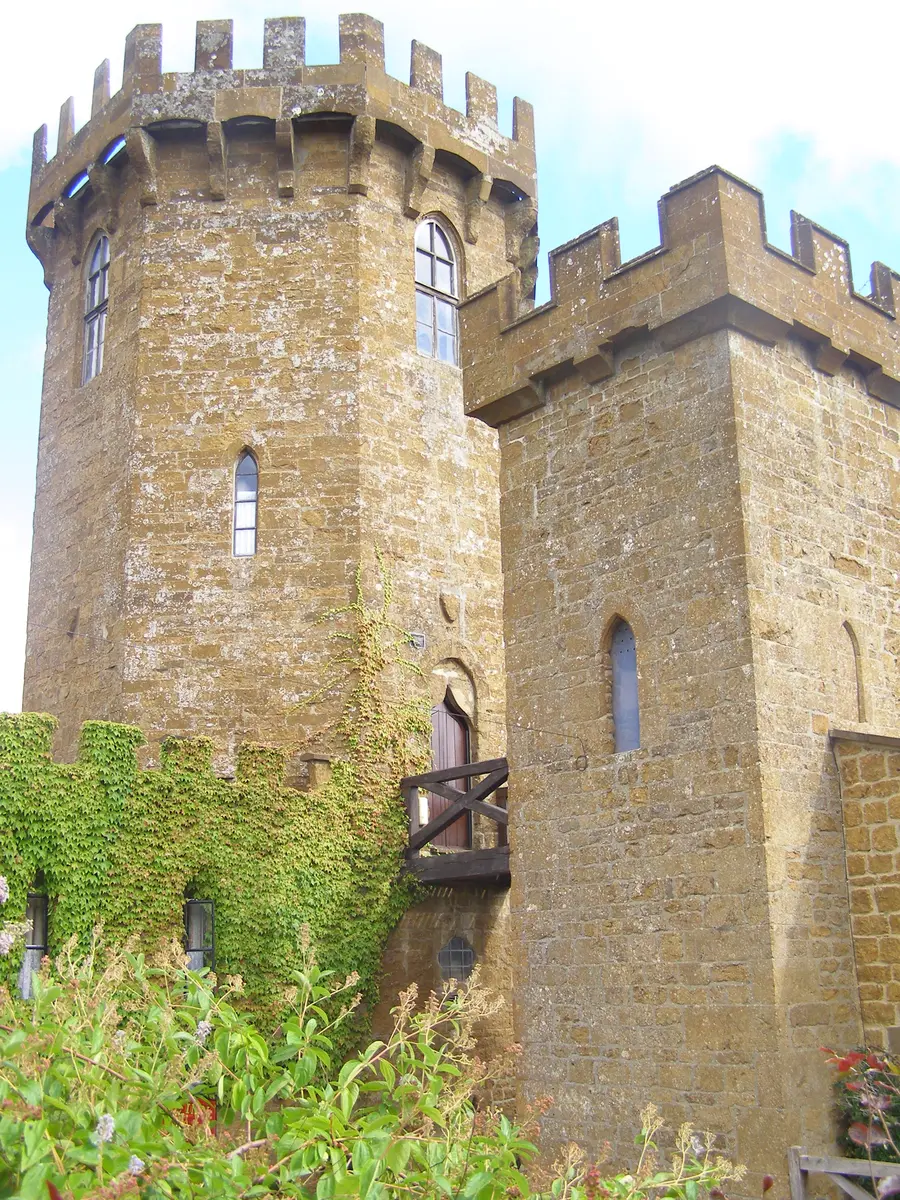
The Castle Inn stands on the crest. The Trust describes the tower as an eighteenth-century folly built where Charles I is traditionally said to have viewed the field, and on 23 October 2005 it unveiled an interpretation panel in the pub garden. The pub's website, consulted on 24 September 2026, trades as The Castle at Edgehill, Edgehill, Banbury OX15 6DJ, telephone 01295 670255, part of the Freespirit Pubs group, and gives the bar hours as 08:00 to close from Monday to Saturday and 08:00 to 18:00 on Sunday. It says the tower was built by Sanderson Miller a hundred years after the battle and "is said to mark the spot where King Charles I raised the standard before the two sides clashed"; the 1995 report records the raising of the standard at Nottingham on 22 August 1642. Historic England's list entry describes "an old stone seat" below the inn next to the footpath, "which gives a fine view of the battlefield, especially the Royalist position".
The Trust's battlefield walk is 4 miles (6.4 km), mostly over flat ground, with "a very long and steep descent and re-ascent (100m) of the Edge Hill scarp". It starts at the Castle Inn, where the Trust says it is possible to park along the road, and climbs back to the crest by the steps of Jacob's Ladder.
Sources consulted
- Anonymous; certified by William Wood and Samuel Marshall, «A great vvonder in heaven: shewing the late apparitions and prodigious noyses of war and battels, seen on Edge-Hill neere Keinton in Northampton-shire» — Printed for Tho. Jackson, London (EEBO-TCP A85647, from the British Library copy), 1643 archive
- English Heritage, «Battlefield Report: Edgehill 1642» — Register of Historic Battlefields, 1995 report
- Historic England, «Battle of Edgehill 1642, list entry 1000009» — National Heritage List for England, 1995 report
- Frances Parthenope Verney, «Memoirs of the Verney Family During the Civil War, vol. II» — Longmans, Green & Co., London, 1892 book
- Anonymous, sometimes attributed to Thomas Dekker, «Looke vp and see vvonders: a miraculous apparition in the ayre, lately seene in Barke-shire at Bawlkin Greene neere Hatford. April 9th 1628» — EEBO-TCP A08755, from the British Library copy, 1628 archive
- The Battlefields Trust, «Battle of Edgehill 1642» — UK Battlefields Resource Centre, 2021 report
- BBC Coventry and Warwickshire, «Echoes of war still surround Edgehill» — BBC, Weird Warwickshire, 2006 newspaper archive
- The Castle at Edgehill, «The Castle at Edgehill: history, opening hours and rooms» — Official pub website, consulted 11 August 2026, 2026 web
Reviewed by V. Serrano on 2026-08-11 · How we verify our content
💬 Field testimonies (0)
No testimonies yet. Add the first.
Add your testimony
🔒 Log in to add a testimony