👻 HAUNTED PLACE · EXP. Nº9477
ACTIVE
Edinburgh Festival Theatre
On the night of Tuesday 9 May 1911 the illusionist Sigmund Neuberger, billed as The Great Lafayette, was closing his act at Nicolson Street's Empire Palace Theatre when a light above the stage failed and the hangings caught.
Where is Edinburgh Festival Theatre?
- Location
- Scotland, United Kingdom
- Type
- Theater
- Coordinates
- 55.947, -3.184
- Last updated
LOCATION
Why is Edinburgh Festival Theatre said to be haunted?
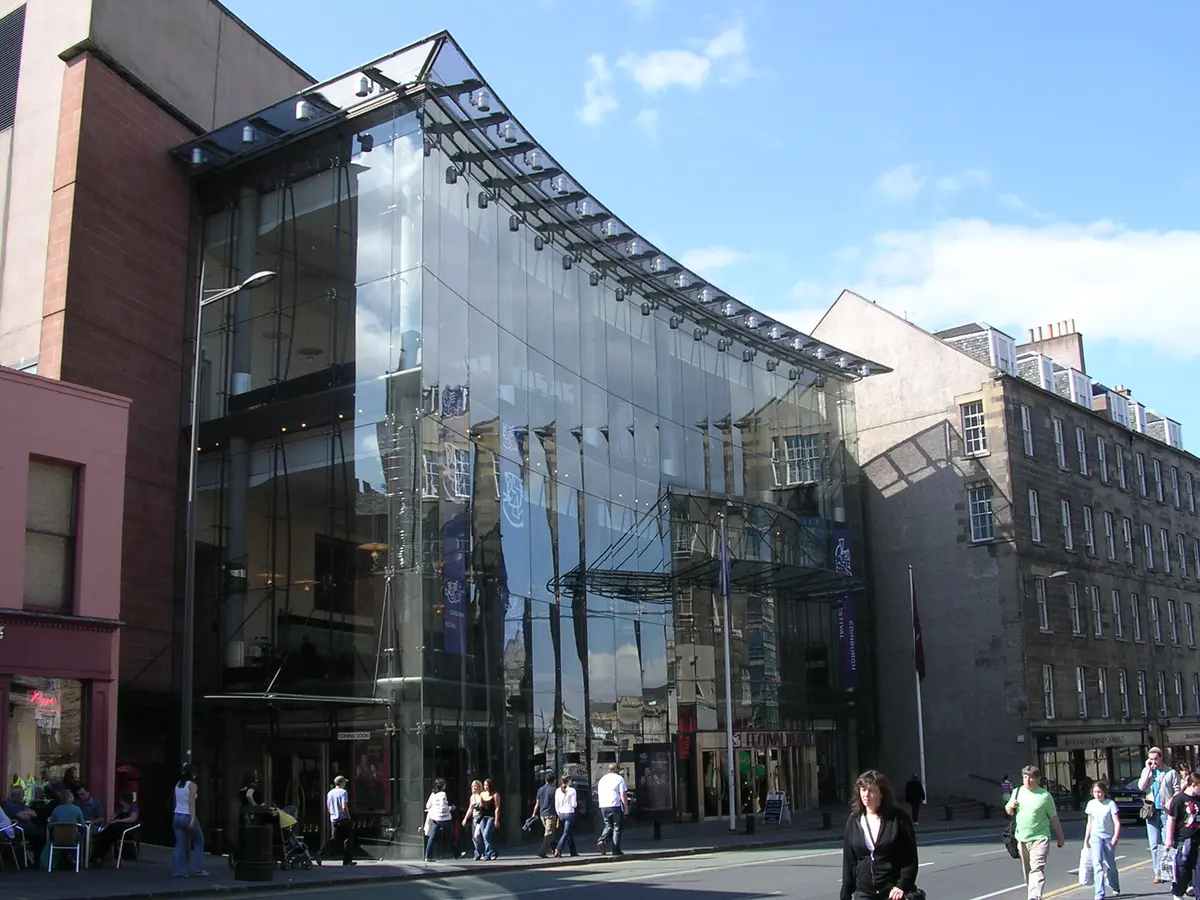
The safety curtain jammed a few feet from the floor. The Times reported that three thousand people left the auditorium in about three minutes while the orchestra played the national anthem; behind the curtain ten died, among them two teenage performers from Sheffield and a musician who went back for them. A body in Lafayette's costume was cremated in Glasgow before a second was found beneath the stage, wearing the same costume and his diamond rings: the first man had been one of the doubles his quick-change act depended on. His ashes were interred at Piershill Cemetery beside his dog Beauty, a gift from Houdini. The theatre reopened ninety days later, was demolished and rebuilt in 1928, and given a glass front in 1994 — so nothing of the stage where he died survives, which is worth knowing before you read what people say they feel in it.
What is the history of Edinburgh Festival Theatre?
The plot at 13–29 Nicolson Street has been given over to entertainment since about 1830 — Ducrow's circus ring, Paterson's Alhambra Music Hall of 1862, later the Queen's and the Hippodrome. H. E. Moss bought the ground around 1890, demolished what stood there and commissioned Frank Matcham, the most sought-after theatre architect in Britain. The Empire Palace of Varieties opened on Monday 7 November 1892, the first house of what became Moss Empires. The ERA, shown round the week before, described an entirely Indian decorative scheme, elephants' heads worked into the plaster, a sliding roof over the auditorium and sloping ramps outside by which horses, elephants and camels could be walked onto the stage. The same notice insisted, twice, that the fabric was fireproof and that hydrants stood on every level, before and behind the curtain.
Nineteen years later that claim was tested. Sigmund Neuberger — born in Munich in 1871, billed as The Great Lafayette, the Man of Mystery — opened a fortnight's engagement on Monday 1 May 1911 at a reported £350 a week, the highest fee then paid to an illusionist. His closing piece was 'The Lion's Bride', an Orientalist tableau of tapestries, cushions, hanging lanterns and a live African lion, with fire-eaters and jugglers filling the stage. On the evening of Tuesday 9 May, at about a quarter to eleven, the act was almost over when a light above the stage failed and the hangings caught.
The Times of 11 May described what followed. The audience took the flames for one of Lafayette's effects; the manager had the orchestra strike up 'God Save the King'; the ample exits emptied the house 'in about three minutes, and no member of the audience was much the worse'. Behind the iron curtain — which jammed three or four feet from the floor, so that the draught from the opened exits fed the blaze — the picture was the opposite one. The Illustrated London News photographed it on 20 May under the caption 'Behind the fireproof curtain, a holocaust; in front, an undamaged auditorium.'
The Scotsman of Friday 12 May printed the funeral arrangements, and they are the closest thing to a roll of the dead. Alice Dale, fifteen, of Hammond Street, Sheffield, and Joseph Coates, thirteen, of Owlerton — the two performers billed as 'midgets', who worked inside a mechanical teddy bear — went home to Sheffield by the 9.05 train. The musicians James Edward Baines of Hackney, Walter E. Scott and John Whelan; Alexander Rae Ross, a flyman at the Empire, of 357 High Street; James Watt, a scene shifter, of 115 Arthur Street. Of the trumpeter Charles Richards nothing at all was found: the paper reported that his body 'must have been so utterly consumed in the furnace-like glow as to leave no tangible trace behind'. Edinburgh's fire chief, Pordage, told the same paper that Baines had died going back for the two children.
Then came the part that made the story travel. A charred body in Lafayette's costume was recovered and sent to Glasgow for cremation. Days later a second body was found beneath the stage, wearing an identical costume and the diamond rings Lafayette never took off. The first man had been one of the doubles on which his quick-change act depended. The urn holding the real ashes was carried through Edinburgh on Sunday 14 May and laid in Piershill Cemetery — not beside a horse, but beside his dog Beauty, a mongrel given to him by Harry Houdini, whose grave he had bought days earlier on the cemetery's condition that he be buried in it himself. Moss Empires moved the Empire's business to the Theatre Royal on 29 May, put Matcham back to work, and reopened on Monday 7 August 1911, ninety days after the fire.
Timeline: the documented record of Edinburgh Festival Theatre
- 7 November 1892 Moss's Empire Palace of Varieties opens on Nicolson Street, designed by Frank Matcham and the first house of what becomes the Moss Empires chain. The ERA, given a tour the week before, reports that the fabric is fireproof and that hydrants stand on every level, before and behind the curtain.
- 1 May 1911 Sigmund Neuberger, billed as The Great Lafayette, opens a fortnight at the Empire at a reported £350 a week, the highest fee then paid to an illusionist.
- 6 May 1911 (disputed) Lafayette's dog Beauty, a gift from Harry Houdini, dies in Edinburgh. Piershill Cemetery agrees to sell a plot for the animal only on condition that Lafayette himself be buried in it. Sources date the death to 2, 4, 5 and 6 May; only the last comes with a weekday, and 6 May 1911 was a Saturday.
- 9 May 1911 During the finale of 'The Lion's Bride', around 22:45 on a Tuesday, a light above the stage fails and the hangings ignite. The safety curtain jams a few feet from the floor. The Times reports the 3,000-strong house emptied 'in about three minutes' while the orchestra played 'God Save the King'; behind the curtain, ten people die, along with an African lion and a horse.
- 12 May 1911 The Scotsman prints the funeral arrangements, naming Alice Dale (15) and Joseph Coates (13) of Sheffield, the musicians James Edward Baines, Walter E. Scott and John Whelan, the flyman Alexander Rae Ross and the scene shifter James Watt. The trumpeter Charles Richards is still missing and never will be found. Fire chief Pordage tells the paper that Baines died going back for the two children.
- 14 May 1911 After a body in Lafayette's costume proves to be one of his doubles and the real corpse is found beneath the stage, identified by his diamond rings, the urn of ashes is carried through Edinburgh on a Sunday afternoon and interred at Piershill Cemetery beside the dog Beauty.
- 15 May 1911 One day after the burial, a Leith picture house advertises 'a special and exclusive film of the funeral of the Great Lafayette'. The disaster is on screen within a week of happening.
- 7 August 1911 The Empire reopens after Matcham rebuilds the gutted stage and dressing rooms — ninety days after the fire. The company had played the interim season at the Theatre Royal from 29 May.
- 1 October 1928 After closing on 12 November 1927, the theatre reopens completely rebuilt to designs by W. and T. R. Milburn, with 'Show Boat'. This is the auditorium that survives today; Matcham's is gone.
- 1963 Moss Empires sells the Empire to Mecca for £160,000 and it becomes a bingo hall, which it remains for nearly thirty years.
- 1994 The building reopens as the Edinburgh Festival Theatre. Law & Dunbar-Nasmith replace the 1928 frontage with a curved glass wall and the stage house and backstage are demolished and rebuilt around a stage of 25 by 18 metres; the Milburn auditorium is restored.
- 9 May 2026 Capital Theatres stages a work-in-progress of 'Lafayette: A New Musical' at its Studio Theatre on the 115th anniversary, calling the date 'especially poignant'. The operator markets the illusionist; it does not market a ghost.
Is there a rational explanation for Edinburgh Festival Theatre?
Start with the building, because it settles most of the question. The stage on which Lafayette died no longer exists, and neither does the auditorium that watched him die. Matcham rebuilt the burnt stage and dressing-room block in the summer of 1911. Moss Empires then closed the whole house on 12 November 1927 and replaced it: the auditorium standing today is the work of W. and T. R. Milburn, opened on 1 October 1928 with 'Show Boat'. In 1994 the stage house and backstage were demolished again and rebuilt around a stage of 25 by 18 metres, and the 1928 frontage came down for the curved glass wall you photograph from Nicolson Street. Historic Environment Scotland's listing (category B, LB30023 — not category A, as several sites claim) credits the auditorium to the Milburns in 1927–9 and the exterior to Law & Dunbar-Nasmith in 1994, and notes only that the site 'has been occupied by a succession of theatres since 1830', one of them Matcham's. A staff member who feels watched from the wings today is standing in a space built two owners and two demolitions after the fire.
The ghost material itself is thin and, so far as we could trace it, undated. The fullest published account we found is a piece by John S Tantalon for Spooky Isles, dated March 2025: a friend of his who has worked at the theatre for over thirty years reports a shadowy figure high on the lighting rig, and a travelling medium visiting backstage claimed a presence there with a wooden leg. No year is given for either. Lafayette did not have a wooden leg. We could not date the earliest printed claim that the Festival Theatre is haunted, and we are not going to pretend otherwise; what can be dated is the fire, exhaustively, and the century of retelling that followed it.
Capital Theatres, which runs the building, is worth reading on this. It talks about Lafayette constantly — it announced 'Lafayette: A New Musical' in March 2026 and staged the work-in-progress at its Studio Theatre on 9 May 2026, the anniversary, calling that 'especially poignant'. In none of that material does the operator claim a ghost. When a venue with every commercial reason to sell a haunting sells a musical instead, that is information.
One more thing an honest page should say: the numbers in circulation do not agree, and the reason is traceable. Published counts of the dead run to nine, ten and eleven. Nine is the number of bodies recovered. Ten is the figure given by the Weekly Scotsman on 2 May 1942 — 'in all ten people, including Lafayette, perished in the flames' — and it matches the arithmetic of The Scotsman's own funeral list of 12 May 1911: seven named funerals, plus Lafayette, plus the double found with him, plus Charles Richards, whose remains were never recovered. Eleven appears where a writer has read 'ten died' as 'ten died besides Lafayette'. The date of the dog Beauty's death has drifted the same way, appearing as 2, 4, 5 and 6 May; only one version comes with a weekday attached — Saturday 6 May — and 6 May 1911 was indeed a Saturday. The animals have drifted too. The University of Birmingham's research page on the fire records that 'an African lion and Arabian horse died in the fire' and that Lafayette 'was rumoured to have perished attempting to save them' — rumoured, and the horse is not named in any contemporary source we could find. Our own earlier version of this page had him buried with a horse called Arizona. He was buried with a dog called Beauty.
Can you visit Edinburgh Festival Theatre?
The Festival Theatre is a working theatre at 13-29 Nicolson Street, Edinburgh EH8 9FT, managed by Capital Theatres, registered Scottish charity SC018605. Historic Environment Scotland lists it at category B (LB30023, national grid reference NT 26007 73258). The listing credits the auditorium to W. and T. R. Milburn, 1927-9, and the concave glass-and-steel front on Nicolson Street to Law & Dunbar-Nasmith, 1994, so the building seen from the street is later than the house in which Lafayette died in 1911.
The listings on the theatre's website, read on 23 September 2026, show SIX the Musical running until 26 September, Scottish Ballet's Emergence from 1 to 3 October and Scottish Opera's Turandot from 11 to 22 November. Capital Theatres also runs backstage tours that take in the history of the site, the Great Lafayette included. The most recent one on its site was on Saturday 4 July 2026, at £15 (£12 for under-16s) for about two hours, and on 23 September the page announced no later date. On 9 May 2026, the anniversary of his death, the same company staged a work-in-progress musical, Lafayette, at its Studio Theatre in Potterrow.
The box office line, 0131 529 6000, answers Monday to Saturday from 11:00 to 15:00; groups of eight or more have their own line, 0131 529 6005, Monday to Friday at the same hours. The stage door, which also handles lost property, is 0131 662 1112. The café opens Monday to Saturday from 10:00 to 16:00, and until curtain up on performance days; on Sundays it opens only from two hours before a performance.
According to the theatre's access page, every level is served by lifts, wheelchair users reach the Stalls directly from street level, and there are eight wheelchair spaces there with seats for companions. Audio-described performances come with a touch tour beforehand. Sign-language interpreted performances are usually the Saturday matinees of week-long runs, and captioned ones the Thursday evenings.
The theatre's travel page puts it about ten minutes' walk from the east end of Princes Street along North Bridge, of which Nicolson Street is the southward continuation, and ten to fifteen minutes from Waverley station. The same page advises against driving. A small 24-hour car park on Nicolson Square is five minutes' walk away, and the NCP car park on Holyrood Road, nine minutes away, is open 24 hours with over 300 bays, disabled bays among them, which cannot be booked in advance. Bike racks stand in front of the theatre and in the stage door courtyard.
Lafayette and his dog Beauty are buried in Piershill Cemetery, on Portobello Road in the east of the city. The local photographic archive EdinPhoto places the memorial stones "at the top of a small mound near the entrance", in photographs taken on 13 August 2010.
Sources consulted
- The Scotsman, «Empire Theatre Disaster. Missing Bandsman Still Undiscovered. Funeral Arrangements» — The Scotsman, 12 May 1911 (transcribed by Chris Hobbs), 1911 newspaper archive
- The Times, «Report on the fire at the Empire Palace Theatre, Edinburgh» — The Times, 11 May 1911 (transcribed on arthurlloyd.co.uk), 1911 newspaper archive
- George Baird, «Edinburgh Theatres, Cinemas and Circuses 1820-1963» — scottishcinemas.org.uk (quoting the Weekly Scotsman of 2 May 1942 and the Edinburgh Evening News of 24 May and 5 August 1911), 1964 book
- Historic Environment Scotland, «Nicolson Street, Edinburgh Festival Theatre (LB30023)» — Statutory list of buildings of special architectural or historic interest, 1974 report
- Forged by Fire: Burns Injury and Identity in Britain, c.1800-2000, «Empire Palace Theatre Fire, Edinburgh, 1911» — Online exhibition, University of Birmingham and Leeds Beckett University academic
- Edinburgh City Libraries, «The Great Lafayette and the Empire Theatre Fire» — Capital Collections archive
- Miriam Bibby, «The Magical Life and Curious Death of the Great Lafayette» — Historic UK, 2019 web
- Capital Theatres, «Announcing Lafayette: A New Musical» — capitaltheatres.com, 2026 web
- Sheffield City Libraries, «Tragedy of the Sheffield 'Teddy Bear Midgets' and the Great Lafayette» — Libraries Sheffield, 2014 archive
- John S Tantalon, «Edinburgh Haunted Theatres And The Ghosts That Linger» — Spooky Isles, 2025 web
Reviewed by V. Serrano on 2026-08-12 · How we verify our content
💬 Field testimonies (0)
No testimonies yet. Add the first.
Add your testimony
🔒 Log in to add a testimony