👻 HAUNTED PLACE · EXP. Nº9477
ACTIVE
Edinburgh Playhouse
Edinburgh's biggest theatre keeps a ghost it has never claimed. Staff at the Playhouse have told reporters for decades about Albert, a figure in grey who appears on Level Six with a rush of cold air: the stage door keeper Keith Donald described his dog refusing the South Tower stairs, the maintenance manager Billy Capener felt someone leaning over him in the Level Nine attic, and before the 1997 Commonwealth summit police sniffer dogs cleared every floor of the building except the sixth.
Where is Edinburgh Playhouse?
- Location
- Scotland, United Kingdom
- Type
- Theater
- Coordinates
- 55.957, -3.185
- Last updated
LOCATION
Why is Edinburgh Playhouse said to be haunted?
All of that is on the record, attributed to the people who said it. What is not on the record is Albert. No death of a Playhouse employee has ever been documented, and the two most detailed histories of the building — the statutory listing and a technical monograph that narrates the 1927 subsidence crisis down to the depth of the piles — mention no casualty at all. Even the theatre's owners say nothing about him. The story is real; the man behind it has never been found.
What is the history of Edinburgh Playhouse?
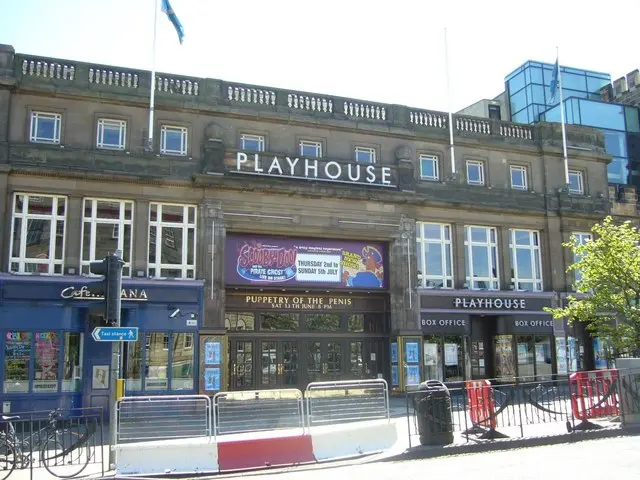
The Playhouse stands on a piece of ground that was staging drama long before anyone thought of building a cinema on it. Greenside is the hollow at the foot of Calton Hill, and in the sixteenth century it was Edinburgh's playfield — the open-air arena the burgh used for spectacle. In August 1554 Sir David Lyndsay's Ane Satyre of the Thrie Estaitis was performed there in the open air in the presence of Mary of Guise, Queen Regent, with the burgh council paying carpenters to build a stage of boards, a seat for the Regent and the French ambassador, and a set of working gallows for the last scene. It ran, by one account, from nine in the morning until seven at night.
Nearly four centuries later the site held a chapel known as the Tabernacle. That was demolished, and in 1927 construction began on a super-cinema for an Edinburgh syndicate, designed by John Fairweather (1867–1942), the Glasgow architect who had been sent to the United States in 1922–23 to study American picture palaces and who had already built Green's Playhouse in Glasgow, then the largest cinema in Europe.
Then the ground moved. Subsidence was found in the half-built structure and the opening was put back by nearly a year. The remedial work was extraordinary: sections of brickwork were taken out, the steel columns were cut into, the building was jacked up while piles were driven down to bedrock — some as deep as 60 feet — hundreds of tons of concrete were poured into new foundations, and steel tie rods were fitted inside the rear wall as adjustable counter-buttresses. The chief engineer, John Foubister, supervised the operation personally. It cost almost as much as the original construction and came close to bankrupting the parent company.
The Playhouse finally opened on Monday 12 August 1929 — the "Glorious Twelfth" — advertised as Scotland's Super Picture Theatre, with both talking and silent films on the bill. Historic Environment Scotland's listing records 3,048 original seats; the trade press of the day gave 3,040 and a later survey 3,053, a small disagreement that has never been tidied up.
The cinema closed in the early 1970s and was scheduled for demolition. A petition of 15,000 signatures saved it; the building was listed Category B in 1974, converted to a theatre between 1978 and 1980 by the Lothian Region Architects Department, sold out of council ownership in 1983, and upgraded to Category A in 2008. It has been operated by the Ambassador Theatre Group since 2009.
The shape of the building matters for everything that follows. The site falls steeply, so the circle is entered at street level, the balcony is upstairs and the stalls are a basement; the stage sits three floors below the pavement at the rear; and the full-height fly tower, built in 1929 because variety was still part of the cinema bill, rises above a warren of staff levels numbered as high as nine, with a north tower and a south tower. Almost none of it is ever seen by an audience.
Timeline: the documented record of Edinburgh Playhouse
- August 1554 Sir David Lyndsay's Ane Satyre of the Thrie Estaitis is performed in the open air on the Greenside playfield, at the foot of Calton Hill, before Mary of Guise, Queen Regent. The burgh council pays for a boarded stage, seating for the Regent and the French ambassador, and a working gallows for the closing scene. Sources agree the performance fell on a Sunday but disagree between 12 and 14 August; only 12 August 1554 was in fact a Sunday in the Julian calendar then in use.
- 1927–1929 Construction begins on Fairweather's super-cinema. Subsidence is discovered in the half-built structure and the opening is delayed by nearly a year: brickwork is removed, steel columns cut, the building jacked up, piles driven as deep as 60 feet to bedrock and hundreds of tons of concrete poured. Chief engineer John Foubister supervises in person. The works nearly bankrupt the parent company. No casualty is recorded in any account of them.
- 12 August 1929 The Playhouse opens on the 'Glorious Twelfth' as Scotland's Super Picture Theatre, with talking and silent films on the same bill. Historic Environment Scotland's listing records 3,048 original seats; the trade press of the month gave 3,040 and a later survey 3,053.
- 1974 After the cinema closes in the early 1970s and is scheduled for demolition, a public campaign gathering 15,000 signatures results in the building being listed Category B.
- 1978–1980 The cinema is converted into a theatre by the Lothian Region Architects Department and reopens in 1980. Edinburgh District Council sells it into private hands in 1983.
- October 1997 Before the Commonwealth Heads of Government Meeting held in Edinburgh, police sniffer dogs sweep the building overnight and clear every level but Level Six, which they refuse to enter; Army dogs are brought in to finish the job. The account is that of Penny Docherty, then a member of the venue's staff, as recorded by Liam Rudden.
- 1999 Journalist Liam Rudden spends a night touring the building with Pam Aldred, later the venue's marketing manager, and gathers first-hand accounts from stage door keeper Keith Donald and maintenance manager Billy Capener. This is the earliest telling of the Albert story that can be fixed to a date; the events it describes are set in the 1950s.
- 2008 Historic Scotland upgrades the listing from Category B to Category A as part of the Cinema Thematic Study of 2007–08, describing the Playhouse as a rare surviving early dual-purpose super theatre-cinema. The building has been operated by the Ambassador Theatre Group since 2009.
- 3 July 2020 With the theatre closed by the pandemic, the Edinburgh Evening News publishes Rudden's collected staff testimony under the headline 'Chilling encounters with Albert, the ghost of the Edinburgh Playhouse'. It remains the fullest attributed account of the legend in print.
Is there a rational explanation for Edinburgh Playhouse?
Start with what is actually attested, because it is not nothing. In 1999 the journalist Liam Rudden toured the building at night with Pam Aldred, later the venue's marketing manager, and collected first-hand accounts from named members of staff. He published them in the Edinburgh Evening News on 3 July 2020, while the theatre sat closed by the pandemic.
The stage door keeper Keith Donald described his dog Meg refusing to climb the South Tower stairs — going rigid on the lead, looking up the stairs, then moaning — and a separate night when a patch of darkness in the foyer doorway receded ahead of him into the auditorium, where he found one stage box lit and the other dimmed to a fraction of its usual output. The maintenance manager Billy Capener said he was called to a leak on Level Nine, an attic running above the auditorium that only maintenance visits, found both the mains and emergency lighting dead, and felt while kneeling that someone was leaning over him; nobody could later be identified as having reported the leak. Penny Docherty recalled that before the Commonwealth Heads of Government Meeting of October 1997 police sniffer dogs cleared every level of the building except Level Six, which they would not enter, and that Army dogs were brought in instead. These are honest recollections, attributed to the people who gave them. They are not evidence of a dead man.
Because there is no dead man on the record. The claim that a stagehand was killed in an accident, or that a night-watchman took his own life here, is repeated everywhere and sourced nowhere I can read. Wikipedia's ghost paragraph rests on a single citation — a Scotsman feature of 8 November 2004 — whose URL has returned a redirect in every Wayback capture since 2012 and which I could not retrieve. Meanwhile the two most detailed accounts of this building that exist are silent. I read Historic Environment Scotland's listed building record LB30029 end to end: 12,394 characters, zero occurrences of death, died, killed, ghost or Albert, against 9 for Playhouse, 5 for Fairweather and 2 for 1929. I read the Scottish Cinemas and Theatres Project monograph on the Playhouse: 17,844 characters, zero for death, killed, fatal, accident, ghost and Albert, against 7 for Fairweather, 16 for organ and 1 for subsidence. That last figure is the point. Both documents narrate the near-catastrophic subsidence of 1927–29 in detail — the jacking, the piling, the engineer by name — and neither reports a single casualty on a site where casualties would have been news.
Note also that the versions contradict each other. Rudden's is that Albert was the theatre's first stage door keeper, who died alone in the building one winter's night; Wikipedia's is a stagehand killed in an accident or a night-watchman who killed himself. Enigma Atlas previously published a third variant — that he fell from the fly tower or the lighting rig — and that specificity was ours. Nothing supports it, and it is withdrawn.
Date the telling rather than the event and the shape becomes clearer. The earliest account I have been able to fix in time is Rudden's night in 1999; the story he was told is set in the 1950s; the building went up in 1929. So the oldest datable telling of the tale postdates the events it describes by about forty-five years, and Rudden himself records two incompatible endings to it — in one, the constable learns Albert died years earlier; in another, he returns to Gayfield Square to find no record of the call ever being made. Two endings competing for the same story is the fingerprint of folklore, not of a report.
There is no mystery about why Level Six specifically. The legend lives entirely in the staff geography of a building that runs from a stage three storeys below the street to an attic on Level Nine, through two towers and a fly loft, with no lift. Those are the unheated circulation spaces where a large volume of air moves and where a lone worker walks with a torch, at night, in a place designed to be full of people and currently empty. Theatres also keep a bare bulb burning on the stage overnight and call it a ghost light: its purpose is to stop anyone walking into the orchestra pit, but its name puts the idea into the building's daily working vocabulary. And the core anecdote — the stranger who gives his name, then turns out to have died — is one of the most widely travelled legend types there is; it is not specific to Greenside Place.
Finally, ask what the owner says. Nothing. The Ambassador Theatre Group's own pages for the venue, including its access and food-and-drink pages, do not mention Albert at all; the circle-level bar is listed as the Circle Bar, not the "Albert's Bar" that Wikipedia describes. The sites that do carry the story are third-party listing and ticketing pages reproducing Wikipedia's sentences almost word for word. A haunted theatre whose operator declines to sell the ghost is a useful thing to notice.
One name deserves rescuing from all this. The man documented as having worked hardest and most dangerously on this site is not a stagehand called Albert. It is John Foubister, the chief engineer who stood in the hole under a half-built cinema while it was jacked off its own foundations.
Can you visit Edinburgh Playhouse?
The Playhouse stands at 18-22 Greenside Place, Edinburgh EH1 3AA, at the top of Leith Walk beside the Omni Centre. Historic Environment Scotland lists it at category A under reference LB30029, designated on 12 December 1974. That record calls the building “particularly important for its opulent interior décor which remains substantially intact”, names John Fairweather as the architect and dates the building to 1927-1929. It opened on 12 August 1929 with 3,048 seats, and Fairweather used the slope of the ground so that the circle is entered at street level. The Ambassador Theatre Group runs it, company number 09467208 on the United Kingdom register.
Nothing on the venue's own listings is a tour of the building. On 10 September 2026 its what's-on page carried 55 events, every one of them a performance; the way inside is a ticket to one of those. The listings that day ran from High Society, closing on 12 September 2026, through to Jersey Boys on 12-17 October. Level Six, where the Albert stories are set, is a staff floor of a working theatre. What a ticket buys is the auditorium, and the 1929 interior survives largely intact, down to the plasterwork shells and sea horses around the proscenium.
The building has no lift: the stalls are 40 steps down over four flights and the balcony 25 steps up over two. The circle is reached on the level from the entrance through the Circle Bar. There are eight step-free wheelchair positions of up to 110 cm and eight further seats suitable for transfers. One accessible toilet sits on the circle level, reached through the Circle Bar. Taxi drop-off is at the Omni Centre on Greenside Row, EH1 3AU. Those figures are the operator's access page as it stood on 10 September 2026. Pizza al Teatro and the Ambassador Lounge are the venue's own food and drink.
Sources consulted
- Historic Environment Scotland, «18-22 (Even Nos) Greenside Place, The Playhouse Theatre — listed building record LB30029» — Historic Environment Scotland Designations Portal, 2008 report
- Scottish Cinemas and Theatres Project, «Playhouse, 18–22 Greenside Place, Edinburgh — building history, citing Cinema Construction (Aug 1929), Kine Weekly (Aug 1929) and The Scotsman of 10 and 12 August 1929» — scottishcinemas.org.uk (archived copy), 2020 archive
- Liam Rudden, «Chilling encounters with Albert, the ghost of the Edinburgh Playhouse» — Edinburgh Evening News, 2020 newspaper archive
- Peter Happé, «Sir David Lyndsay, A Satire of the Three Estates: Space – Language – Concepts — on the 1554 open-air performance at the Greenside, Edinburgh» — Staging and Representing the Scottish Renaissance Court (Brunel University), 2013 academic
- Ambassador Theatre Group, «Edinburgh Playhouse — access information (step counts, wheelchair positions, absence of a lift)» — atgtickets.com, 2026 web
- Companies House, «The Ambassador Theatre Group Limited, company no. 09467208 — active company record» — UK Government company register, 2026 report
- Wikipedia contributors, «Edinburgh Playhouse — the ghost paragraph and its single citation, a Scotsman feature of 8 November 2004 whose URL no longer resolves» — English Wikipedia, 2026 web
Reviewed by V. Serrano on 2026-08-12 · How we verify our content
💬 Field testimonies (0)
No testimonies yet. Add the first.
Add your testimony
🔒 Log in to add a testimony