👻 HAUNTED PLACE · EXP. Nº9477
ACTIVE
Edinburgh Vaults
Built into the nineteen arches supporting South Bridge, completed in 1788, the Edinburgh Vaults once housed taverns, cobblers' workshops and storage for merchants before damp and disrepair turned them into a refuge for the city's poorest residents and, according to persistent rumor, a hiding place for bodysnatchers preserving corpses before sale to anatomy schools.
Where is Edinburgh Vaults?
- Location
- Edinburgh, Scotland, United Kingdom
- Type
- Road / bridge
- Coordinates
- 55.949, -3.187
- Last updated
LOCATION
Why is Edinburgh Vaults said to be haunted?
Sealed up for over a century and rediscovered in the 1980s, the vaults are now among Scotland's most investigated paranormal sites, with visitors and mediums repeatedly reporting an aggressive presence nicknamed "Mr Boots," said to shove and grab people in one particular chamber, alongside cold spots, disembodied growls and sudden feelings of dread.
What is the history of Edinburgh Vaults?
The Edinburgh Vaults have a documented past and a famous past, and the two barely overlap. The documented one is an engineering story; the famous one is about forty years old.
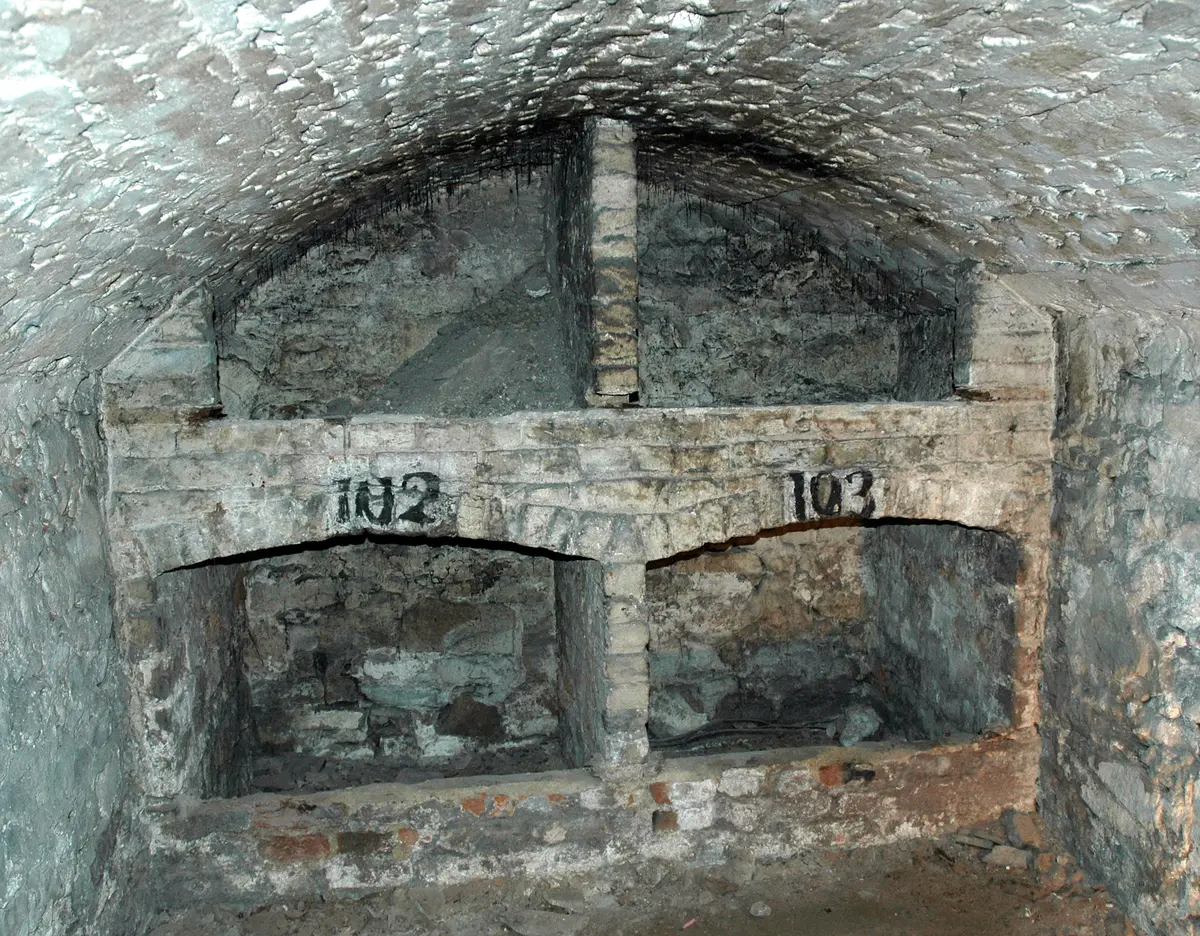
The engineering came first. Edinburgh needed a way over the Cowgate ravine to reach its expanding southern suburbs, and the foundation stone of South Bridge was laid on 1 August 1785. Robert Adam had submitted elaborate plans that June; the town rejected them as too ornate. The contract went instead to the mason Alexander Laing in February 1786, working to designs generally attributed to Robert Kay, and the bridge opened to traffic in July 1788. Historic Environment Scotland's listing record describes what resulted: a thousand-foot structure of nineteen round arches, of which only one is actually visible — the span over the Cowgate. The other eighteen were swallowed immediately by the tenements built flush against both parapets, and it is inside those buried arches that the chambers we call the Vaults were formed.
What were they for? The listing record is unglamorous and specific: the vaults "were originally used for storage by the shops and businesses above". Mercat Tours, which runs the Blair Street system today, points to street directories showing leatherworkers, jewellers and haberdashers using them as workshop and warehouse space. The stone was porous, the bridge was never properly waterproofed, and within roughly thirty years of opening the legitimate trades had largely gone.
What happened next is the part everybody quotes and almost nobody can source. The standard account — the vaults filling with the destitute, with illicit stills and drinking dens — rests almost entirely on physical remains rather than on paper. Mercat's own social history of the site lists what excavation turned up in the chambers: middens with animal bone bearing butchery marks, storage bins, a makeshift stone bed, a fireplace with a brick hole punched through the ceiling for smoke, and piles of oyster shells in one room that was "almost certainly used as a tavern". Convincing evidence that people ate, worked and slept underground. But the operator is unusually frank about the limits of it, conceding that where those people came from and went to "remains one of the Edinburgh underground vaults' great archival mysteries". Nobody can even date the closure: estimates for when the entrances were bricked up range across four decades of the nineteenth century, and the abandonment is normally placed loosely at "less than a hundred years" after construction.
Then the vaults simply stopped existing, as far as the city was concerned, for over a century. They were not haunted during that time, because nobody was in them.
Timeline: the documented record of Edinburgh Vaults
- 1 August 1785 The foundation stone of South Bridge is laid. Robert Adam had submitted elaborate designs that June; the town rejected them as too ornate.
- February 1786 The mason Alexander Laing receives the contract, building to designs generally attributed to Robert Kay.
- July 1788 The bridge opens to traffic: a thousand feet of masonry over nineteen arches, only one of them visible. The chambers inside the buried arches are recorded as storage for the shops and businesses above.
- c. 1835–1875 The vaults are abandoned and their entrances bricked up, less than a century after construction. No record fixes the date; estimates spread across four decades.
- 1985 Norrie Rowan, a former Scotland rugby prop turned Old Town property developer, breaks through into the sealed chambers by chance. He and his family clear tonnes of rubble by hand over the following two decades.
- December 1989 Romanian international Cristian Răducanu defects in Edinburgh and goes to work for Rowan. A plaque is later fixed in the tunnel marking his escape from the Securitate through it; interviewed years afterwards, Răducanu said the tunnel story was untrue and called it "a clever piece of marketing".
- 1995 Auld Reekie Tours is formed and begins running underground and graveyard tours, later acquiring its own vaults at 45 Niddry Street.
- 1996 The vaults open for regular public tours. Guides and visitors begin reporting a sense of presence, footsteps and apparitions, and the operator starts logging them — the database that gives the site its international reputation.
- April 2001 Richard Wiseman's team runs 218 volunteers alone through ten vaults during the Edinburgh International Science Festival. Reports cluster in the reputedly haunted chambers, but track exterior lighting, floorspace and ceiling height rather than anything anomalous.
Is there a rational explanation for Edinburgh Vaults?
The haunting of the Edinburgh Vaults is not an old tradition. It cannot be, because the vaults were sealed and forgotten until a chance breakthrough in 1985, when the former Scotland rugby prop Norrie Rowan, working on property in the Old Town, broke into the buried chambers and began clearing them of rubble by hand — an excavation his family continued for more than twenty years. Every ghost story attached to the site postdates that moment. Regular public tours did not begin until 1996; Richard Wiseman's 2003 paper dates the reopening to that year, and in 2001 the tour operator's log of visitor reports was described as five years deep. The reputation and the ticket office are exactly the same age.
There is a small parable of how such stories form here. Rowan employed the Romanian international Cristian Răducanu, who defected in Edinburgh in December 1989, and put up a plaque in the tunnel commemorating his escape from the Securitate through it. Interviewed years later by The Rugby Journal, Răducanu's response to the story was blunt: "Ha! Yeah, that's not true." He had simply walked out of his hotel, seen a police car on Princes Street and asked the officer for political asylum, in his official Romanian blazer and tie. He called the tunnel version "a clever piece of marketing". The plaque, however, is underground and the correction is not.
The site has also had the rare privilege of a controlled experiment. In April 2001, during the Edinburgh International Science Festival, Richard Wiseman and colleagues ran 218 volunteers through ten of the South Bridge Vaults, each alone for about ten minutes. A senior guide had ranked the ten chambers by how many unusual experiences the company's database recorded for each, and the researchers were blind to that ranking. Ninety-five participants (43.6%) reported something. But when asked whether their experience was due to a ghost, exactly one person out of 172 reported experiences answered "definitely yes".
The results held up in an interesting way. Reports did cluster in the reputedly haunted chambers, and did so even more strongly among volunteers with no prior knowledge of the vaults' reputation — so this was not simply people performing the legend they had been told. What predicted the reports was the architecture. The number of experiences correlated significantly with how brightly lit the corridor outside a vault was, with the vault's floorspace and with its height. Magnetic fields, the favourite culprit of paranormal researchers, explained nothing here: readings ran from 47,018 to 51,588 nT, entirely within natural variation and, as the authors noted, unsurprising in chambers with no mains wiring beyond a single minimal lighting circuit. Wiseman's team suggested the plainest mechanism available — stepping from a lit corridor into a much darker chamber produces the mild sensory-deprivation effects long documented in laboratories, and an unusually large or high vault leaves a person alone in the dark feeling exposed. Their conclusion was that alleged hauntings "could be, at least in part, the result of people responding to 'normal' factors in their surroundings".
Worth noting too how the story travelled. ABC News reported the experiment that same month with 250 volunteers, five haunted vaults and a headline split of 51% against 35% — figures that do not match the paper eventually published in the British Journal of Psychology two years later. Even the sceptical coverage drifted.
Some claims made underground today have no documentary support at all: that the vaults housed the stables of a French cavalry guard, or that body snatchers stored corpses there. The latter is dismissed even in an article written for Historic UK by a member of Mercat's own events team.
Can you visit Edinburgh Vaults?
The vaults are the chambers built into the arches of South Bridge, the nineteen-span road bridge of 1786-88 that Historic Environment Scotland lists at Category B (LB27950, added on 14 December 1970); from outside, only the single arch over the Cowgate is visible. The chambers lie under the buildings that line the bridge, and public access is by guided tour with one of the two companies that hold separate parts of the system. Each describes its share as the largest: Mercat Tours calls the Blair Street vaults the city's "oldest, deepest vault system", and Auld Reekie Tours speaks of "Edinburgh's most extensive set of vaults".
Mercat Tours' Historic Vaults tour starts at the Mercat Cross on the High Street (postcode EH1 1RF), runs daily in the morning and afternoon and lasts 1 hour 15 minutes by the company's tour page. It ends at the Vaults Museum at 28 Blair Street, off Hunter Square, which has interactive 3D models and a film, The Vaults Revealed. VisitScotland's listing, read on 24 September 2026, gives £27 for adults, £24 concessions and £21 for children, prices "subject to change depending on season". The company's FAQ caps groups at 18 and does not admit children under five. The way down is three flights of stairs with 28 steps and a handrail; there is no lift, and the accessibility page states that the Blair Street vaults are not wheelchair accessible and points visitors with mobility needs to the museum's audio-visual display. Registered guide, hearing and medical-detection dogs are admitted with proof of registration, while the FAQ calls the area "not suitable for emotional support animals". There is one public toilet at Blair Street, reached by a step, and flash photography is not allowed in the vaults. Bookings are taken on +44 (0)131 225 5445.
Auld Reekie Tours, which dates its start to 1995, runs a 60-minute Vaults Tour from 300 Lawnmarket (EH1 2PH) to its premises at 45 Niddry Street (EH1 1LG). Its page lists fourteen departures a day, every half hour from 10:00 to 16:30, at £24 a person or £80 for four, and says the tour is not suitable for under-fives. The route passes a stone circle in a chamber that the company presents as a witchcraft temple "recently used" by a modern coven.
The conditions underground are on record in the 2003 paper by Richard Wiseman's team, whose experiment ran in ten of the vaults in April 2001. The guide had to be present "due to uneven flooring and low ceilings in parts of the vaults", and the chambers had no mains wiring beyond "a single, minimal lighting circuit". A further part of the same substructure, The Caves at 8-10 Niddry Street South (EH1 1NS), is run as a hire venue for weddings and private events, with wedding bookings for a minimum of 70 adults.
Sources consulted
- Richard Wiseman, Caroline Watt, Paul Stevens, Emma Greening and Ciarán O'Keeffe, «An investigation into alleged 'hauntings'» — British Journal of Psychology, 94, 195–211, 2003 academic
- Historic Environment Scotland, «South Bridge, Including Railings (LB27950) — Category B listed building record» — Designations portal, 1970 archive
- Samira Beavis, «Exploration of Ghost-like Phenomena» — ABC News, 2001 newspaper archive
- Ryan Herman, «Romania — interview with Cristian Răducanu» — The Rugby Journal, 2020 interview
- Mercat Tours, «Did people live in the Edinburgh underground vaults?» — Operator research blog, 2024 web
- Mercat Tours, «A social history of Edinburgh's underground vaults» — Operator research blog, 2023 web
- Claire Palmer (Mercat Events), «Edinburgh's South Bridge and Vaults» — Historic UK, 2023 web
- Unusual Venues of Edinburgh, «The Caves — venue history» — Official venue site, 2026 web
- Mercat Tours, «Historic Vaults tour and visitor FAQs» — Official visitor information, 2026 web
- Auld Reekie Tours, «The Vaults Tour» — Official visitor information, 2026 web
- Mercat Tours, «FAQs — group size capped at 18; 3 flights of stairs with a total of 28 steps and a handrail; no lifts; registered guide, hearing and medical-detection dogs only; one public toilet at Blair Street with one step; no flash in the vaults» — Official visitor information, 2026 web
- Mercat Tours, «Accessibility — 'The Blair Street Underground Vaults are not wheelchair accessible'; audio-visual display in the Vaults Museum for guests with mobility or sensory needs» — Official visitor information, 2026 web
- VisitScotland, «Mercat Tours — Historic Vaults: £27 per adult, £24 concession, £21 per child, 'subject to change depending on season' (consulted 24 September 2026)» — visitscotland.com, 2026 web
Reviewed by V. Serrano on 2026-07-29 · How we verify our content
💬 Field testimonies (0)
No testimonies yet. Add the first.
Add your testimony
🔒 Log in to add a testimony