👻 HAUNTED PLACE · EXP. Nº9476
ACTIVE
Eltham Palace
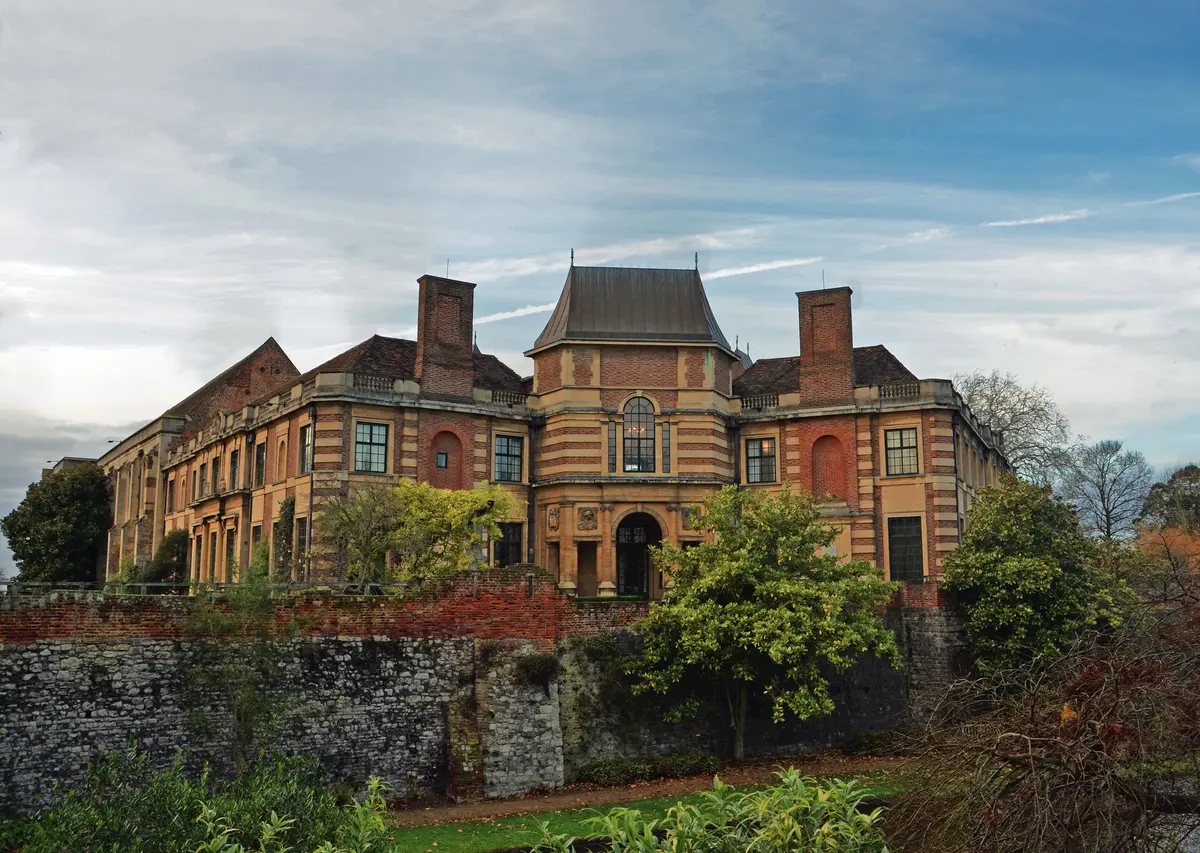
Eltham Palace is two buildings sharing a wall: the great hall Edward IV raised in the 1470s, where Erasmus met the boy who became Henry VIII, and the art deco house Stephen and Virginia Courtauld wrapped around it in the 1930s, complete with heated quarters for their pet lemur.
Where is Eltham Palace?
- Location
- London, United Kingdom
- Type
- House / mansion
- Coordinates
- 51.447, 0.048
- Last updated
LOCATION
Why is Eltham Palace said to be haunted?
Between those two lives the palace was a farm barn and then an indoor tennis court. Its ghost story is far smaller than its reputation. English Heritage's first survey of unexplained incidents across its sites, reported by the Daily Telegraph in June 2009, gave Eltham two sentences: a former member of staff who had died a week after retiring was said to have shown visitors round when the site was otherwise empty. No name, no date, no witness. The Tudor material that circulates online — children laughing in the empty hall, footsteps on the minstrels' gallery — we could not trace to any source, and the gallery in question was built by Seely & Paget in the 1930s. What Eltham really offers is a documented collision of centuries and one very persistent anecdote.
What is the history of Eltham Palace?
Eltham is two buildings pretending to be one, and the seam between them is the whole story.
The manor appears in the Domesday survey of 1086, held by Odo, Bishop of Bayeux, half-brother of William the Conqueror. It became a palace in 1295, when Anthony Bek, Bishop of Durham, acquired the estate, rebuilt the manor house and ran a perimeter wall of stone and brick inside the line of the moat. Bek presented the manor to the future Edward II in 1305 and then simply stayed on, living there until he died at Eltham in 1311.
For the next three centuries this was one of the largest and most frequented royal residences in England: close enough to Westminster to be useful, far enough out to feel like open country. Edward II's second son was born here in 1316 and known ever after as John of Eltham. Edward III received John II of France at the palace in 1364 amid what English Heritage describes as 'great dancing and caroling'; the king's party included Jean Froissart, who wrote Eltham into his Chronicles as a very magnificent manor. Richard II built a walled garden beyond the moat so that the king and queen could dine outdoors in summer. Henry IV spent ten of his thirteen Christmases as king at Eltham and entertained the Byzantine emperor there at Christmas 1400.
The great hall visitors walk into today was built for Edward IV in the 1470s; Historic England's scheduling dates the surviving fabric to about 1480. It is six bays of ashlar and ragstone under a hammerbeam roof, and English Heritage calls it one of the largest and best preserved medieval great halls in England. At Christmas 1482 it held a feast for some 2,000 people — Edward's last visit before his death the following April.
Eltham was also a royal nursery, and that is why a Dutch scholar walked in one summer afternoon in 1499 and left the best surviving description of the boy who became Henry VIII. Henry passed much of his childhood here, and he was the last monarch to spend serious money or time on the place: a tiltyard laid out in July 1517, new lodgings and a brick chapel in the 1520s, Cardinal Wolsey's oath as lord chancellor taken here on Christmas Eve 1515 and his Ordinances of Eltham drawn up in 1525. Then the court moved west to Hampton Court and Greenwich, and Eltham was left behind.
What followed was a long humiliation. James I found the palace 'farre in decay'. Parliament sold it in 1651 to Colonel Nathaniel Rich, who demolished buildings and stripped the lead from the great hall roof; John Evelyn, visiting in 1656, found 'both the palace and chapel [are] in miserable ruins, the noble wood and park destroyed by Rich the Rebel'. For two centuries the site was a farm and the hall was a barn, shored up after repairs in 1828 by props that stayed in place until 1903. When a gentleman's house called Eltham Court went up beside it in 1859, its tenants used Edward IV's hall as an indoor tennis court.
In 1933 the millionaires Stephen and Virginia Courtauld took a 99-year Crown lease and commissioned the then unproven architects Seely & Paget to build a modern house on the site of the Victorian buildings, wrapped around the medieval hall. The scheme was controversial because of its impact on the palace remains, and only went ahead with Sir Charles Peers — formerly Chief Inspector of Ancient Monuments — brought in as consultant on the hall repairs. The result is a 'Wrenaissance' exterior nodding at Hampton Court over interiors by Peter Malacrida, Rolf Engströmer, Carlton Attwood and Gilbert Ledward: underfloor and radiant ceiling heating, synchronous clocks regulated by the mains, a loudspeaker system that piped records through the ground floor, a Siemens internal telephone exchange, a centralised vacuum plant in the basement — and heated first-floor quarters for Mah-Jongg, Virginia Courtauld's ring-tailed lemur. Queen Mary visited twice; so did Stravinsky, Gracie Fields and Malcolm Sargent.
Four incendiary bombs severely damaged the east end of the great hall roof in September 1940. The Courtaulds sat out most of the war in a basement fitted as a comfortable shelter, then moved out in May 1944, reputedly tired of the bombing, and passed the remainder of the lease to the Army Educational Corps. The Royal Army Educational Corps ran its overseas schools, examinations and language training from Eltham until 1992, lowering the corps flag at a ceremony on 5 April that year. English Heritage had taken on the great hall in 1984 and took over the whole site in 1995.
Timeline: the documented record of Eltham Palace
- 1086 The Domesday survey records the manor of Eltham as held by Odo, Bishop of Bayeux, half-brother of William the Conqueror. Nothing is known of any earlier settlement on the site.
- 1295–1311 Anthony Bek, Bishop of Durham, acquires the estate, rebuilds the manor house and constructs a stone and brick perimeter wall inside the moat. He gives the manor to the future Edward II in 1305 but goes on living there until his death at Eltham in 1311.
- 1364 Edward III receives John II of France at Eltham on the French king's return to voluntary captivity in England, amid what English Heritage describes as 'great dancing and caroling'. Jean Froissart, in the party, records the visit in his Chronicles and calls Eltham a very magnificent manor.
- Christmas 1400 Henry IV entertains the Byzantine emperor at Eltham. He spends ten of his thirteen Christmases as king at the palace, which by then is one of the largest and most frequented royal residences in the country.
- 1470s (fabric dated c.1480) The great hall is built for Edward IV: six bays of ashlar and ragstone under a hammerbeam roof. A feast for some 2,000 people is held there at Christmas 1482, on Edward's last visit before his death the following April.
- Summer 1499 Erasmus, staying at Lord Mountjoy's country house, is walked over to Eltham by Thomas More. Writing 24 years later he recalled: 'When we came into the hall, the attendants not only of the palace but also of Mountjoy's household were all assembled. In the midst stood prince Henry, then nine years old, and having already something of royalty in his demeanour, in which there was a certain dignity combined with singular courtesy.' The boy sent him a note at dinner demanding something from his pen; Erasmus went home and finished the poem in three days.
- 1656 Five years after Parliament sold the palace to Colonel Nathaniel Rich, who demolished buildings and stripped the lead from the great hall roof, the diarist John Evelyn visits and finds 'both the palace and chapel [are] in miserable ruins, the noble wood and park destroyed by Rich the Rebel'.
- 1859 A gentleman's residence called Eltham Court is built beside the great hall. Its tenants use Edward IV's hall as an indoor tennis court and as an occasional party venue; before that it had served for two centuries as a farm barn.
- 1933–1935 Stephen and Virginia Courtauld take a 99-year Crown lease and commission Seely & Paget to build a modern house around the medieval hall. The scheme is controversial because of its impact on the palace remains and proceeds with Sir Charles Peers as consultant. The 1930s work includes the first-floor balustrade to the gallery above the screens passage and the west timber screen, dated 1935.
- September 1940 Four incendiary bombs severely damage the east end of the great hall roof and further bombs damage the glasshouses. The Courtaulds shelter in a fitted basement, move out in May 1944 and hand the lease to the Army Educational Corps.
- 27 June 2009 The Daily Telegraph reports English Heritage's first 'spectral stocktake' of incidents logged by staff and visitors. Eltham's entire entry reads: 'Eltham Palace, in Greenwich, south east London, is said to be haunted by a former member of staff who died a week after retiring. A man matching his description and with the same accent is said to have given a guided tour to visitors when the site was otherwise empty.' No name, date or witness is given.
- October 2017 English Heritage publishes a staff-voted top ten of its spookiest sites on 17 October — Eltham is not on it — and the same year issues Eight Ghosts, an anthology of commissioned ghost fiction in which Max Porter's 'Mrs Charbury at Eltham' is set at the palace, half in the present and half in 1937.
Is there a rational explanation for Eltham Palace?
There is exactly one ghost account at Eltham that can be traced back to a source, and it is thinner than the internet makes it sound.
On 27 June 2009 the Daily Telegraph published Jasper Copping's report on what it called English Heritage's 'spectral stocktake' — described as the first time staff across the organisation's sites had been asked to log incidents reported by workers and visitors. Most of the article is taken up with Dover Castle, Bolsover, Battle Abbey and Portchester. Eltham gets two sentences: 'Eltham Palace, in Greenwich, south east London, is said to be haunted by a former member of staff who died a week after retiring. A man matching his description and with the same accent is said to have given a guided tour to visitors when the site was otherwise empty.'
Note what is absent. No name for the dead employee, no date for the tour, no named witness, no year. 'Is said to' carries the entire claim, and the story is a stock modern legend in the visitor-attraction world: the phantom guide who shows a party round a building that is closed. Even the wording drifts — a British heritage-travel article from July 2009 relaying the same survey has the guide dying a week before the tour rather than a week after retiring. When English Heritage polled its staff again and published a top ten of its spookiest sites on 17 October 2017, Eltham was not on the list.
The Tudor material that has attached itself to Eltham online — children laughing in the empty hall, footsteps crossing the minstrels' gallery, a boy in Tudor dress near the dais — we could not trace to any source at all. It also sits badly with the fabric. The hall is far less medieval than it looks: the roof was dismantled, reassembled with steel braces and re-tiled between 1911 and 1914 under the Office of Works; Historic England records that the first-floor balustrade to the gallery above the screens passage is 20th-century and the west timber screen is dated 1935; the stone-flagged floor is from the 1950s. Footsteps on the 'minstrels' gallery' at Eltham would be footsteps on Seely & Paget's balustrade.
The rest is atmosphere and acoustics — a tall, six-bay stone hall with a timber roof, entered from a low screens passage, does interesting things to sound — and the incentive is not hidden. English Heritage sells the mood directly: ghost tours of the house at £14 a head with three departures a night in October 2022, a Halloween half-term programme every year, and in 2017 a commissioned anthology of new ghost fiction, Eight Ghosts, for which Max Porter wrote 'Mrs Charbury at Eltham', a story set half in the present and half in 1937. Eltham's ghost literature is mostly modern and mostly authored.
Can you visit Eltham Palace?
Eltham Palace and Gardens is run by English Heritage at Court Yard, Eltham, Greenwich, London SE9 5NP, and the site telephone is 020 8294 2548. On 24 September 2026 its visitor page gave daily opening from 10am to 5pm, with last entry at 4.30pm, and earlier closing on 5, 19 and 26 September, when the house shut at noon and the grounds at 2pm. Tickets are valid all day and members enter free; booking online by midnight the day before costs less than paying on the day. English Heritage's 2025/26 rate card, valid until 27 March 2026, set adult admission at between £15.00 and £18.60 depending on the date.
The same page reported that the lift was out of service, so that the upper floors of the 1930s house could only be reached by the stairs, and that a virtual tour of them was available on the multimedia guides.
According to English Heritage, Mottingham railway station is a 15-minute walk away and TfL bus routes 124, 126, 160 and 161 run nearby. Its Good Journey partnership takes 20% off entry for visitors who show a travel ticket at the site, which also has cycle racks.
The autumn calendar lists a Halloween half-term programme from 24 October to 1 November 2026, from 10am to 4pm. English Heritage's own ghost writing about Eltham is fiction: Max Porter's story "Mrs Charbury at Eltham", set partly in 1937, appears in Eight Ghosts: The English Heritage Book of New Ghost Stories, published in 2017.
Sources consulted
- Jasper Copping, «English Heritage reveals most haunted sites» — The Daily Telegraph, 2009 newspaper archive
- Historic England, «Eltham Palace, scheduled monument, list entry 1014833» — National Heritage List for England, 1998 report
- English Heritage, «History of Eltham Palace and Gardens» — English Heritage site history, 2026 archive
- Francis Morgan Nichols (trans.), «The Epistles of Erasmus, from his earliest letters to his fifty-first year, vol. I, pp. 200–202 (translating Erasmus's Catalogue of Lucubrations, 1523)» — Longmans, Green & Co., London, 1901 book
- English Heritage, «Research on Eltham Palace» — English Heritage research pages, 2026 archive
- Sarah Perry, Mark Haddon, Max Porter and others, «Eight Ghosts: The English Heritage Book of New Ghost Stories (includes Max Porter, 'Mrs Charbury at Eltham')» — September Publishing, 2017 book
- English Heritage, «Bolsover Castle rated English Heritage's spookiest site by staff» — English Heritage press release, 17 October 2017, 2017 archive
- English Heritage, «Group admission prices & site opening times 2025/26» — English Heritage travel trade rate card (PDF), 2025 report
- English Heritage, «Eltham Palace and Gardens — visitor information» — Official visitor page, 2026 archive
- David Ross, «English Heritage Haunted Sites» — Britain Express, 5 July 2009, 2009 newspaper archive
Reviewed by V. Serrano on 2026-08-11 · How we verify our content
💬 Field testimonies (0)
No testimonies yet. Add the first.
Add your testimony
🔒 Log in to add a testimony