👻 HAUNTED PLACE · EXP. Nº0482
ACTIVE
Enfield Poltergeist House
Enfield Poltergeist House is a location reputed to be haunted in London, GB. Its reputation comes from reported apparitions, unexplained phenomena and eyewitness accounts gathered over time.
Where is Enfield Poltergeist House?
- Location
- London, GB
- Type
- House / mansion
- Coordinates
- 51.655, -0.035
- Testimonies
- 0
- Last updated
LOCATION
Why is Enfield Poltergeist House said to be haunted?
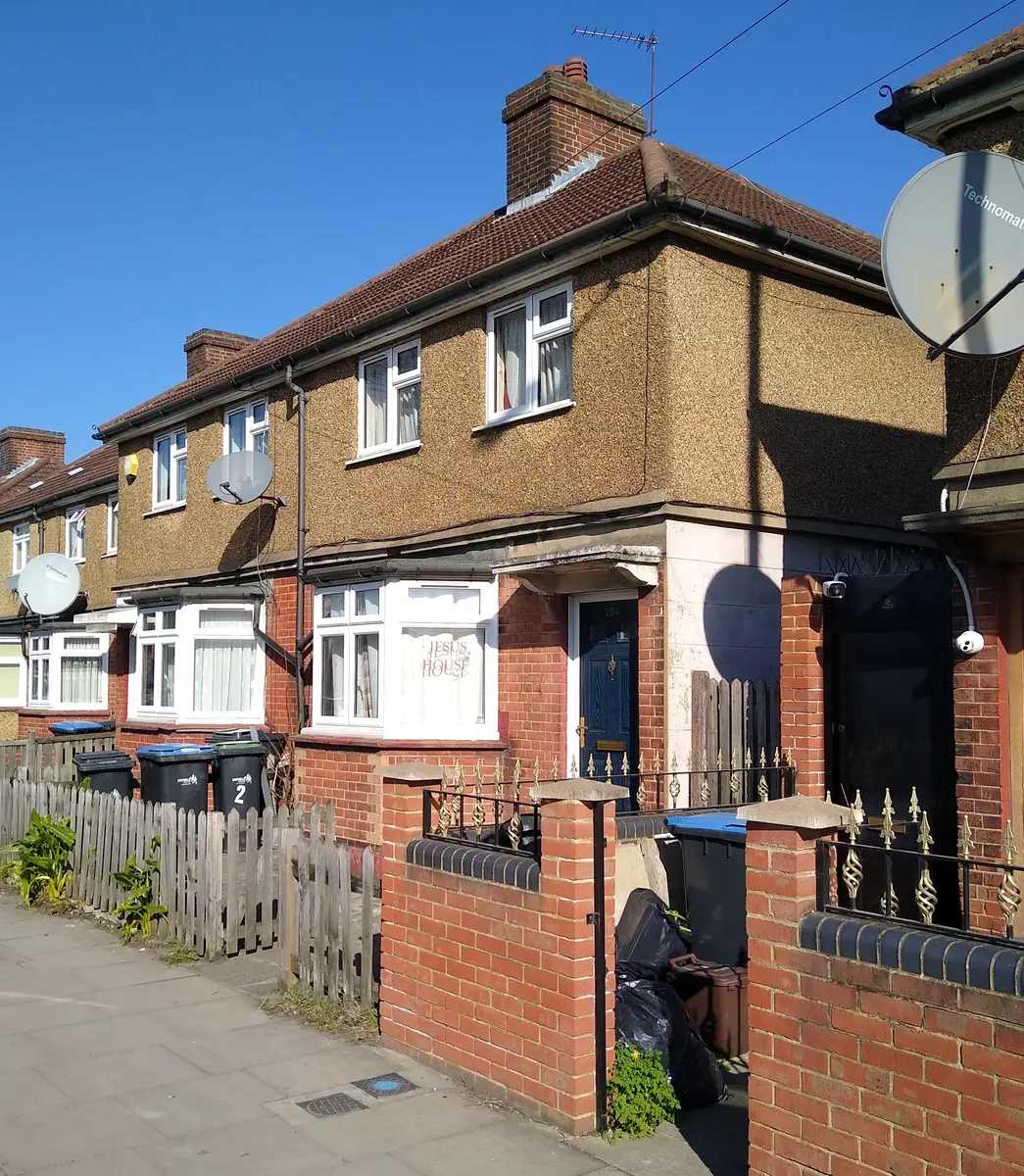
Between 1977 and 1979, a council house in Brimsdown, in the London Borough of Enfield, became the setting for one of Britain's most discussed poltergeist cases. The alleged activity centred on two sisters, aged eleven and thirteen, and the reports coming out of the house attracted sustained press coverage across England. Several paranormal investigators took an interest in the case and reached openly divergent conclusions. Maurice Grosse, an inventor, and the writer Guy Lyon Playfair, both linked to the Society for Psychical Research, spent long periods in the property and came away convinced that the phenomena were genuine. Other researchers, among them the psychologists Anita Gregory and John Beloff, remained unpersuaded and reported finding evidence that the girls had faked at least part of the events. The dispute was never settled, and the modest suburban house remains a fixed point of reference in the literature on poltergeist claims.
What is the history of Enfield Poltergeist House?
The Enfield case is the most heavily documented poltergeist investigation in British history, and it is unusual because it split the organisation that investigated it.
It began in 1977 at a council house in Green Street, Enfield, north London, occupied by a single mother and her four children. The reported phenomena escalated through the familiar poltergeist repertoire: knocking, furniture moving, objects thrown, and — the element that made this case famous — a gruff male voice apparently issuing from Janet Hodgson, then eleven years old.
The Society for Psychical Research sent Maurice Grosse, who had volunteered as an investigator. He was joined by the writer Guy Lyon Playfair, and between them they spent an extraordinary amount of time in the house over the following months, recording tapes, taking photographs and keeping detailed notes. Playfair published the case in 1980 as This House is Haunted: An Investigation of the Enfield Poltergeist, which remains the primary account.
What gave Enfield its cultural reach was that combination: a working-class family with no obvious interest in publicity, two named investigators from a serious organisation, and an archive of recordings. It became the model for a genre — the basis of documentaries, dramatisations and, eventually, of a Hollywood horror franchise that bears very little resemblance to what Grosse and Playfair actually recorded.
What is far less well known is that the SPR itself never agreed about it.
Timeline: the documented record of Enfield Poltergeist House
- August 1977 Reported phenomena begin at a council house on Green Street, Enfield, occupied by a single mother and her four children: knocking, furniture moving and objects thrown.
- Autumn 1977 The Society for Psychical Research sends Maurice Grosse, joined by the writer Guy Lyon Playfair. The two spend months in the house recording tapes, photographing and taking notes.
- December 1977 Anita Gregory, a prominent SPR member, visits the house with John Beloff. Her reading will be the opposite of Grosse and Playfair's: the girls enjoy play-acting and the voice is nothing paranormal.
- 1980 Playfair publishes This House is Haunted, the standard account of the case. The SPR is left divided: Grosse and Playfair consider it genuine; Gregory and Beloff do not.
- 1980, television interview Janet Hodgson acknowledges on television that they faked phenomena "once or twice, just to see if Mr Grosse and Mr Playfair would catch us", adding that they always did.
- 1980-1981, Journal of the SPR Anita Gregory publishes her sceptical review of Playfair's book in the Journal of the Society for Psychical Research and defends it afterwards in the journal's correspondence. The split is put in writing inside the SPR itself.
- 2011 In an interview with the British press, Janet puts the proportion faked at about 2% of the total — a figure there is no independent way to audit, and one that does not sit easily with her "once or twice" of 1980.
Is there a rational explanation for Enfield Poltergeist House?
Enfield is unusual because the sharpest criticism came not from outside the paranormal world but from inside it: from the same Society for Psychical Research that had sent the investigators.
Anita Gregory, a prominent SPR member, visited the house in December 1977 with John Beloff and reached conclusions opposite to Grosse and Playfair's. She published her criticism where it counted most: a sceptical review of Playfair's book in the Society's own Journal of the Society for Psychical Research (1980), followed by correspondence in the journal (1981). Her case was that the girls enjoyed play-acting and that the voice was nothing paranormal: she maintained that John Burcombe had told her Janet taught herself to speak in a deep voice, and reported the neighbour Peggy Nottingham describing the phenomena as "pure nonsense", "kept going by the investigators". It is hard to overstate what this means: the organisation that gave the case its credibility also contained its most formidable critic.
And then there is the admission by the principals themselves, which came in two instalments that do not say the same thing. In a television interview in 1980, Janet acknowledged that they had faked things "once or twice, just to see if Mr Grosse and Mr Playfair would catch us", adding: "They always did." Thirty-one years later, in a 2011 interview with the British press, she put the proportion faked at about 2% of the total.
That 2% is where the whole case is decided, and both arguments deserve stating honestly.
The defenders say: two per cent of fakery does not invalidate the other ninety-eight, and Grosse and Playfair always acknowledged episodes of trickery while arguing that deception could not explain the case as a whole. That is a reasonable argument.
The sceptics answer: the percentage is calculated by the people who did the faking, and there is no independent way to audit it. If two children were capable of deceiving investigators who were present and forewarned — and they were, by their own admission — then the capability is established; what remains to be determined is the frequency, and for that the same children's testimony is no use. To which can be added that the signature phenomenon, the male voice, is reproducible: it is produced with the ventricular folds of the larynx, anyone can learn to do it, and it is exhausting — which is exactly what was observed.
The honest conclusion is that Enfield remains unresolved, not because there is conclusive evidence in either direction, but because its archive depends on the credibility of two children who admitted lying some of the time.
Can you visit Enfield Poltergeist House?
The house stands on Green Street in Brimsdown, in the London Borough of Enfield, and it is a private dwelling. The Society for Psychical Research's Psi Encyclopedia describes it as a three-bedroom council-owned semi-detached house, one of a run of near-identical properties on an ordinary residential street; it is occupied today by a family with no connection to the events of 1977, and press interviews with later residents record strangers arriving to photograph the front elevation whenever a film revives the case. No part of the building is open, nothing about it is signposted, and the whole of what can be seen of it is seen from the public pavement.
The London Borough of Enfield has other things in it that are open. Forty Hall, a Jacobean house of the seventeenth century at Forty Hill, Enfield EN2 9HA, sits in its own gardens and parkland and holds a museum; its own site states that entry to the estate is free, which was the position on 22 September 2026. Neither the borough nor any museum in it presents anything connected to the case.
The primary material is elsewhere and it is extensive. Tape recordings made mainly by Playfair and Grosse "eventually totalled over 180 hours", according to the Psi Encyclopedia, and the SPR archives are deposited at Cambridge University Library. The same encyclopedia article sets out Anita Gregory's objections alongside the investigators' claims, and Playfair's book of 1980 remains in print. Apple TV+ released a four-part documentary built on the original recordings on 27 October 2023.
Sources consulted
- Psi Encyclopedia, «Enfield Poltergeist — artículo del caso y del archivo de la investigación» — Society for Psychical Research, 2021 academic
- Joe Nickell, «Enfield Poltergeist — expediente crítico: las objeciones de Anita Gregory en la SPR y las admisiones de fraude parcial de las hermanas» — Skeptical Inquirer, vol. 36, n.º 4 (Investigative Files), 2012 report
- Guy Lyon Playfair, «This House is Haunted: An Investigation of the Enfield Poltergeist» — Souvenir Press, 1980 book
- Melvyn Willin, «Maurice Grosse — perfil biográfico del investigador principal de la SPR en el caso» — Psi Encyclopedia (Society for Psychical Research), 2021 academic
- John Saavedra, «The Conjuring 2's Enfield case: a true story that still haunts us today — la entrevista de Janet en ITV en 1980» — Den of Geek, 2021 web
Reviewed by V. Serrano on 2026-07-28 · How we verify our content
📎 Source: Wikipedia (CC BY-SA)
💬 Field testimonies (0)
No testimonies yet. Add the first.
Add your testimony
🔒 Log in to add a testimony