👻 HAUNTED PLACE · EXP. Nº9476
ACTIVE
Faringdon: All Saints' Church
Faringdon's ghost is not a Civil War soldier, though the town has the war all over it: Cromwell was beaten off Faringdon House in April 1645, the church lost its spire, and the townspeople's claim for the wreckage was assessed at £56,976.
Where is Faringdon: All Saints' Church?
- Location
- Oxfordshire, United Kingdom
- Type
- Church / religious site
- Coordinates
- 51.657, -1.586
- Last updated
LOCATION
Why is Faringdon: All Saints' Church said to be haunted?
The figure said to walk the north side of All Saints' churchyard, along the wall facing the house, is a headless naval officer - Hampden Pye, born here in 1646, whose head the story says was carried off by a cannon shot at the taking of Vigo in 1702, and whom a priest is said to have finally laid with bell, book and candle. It is one of the few English ghosts whose paper trail can be followed name by name: told to the Reverend Richard Harris Barham by Mary Ann Hughes, printed by him as "The Legend of Hamilton Tighe" in March 1837, and pinned to the Pye family in a footnote he signed with the name of an invented housekeeper. Between the supposed death and that first printing lie about 135 years - and a pedigree that does not fit the tale.
What is the history of Faringdon: All Saints' Church?
Faringdon sits on the northern lip of the Vale of White Horse, where the London-Gloucester road crosses the smaller road that reaches the Thames at Radcot Bridge, two and a half miles away. That crossing is the only reason a market town of this size has a war story at all.
In November 1644, returning to Oxford, Charles I stopped overnight in Faringdon, decided the town should quarter his horse, and appointed Colonel George Lisle governor of the town and garrison. The house Lisle's men fortified was not the present Faringdon House but a rambling Elizabethan mansion built in the 1590s for Sir Henry Unton, standing closer to the church. Its owner was Sir Robert Pye, Remembrancer of the Exchequer, who had bought the manor in 1623 from Sir John Wentworth. Pye spent the first years of the war on the fence, passing at Westminster for a supporter of Parliament while quietly sending money to the King. His eldest son, also Robert, had married Anne, daughter of John Hampden, and raised a troop of horse for Parliament. The family was not in residence when the Royalists moved in.
On the evening of 28 April 1645 Oliver Cromwell, then commanding the horse in the Oxford district, reported to the Committee of Both Kingdoms that he was "quartered up to Faringdon". Next morning he sent a summons to the house: "Sir, I summon you to deliver into my hands the house wherein you are, and your ammunition, with all things else there, together with your Persons to be disposed of as the Parliament shall appoint: which, if you refuse to do, you are to expect the utmost extremity of war." Refused, he wrote again, arguing that the garrison had pressed poor men into the house who could not be armed: "If God gives you into my hands, I will not spare a Man of you, if you put me to a Storm." Lisle was away. The answer came from Colonel Roger Burges, commanding in the house: "We have forced none into our Garison: we would have you know you are not now at Blechington."
At three o'clock in the morning on 30 April the foot went in with scaling ladders. Captain Canon reared the first ladder, climbed it first, and was taken prisoner at the top with an ensign and eight troopers. Fourteen men were killed. Cromwell abandoned the assault and never tried the house again.
It fell a year later, and to the owner's son. In May 1646, closing on Oxford, Sir Thomas Fairfax gave the Faringdon command to Colonel Sir Robert Pye the younger: a native of the town, sitting down in front of his own father's house, which he expected to inherit. He does not appear to have pressed it hard. Faringdon was written into the capitulation of Oxford as Article XXIV, and at about ten in the morning on 24 June 1646 the garrison marched out with the honours of war. Two years later the Lords' Journals recorded the townspeople's claim for the ruin of "their habitations, goods, and church", assessed by workmen at £56,976 4s. 0d.
The ghost belongs to the next generation and to a different war. Sir Robert and Anne Pye's eldest son was christened Hampden Pye and born in 1646, the year the fighting ended here. What Faringdon has said about him since at least the 1830s is that he went to sea, had his head taken off by a cannon shot, and came back: a headless naval officer walking the north side of All Saints' churchyard, along the wall that faces Faringdon House, until a priest laid him with bell, book and candle.
That story reached print by a route that can be followed name by name. Mary Ann Hughes, whose own father was - in her son's words - "a neighbour and brother magistrate" of Mr Pye the Poet Laureate, passed it to the Reverend Richard Harris Barham, who made it "The Legend of Hamilton Tighe" for Bentley's Miscellany in March 1837. Barham's son printed the provenance in his father's Life and Letters, quoting Mrs Hughes's son: "The Original Ghost Story was said to have occurred in the family of the late Mr. Pye, the Poet Laureate, a neighbour and brother magistrate of my maternal grandfather, and the date of it was supposed to be connected with the taking of Vigo." Barham gave the name away himself, in a footnote signed by a fictional housekeeper: "everybody knows that the poor young gentleman's real name wasn't Sobriquet at all, but Hampden Pye, Esq., and that one of his uncles - or cousins - used to make verses about the king and the queen, and had a sack of money for doing it every year.".
Timeline: the documented record of Faringdon: All Saints' Church
- 1623 Sir Robert Pye, Remembrancer of the Exchequer, buys the manor of Faringdon from Sir John Wentworth. The house his family acquires is the Elizabethan mansion built in the 1590s for Sir Henry Unton, standing nearer the church than the present one.
- November 1644 Charles I, halting overnight in Faringdon on his way back to Oxford, decides the town shall quarter his horse and appoints Colonel George Lisle governor of the town and garrison.
- 29 April 1645 Cromwell sends two summonses to Faringdon House. Colonel Roger Burges, commanding inside in Lisle's absence, answers: "We have forced none into our Garison: we would have you know you are not now at Blechington."
- 3 a.m., 30 April 1645 The escalade fails. Captain Canon, first up the first ladder, is captured with an ensign and eight troopers; fourteen attackers are killed. Cromwell abandons the assault and never attempts the house again - Faringdon is one of the few places that repelled him.
- 1646 Hampden Pye is born at Faringdon, eldest son of Sir Robert Pye the younger and Anne, daughter of the parliamentarian John Hampden. The compiled family pedigree records his birth and gives him no death date.
- 24 June 1646 Under Article XXIV of the Articles of Oxford, the Faringdon garrison marches out at about ten in the morning with the honours of war. The besieging commander was Colonel Sir Robert Pye the younger, the owner's son, sitting down in front of the house he expected to inherit.
- 2 September 1648 The Lords' Journals record a draft order for a collection for the inhabitants of Faringdon and Westbrook, whose "habitations, goods, and church" had been demolished and burnt; the damage is assessed by workmen at £56,976 4s. 0d.
- 1701 Sir Robert Pye and his wife Anne both die, "having lived together for sixty years in great reputation"; he is buried at Faringdon on 28 December. This is the year before the battle to which the ghost story is attached, which rules out the mother or stepmother who supposedly sent Hampden to sea.
- 12 October 1702 An Anglo-Dutch fleet under Sir George Rooke destroys the Spanish treasure fleet and its French escort at Redondela, inside Vigo Bay. This is the event the Pye family itself attached to the story, according to the account Barham was given.
- March 1837 The oldest printed appearance of the story I have been able to date: Richard Harris Barham publishes "The Legend of Hamilton Tighe" in Bentley's Miscellany, with a footnote signed by his fictional housekeeper naming the young man as "Hampden Pye, Esq." and his relative as the Poet Laureate.
- 1870 Barham's son prints the provenance in his father's Life and Letters, quoting Mrs Hughes's son: the original ghost story "was said to have occurred in the family of the late Mr. Pye, the Poet Laureate, a neighbour and brother magistrate of my maternal grandfather".
- 1926 When the bells of All Saints' come down to be recast by John Taylor & Co., a broken cannonball is found inside the tower wall. The ball shown to visitors today is in a case on the east wall of the south transept.
- 1935 Lord Berners builds the Folly tower on Faringdon Hill, over local objections. The hill had been called the Folly long before there was a tower on it. Robert Heber-Percy later gave tower and woodland to the town.
Is there a rational explanation for Faringdon: All Saints' Church?
The family itself put the death at the taking of Vigo, the Anglo-Dutch attack on the Spanish treasure fleet at Redondela on 12 October 1702. The oldest dated version of the story is a memorandum Barham wrote in 1832, signed "T. I." and ending "Told me by Mrs. Hughes", which Charles G. Harper quoted in 1910 and which was printed among the notes to the 1894 edition of the Ingoldsby Legends edited by Barham's daughter. The tale itself first reached print as his poem in Bentley's Miscellany in March 1837, about 135 years after the battle. Its printed link to Faringdon is a joke of Barham's: a footnote signed "Elizabeth Botherby", a fictional housekeeper he used as a running character, who gives the young man's real name as "Hampden Pye, Esq." A local ghost identified in verse by an invented servant is a literary aside that the town later took literally.
The two oldest versions disagree about who sent him to sea. In the 1832 memorandum it is his mother, who "drooped" after his death and was visited by his headless ghost whenever she went out in her carriage; in the poem it is a stepmother, who has a mass said "for my step-son's soul". The family pedigree gives Hampden a birth year of 1646, while Harper and David Nash Ford give 1647, which makes him fifty-five or fifty-six at Vigo. Harper did the sum in 1910: Hampden "was by no means the reckless youngster we might at first suppose, for a comparison of dates shows him to have been fifty-five years of age at the time". His father, Sir Robert, was buried at Faringdon on 28 December 1701, and the History of Parliament gives the death of his mother, Anne, as November 1701, so neither parent was alive when the fleet sailed. Ford, who worked through the genealogy for Royal Berkshire History, found that Sir Robert "only ever married once, to Anne Hampden", which leaves no room for a stepmother.
The naval career itself rests on family tradition. Barham's memorandum says that Hampden, "the eldest son, is traditionally said" to have made an unsuitable marriage and joined the Vigo expedition, and that he "is said to have been purposely placed in the front of the battle". The compiled Pye pedigree gives him a birth year and no death year, and the estate passed to his younger brother Edmund (1656-1705), which Ford reads as a sign that Hampden, "if still alive at the time, was probably out of the country". The family produced a second Hampden Pye a century later: Robert Hampden Pye, born at Faringdon in 1746 according to the same pedigree, brother of the Poet Laureate Henry James Pye, and named in the London Gazette of May 1780 as a lieutenant-colonel in the Foot Guards.
The Civil War material has its own problem. All Saints' own visitor guide states that the spire was "destroyed during the Civil War by Cromwell's battery on or below Folly Hill aiming at Faringdon House behind". Cyril Hughes Hartman, who wrote the archival account of the siege, sets out the case against. In 1645 Cromwell commanded "a cavalry force, which was intended to be highly mobile"; guns "are not mentioned in his own account of the events at Bletchington and Bampton in the days immediately before"; and "there were four pieces of ordnance in the house when it was surrendered". The townspeople's petitions blamed the garrison, and Hartman writes that their assertion "cannot be wholly discounted". The Victoria County History dates the lowering of the tower to 1645, the Faringdon and District Archaeological and Historical Society the damage to the spire to 1646. Hartman leaves both questions open: the steeple came down "at some time during the war", and "who was responsible for all this is a debatable point".
Two details that circulate about the church are misplaced. The cannonball on show sits in a case on the east wall of the south transept, under the overhang, as the pilgrim guide says. A separate broken ball was found inside the tower wall in 1926, when the bells came down to be recast, according to the Faringdon historical society. And the often repeated statement that Sir Marmaduke Rawdon was governor of Faringdon derives, according to Hartman, from a misreading of the only visible words on a ledger stone now under a choir stall: Marmol hoc posuit Marmaduc Rawdon Armiger, "this stone was placed here by Marmaduke Rawdon, Esquire". Hartman allows that the slab may mark Sir Marmaduke's grave, laid by a son or nephew, and is categorical on the other point: "it is certain that he was never Governor".
The parish's pilgrim guide takes the visitor through the tower, the cannonball, the Unton Chapel and the Pye Chapel, and mentions no ghost.
Can you visit Faringdon: All Saints' Church?
All Saints' Church stands on Church Street, Faringdon, at the top of the town, about 150 m north of the Old Town Hall in the Market Place; the parish gives its postcode as SN7 8AD. The pin (51.657, -1.586) is on Marlborough Street, about 310 m (340 yards) south-south-west of the church. Faringdon is in the Vale of White Horse district of Oxfordshire and belonged to Berkshire until the boundary change of 1974. In a straight line it is about 25 km (15.5 miles) south-west of central Oxford and 17.5 km (10.9 miles) north-east of central Swindon, on the A420. The Stagecoach S6 bus between Swindon and Oxford calls in the town, according to the timetable data published by bustimes.org on 22 September 2026.
The churchyard is open and free to enter. The story in this file places the headless naval officer on its north side, along the wall that faces Faringdon House. The parish website says the church is open to visitors "on some Wednesdays from 1 - 3pm" during the summer, besides its services, and on 23 September 2026 it still gave 26 August 2026 as the next such opening. The parish's Pilgrim's Guide takes visitors to the cannonball in a case on the east wall of the south transept, the thirteenth-century piers of the tower with their carved capitals, the Unton Chapel with the kneeling figure of Lady Dorothy Unton, and the Pye Chapel. The Barber Rooms behind the church opened on 14 September 2014, and a church community café runs there from 13:30 to 15:00 on the second and fourth Wednesdays of the month.
Faringdon House, beyond the churchyard wall, is a Grade I listed house (Historic England list entry 1048410) built in about 1770-1785 for Henry James Pye, later Poet Laureate. It replaced the Elizabethan mansion that the Royalist garrison held in the Civil War, which stood closer to the church. Lord Berners lived there from 1931 with Robert Heber-Percy. The house and its grounds are private property, and the public view of them is from the churchyard.
The Folly Tower on Folly Hill, off Stanford Road (SN7 8EP), was built by Lord Berners in 1935 and is run by the Faringdon Folly Tower Trust, which gives its height as 100 feet (30 m). On 23 September 2026 the Trust's openings page said the tower was closed for repairs and "should be open mid September 2026". In its published season the tower opens every Sunday from April to October, 10:00 to 16:00, at £3 for adults, £1 for ages 11 to 16 and free for under-11s, and dogs are not allowed inside. The four-acre (1.6 ha) woodland around it belongs to the Trust, is open to the public under permissive access at no charge, and holds sculptures that include a storytelling chair of 2023 and a figure of Mavka, the Ukrainian woodland spirit, of 2024.
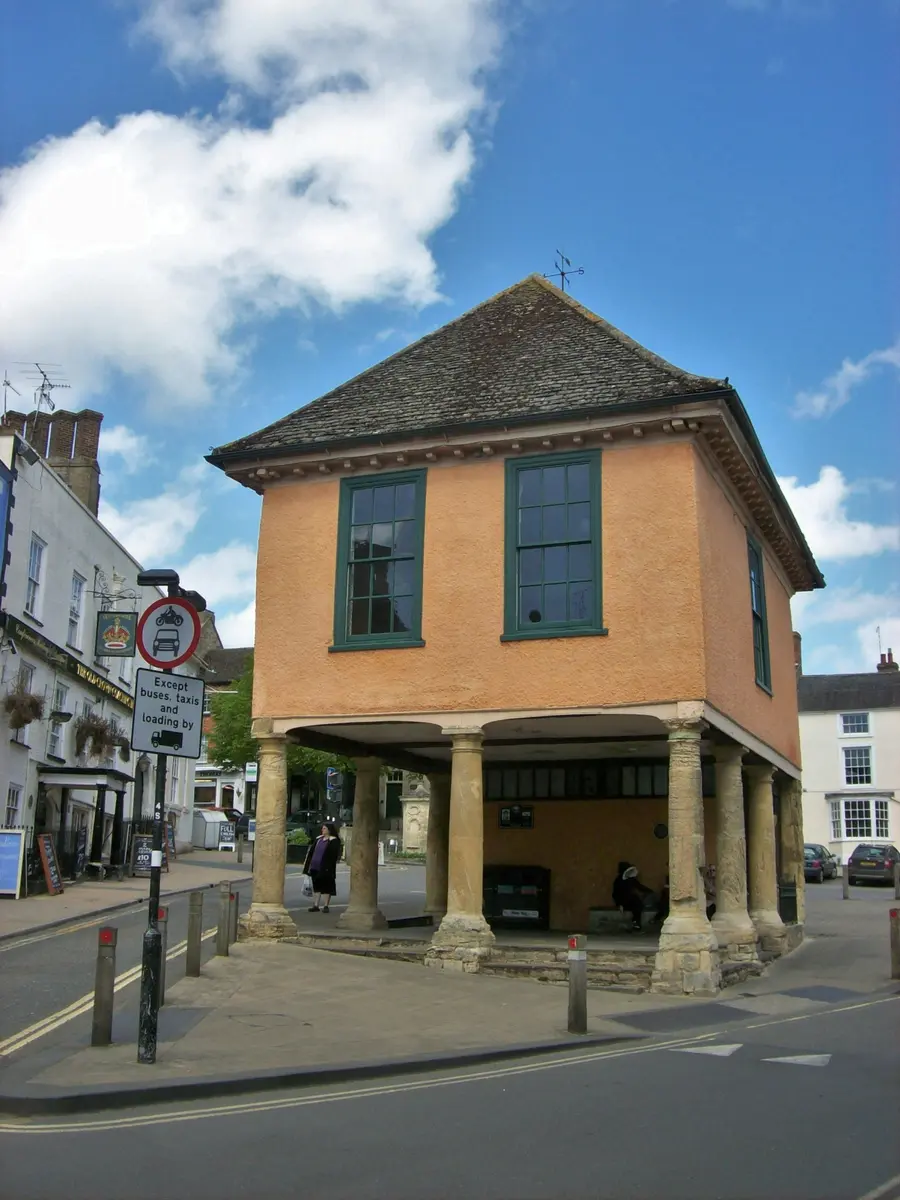
In the Market Place, the Old Town Hall is a former market building of the late seventeenth or early eighteenth century, with an open ground floor and a chamber above, listed Grade II* (list entry 1048440). It is the building in this file's photograph.
Sources consulted
- Cyril Hughes Hartman, «Faringdon in the Civil War» — Pamphlet, undated; PDF published by faringdon.org book
- William Page and P. H. Ditchfield (eds.), «Parishes: Great Faringdon» — A History of the County of Berkshire, vol. 4 (Victoria County History), 1924 book
- Richard Harris Barham ('Thomas Ingoldsby'), «The Legend of Hamilton Tighe» — Bentley's Miscellany, vol. I, no. 3 (March 1837); later in The Ingoldsby Legends, first series, 1837 newspaper archive
- Richard Harris Dalton Barham, «The Life and Letters of the Rev. Richard Harris Barham» — Richard Bentley, London, 1870 book
- B. D. Henning (ed.), «PYE, Sir Robert (c.1622-1701), of Faringdon, Berks.» — The History of Parliament: the House of Commons 1660-1690, 1983 academic
- All Saints' Church, Faringdon, «All Saints' Church, Faringdon: Pilgrim's Guide» — Parish visitor leaflet report
- Faringdon and District Archaeological and Historical Society, «All Saints Church / Faringdon House» — Faringdon History Website web
- David Nash Ford, «The Ghost of Hampden Pye (Faringdon)» — Royal Berkshire History web
- Faringdon Community Website, «Descendants of Robert Pye (1585-1662)» — Compiled pedigree (PDF) report
- The Faringdon Folly Tower Trust, «Faringdon Folly Tower and Woodland» — Official site of the managing trust (registered charity 284795) web
- Royal Museums Greenwich, «The Battle of Vigo Bay, 12 October 1702» — National Maritime Museum collection, 1702 archive
- Richard Harris Barham ('Thomas Ingoldsby'); edited by his daughter, Mrs Edward A. Bond, «The Legend of Hamilton Tighe — Barham's note "The Legend of Hampden Pye" (memorandum of 1832, signed T. I., "Told me by Mrs. Hughes")» — The Ingoldsby Legends or Mirth and Marvels, vol. 1, pp. 165-166 (London: Richard Bentley and Son), 1894 book
- Charles G. Harper, «Thames Valley Villages, vol. 1 (Faringdon and the legend of Hampden Pye, pp. 112-113)» — London: Chapman & Hall, 1910 book
- The London Gazette, «The London Gazette, no. 12081 (6-9 May 1780): Foot Guards, Lieutenant-Colonel Robert Hampden Pye appointed captain of a company» — The London Gazette, issue 12081, 1780 archive
Reviewed by V. Serrano on 2026-08-12 · How we verify our content
💬 Field testimonies (0)
No testimonies yet. Add the first.
Add your testimony
🔒 Log in to add a testimony