👻 HAUNTED PLACE · EXP. Nº9476
ACTIVE
Flitwick Manor
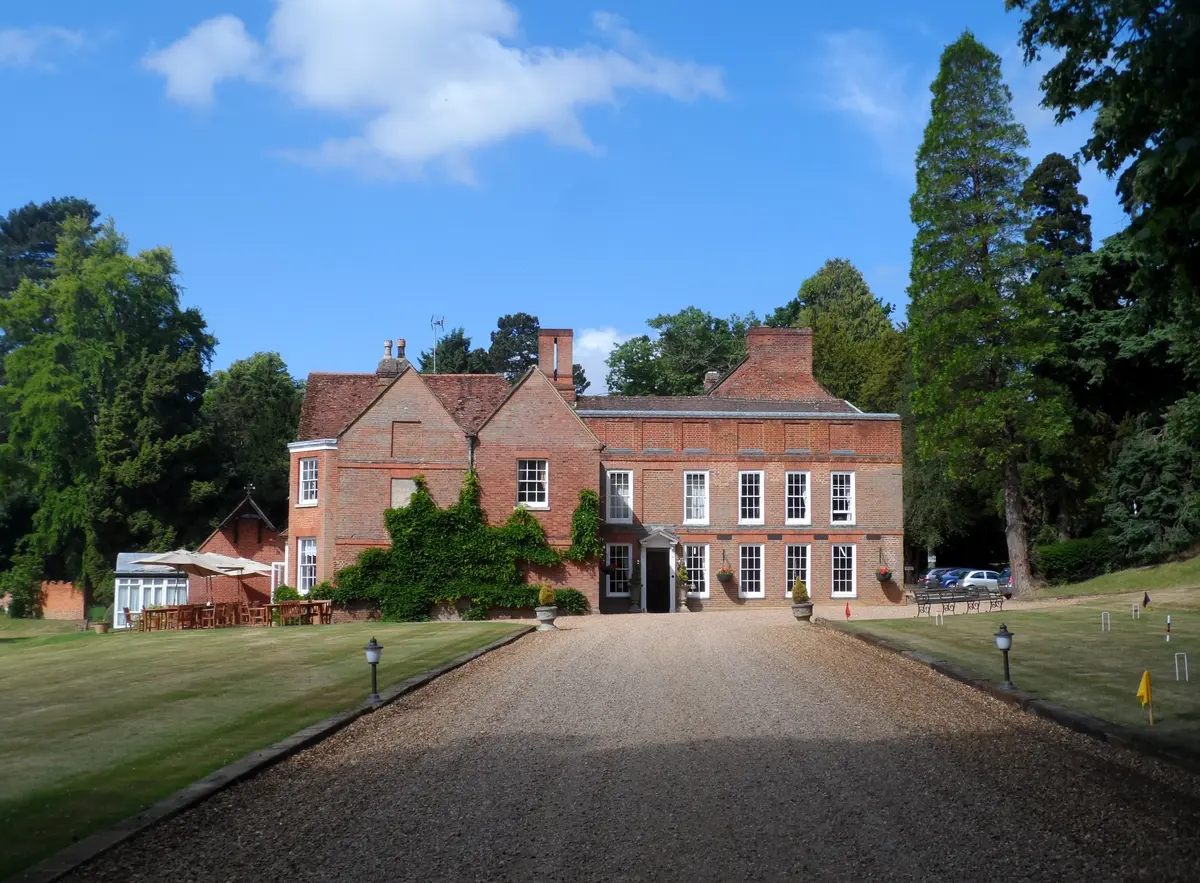
Flitwick Manor is a Grade II* listed country house in Bedfordshire, built in the early seventeenth century and encased in red brick around 1736, which has traded as a hotel for decades and returned to independent ownership in July 2024.
Where is Flitwick Manor?
- Location
- Bedfordshire, England, United Kingdom
- Type
- Hotel / inn
- Coordinates
- 51.997, -0.502
- Last updated
LOCATION
Why is Flitwick Manor said to be haunted?
Its ghost story surfaced in the mid-1990s: an ITV episode of Strange but True? broadcast on 27 October 1995, and a run of newspaper pieces across 1995 and 1996, made the house briefly famous. Bedfordshire Archives, which keeps those cuttings, records that the papers could not agree who the ghost was: a housekeeper of the twentieth-century owner Mr Lyall, a housekeeper sacked over an alleged poisoning, or a Mrs Brooks who had lost a child. The Brooks family was real. Mary Ann Brooks, daughter of the squire and gardener John Thomas Brooks, died on 19 September 1848 aged twenty-six, and a window was placed in the parish church that year in her memory. She was also a botanist: her herbarium is at the University of Birmingham, her diaries are at Bedfordshire Archives, and a fern she gathered in 1846 is still a citable record in the national botanical database.
What is the history of Flitwick Manor?
The house began as a lease. In 1632 George Jeere and William Holte conveyed it to its sitting tenant, Edward Blofeild of Flitwick, gentleman, for ninety pounds; the deed held it of the Crown for the remainder of a ninety-nine-year lease dating from 1617, which is probably the date of the oldest fabric. Historic England describes an early seventeenth-century structure encased around 1736 in a red-brick E-shaped block with vitrified headers, extended in the late eighteenth century and repeatedly in the nineteenth, with an 1872 addition in colour-washed concrete blocks and a reworking in 1936 by the Ampthill architect Sir Albert Richardson. The house was listed Grade II* on 22 October 1952 and the listing was amended in 1985. The hotel's own website today calls the building Grade II, one notch below what the register actually says.
Ownership descended by will and by marriage rather than by sale. Blofeild's will was proved in 1667 and the house went to his widow Jane, who remarried Samuel Rhodes of Clerkenwell. Their daughter Jane, who in her will of 1712 called herself the "unhappy wife of a very bad husband", parcelled out her few remaining possessions to friends and to her servant Mary Saunders and asked to be buried near her mother at Maulden; she died on 4 March 1713, and her husband and her brother Benjamin Rhodes then fought over her property in Chancery. Benjamin, Sheriff of Bedfordshire in 1730, left everything in 1735 to Humphrey Dell of Maulden, who in 1765 left it to his goddaughter Ann Fisher. Ann married a Hesse in 1778 and then George Brooks, and with that the Brooks family arrived. The two best sources disagree about the year of that second marriage: Bedfordshire Archives dates it to 1789, Historic England's register of the park to 1783.
Their son John Thomas Brooks (1794-1858) inherited in 1817 and spent forty years turning the estate into a horticultural showpiece. He bought the strip called The Five Acres in 1819 and planted an arboretum along it in a so-called Natural Arrangement; he had the public road re-routed to the far side of the parish church in 1829; he built the Upper and Lower Lodges in 1831; and through the 1820s and 1830s he laid out some twelve miles of walks through natural and planted woods, ornamented with rustic buildings and seats and circuiting a ferme ornee. He absorbed The Mount, the remains of a small motte-and-bailey castle and now a scheduled monument, into his grounds, inserted an icehouse into its flank and drove a tunnel under Church Road to reach it. John Claudius Loudon praised the gardens repeatedly in the Gardener's Magazine between 1827 and 1843 and again in his Arboretum et Fruticetum Britannicum of 1838. Brooks kept a diary for decades; it was published in 1987 by the Bedfordshire Historical Record Society.
His daughter Mary Ann Brooks was born on 20 August 1822. She was educated at Perceval House, Blackheath, from 1833 to 1839 and afterwards at home, and she botanised in the field from 1841 until the year she died, in Hertfordshire, Bedfordshire and Cheshire, signing her sheets M A B. Her herbarium, mostly Bedfordshire and Hertfordshire plants, is held at the University of Birmingham; her own diaries are at Bedfordshire Archives under reference LL19/2. One of her gatherings can still be looked up: an adder's-tongue fern, Ophioglossum vulgatum, taken at Woodside in Hertfordshire in 1846, survives as a preserved specimen and as a live record in the national botanical database. She died on 19 September 1848, aged twenty-six. That same year a window showing the Virgin with the infant Christ was placed in the vestry of Flitwick church in her memory.
Her mother, Mary Brooks, made her will on 8 December 1858, months after her husband's death, leaving her diamond earrings, brooch and two rings to their son John Hatfield Brooks. She died in 1879, aged eighty-four, and a window of St Peter and St Paul on the south side of the chancel commemorates her. The family held the property into the twentieth century: a district valuer who called on 30 August 1927 found Miss C M F Brooks still in residence in a house with a single bathroom, no lighting "except lamps" and roofs in very bad repair, and noted that it would cost a small fortune to put right. It passed to the Lyalls through the marriage of Mary Catherine Brooks to Colonel R A Lyall, and their son John Comyn Lyall sold it at auction in June 1953. It later became a country-house hotel and has been one ever since, trading in recent decades under the Menzies, Hallmark and Best Western Premier Collection names before returning to independent ownership in 2024.
Timeline: the documented record of Flitwick Manor
- 1632 George Jeere and William Holte convey the house to its tenant, Edward Blofeild of Flitwick, for ninety pounds, to be held of the Crown for the rest of a ninety-nine-year lease dating from 1617.
- 4 March 1713 Jane Chester, who a year earlier had described herself in her will as the unhappy wife of a very bad husband, dies; her widower and her brother then fight over her property in Chancery.
- 1765 Humphrey Dell of Maulden leaves the property to his goddaughter Ann Fisher, who later marries George Brooks: the start of a century and a half of Brooks ownership.
- 1817 John Thomas Brooks (1794-1858) inherits the estate and begins the improvements that will make it a horticultural showpiece praised by J. C. Loudon.
- 20 August 1822 Mary Ann Brooks is born at Flitwick. She will be schooled at Perceval House, Blackheath, from 1833 to 1839 and then at home.
- 1831 Brooks builds the Upper and Lower Lodges, two years after having the public road re-routed to the far side of the parish church; neither lodge survives.
- 1846 Mary Ann Brooks collects an adder's-tongue fern, Ophioglossum vulgatum, at Woodside in Hertfordshire. The sheet survives and is still a citable record in the national botanical database.
- 19 September 1848 Mary Ann Brooks dies at twenty-six. Her herbarium of Bedfordshire and Hertfordshire plants goes to the University of Birmingham and her diaries to Bedfordshire Archives.
- 1848 A window showing the Virgin with the infant Christ is erected in the vestry of Flitwick parish church in her memory, the physical record that fixes the date of her death.
- 1879 Mary Brooks, her mother and the woman usually cast as the inconsolable ghost, dies aged eighty-four, thirty-one years after her daughter. A second window in the chancel commemorates her.
- 30 August 1927 A district valuer finds Miss C M F Brooks still living in the house: one bathroom, no lighting except lamps, roofs in very bad repair. It would cost a small fortune to put right, he writes.
- June 1953 John Comyn Lyall sells the manor at auction, described in the particulars as a delightful Caroline and Georgian residence. It later becomes a country-house hotel.
- 27 October 1995 ITV's Strange but True? devotes a segment to the Flitwick ghost in the episode paired with The Jim Twins, the broadcast that launches the hotel's paranormal fame.
- 1995-1996 Newspapers give at least three incompatible identities for the ghost, as Bedfordshire Archives records from its own file of cuttings: Mr Lyall's housekeeper, a housekeeper sacked over an alleged poisoning, and a Mrs Brooks who lost a child.
- 10 July 2024 Flitwick Manor Country House Hotel Ltd is incorporated and the hotel returns to independent ownership after years under national hotel brands.
Is there a rational explanation for Flitwick Manor?
The Flitwick ghost is unusually easy to date, and what can be dated is the publicity rather than the haunting. Bedfordshire Archives keeps a file of press cuttings under the reference CRT130Flitwick19 and records that in 1995 and 1996 the hotel achieved what it calls a fleeting moment as a cause celebre because it was supposedly haunted. The archive's own summary is the best sceptical document available, because it shows the papers contradicting one another. Some described a rose-scented apparition and identified her as a former housekeeper of a "Mr Lyall", meaning one of the two twentieth-century owners of that name. Others said the housekeeper had been sacked after being accused of trying to poison an old man. Another paper said the ghost was a Mrs Brooks who had lost a child to tuberculosis. Those are not variants of one story: they are a Victorian mistress of the house, a twentieth-century servant and a suspected poisoner competing for the same corridor.
The best-known modern retelling, written by Rick Hale for Spooky Isles in 2019, adds a hidden room found behind brickwork during renovation works, a hostile presence supposedly released by opening it, an unnamed manager who watched a figure fade in front of him, and a receptionist who woke in Room 7 to a transparent young woman sitting at her feet. Nothing in it is tied to a named witness or a dated document, and the details drift between tellings: that article calls the housekeeper a little old lady with white hair, where later versions dress her in a black Victorian gown and a white cap.
The identity most often given, a mother still mourning her daughter, does not survive a look at the church next door. Mary Ann Brooks died in 1848 at twenty-six; her mother Mary Brooks lived on until 1879 and reached eighty-four. Both women are commemorated in Flitwick church by two different windows, which is exactly the sort of pairing that lets two generations be collapsed into a single grieving "Mrs Brooks".
Finally, the house itself says nothing. Checked on 12 August 2026, the hotel's own website ran to thirty pages and roughly eight megabytes of markup: the words ghost, haunted, haunting, apparition, paranormal and spectre appear zero times between them, while the word Flitwick appears 8,341 times and restaurant 354. A business with a marketable ghost normally sells it. This one does not, and has not put the story back on its site since the change of ownership.
One honest gap: the earliest appearance of the story that this review could date is the 1995 television broadcast and the 1995-96 cuttings, which is 147 years after Mary Ann Brooks died. That is not proof that nothing was told locally before then, only that no earlier printed telling could be dated here.
Can you visit Flitwick Manor?
Flitwick Manor is a hotel, at Church Road, Flitwick, Bedford MK45 1AE, telephone 01525 712242. Its website, consulted on 24 September 2026, offers 19 bedrooms and a restaurant, and its page of frequent questions gives the function rooms as the Brooks Room for 100 people, the Morning Room for 18 and the Library for 12, with free parking for about 100 cars. The footer names the operator as Flitwick Manor Country House Hotel Ltd, "Powered by Apart Hospitality"; Companies House lists that company, number 15831739, as incorporated on 10 July 2024 and active, with its registered office in Northampton. On the same day, the home page and 22 further pages of the site contained no mention of a ghost or of anything paranormal, while the name Brooks, as in the Brooks Room, appeared twelve times on six of them. The house is listed Grade II* (list entry 1137690, first listed on 22 October 1952), although the hotel's home page calls it "Grade II-listed".
Manor Park, south of the house, was part of the Flitwick Manor estate, and Flitwick Town Council bought it "to preserve it for the community", and it is on Historic England's Register of Parks and Gardens at Grade II. The council also owns The Mount to the north, the site of a small motte-and-bailey castle of about 1100 and a scheduled monument, which John Thomas Brooks brought into his gardens with a tunnel under the road and a prospect tower on top. The Flit Valley Walk crosses the park, and the restored South Gate, on the A5120 opposite Nuyard Garden Centre, was finished in May 2023. Bedfordshire Archives places The Grotto, a late eighteenth-century garden building in the form of a small bridge, about 50 metres south-west of the manor, and records its Grade II listing in January 1961.
The parish church of St Peter and St Paul, on the same road, is listed Grade I (list entry 1137705, 23 January 1961); by the grid references of the two list entries it stands about 55 metres north of the manor. Bedfordshire Parish Churches describes three Brooks memorial windows inside. The vestry window of the Virgin with the infant Christ was put up in 1848 for Mary Ann Brooks. On the south side of the chancel, a window with Saints Peter and Paul commemorates her mother Mary, who died in 1879 aged 84. The west window, of Christ appearing to St Peter, was erected in 1907 for John Hatfield Brooks.
The hotel's location page puts it an hour from London on the main line and minutes from junction 12 of the M1. The Herbaria@home record for Mary Ann Brooks places her herbarium at the University of Birmingham and her diaries at Bedfordshire Archives under reference LL19/2; the archive service is at Borough Hall, Cauldwell Street, Bedford MK42 9AP.
Sources consulted
- Bedfordshire Archives Service, «Flitwick Manor — Community Histories» — Bedford Borough Council, 2017 archive
- Historic England, «Flitwick Manor — Register of Parks and Gardens, list entry 1000383 (Grade II)» — Historic England, National Heritage List for England, 1989 report
- Historic England, «Flitwick Manor — listed building entry 1137690, Grade II*, listed 22 October 1952 (full list description consulted in transcription)» — Historic England, via British Listed Buildings, 1985 report
- Bedfordshire Parish Churches, «Flitwick — St Peter and St Paul: description of the church windows and their dedications» — bedfordshireparishchurches.co.uk, 2020 web
- Herbaria@home / herbariaUnited, «Botanist record: Mary Ann Brooks M A B (20.8.1822 - 19.9.1848)» — Botanical Society of Britain and Ireland collections database, 2026 archive
- Botanical Society of Britain and Ireland, «Preserved specimen: Ophioglossum vulgatum L., coll. M.A. Brooks, 1846, Woodside, VC20 Hertfordshire (herbarium BIRM)» — BSBI Distribution Database, via GBIF occurrence 6058961177, 1846 archive
- Bedfordshire Archives Service Catalogue, «HN2/B3/22/12 — Will of Mary Brooks, wife of John Brooks of Flitwick House, 8 December 1858» — Bedford Borough Council, 1858 archive
- Companies House, «FLITWICK MANOR COUNTRY HOUSE HOTEL LTD (company 15831739), incorporated 10 July 2024, status active» — UK Government register of companies, 2024 report
- Flitwick Manor Country House Hotel Ltd, «Flitwick Manor — official hotel website (30 pages swept 12 August 2026: zero mentions of ghost, haunted, apparition or paranormal)» — flitwickmanor.com, 2026 web
- Flitwick Town Council, «Manor Park — history, ownership and public access» — flitwick.gov.uk, 2026 web
- Rick Hale, «Guide To Haunted Flitwick Manor, Over A Century Of Ghostly Scares» — Spooky Isles, 2019 web
- London Weekend Television, «Strange But True? — The Jim Twins / Flitwick Ghost (ITV, broadcast 27 October 1995)» — IMDb entry tt3406586, 1995 web
Reviewed by V. Serrano on 2026-08-12 · How we verify our content
💬 Field testimonies (0)
No testimonies yet. Add the first.
Add your testimony
🔒 Log in to add a testimony