👻 HAUNTED PLACE · EXP. Nº9476
ACTIVE
Fyvie Castle
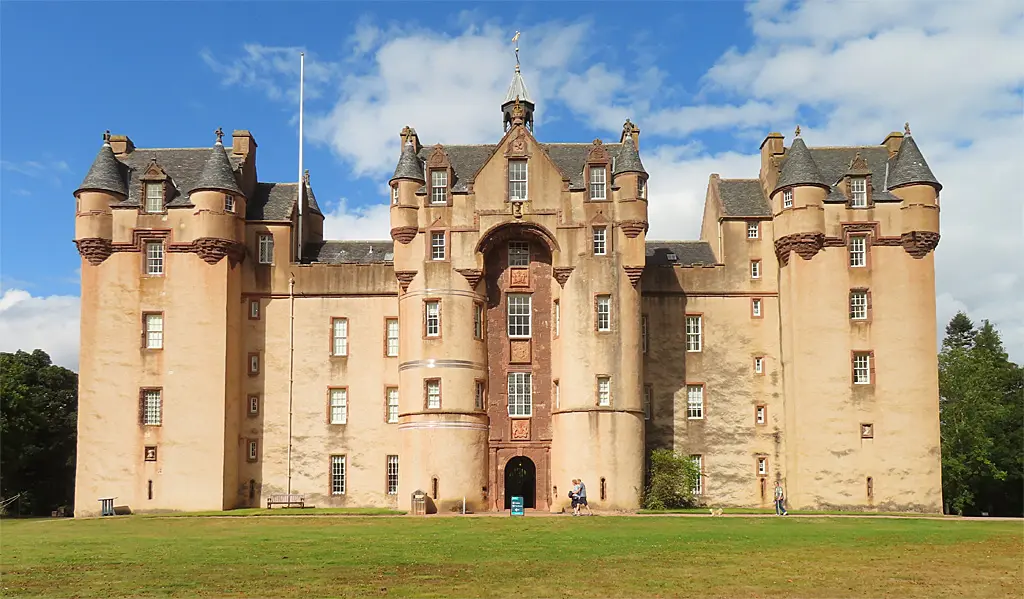
Fyvie Castle, in Aberdeenshire, is a category A listed pile of five towers, each named for a family that held it: Preston, Meldrum, Seton, Gordon and Leith.
Where is Fyvie Castle?
- Location
- Aberdeenshire, Scotland, United Kingdom
- Type
- Castle
- Coordinates
- 57.443, -2.395
- Last updated
LOCATION
Why is Fyvie Castle said to be haunted?
Its ghost, the Green Lady, is identified with Lilias Drummond, first wife of Alexander Seton, 1st Earl of Dunfermline. She bore him five daughters and no son, and the story runs that he shut her away until she starved. The only contemporary document, the testament registered in the Commissariot of Edinburgh, says instead that she died at Dalgety in Fife on 8 May 1601, and that Seton remarried within the same year. Visitors are shown a name cut upside down on an outer window ledge fifty feet up, which the National Trust for Scotland says appeared on the night of that second wedding. The oldest dated Fyvie ghost the Press and Journal cites from its archive is not hers: in January 1920 the Aberdeen Journal reported a maid's sighting after a skeleton was found built into a wall. And Thomas the Rhymer's curse of the three weeping stones was printed in 1858 in a form that dooms the ladies of the house, not its heirs.
What is the history of Fyvie Castle?
Fyvie is five castles in one, and the Trust names them for the five families who raised them: Preston, Meldrum, Seton, Gordon and Leith. The Historic Environment Scotland listing reads the fabric the same way. Category A, listed on 16 April 1971 as LB9615, it describes a south range 147 feet long, originally fifteenth-century, incorporating the Preston Tower of about 1400 at the south-east and the Meldrum Tower at the south-west, with the upper stages of both and the arch-linked Seton Tower between them added in 1599 - the date cut in the stone - for Alexander Seton, Earl of Dunfermline.
Before any of that it was the king's. The Trust's own timeline places William the Lion at Fyvie with the high officers of his court between 1211 and 1214; Edward I of England visited in 1296, and Robert the Bruce afterwards dispensed justice here in an open-air court. It stopped being a royal seat in 1380, when the future Robert III made it over to his cousin Sir James de Lindsay. From Lindsay it went to Sir Henry Preston in redemption of Ralph de Percy, the English knight taken at Otterburn; Pratt, writing in the 1850s, noted that an extract of the original charter was still kept at the castle, and that the grant had to be confirmed because the king had already given Fyvie away once. Preston died about 1433 leaving two daughters and no son. The elder carried the castle to the Meldrums, who held it for a century and a half.
In 1596 the Meldrums sold. The buyer was Alexander Seton, third son of the sixth Lord Seton and a lawyer of the first rank: a free lordship of Fyvie in 1597, Lord Fyvie in 1598, Earl of Dunfermline in 1606, President of the Court of Session and Chancellor of Scotland, and guardian of the boy who became Charles I, who spent part of 1603-04 in the castle. MacGibbon and Ross, surveying it in 1887, wrote that Lord Fyvie had "quite a passion" for heraldry and that his south front is perhaps the most imposing of any ancient domestic building in Scotland. His west range of 1603 holds the great wheel stair, twenty feet four inches by eighteen feet six, its steps carried on flat arches thrown between the outer wall and a stone newel one foot nine inches thick. Near the top an inscription carved in oak reads ALEXANDER SETON, LORD FYVIE. DAME GRESSEL LESLIE, LADIE FYVIE. 1603. Lower down, the imposts carry a shield with the Seton arms and those of the Earl's two wives, Lilias Drummond and Grizel Leslie.
Lilias was the second daughter of Patrick, third Lord Drummond, and sister of the first Earl of Perth. She married Seton about 1592 and bore him five daughters - Anne, Isabel, two Margarets (the first died in infancy) and Sophia - and no son. George Seton, compiling the family history in 1896, went to the record of the testaments-dative of the two successive countesses, registered in the Commissariot of Edinburgh in 1609. It states that Lilias Drummond died "in the place of Dalgatie in Fyff" - Dalgety in Fife - on 8 May 1601, and that Grizel Leslie died on 6 September 1606. Seton married Grizel, fourth daughter of the Master of Rothes, in that same year of 1601. The son who eventually inherited, Charles, second Earl of Dunfermline, was the child of a third wife, Margaret Hay.
What follows is a chain of interrupted inheritances. In October 1644 Montrose occupied Fyvie, judged it untenable against Argyll's far larger force and dug in on the mound to the north-east; Patrick Gordon of Ruthven's account of the day, quoted at length by Pratt, presents it as the moment the Royalists learned they could face a bigger army and survive. A Puritan detachment garrisoned the castle in 1650-52. James, fourth Earl of Dunfermline, followed Dundee to Killiecrankie in 1689, was outlawed, and died at Saint-Germain in 1694 without surviving issue; the estate was forfeit to the Crown. It was bought by William, second Earl of Aberdeen - Pratt and Groome say 1726, the Trust says 1733 - and passed in 1746 to his son the Hon. William Gordon, whose Gordon Tower of 1777 replaced the ruinous chapel and whose Batoni portrait of 1766 is still the best-known object in the house.
The Gordons ran out of money and the estate went on the market in 1885. In 1889 it was bought for 175,000 pounds by Alexander Forbes-Leith, a local man who had made a fortune in the American steel industry. He added the Leith Tower (John Bryce, 1890), a clock tower by A. Marshall Mackenzie in 1899 and the racquets court, and filled the rooms with thirteen Raeburn portraits, works by Gainsborough, Romney, Lawrence, Greuze, Vigee Le Brun and Millais, and a Tiffany lamp. He was created Baron Leith of Fyvie in 1905. His only son Percy was killed in the Second Boer War; the barony died with him in 1925 and Fyvie passed to his daughter Ethel. The National Trust for Scotland bought castle and estate in 1984, and in July 2025 launched the Reimagining Fyvie masterplan with Page\Park Architects - a first phase running to 2027 on the A-listed stonework, including the sixteenth-century roofline finials of sportsmen and musicians, and the rescue of the B-listed Old Home Farm as a visitor hub.
Timeline: the documented record of Fyvie Castle
- 1211-14 The National Trust for Scotland's timeline records William the Lion staying at Fyvie with the high officers of his court, when the site served as an administrative centre and probably a hunting lodge for a travelling monarchy.
- 1296 Edward I of England visits Fyvie during his progress through the north of Scotland; the castle or a predecessor on the site was then a royal seat, and remained one until 1380.
- c. 1400 Sir Henry Preston begins the Preston Tower, the earliest surviving part of the building: a tower about 24 feet square with a projecting stair wing, square outside and circular within, as measured by MacGibbon and Ross.
- 1596 The Meldrums sell Fyvie to Alexander Seton, later Lord Fyvie and 1st Earl of Dunfermline. He raises the upper stages of the Preston and Meldrum towers and builds the Seton Tower between them; the date 1599 is cut in the stonework.
- 8 May 1601 Lilias Drummond dies at Dalgety in Fife, according to the testament-dative registered in the Commissariot of Edinburgh in 1609. She had borne Alexander Seton five daughters and no son. Seton married Grizel Leslie later the same year.
- 1603 The west range and the great wheel stair are finished. Near the top an oak inscription reads ALEXANDER SETON, LORD FYVIE. DAME GRESSEL LESLIE, LADIE FYVIE. 1603; below it the imposts carry the arms of both of the Earl's wives, Lilias Drummond and Grizel Leslie.
- October 1644 The Skirmish of Fyvie. Montrose occupies the castle, judges it untenable and entrenches on the mound to the north-east, where he holds off Argyll's larger force. Patrick Gordon of Ruthven's eyewitness account is quoted at length by Pratt.
- 1823 Alexander Laing prints the ballad of Andrew Lammie, Lord Fyvie's trumpeter, and of Mill o' Tifty's Annie. This is the castle's musical ghost: a trumpeter, not a drummer.
- 1858 Rev. John B. Pratt prints Thomas the Rhymer's Fyvie prophecy, in which the three plundered church stones make the ladies of the house hapless. Pratt notes the seer says nothing about heirs, and contrasts Fyvie with Towie Barclay, where the weird struck the men.
- 1887 MacGibbon and Ross survey the castle and record that the ground-floor chamber in the Meldrum Tower has no entrance and was probably reached by a trap-door from above, as is common in Scottish houses. This is the sealed room of the legend.
- January 1920 The Aberdeen Journal runs the headline 'Green Ladye's ghost seen in Fyvie Castle. Maid's remarkable story. Skeleton built in the wall: What followed its removal'. A skeleton had been found cemented in a wall opened to trace damp; the maid Miss Massie described a figure in a flowing white gown. It is the oldest dated Fyvie ghost the newspaper cites from its own archive, and the passages it reproduces name no Lilias Drummond.
- 1924 Charles Harper's Haunted Houses gives Fyvie three pages: the Rhymer's rhyme and the walled-up chamber beneath the charter room, with the dry remark that the doom of sacrilege 'has not always come to pass'. There is no Green Lady and no carved window in it.
- 1925 Alexander Forbes-Leith, 1st Baron Leith of Fyvie, dies. His only son Percy had been killed in the Second Boer War, so the barony is extinguished and the estate passes to his daughter Ethel: the best-documented case of the succession failing at Fyvie, and it needs no curse.
- 1984 The National Trust for Scotland buys the castle and estate. In July 2025 it launches the Reimagining Fyvie masterplan with Page\Park Architects, a first phase to 2027 covering the stonework and the sixteenth-century roofline finials.
Is there a rational explanation for Fyvie Castle?
The document that ought to anchor the ghost story undoes it. Lilias Drummond is said to have been shut up at Fyvie and starved for failing to produce a son; the Trust's own page says she was "allegedly starved to death" in a lonely room shown on the tour. But the testament registered in the Commissariot of Edinburgh in 1609, printed by George Seton in 1896, states that she died at Dalgety in Fife on 8 May 1601. Dalgety was Seton's favourite residence, on the other side of the country. Whatever happened to her did not happen in the room visitors are shown.
Then there is the date of the story itself. The Green Lady is absent from every substantial account of Fyvie written before the twentieth century. She is not in Pratt's Buchan (1858), which gives the castle ten pages, the Rhymer's prophecy and the secret chamber; not in Walter Gregor's Notes on the Folk-Lore of the North-East of Scotland (1881), which prints two versions of the prophecy and the tradition behind it; not in Groome's Ordnance Gazetteer (1882); not in MacGibbon and Ross (1887); and not in George Seton's eight-hundred-page family history of 1896, where "Fyvie" appears 151 times and "Drummond" 42. Seton does print a green lady, at another house: in a footnote on Pinkie, the Musselburgh mansion that the same Alexander Seton enlarged, he describes a female portrait in the painted gallery that "is said to come forth in shadowy embodiment, and stalk through its gloomy length by night", "usually called the 'Green Lady,' from the colour of her dress, and supposed to be a member of the Seton family". In the family's own history of 1896 the Seton green lady walks at Pinkie, and the index lists her there. The strongest measurement is Charles Harper's Haunted Houses (1924 edition), a book devoted to exactly this subject: it gives Fyvie three pages, prints the Rhymer's rhyme in full, describes the walled-up chamber beneath the charter room - and says nothing whatever about Lilias Drummond, a green lady or a carved window. The control in the same file: "castle" 156 hits, "Glamis" 47, "green lady" none.
The oldest dated Fyvie ghost that the Press and Journal cites from its own archive is from January 1920, and she is not Lilias. The Press and Journal, reproducing its own archive in 2020, quotes the headline: "Green Ladye's ghost seen in Fyvie Castle. Maid's remarkable story. Skeleton built in the wall: What followed its removal." A wall had been taken down to investigate a damp patch and a complete skeleton was found cemented in the rubble; the bones were buried in the local churchyard, and, the paper reported, "their removal was the signal for boisterous disturbances throughout the castle." A maid named Miss Massie, who told the reporter she had no belief in the supernatural, described a figure "dressed in a wide, flowing white gown" that stepped out of the wall by her bed shortly before five in the morning. In the passages the paper reproduced, the figure is white, has no name and is tied to the skeleton; neither Lilias Drummond nor a windowsill appears in them. By 2022 the same newspaper was telling the same episode as a Grey Lady, dating it to the late 1920s and identifying her as a Lady Meldrum dead in the thirteenth century. That drift, inside one newspaper's own files, is the clearest thing in the whole dossier.
The curse has been read backwards as well. In both nineteenth-century texts the doom falls on the women of the house: "Fyvyns riggs and towers, / Hapless shall your mesdames be, / When ye shall hae within your methes, / Frae harryit kirk's land, stanes three", with one stone in Preston's tower, one in my lady's bower and one below the water-yett. Pratt adds that the prophet "says nothing of the peculiar nature of the haplessness of his mesdames", and a few pages later, describing the neighbouring weird of Towie Barclay, writes: "At Fyvie the malefic influence was against the fair sex; here it is the reverse." Gregor's second version is blunter still - "Fyvie, Fyvie, thou'se never thrive / As lang's there's in thee stanes three" - and its object is the castle itself; Gregor adds that two of the stones had been found and the one below the water-yett "has as yet baffled search". The succession reading is in print by 1924, when Charles Harper wrote that until the three stones were all recovered the family owning the castle would not "perpetuate itself beyond the next generation". The direction of the condition matters as well: the Trust says the curse holds "until the three stones are discovered and removed", the guides say until they are returned to the ground they came from. The stones have to leave. Any version in which reuniting them inside the castle lifts the curse has inverted the rhyme.
The sealed chamber has an ordinary explanation on the record since 1887. MacGibbon and Ross, measuring the ground floor, wrote that "there is no entrance to the ground-floor chamber in the Meldrum Tower, which was probably reached through a trap-door down from the floor above, as is so frequently the case in Scottish houses." On their reading, a chamber without a door, entered from the floor above, is a common arrangement in a Scottish tower house. In September 1930 the Press and Journal reported the Deeside Field Club making "an attempt to solve the mystery of the secret chamber"; the same report told how in 1885 Sir Maurice Duff-Gordon set workmen to break into the room, how they came on the top of a staircase leading down, and how the work stopped and everything was put back when the laird fell and broke his leg and his wife's eyesight began to fail.
The readings of the window inscription that circulate differ - D. LILIAS DRUMMOND in some retellings, D LILLIAS DRUMMOND in Richard Jones's version, letters about three inches high, cut upside down on an outer ledge more than fifty feet up. The carving is real enough to be shown: in November 2022 the guide Joe Malster took a Press and Journal reporter to it and she wrote that "the carved name remains to this day". What is documented in stone is something else, and better. Lilias Drummond's arms are carved on the great staircase beside Grizel Leslie's, recorded there by MacGibbon and Ross in 1887 - put up by the husband the legend accuses.
When staff are named, they are careful. Joe Malster lifts the carpet on the bloodstains that supposedly cannot be washed out and is sceptical: "There are various stories. Some say Lilias was killed here, others say her family rescued her. Others say her relatives were killed here. Who knows!" Stuart Stockley, the gardener, who lived in the castle with his family for eight years, says he is not a great believer in ghosts, that the alarm below the Drummond Bedroom goes off for no reason and that engineers have never found a fault, and that new arrivals are told on arrival that the smell of roses means Lilias is present - which is a fair description of how an expectation is transmitted.
Fyvie's musical ghost is a trumpeter: Andrew Lammie, Lord Fyvie's trumpeter in the ballad of Mill o' Tifty's Annie, printed by Alexander Laing in 1823, and Pratt says a stone figure of him stands on one of the turrets blowing his horn towards Tiftie. The two datings do not sit together: the Trust describes the roofline finials of sportsmen and musicians as sixteenth-century, while Groome gives Agnes Smith's death as 1678. Her grave in Fyvie kirkyard is not an independent witness either - the New Statistical Account records that the original stone had decayed and that Mr Gordon of Fyvie had a new one cut.
Can you visit Fyvie Castle?
Fyvie Castle, Garden and Estate is run by the National Trust for Scotland. The Trust's planning page gives the address as Fyvie, Turriff, Aberdeenshire AB53 8JS and the telephone as 01651 891266, and places the castle off the A947, 8 miles (13 km) south-east of Turriff and 25 miles (40 km) north-west of Aberdeen. Its directions for bus passengers are to alight in Fyvie village, follow the signposts to the main castle drive and take the path network round the side of the loch up to the castle. Historic Environment Scotland lists the building at Category A (LB9615, added on 16 April 1971) and gives its grid reference as NJ 76390 39306.
The opening pattern that follows is the one the Trust published on 17 July 2026, and the prices and tour times were unchanged on its overview page on 16 September 2026, according to the Internet Archive's captures of both dates. Castle and shop open from 10.30 to 16.00, daily between 18 June and 30 August and from Wednesday to Sunday between 31 August and 1 November; from 2 November to 28 February 2027 they are closed. The tearoom keeps the same hours and stays open at weekends during that winter closure. The grounds and garden are open every day of the year from 09.00 to dusk. The racquets court opened on Wednesdays from 12.00 to 15.00 between 9 July and 26 August, and from 27 August it is available only for private hire.
The castle is seen on guided tours of at most fifteen people, taken in order of arrival; there is no advance booking, and tickets are sold at the admission desk in the front entrance hall. Tours leave every 45 minutes from 10.45 until 15.15. On which weekdays they run, the Trust's own page gives two answers: Monday to Friday in its opening-times section, Wednesday to Friday in its facilities section. At weekends visitors go round on their own until 13.00, with guided tours at 13.45, 14.30 and 15.15. Adult admission was £18 on both dates and concession £14, with a family ticket at £40.50 and a one-adult family ticket at £34.50; a Young Scot card holder paid £1. The car park costs £5, and Trust members get in and park free. Under a ScotRail scheme, two adults with a valid rail ticket and the paper voucher are admitted for the price of one.
On access, the Trust states that the front hall is wheelchair accessible and that inside the castle there are steps to various rooms. The tearoom and the walled garden are accessible, as is the American garden. Disabled parking is beside the castle and by the tearoom, and a separate accessibility guide is published. Dogs are allowed in the grounds on a lead, and grazing livestock are kept outside the main visitor areas. Flying a drone needs the Trust's prior permission. An avian flu notice headed 2025 reports confirmed cases at Fyvie Loch, mainly among greylag geese; the estate remains open, some paths may be closed temporarily, and the Trust asks that dead birds are not touched. The Reimagining Fyvie masterplan, announced in July 2025, sets a first phase, due to finish by 2027, of conservation work on the Category A castle and the rescue of the Category B Old Home Farm buildings. Inside the castle, the Preston Tower Apartment is let by the Trust as holiday accommodation for up to twelve guests.
Sources consulted
- Rev. John B. Pratt, «Buchan» — Lewis Smith, Aberdeen (3rd ed.), 1870 book
- George Seton, «A History of the Family of Seton During Eight Centuries, vol. II» — T. and A. Constable, Edinburgh, 1896 book
- Rev. Walter Gregor, «Notes on the Folk-Lore of the North-East of Scotland» — Elliot Stock for the Folk-Lore Society, London, 1881 book
- David MacGibbon and Thomas Ross, «The Castellated and Domestic Architecture of Scotland, vol. II» — David Douglas, Edinburgh, 1887 book
- Historic Environment Scotland, «Fyvie Castle: listed building record LB9615, category A» — Designation record, listed 16 April 1971, 1971 report
- Charles G. Harper, «Haunted Houses: Tales of the Supernatural» — J. B. Lippincott, Philadelphia (the US edition linked; also published in London by Cecil Palmer), 1924 book
- Francis H. Groome, «Ordnance Gazetteer of Scotland, vol. III» — Thomas C. Jack, Edinburgh, 1882 book
- Scott Begbie, «Locked down with ghosts, secret chambers and cursed stones in north-east's most haunted castle» — The Press and Journal, Aberdeen (quoting the paper's own January 1920 report), 2020 newspaper archive
- Gayle Ritchie, «Spooky stronghold: The ghosts, 'weeping' stones and secret chambers of Fyvie Castle» — The Press and Journal, Aberdeen, 17 November 2022, 2022 newspaper archive
- Alexander Laing, «The Thistle of Scotland: A Selection of Ancient Ballads, with Notes» — Aberdeen (ballad of Andrew Lammie), 1823 book
- National Trust for Scotland, «Fyvie Castle: the castle, and Timeline of the Five Ages of Fyvie» — nts.org.uk (highlights and history pages), 2026 web
- National Trust for Scotland, «Fyvie Castle, Garden & Estate: planning your visit» — nts.org.uk (as published 17 July 2026), 2026 web
- Scottish Construction Now, «Masterplan unveiled to transform Fyvie Castle for a new era» — Scottish Construction Now, 16 July 2025, 2025 newspaper archive
- National Trust for Scotland, «Fyvie Castle, Garden & Estate — overview page: today's tour times, tearoom and grounds hours, entry prices (captured 16 September 2026)» — nts.org.uk via the Internet Archive, 2026 archive
Reviewed by V. Serrano on 2026-08-12 · How we verify our content
💬 Field testimonies (0)
No testimonies yet. Add the first.
Add your testimony
🔒 Log in to add a testimony