👻 HAUNTED PLACE · EXP. Nº9477
ACTIVE
Goodrich Castle
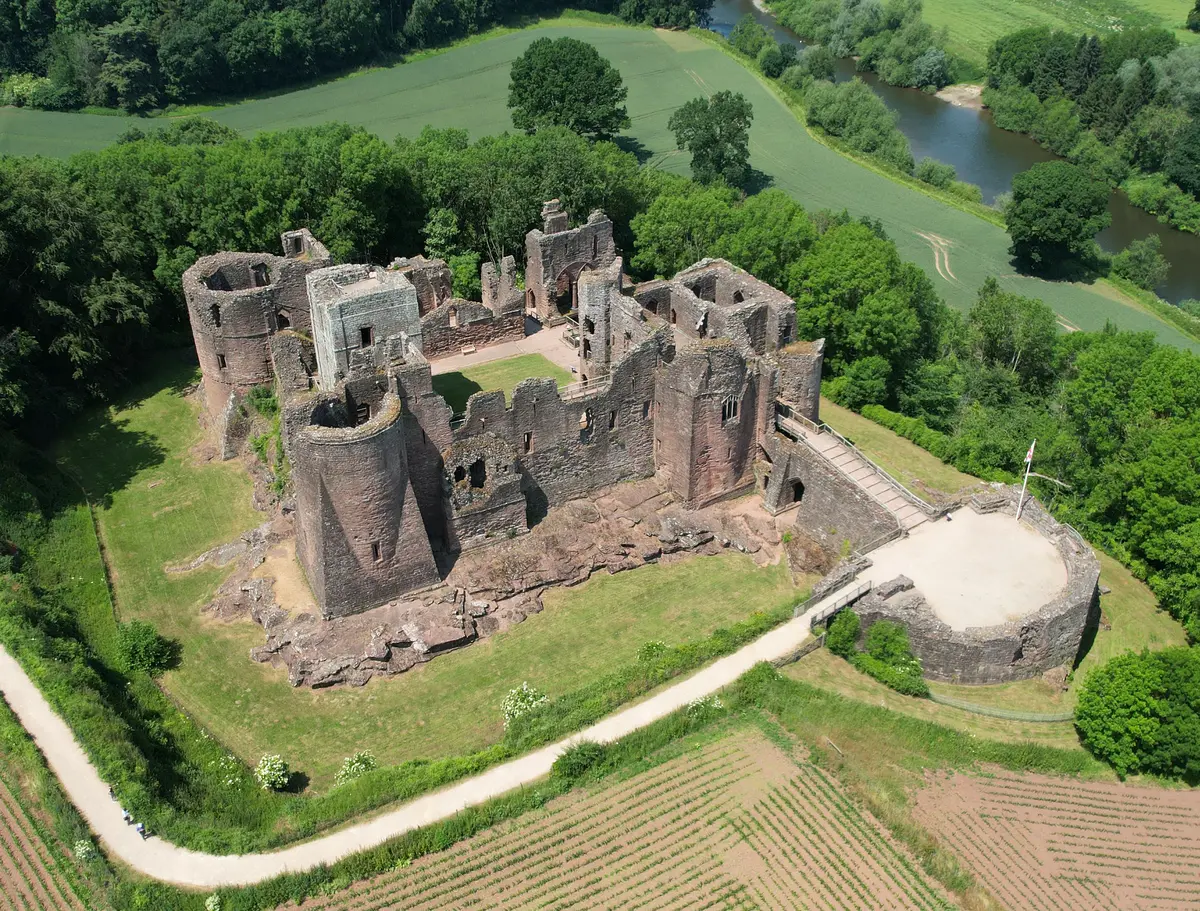
Goodrich Castle stands in red sandstone above a bend of the River Wye in Herefordshire, and its ruin is the work of a siege that can be followed almost week by week.
Where is Goodrich Castle?
- Location
- England, United Kingdom
- Type
- Castle
- Coordinates
- 51.876, -2.613
- Last updated
LOCATION
Why is Goodrich Castle said to be haunted?
In 1646 the Parliamentarian colonel John Birch had a mortar cast on the spot — the gun now known as Roaring Meg — and battered Sir Henry Lingen's Royalist garrison into surrendering on 31 July. The ghost story attached to the place is a love story: Alice Birch, said to be the colonel's niece, and Charles Clifford, a Royalist officer, are supposed to have ridden out of the doomed castle and drowned in the flooded Wye, and to ride into it again whenever a storm comes down the valley. The story appears in print in 1827 as fiction: a short story called "Goodrich Castle", written by the poet Henry Neele and published in his Romance of History: England. The siege papers, reprinted for tourists the year before, list by name every officer who surrendered, and no Clifford is among them. This page tells both: the siege that happened, and the tale that was written.
What is the history of Goodrich Castle?
Goodrich Castle takes its name from Godric Mappestone, the Englishman who held the manor when Domesday Book was compiled. The oldest thing standing is the square Norman keep in the middle of the courtyard, built of grey stone; everything around it is the local red sandstone, quarried out of the rock the castle sits on, which is why the walls and the dry moat below them are the same colour. King John granted Goodrich to William Marshal, earl of Pembroke, in 1203, and Marshal threw a towered curtain wall around the old keep. The castle a visitor walks through today is mostly the work of William de Valence, half-brother to Henry III, who from the 1280s demolished Marshal's work and raised a concentric castle of the sort Edward I was building in north Wales — a rare thing in England itself. His son Aymer added the outer barbican before his death in 1324. Goodrich then passed to the Talbots, earls of Shrewsbury, and in 1616 to the Greys, earls of Kent, who never lived there and let it to tenants. The last of them, a local lawyer named Richard Tyler, was still renovating it in the 1630s.
Then came the war, and Goodrich is one of the few English sieges that can be followed almost week by week, because the London newsbooks printed the letters as they arrived. The Earl of Stamford held the castle for Parliament until December 1643; after his withdrawal it was garrisoned for the King by Sir Henry Lingen, with about 200 men and 90 horses, and Lingen used it to raid Parliamentary forces across the county. On the morning of 10 March 1645/6 Colonel John Birch, coming from Hereford, and Colonel Robert Kyrle, coming from Monmouth, fell on the stables: they took sixty-four horses with the hay and provisions, burned the stables down and seized most of the men in the passage house. The Perfect Diurnall for the week of 16-22 March carried the report.
Birch came back in earnest at the start of June. He had already told the committee that without battering cannon "I may sit down long enough before it; Lingen being an excepted person, and one unto whom I cannot grant any honourable terms." On 1 June his pioneers began digging approaches to within pistol shot of the ramparts; a summons sent in on 13 June was flatly refused. One of the Cavaliers shouted down at the miners that they cared not for being blown up, they could from the sky laugh at the flourishing of the Roundheads. The Royalists sallied out, surprised the main guard, killed eight men and briefly held both of Birch's mortar pieces — they tried to break them, could not, and retreated carrying away a lighted grenade.
It was during this siege that Roaring Meg was made. Birch wrote to the Speaker from Goodrich on 18 June 1646 that he was pressing the work with "my batteries, mortar pieces, and mining, being the three ways we now put in execution, having cast a mortar piece here, which carries a shell of 200lbs. weight", and asked for eighty barrels of powder. A letter of 4 July adds the calibre: "Our mortar piece is 15 inches diameter". Birch turned it on the north-west tower, mining underneath at the same time; Lingen's counter-mine was buried when the tower came down. The surrender was agreed on four articles, the last of which required that it "be performed personally the same day, (viz.) July 31st, 1646" — a Friday. The newsbooks printed the inventory: Sir Henry Lingen, a long list of named officers and gentlemen, sixty common soldiers, 120 arms, four barrels of powder and thirty of beer. Parliament had the castle slighted the following year, and the Countess of Kent took £1,000 in damages rather than rebuild.
The ruin then became a destination. William Gilpin put Goodrich in Observations on the River Wye in 1782 as an example of the "correctly picturesque"; Wordsworth visited in 1793 and got We Are Seven out of a conversation with a little girl in the ruins. By the early nineteenth century, according to English Heritage's history of the castle, visitors climbed ladders to reach the stairs in the keep, and local guides were on hand for historical information. That tourist trade produced the book that matters most here: Thomas Dudley Fosbroke's The Wye Tour, or Gilpin on the Wye, which reprinted the 1646 siege papers in full for holidaymakers. The year after its 1826 edition, the London-born poet Henry Neele published a short story called simply "Goodrich Castle" in his Romance of History: England. Alice and Clifford come from that story; the newsbooks name neither.
Timeline: the documented record of Goodrich Castle
- 1203 King John grants Goodrich to William Marshal, earl of Pembroke, who walls the Norman keep about with a towered curtain.
- From the 1280s William de Valence demolishes Marshal's work and builds the concentric castle that survives; his son Aymer adds the outer barbican before dying in 1324.
- December 1643 The Earl of Stamford withdraws to Gloucester and Sir Henry Lingen garrisons the castle for the King with some 200 men and 90 horses.
- 10 March 1645/6 Colonels Birch and Kyrle burn the stables in a dawn attack, taking sixty-four horses. The Perfect Diurnall for 16-22 March reports it; the paper's own dateline, Tuesday 17 March, falls correctly on a Tuesday.
- 18 June 1646 Birch writes to the Speaker from Goodrich that he is working by batteries, mortars and mining, "having cast a mortar piece here, which carries a shell of 200lbs. weight", and asks for eighty barrels of powder. This is Roaring Meg's birth certificate.
- 4 July 1646 A letter from the leaguer gives the calibre — "Our mortar piece is 15 inches diameter" — and describes a Royalist sally that briefly captured both mortars and could not break them.
- 31 July 1646 Goodrich surrenders on four articles, the last requiring performance "personally the same day". The printed list of those taken names Lingen, his officers and some thirty gentlemen, plus sixty soldiers, four barrels of powder and thirty of beer. No Clifford appears in it. The date falls on a Friday, and the newsbook's own "Saturday August 1st" agrees.
- 1647 Parliament has the castle slighted; the Countess of Kent accepts £1,000 in damages rather than rebuild, and Goodrich stays a ruin.
- 1782 William Gilpin publishes Observations on the River Wye and makes Goodrich a stop on the fashionable Wye Tour; Wordsworth follows in 1793 and writes We Are Seven in 1798.
- 1826 Fosbroke's Wye Tour reprints the siege papers in full for tourists — letters, articles and the roster of the surrendered. There is no Alice and no Clifford anywhere in it.
- 1827 (read in the 1829 edition) Henry Neele publishes the short story "Goodrich Castle" in The Romance of History: England. It tells the story of Alice Birch and Charles Clifford, and it ends by claiming the ghosts are already local tradition. Neele died the following February.
- 2004 Roaring Meg, preserved by Herefordshire Council, returns to Goodrich Castle, where English Heritage displays it in the courtyard as the only surviving mortar of the English Civil War.
Is there a rational explanation for Goodrich Castle?
Henry Neele's short story "Goodrich Castle" appeared in The Romance of History: England, which the Dictionary of National Biography dates to 1827; the text quoted here is the third edition (London: Edward Bull, 1829, vol. III, pp. 279-302). Neele, born in the Strand in 1798, was found dead on 7 February 1828, having cut his throat; the book outlived him through several editions. In his plot Alice Birch is the "ward and niece" of the Parliamentarian Colonel Birch, and Charles Clifford is the nephew of the Royalist governor, Sir Henry Lingen. Lingen refuses to give her up — "while Goodrich Castle is under my command, Alice Birch may rely upon finding protection within its walls" — and the pair leave by a secret passage. On the road along the Wye, Clifford kills the colonel's son, Captain Birch, after the captain's horse stumbles; at the ferry there is no boat. Alice's line is "We shall find peace, if not safety, Clifford, in the bed of yonder Wye." Clifford's horse rears at the water's edge, and the colonel, riding up, sees "the lovers dismount, and after tenderly embracing each other, disappear in the foaming torrent". Neele closes: "It is said that to this day the spirit of Alice and Clifford haunt the ruined towers of Goodrich, and are heard in every storm, shrieking on the swollen waters of the Wye", and adds a peasant who saw "a horseman, with a female behind him, vainly urging his steed to cross the river".
Fosbroke's The Wye Tour, the standard local handbook, gave the siege nine pages in its 1826 edition and reprinted the newsbook reports, Birch's own letters, the four articles of surrender and the roster of those taken in the castle on 31 July 1646: Lingen, his lieutenant-colonel, majors and captains by name, lieutenants, cornets, some thirty gentlemen and "a supposed Popish Priest". In the Internet Archive's text of that edition "Birch" occurs twenty-two times and "Lingen" ten. The name Alice does not occur, and the only Cliffords are the family of Clifford Castle, where Fair Rosamond was born, some 42 km (26 miles) north-west of Goodrich in a straight line. Neele worked from this material: his "gallant Vaughan" is Captain John Vaughan of the roster, and his "only four barrels of powder were found left" follows the newsbook inventory, which lists "Four Barrels of Powder".
The Dictionary of National Biography (1886) gives Colonel John Birch's birth as 7 April 1616; English Heritage gives 1615. Either way he was about thirty at the siege, so a son old enough to lead a parley as a captain in 1646 would have been born when his father was in his early teens at most. The only Alice that the same article attaches to the colonel is his wife: citing Dugdale's Visitation of Lancashire of 1664, it names her as Alice, daughter of Thomas Deane and widow of Thomas Selfe, a Bristol grocer, married before Birch joined the army.
English Heritage, which runs the castle, publishes five history-and-stories pages on Goodrich: its history, the siege, life under siege, the medieval household and a virtual tour. Read on 6 October 2026, none of them contains the names Alice or Clifford or the words ghost or haunt, while the siege page names Birch twenty-one times. The tale circulates through Historic England's Heritage Calling blog, which in 2016 listed "The Drowned Lovers of Goodrich Castle" in a version different from Neele's: "Heavy rain had flooded the river, and as they attempted to cross, the couple were swept to their death. It is said that whenever a heavy storm hits, the cries of the drowned young lovers ring out through the castle." The post cites no source for it.
Can you visit Goodrich Castle?
Goodrich Castle is at Castle Lane, Goodrich, Ross-on-Wye, Herefordshire HR9 6HY. English Heritage, which runs it, places it 5 miles (8 km) south of Ross-on-Wye, off the A40, and gives a sat-nav position of 51.874633, -2.61373, about 170 metres from the pin on this file. The castle is listed Grade I, list entry 1348917, at national grid reference SO 57685 19990. The site telephone is 01600 890538.
On 24 September 2026 English Heritage's page for the castle gave its hours as daily from 10am to 5pm, with last entry at 4.30pm. The ticket page sells Standard, Saver and Super Saver tickets by date, showing a price only once a day is chosen; it offers 15 per cent off for booking in advance, and members go in free. The car park is by the visitor centre, a 400-metre walk from the castle, and non-members pay £4 to use it. According to the facilities page the gift shop is in the visitor centre and the toilets include baby-changing facilities. Picnics are allowed in the grounds and in the dry moat, and dogs on leads are admitted throughout the site, indoor spaces included.
English Heritage calls Roaring Meg "the only surviving mortar from the English Civil Wars". It was cast in June 1646 on the orders of Colonel John Birch, reputedly by a local blacksmith in a forge near the castle, and it is displayed at the north-east corner of the inner courtyard. The page on things to do notes that it is kept under cover in winter.
The access page states that "the castle is not accessible for wheelchairs", while the café and shop are. Two disabled parking spaces lie within 150 metres of the castle entrance, at the end of the driveway marked no entry, which it describes as a rough track. The page describes the way to the top of the keep as "a steep, narrow and dark spiral staircase", with uneven steps, low light and a rope to help with the climb, and notes steep steps on the ground level, on the first floor and at the access to the dry moat, which "may become slippery when wet". It singles out the limited edge protection at the top of the keep and states that children must be supervised at all times.
Historic England retold the story of the drowned lovers on its Heritage Calling blog on 24 October 2016. Twelve English Heritage pages on Goodrich, read on 24 September 2026, contain none of the words ghost, haunted, lovers, drowned, Alice or Clifford, although eight of them name Roaring Meg.
Sources consulted
- Henry Neele, «The Romance of History: England, vol. III — el relato "Goodrich Castle", pp. 279-302» — Londres: Edward Bull (3.ª ed.), 1829 book
- Thomas Dudley Fosbroke (sobre William Gilpin), «The Wye Tour, or Gilpin on the Wye — el asedio de Goodrich, pp. 125-133» — Ross: W. Farror (3.ª ed.), 1826 book
- Semanarios londinenses de 1646, reimpresos por Fosbroke, «Partes del asedio de Goodrich: Perfect Diurnall (16-22 marzo 1645/6), Perfect Occurrences (junio-agosto 1646) y carta del coronel John Birch al presidente de los Comunes, 18 de junio de 1646, con los artículos de capitulación y la lista de rendidos del 31 de julio de 1646» — The Wye Tour, pp. 126-133, 1646 newspaper archive
- English Heritage, «The Siege of Goodrich Castle» — english-heritage.org.uk, 2026 web
- English Heritage, «Goodrich Castle: plan your visit and access guide» — english-heritage.org.uk (consultado 12-08-2026), 2026 web
- Wikipedia (con History of Parliament y ODNB como fuentes), «John Birch (1615-1691): nacimiento, familia, hermanos, matrimonio con Alice Deane y descendencia» — Wikipedia, 2026 web
- Historic England, «7 Spooky Tales from England's Haunted Castles — "The Drowned Lovers of Goodrich Castle"» — Heritage Calling, 2016 web
- Dictionary of National Biography, «Neele, Henry (1798-1828) — born in the Strand, London, 29 January 1798; The Romance of English History, 1827, for Edward Bull; found dead on 7 February 1828» — Smith, Elder & Co., London; Wikisource, 1894 book
- Thomas Finlayson Henderson (Dictionary of National Biography, vol. 5), «Birch, John (1616-1691) — born 7 April 1616, eldest son of Samuel Birch of Ardwick; married Alice, daughter of Thomas Deane and widow of Thomas Selfe of Bristol» — Smith, Elder & Co., London; Wikisource, 1886 book
- English Heritage, «History of Goodrich Castle — owners, the siege, the slighting and the castle as a Picturesque destination, with ladders to the keep stairs and local guides in the early nineteenth century» — english-heritage.org.uk, 2026 web
Reviewed by V. Serrano on 2026-08-12 · How we verify our content
💬 Field testimonies (0)
No testimonies yet. Add the first.
Add your testimony
🔒 Log in to add a testimony