👻 HAUNTED PLACE · EXP. Nº9478
ACTIVE
Hay–Adams Hotel
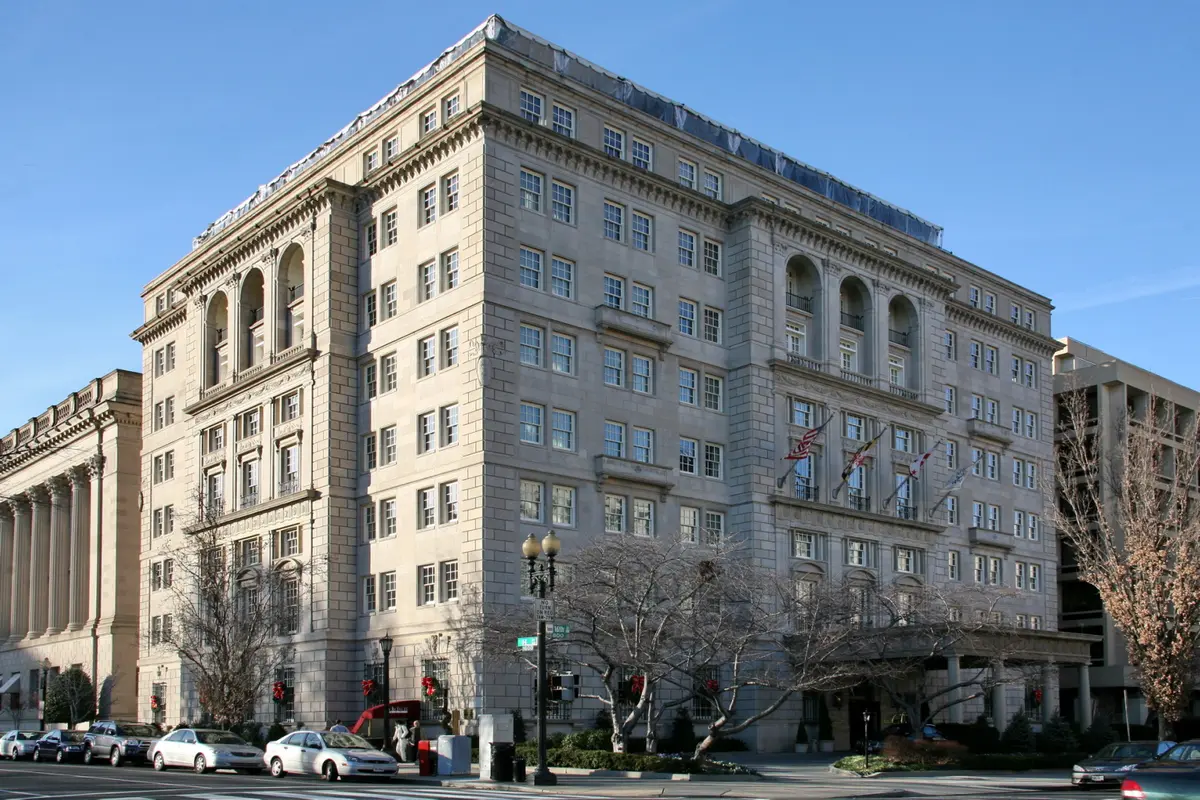
The Hay-Adams stands at 800 16th Street NW, on the corner where the architect H. H. Richardson built joined houses for the statesman John Hay and the historian Henry Adams in the mid-1880s.
Where is Hay–Adams Hotel?
- Location
- District of Columbia, United States
- Type
- Hotel / inn
- Coordinates
- 38.9, -77.037
- Last updated
LOCATION
Why is Hay–Adams Hotel said to be haunted?
Ghost tours say the hotel is haunted by Adams's wife, the photographer Marian "Clover" Adams, who died by suicide in December 1885 with the potassium cyanide she used in her darkroom, and that she died in the house that stood on this site. The contemporary record says otherwise. Reporting the death, the Evening Star of 7 December 1885 placed it at "her residence, 1607 H street", two doors west along the same block, and noted that her husband "had nearly completed a fine residence adjoining that of Col. John Hay, at the corner of 16th and H streets, and expected to occupy it in a few months." Clover Adams never lived on the ground the hotel occupies. What is documented here is stranger than the haunting: a widower who moved alone into the house they had planned together, kept it for thirty-two years, commissioned a nameless bronze for her grave, and wrote an autobiography that omits his marriage entirely.
What is the history of Hay–Adams Hotel?
Two houses stood on this corner before the hotel, and the death that draws ghost hunters here happened in neither of them.
In 1884 John Hay — Abraham Lincoln's former private secretary, later Secretary of State — and the historian Henry Adams commissioned Henry Hobson Richardson to build them adjoining houses on the north-west corner of 16th and H Streets, looking across Lafayette Square to the White House. Hay took the corner lot, at what is now 800 16th Street NW; the Adams house adjoined it along H Street, at number 1603. The two couples, together with the geologist Clarence King, called themselves the Five of Hearts, and their dining room was one of the more consequential in Gilded Age Washington.
Adams's wife was Marian Hooper Adams, called Clover, born in Boston on 13 September 1843 and married to Henry in June 1872. She wrote constantly to her father, the Boston eye doctor Robert William Hooper — the Massachusetts Historical Society, which holds the correspondence, notes the letters were "often sent weekly" — and she wrote them from the house the Adamses rented two doors west along the same block, at 1607 H Street. Ward Thoron's edition of that correspondence, published in 1936, runs from 1865 to 1883 and stops there.
In the spring of 1883 she took up photography and did her own developing, a wet and frankly dangerous craft in the 1880s. The Historical Society holds 137 of her images, among them three albums of work made between 1883 and 1885, and a notebook she kept from May 1883 to January 1884 in which she logged exposures and lighting. She photographed senators and cabinet officers, her own family, Washington streets, and the Adams and Hooper houses in Massachusetts. Her husband discouraged her from publishing.
Her father died on 13 April 1885. In the Society's words, "after her father's death on 13 April 1885, Clover succumbed to an overwhelming depression and took her own life."
She died on Sunday 6 December 1885, aged 42. What Washington was told the following afternoon is worth quoting, because it settles the question the ghost story depends on. Under the heading "Sudden Death of Mrs. Henry Adams", the Evening Star of Monday 7 December reported that she "was found lying on a rug before the fire in an unconscious condition at her residence, 1607 H street, yesterday morning by her husband"; that "the immediate cause of her death was paralysis of the heart"; and — the decisive sentence — that Henry Adams "had nearly completed a fine residence adjoining that of Col. John Hay, at the corner of 16th and H streets, and expected to occupy it in a few months." The paper's account of that morning is domestic and unbearable: Adams was leaving the house for a walk when a caller at the door asked whether she might see his wife, and he went upstairs to enquire.
The cause the newspaper printed was not the cause. She had swallowed potassium cyanide from her darkroom.
Adams moved into the finished house in 1886, alone, and kept it for the remaining thirty-two years of his life. In 1886 he commissioned Augustus Saint-Gaudens to make a memorial for her grave in Rock Creek Cemetery; Stanford White designed its granite setting, and the bronze figure was installed in 1891. Adams refused to let it be given a name. Writing to the editor Richard Watson Gilder on 14 October 1896, in a letter his son published in 1913, he said: "The whole meaning and feeling of the figure is in its universality and anonymity. My own name for it is 'The Peace of God.'" Saint-Gaudens, asked point-blank at the grave on 5 May 1904 what he called it, hesitated and answered, "I call it the Mystery of the Hereafter"; pressed that it did not look like happiness, he said, "it is beyond pain, and beyond joy." John Hay, standing beside him, said: "Thank you for asking. I have always wished to know."
Adams wrote about that grave in The Education of Henry Adams without once saying whose it was, or that he had paid for it. He described sitting there while tourists guessed at the figure's meaning, and concluded: "The interest of the figure was not in its meaning, but in the response of the observer." The book itself contains the most famous silence in American autobiography. Chapter XX is titled "Failure (1871)". Chapter XXI is titled "Twenty Years After (1892)". Into the space between those two headings fall his courtship, his marriage, his wife and her death, none of them mentioned.
The two houses lasted until 1927, when the developer Harry Wardman bought and demolished both and hired the architect Mihran Mesrobian to design an Italian Renaissance apartment-hotel in their place. The Hay-Adams House opened in 1928. It took its name from two men, and eventually took its ghost from a woman who never lived on the site.
Timeline: the documented record of Hay–Adams Hotel
- June 1872 Henry Adams marries Marian Hooper, known as Clover, daughter of the Boston physician Robert William Hooper. The couple later settle in Washington, in a house rented at 1607 H Street NW facing Lafayette Square.
- Spring 1883 Clover Adams takes up photography and does her own developing. The Massachusetts Historical Society holds 137 of her images, three albums made between 1883 and 1885, and the notebook she kept from May 1883 to January 1884 recording exposures and lighting.
- 1884 John Hay and Henry Adams commission Henry Hobson Richardson to design adjoining houses at the north-west corner of 16th and H Streets NW. The hotel's own history dates the commission to this year; the houses were finished in 1886.
- 13 April 1885 Robert William Hooper dies. In the words of the Massachusetts Historical Society, "after her father's death on 13 April 1885, Clover succumbed to an overwhelming depression and took her own life."
- 6 December 1885 Marian Hooper Adams dies at 1607 H Street NW, the house the Adamses were renting, after swallowing potassium cyanide from her darkroom. She was 42.
- 7 December 1885 The Evening Star reports the death under the heading "Sudden Death of Mrs. Henry Adams", gives the cause as "paralysis of the heart", and records that Henry Adams "had nearly completed a fine residence adjoining that of Col. John Hay, at the corner of 16th and H streets, and expected to occupy it in a few months." This is the contemporary evidence that she never lived on the hotel's site.
- 1886 The Richardson houses are completed and Henry Adams moves in alone, at 1603 H Street NW. He commissions Augustus Saint-Gaudens the same year to make a memorial for his wife's grave at Rock Creek Cemetery.
- 1891 The bronze figure is installed in Section E of Rock Creek Cemetery, in a granite setting designed by Stanford White. It carries no name, no dates and no inscription, at Adams's insistence.
- 14 October 1896 Adams writes to the editor Richard Watson Gilder about the memorial: "The whole meaning and feeling of the figure is in its universality and anonymity. My own name for it is 'The Peace of God.'" The letter was printed by Homer Saint-Gaudens in 1913.
- 5 May 1904 At the grave, Saint-Gaudens is asked what he calls the figure and answers, "I call it the Mystery of the Hereafter", adding that "it is beyond pain, and beyond joy". John Hay, present, replies: "Thank you for asking. I have always wished to know." The exchange was recorded by Mrs Barrett Wendell in a letter to the sculptor's son.
- 1918 Henry Adams dies, thirty-two years after moving into the house. The Education of Henry Adams is published the same year: chapter XX is "Failure (1871)", chapter XXI is "Twenty Years After (1892)", and his marriage and his wife's death fall into the gap between them, unmentioned.
- 1927 The developer Harry Wardman buys and demolishes both houses and commissions the architect Mihran Mesrobian to design a 138-room Italian Renaissance apartment-hotel on the site.
- 1928 The Hay-Adams House opens, a $900,000 building with what the hotel describes as Washington's first air-conditioned dining room. Its official history mentions neither Clover Adams's death nor any haunting.
- 29 August 1970 Lafayette Square and its surrounding buildings are listed on the National Register of Historic Places and designated a National Historic Landmark district on the same day.
- 2006–2008 The earliest printed accounts of a Clover Adams haunting located for this entry: Mary Beth Sammons's City Ghosts (2006) and E. Ashley Rooney's Washington D.C. Ghosts, Legends & Lore (2008), seventy-eight years after the hotel opened.
Is there a rational explanation for Hay–Adams Hotel?
The Hay-Adams ghost story has one load-bearing claim, and a Washington newspaper demolished it the day after the death it is built on.
Every version told on the commercial ghost walks says that Clover Adams killed herself in the house that stood where the hotel now stands, and that she therefore never left the address. The Evening Star of 7 December 1885 places her death "at her residence, 1607 H street", and states in the same paragraph that her husband "had nearly completed a fine residence adjoining that of Col. John Hay" and "expected to occupy it in a few months." The Richardson houses were not finished; the Adamses were renting two doors along the block; Henry Adams moved into the new house alone, in 1886, after her death. Mainstream guidebooks get this right — a 2009 walking guide to Washington notes flatly that the corner "belonged to Henry and Marion 'Clover' Adams. However, Clover never lived in the house." The error appears to be propagated by shorter reference summaries and by the tour industry that quotes them.
The rest of the story is unsourced in a very specific way. The standard claims — the fourth floor, rooms numbered with a four, doors opening, lifts stopping uncalled, drinks vanishing at the bar, a woman weeping in a stairwell, a voice asking a housekeeper "what do you want?" — appear on ghost-tour and haunted-hotel websites in the passive voice, and not one of them names a witness, a date, a room number on record, or a publication. There is no incident, in this catalogue's reading of the available material, that can be tied to a named person on a named day.
The hotel itself is the most interesting witness, precisely because it declines to testify. Haunted hotels almost always monetise their ghosts; the Hay-Adams does not. Its official history page walks through Richardson, Wardman, Mesrobian, the 1928 opening and its celebrity guests, and never mentions Clover Adams's death or any haunting. Under this project's rule that a business is a reliable source on what it claims, the Hay-Adams claims nothing.
The signature detail — a smell of bitter almonds in the corridors, said to be the cyanide — is the part that gives the game away chronologically. Hydrogen cyanide does have that characteristic odour, but roughly one person in four is genetically unable to detect it at all, which makes it a poor candidate for a phenomenon that a whole staff reports. More to the point, in December 1885 nobody outside the family circle was told that cyanide was involved: the Evening Star printed "paralysis of the heart." The manner of her death reached the public through twentieth-century biography and scholarship. A ghost whose calling card is the smell of cyanide cannot predate the books that revealed the cyanide, which means the motif is modern, whatever else it is.
Dating the legend is consistent with that. The hotel opened in 1928; the earliest printed accounts of a Clover Adams haunting that could be located for this entry are in popular ghost compilations of the 2000s — Mary Beth Sammons's City Ghosts (2006) and E. Ashley Rooney's Washington D.C. Ghosts, Legends & Lore (2008) — after which the story spread through paid ghost walks across Lafayette Square, a block that those operators openly market as the city's densest concentration of hauntings. Absence of earlier printing is not proof that nobody told the story before, but it does mean the paper trail is short and commercial at both ends.
What survives verification is grief, not haunting: a woman with a documented depression after her father's death, a widower who moved into their unfinished house alone, a nameless bronze he refused to explain, and an autobiography with twenty years cut out of it. That is a stranger and sadder record than anything the tour scripts add to it.
Can you visit Hay–Adams Hotel?
The Hay-Adams is a working luxury hotel at 800 16th Street NW, Washington, D.C. 20006. The plot is the north-west corner of 16th and H Streets, across Lafayette Square from the White House; the switchboard is 202.638.6600. Its own history page runs from the Richardson houses straight to their demolition — "Local developer Harry Wardman buys and razes both homes, replacing them with the Hay-Adams House, an Italian Renaissance-style, 138-room apartment-hotel designed by architect Mihran Mesrobian" — with no line on Clover Adams and none on any ghost. Anyone without a room can eat at The Lafayette on the ground floor or drink at Off the Record in the basement. Top of the Hay, the top-floor room with the White House view that ghost writing turns into a haunted rooftop terrace, is marketed by the hotel as an event space offering "privacy and exclusivity". The hotel site publishes no rate as a figure, on a check made on 9 September 2026. McPherson Square and Farragut West are the nearest Metro stations.
Nothing of Richardson's work survives on the corner: both houses came down in 1927 and the 1928 building stands on their footprint. The room where Clover Adams died was in the house the Adamses rented two doors west, at 1607 H Street. Lafayette Square and the buildings around it entered the National Register of Historic Places and were designated a National Historic Landmark district on 29 August 1970, and the square is public ground at any hour of the day.
The Adams Memorial stands in Section E of Rock Creek Cemetery, 201 Allison Street NW, Washington, D.C. 20011; the office answers on 202.726.2080. On 9 September 2026 the cemetery's contact page gave the grounds hours as 7 a.m. to 5 p.m. from October to March and 7 a.m. to 7 p.m. from April to September, with the office open from 9 a.m. to 5 p.m. on weekdays and closed on all holidays; entering the grounds costs nothing. The hooded bronze sits in a hexagonal granite enclosure designed by Stanford White, screened by holly. It carries no name and no date of any kind, which was Henry Adams's instruction; Marian and Henry Adams lie in front of it under small flat stones. Rock Creek Cemetery is the burial ground of an active parish and it is still burying people.
The Massachusetts Historical Society in Boston holds 137 of Marian Hooper Adams's photographs; among them are three albums of images she made between 1883 and 1885. The Society has digitised the collection and published an online feature on her life and letters.
Sources consulted
- Evening Star (unsigned), «Sudden Death of Mrs. Henry Adams» — Evening Star, Washington, D.C., 7 December 1885, p. 4 (Local Mention); digitised by Chronicling America, Library of Congress, 1885 newspaper archive
- Henry Adams, «The Education of Henry Adams» — Massachusetts Historical Society / Houghton Mifflin; full text at Project Gutenberg, 1918 book
- Homer Saint-Gaudens (ed.), «The Reminiscences of Augustus Saint-Gaudens, vol. I (chapter on the Rock Creek figure)» — The Century Co., New York; full text at Internet Archive, 1913 book
- Marian Hooper Adams, ed. Ward Thoron, «The Letters of Mrs. Henry Adams, 1865-1883» — Little, Brown & Co., Boston, 1936 book
- Massachusetts Historical Society, «Who was Marian "Clover" Hooper Adams? (with selected letters)» — Massachusetts Historical Society, Boston, 2026 archive
- Massachusetts Historical Society, «Marian Hooper Adams Photographs, ca. 1846-1885 (Photo. Coll. 50)» — MHS collection guide, 2026 archive
- The Hay-Adams, «Our Historic Hotel» — hayadams.com (the hotel's own account of its history), 2026 web
- DC Preservation League, «Adams Memorial, Rock Creek Cemetery» — DC Historic Sites, 2026 report
- District of Columbia Office of Planning / National Park Service, «Lafayette Square Historic District» — National Register of Historic Places and National Historic Landmark listing, 29 August 1970, 1970 report
- Mary Beth Sammons, «City Ghosts: True Tales of Hauntings in America's Cities» — Sterling; located via Internet Archive full-text search, 2006 book
- David Gidlow, «Hydrogen cyanide - an update» — Occupational Medicine, vol. 67, no. 9, pp. 662-663, 2017 academic
- Ghost City Tours, «The Haunted Hay-Adams Hotel» — ghostcitytours.com (commercial ghost-tour operator; cited as the source of the modern claims), 2026 web
- Rock Creek Cemetery, «Rock Creek Cemetery - visitor information» — rockcreekcemetery.org, 2026 web
Reviewed by V. Serrano on 2026-08-11 · How we verify our content
💬 Field testimonies (0)
No testimonies yet. Add the first.
Add your testimony
🔒 Log in to add a testimony