👻 HAUNTED PLACE · EXP. Nº9477
ACTIVE
Hellfire Caves
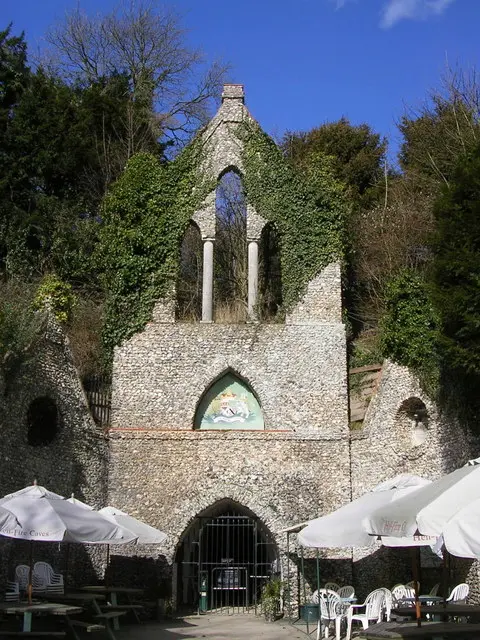
Cut into the chalk hillside above West Wycombe between 1748 and 1752, the Hellfire Caves were commissioned by Sir Francis Dashwood, founder of the notorious Hellfire Club, whose members allegedly held secret rites deep in the tunnels under the motto "Fais ce que tu voudras" — do what thou wilt.
Where is Hellfire Caves?
- Location
- Buckinghamshire, England, United Kingdom
- Type
- Mine
- Coordinates
- 51.646, -0.803
- Last updated
LOCATION
Why is Hellfire Caves said to be haunted?
Local legend attaches the caves to Suki, a village girl said to have been killed by a mob after being lured into a prank near the site in the 18th century; her cries are reported echoing through the passages, along with unexplained cold spots and shadowy figures glimpsed by staff since the caves reopened as a tourist attraction in 1951. Some visitors describe an oppressive feeling of being watched deep in the inner chamber.
What is the history of Hellfire Caves?
Almost everything about the Hellfire Caves is remembered backwards. The tunnels are famous for a club that may never have met in them, and forgotten for the thing that actually put men underground: three failed harvests.
The crops failed at West Wycombe in 1748, in 1749 and again in 1750. The village lived on farm labour and there was none. Sir Francis Dashwood, 2nd Baronet, owned the hill above it, and on its flank there had been an open-cast chalk quarry since at least the Middle Ages, worked for house foundations and road metal; it appears in one of William Hannan's paintings of the 1740s. Instead of distributing relief, Dashwood extended that quarry inwards and paid men to dig. The wage, according to the estate's own history, was one shilling a day, "enough in those times to keep body and soul together".
The chalk had a destination. The road from West Wycombe to High Wycombe — then part of the London-to-Oxford route — ran along the valley bottom and had been rutted so deep that carriages routinely overturned in wet weather. Dashwood's replacement ran three miles in a straight line, framing a view of his own hilltop church tower and its gilded ball. The estate dates the work to 1748–1754 and the road to 1752. It was consistent with the man: he had already argued in Parliament for public works to soak up rural unemployment.
What is not consistent is the shape of the hole. Widening the existing quarry would have produced the same chalk and the same wages. Instead the diggers drove a winding tunnel a quarter of a mile into the hill, with side passages, a great chamber halfway down, a pool of standing water crossed by stepping stones, and a domed circular chamber at the far end with a hook in the roof for a lamp. The estate's own account is disarmingly honest about this: "We are not entirely sure of the reasoning behind his decision." The layout is usually read as a Grand Tour conceit — an underground answer to the follies his neighbours were building above ground, with a nod to the Eleusinian mysteries.
The club came later and, on the evidence, elsewhere. The Knights of St Francis of Wycombe grew out of Dashwood's earlier societies — the Society of Dilettanti (1733), for men who had travelled, and the Divan Club (1744), for those who had reached the Ottoman Empire. Dashwood had returned from Italy with a settled contempt for the Roman church and had himself painted by Knapton as "San Francesco di Wycombo", toasting a statue of Venus. For a meeting place he took the ruined Cistercian abbey at Medmenham, six miles away on the Thames, fitted it out with a cloister and a chapter room, and had the ceilings frescoed by Giuseppe Borgnis, brought from Italy in 1751. Over the door went the Rabelaisian motto "Fay ce que voudras".
The members were not obscure. Lord Sandwich, First Lord of the Admiralty; the radical MP John Wilkes; the satirist Charles Churchill; George Bubb Dodington, Lord Melcombe; Thomas Potter, an archbishop's disinherited son; the poet Paul Whitehead as steward; Dr Benjamin Bates; the three Vansittart brothers. Wilkes himself described the point of it plainly: "a set of worthy, jolly fellows, happy disciples of Venus and Bacchus", who "got occasionally together to celebrate woman in wine". A 1779 book, Nocturnal Revels, recorded the house rules — every member might bring "a Lady of a cheerful lively disposition", and "no indelicacy or indecency is allowed to be intruded without a severe penalty".
It ended quietly. John Tucker, MP for Weymouth, was still angling for an invitation in August 1764; by 22 March 1766 he wrote that he had gone to Medmenham "and to my amazement found the Chapter Room stripped naked". When Whitehead died the club's entire estate was inventoried on 15 October 1774: some wine, 29 pewter plates, 27 knives, 29 forks and 24 wine glasses. Meanwhile Dashwood — by then Lord Le Despencer — was hosting Benjamin Franklin at West Wycombe, where the two men worked on an abridged Book of Common Prayer, and Franklin wrote to his son on 3 August 1773 that he was "in this House as much at my Ease as if it was my own, and the Gardens are a Paradise".
Timeline: the documented record of Hellfire Caves
- 1748–1750 Three successive harvest failures leave West Wycombe without farm work. Dashwood begins driving the old hillside chalk quarry inwards, paying local men a shilling a day to dig.
- 1752 The new straight road between West Wycombe and High Wycombe is finished with chalk from the tunnels, replacing a valley-bottom track so rutted that carriages overturned in wet weather.
- 1760 Charles Johnstone publishes Chrysal; or, The Adventures of a Guinea, a satire narrated by a coin. Its account of a devil-worshipping brotherhood — including the baboon dressed as Satan — becomes, and remains, the fullest source for the satanic Hellfire Club.
- 15 November 1763 Lord Sandwich, himself a member of the brotherhood, reads the obscene Essay on Woman aloud in the House of Lords to destroy John Wilkes. Horace Walpole records that the hypocrisy was so blatant that "the whole world almost united in crying out against the informers".
- 22 March 1766 John Tucker, MP for Weymouth, writes that he went to Medmenham "and to my amazement found the Chapter Room stripped naked". Dashwood had cleared the club's rooms, down to the pegs with the brothers' names above them.
- 3 August 1773 Benjamin Franklin writes to his son from West Wycombe that he is "in this House as much at my Ease as if it was my own, and the Gardens are a Paradise". He and Dashwood were working on an abridged Book of Common Prayer.
- 15 October 1774 After the death of the club's steward Paul Whitehead, an inventory lists everything the order still owned: some wine, 29 pewter plates, 27 knives, 29 forks and 24 wine glasses.
- 16 August 1775 Whitehead's heart, left to Dashwood in his will, is placed in a marble urn in the Dashwood mausoleum with the Bucks militia and a band in procession. The same year Mrs Philip Lybbe Powys visits West Wycombe and writes up the church and mausoleum in her diary without mentioning the caves at all.
- 1899 Emily Climenson's edition of the Powys diaries describes the tunnel, the pool called the Styx and the domed chamber with its lamp hook, and adds the crucial hedge: "In these caves it is asserted the club held their meetings after the break up at Medmenham." The same notes report, on Lipscomb's authority, that Whitehead's heart was stolen from the urn in 1839.
- 1951 Sir Francis Dashwood, 11th Baronet, reopens the cleared caves at a shilling, candles included. The vicar, Father Allen, tells the Daily Mirror that "my tummy wobbles like a jelly every time I pass the entrance" and preaches against the site; nearly 10,000 people pay to go in that first summer. Dashwood's stated view was that any evil would evaporate once crowds of sceptical visitors were let in.
Is there a rational explanation for Hellfire Caves?
The satanic Hellfire Club has one substantial source, and it is a novel.
Charles Johnstone's Chrysal; or, The Adventures of a Guinea (1760) is where the black masses, the invocation of the devil and the whole diabolical apparatus enter the record. It is a satire narrated by a coin. Its own modern editor, E. A. Baker, who reprinted it in 1907 precisely because it is "the fullest extant account" of the Medmenham brotherhood, is blunt about its author: "His extravagance proves him a jaundiced and untrustworthy witness, a man who when he chose played unscrupulously to the mob. His book is a historical document only in the sense that it is a picture of public opinion at the time."
Read the chapter itself and the problem is worse. Johnstone's "monastery" stands on an island in the middle of a lake on the founder's own estate. Medmenham Abbey was a leased riverside ruin six miles from Dashwood's land. The one detailed description of the club's premises does not describe the club's premises.
The timing is the second problem. Horace Walpole — a hostile witness who supplied much of the rest of the legend — gave the game away himself. The Medmenham "follies", he wrote, "would have escaped the eye of the public, if Lord Bute from this seminary of piety and wisdom had not selected a Chancellor of the Exchequer", and it was then that "a false brother arose, who divulged the arcana, and exposed the good Prior, in order to ridicule him as Minister of the Finances". The scandal broke because Dashwood took office, and it was aimed at the office. The pattern repeated on 15 November 1763, when Lord Sandwich — a fellow member — rose in the Lords to read out the obscene Essay on Woman and pin it on John Wilkes. Walpole records that the hypocrisy was so gross that "the whole world almost united in crying out against the informers". This was faction fighting, conducted with the club's own laundry.
That the club met in the caves at all is an assertion, and an old one. The fullest early notice, printed in Emily Climenson's 1899 edition of the diaries of Mrs Philip Lybbe Powys, describes the passage, the pool called the Styx and the circular chamber with its lamp hook, and then says only: "In these caves it is asserted the club held their meetings after the break up at Medmenham." Mrs Powys herself visited West Wycombe in 1775, wrote up the church and the mausoleum in detail — and did not mention the caves.
The ghosts are younger still. The best-known, "Sukie", the servant girl killed by a prank, has no eighteenth- or nineteenth-century record that we have been able to trace; the versions disagree about the inn she worked at and about how she died, and the estate's own history page, which quotes cellar books, private letters and an inventory, never names her. What it does say is that "there have always been tales of ghosts inhabiting the Caves ever since they were dug" — unsourced, and offered as folklore.
The modern reputation has a datable start. Sir Francis Dashwood, 11th Baronet, reopened the cleared tunnels in 1951 at a shilling, candles free. The local vicar, Father Allen, told the Daily Mirror that "my tummy wobbles like a jelly every time I pass the entrance" and followed it with a sermon against the evil emanating from the caves; nearly 10,000 people paid to look that first summer. Dashwood's own response is the most sceptical thing anyone has said about the place: if there was any evil there, he thought it would evaporate once the caves were exposed to crowds of sceptical visitors, and the worst thing to do was keep them shut and lend the stories credibility. Today the operator sells paranormal investigation nights. Underground, a quarter of a mile of unlit chalk that is cold, damp and acoustically strange does the rest.
Can you visit Hellfire Caves?
The caves are open to the public and are run commercially by Hellfire Enterprises within the West Wycombe Estate. West Wycombe Park went to the National Trust in 1943 as a gift from Sir John Dashwood, and the house and grounds are a separate visit; National Trust membership appears on the caves' concession list alongside students, OAPs, Blue Light card holders and the armed forces.
The entrance is on Church Lane, West Wycombe, HP14 3AH, where there is very little parking; the 200-space car park is at Chorley Road, HP14 3AP, about five minutes away on foot. The operator's prices on 22 September 2026 were £9.50 for an adult, £8.00 for under-16s and concessions, £21.00 for a three-person family and £30.00 for a four-person family, both family tickets requiring at least one child under 16; under-2s go free.
The published timetable changes several times a season, and on 22 September 2026 it ran as follows: weekdays 10:00-16:00 and weekends 10:00-17:00 until 11 October; closed 12 to 17 October for decorating; 10:00-16:00 from 18 October to 1 November; weekends only, 10:00-16:00, from 7 to 15 November; closed from 16 November to Christmas Eve for a Santa's Grotto; and daily 10:00-16:00 from 27 December to 3 January. Last admission to the caves is 30 minutes before the published closing time. Private guides and candlelit tours can be booked separately. A group booking of 20 people or more goes through 01494 533739 or [email protected].
The operator's own safety notice says that the caves “can be dangerous”, that “in parts they are steep, narrow, slippery and dark” and that “the floors are uneven and some of the ceilings are low”. Appropriate footwear is required, running is prohibited, children must be accompanied by an adult, and the notice states that “sufferers of dizzy spells, faints, blackouts or loss of balance should not enter”. The tunnels are unheated chalk and stay cool and damp in any weather. They are described as unsuitable for pushchairs and wheelchairs because of the width of the passages, with pushchair parking and baby slings provided instead. Dogs are barred from the caves and the café and allowed in the courtyard. The café, in the Walled Garden, is open to ticket holders and other visitors alike. St Lawrence's church with its golden ball and the Dashwood mausoleum, where Paul Whitehead's heart was kept, stand on the hill directly above the entrance.
Sources consulted
- Horace Walpole, «Memoirs of the Reign of King George the Third, Volume 1» — Richard Bentley (written c. 1763–71, published 1845), 1845 book
- Charles Johnstone, «Chrysal; or, The Adventures of a Guinea, edited with an introduction by E. A. Baker» — George Routledge & Sons (novel first published 1760–65), 1907 book
- Emily J. Climenson (ed.), «Passages from the Diaries of Mrs Philip Lybbe Powys of Hardwick House, Oxon, A.D. 1756–1808» — Longmans, Green & Co., 1899 book
- Benjamin Franklin, «Benjamin Franklin to William Franklin, 3 August 1773» — The Papers of Benjamin Franklin, vol. 20 — Founders Online, National Archives, 1773 archive
- West Wycombe Estate / Hellfire Enterprises, «History: The Caves, The Hellfire Club, Benjamin Franklin, The Mausoleum» — Estate history, quoting the club cellar book, the Tucker letters and the 1774 inventory, 2026 archive
- Esmé Louise James, «Pornography, the devil and baboons in fancy dress: what went on at the infamous historical Hellfire Club» — The Conversation, 2022 newspaper archive
- West Wycombe Parish Council, «History of West Wycombe» — Official parish history, 2026 web
- The Hellfire Caves, «Visit — tickets, opening times and FAQs» — Official visitor information, 2026 web
- National Trust, «West Wycombe's history» — West Wycombe Park, Village and Hill, 2026 web
- Mausolea & Monuments Trust, «Dashwood Mausoleum, West Wycombe» — Mausolea gazetteer, 2026 web
Reviewed by V. Serrano on 2026-07-29 · How we verify our content
💬 Field testimonies (0)
No testimonies yet. Add the first.
Add your testimony
🔒 Log in to add a testimony