👻 HAUNTED PLACE · EXP. Nº9476
ACTIVE
Hermitage Castle
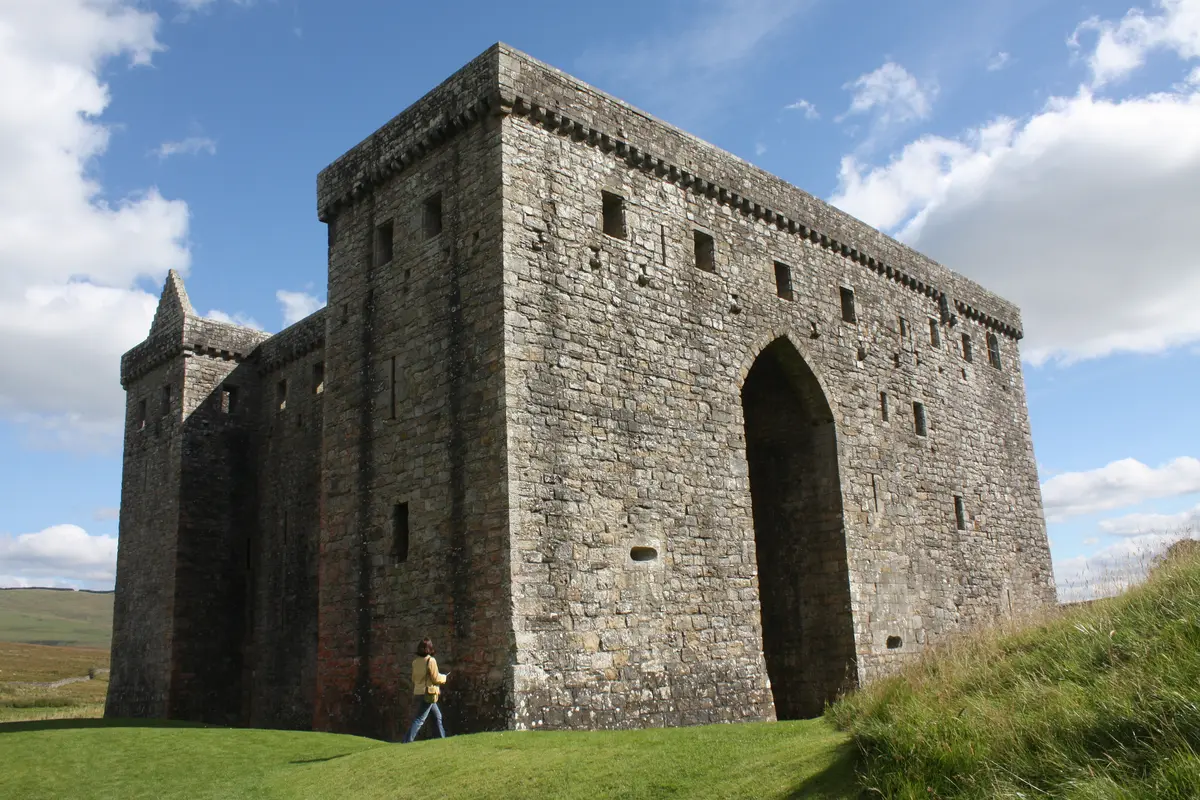
Hermitage Castle stands alone in Liddesdale, in the Scottish Borders, and has long been called the most sinister ruin in Scotland.
Where is Hermitage Castle?
- Location
- Scottish Borders, Scotland, United Kingdom
- Type
- Castle
- Coordinates
- 55.256, -2.793
- Last updated
LOCATION
Why is Hermitage Castle said to be haunted?
The story attached to it is that a 14th-century lord, William de Soulis, was boiled alive in lead by his own tenants at the Nine Stane Rig stone circle. That story is literature, not folklore: it comes from a ballad written by John Leyden and published by Walter Scott in the Minstrelsy of the Scottish Border in 1802, and the historical Soules was in fact convicted of conspiring against Robert Bruce at the Black Parliament of 1320 and died a prisoner, Barbour says at Dumbarton. The castle you see is not even his: Historic Environment Scotland dates the present building to about 1360. The documented horror here is different and worse. In 1342 Sir Alexander Ramsay was chained, dragged to Hermitage by William Douglas and left to starve for seventeen days. In 1566 Mary Queen of Scots rode 25 miles from Jedburgh to visit the wounded Earl of Bothwell, and nearly died of what followed.
What is the history of Hermitage Castle?
Hermitage is older than the building that now carries the name. John of Fordun's chronicle records that Henry III of England mustered an army against Alexander II in the 1240s because "a certain castle, which is called Hermitage, had been reared by the Scots, in the marches between Scotland and England, in Liddesdale". Historic Environment Scotland, which cares for the site today, likewise puts the earliest records of a de Soules residence here in the 1240s, and suspects it stood a little to the west, near the ruined chapel.
The de Soules family lost Liddesdale in one of the most notorious treason trials in Scottish history. In early August 1320 Robert I held a parliament at Scone. Fordun records that Sir William de Soules and the Countess of Strathearn were convicted of conspiring against the king and sentenced to perpetual imprisonment, while David of Brechin, Gilbert Malherbe, John of Logie and Richard Brown were drawn by horses and put to death. John Barbour, writing his verse life of Bruce some fifty years later, adds that Soules was seized at Berwick with three hundred and sixty squires in his company, that he made open confession before parliament, and that he was afterwards "sent to Dunbarton, where he died in the stone castle". The assembly was long remembered as the Black Parliament. The Records of the Parliaments of Scotland note that nothing of it survives in the parliamentary record itself: it is known only from chronicles.
The castle visitors walk into was not his. HES attributes the present stone building to the English lord Sir Hugh de Dacre, who began it around 1360, some forty years after Soules died, and says it was then transformed beyond recognition by his successor William, 1st Earl of Douglas.
It is under the Douglases that Hermitage acquires a documented atrocity, and it is grimmer than the legend. On 20 June 1342, Fordun writes, Sir Alexander Ramsay of Dalhousie, newly sheriff of Teviotdale, was holding court in the church at Hawick when William Douglas and his armed men fell on him, bound him in chains and carried him off. Brought down to Hermitage, Ramsay "is said to have lived seventeen days without any bodily sustenance", and died on the seventeenth day. Douglas wanted the sheriffdom.
In the 1500s the walls were pierced with gun holes and a heavy artillery defence was thrown up to guard the western approach. In October 1566 James Hepburn, 4th Earl of Bothwell, lay here wounded after a skirmish with Border reivers, and Mary Queen of Scots rode twenty-five miles from Jedburgh and back to see him. Hermitage lost its purpose in 1603, when Mary's son inherited the English throne and the border stopped being a frontier. Abandoned, it decayed for two centuries until the Duke of Buccleuch and Queensberry had the ruin consolidated in the 1800s, an act of preservation that HES links directly to the appetite for the Border past created by Walter Scott.
Timeline: the documented record of Hermitage Castle
- 1240s John of Fordun's chronicle names Hermitage as the reason Henry III of England mustered an army against Alexander II: a castle "reared by the Scots, in the marches between Scotland and England, in Liddesdale". Historic Environment Scotland places the earliest records of a de Soules residence here in the same decade.
- Early August 1320 At a parliament at Scone remembered as the Black Parliament, Fordun records that Sir William de Soules and the Countess of Strathearn are convicted of conspiring against Robert I and sentenced to perpetual imprisonment. Barbour adds that Soules was taken at Berwick, confessed in open parliament, and was sent to Dumbarton, "where he died in the stone castle". The Records of the Parliaments of Scotland note that no parliamentary record of the session survives, only chronicle accounts.
- 20 June 1342 Fordun records that Sir Alexander Ramsay of Dalhousie, sheriff of Teviotdale, is seized in the church at Hawick by William Douglas, who wanted the office, chained and carried to Hermitage. Ramsay "is said to have lived seventeen days without any bodily sustenance" and died on the seventeenth day. It is the best-documented death in the castle's history and owes nothing to sorcery.
- c.1360 Historic Environment Scotland attributes the present stone castle to the English lord Sir Hugh de Dacre, who begins it about forty years after William de Soules died, and says it was then transformed beyond recognition by William, 1st Earl of Douglas.
- October 1566 The Earl of Bothwell lies wounded at Hermitage after a skirmish with Border reivers. Mary Queen of Scots rides the 25 miles from Jedburgh and back in a day to see him. HES relates that her horse threw her into a bog on the return; the serious collapse followed at Jedburgh, where she was confined to bed for a week.
- 1802 Walter Scott publishes "Lord Soulis" in the Minstrelsy of the Scottish Border, acknowledging Dr John Leyden as its author. The ballad and Scott's prose note are the source of the boiling story, of Redcap the familiar, and of the cauldron said to be kept at Skelf-hill. Almost everything told about Lord Soulis today descends from this Romantic-era text, not from a medieval one.
- 30 September 1948 The Royal Commission on the Ancient and Historical Monuments of Scotland surveys the circle at Ninestone Rig, publishing the plane-table plan in its Roxburghshire inventory of 1956: eight earthfast stones and a ninth fallen inwards, six broken to stumps under two feet, the ring 23 ft by 21 ft, probably Early Bronze Age. The record mentions no cauldron, no iron bar and no Lord Soulis.
- 23 January 2002 Historic Scotland amends the scheduling of the circle, a scheduled monument since 14 February 1958, as "Nine Stones, stone circle, Ninestone Rig", protecting it as a prehistoric monument rather than as a place of execution.
Is there a rational explanation for Hermitage Castle?
The line most often quoted about Hermitage, "on the ninth stane they buried him then", offered as an anonymous local rhyme, is not in the poem it comes from.
The boiling of Lord Soulis at the Nine-stane Rig reaches us through "Lord Soulis", a ballad written by Dr John Leyden and published by Walter Scott in the Minstrelsy of the Scottish Border in 1802. We read it in the second edition of 1803 and again in T. F. Henderson's edition of 1902. It runs to sixty-six stanzas and contains no such line. What it actually says is: "On a circle of stones they placed the pot, / On a circle of stones but barely nine". The cauldron then travels to Skelf-hill, where Scott says the men of Liddesdale still showed it; nobody is buried under a ninth stone. Two further details of the popular retelling are absent from the source. Scott's prose note gives the king's exasperated "Boil him, if you please, but let me hear no more of him" as tradition, and then immediately supplies the parallel case of Melville of Glenbervie, sheriff of the Mearns, whom the local barons boiled and supped after James I said much the same thing. A story that surfaces twice in two counties with the same royal wisecrack is a migratory legend, not a memory. And Leyden's Soulis abducts no children: he carries off an adult woman, May of Goranberry, betrothed to the heir of Branxholm.
The historical Soules died in custody. Fordun and Barbour agree on a sentence of imprisonment, and Barbour names Dumbarton. He also cannot be the presence in the dungeon shown to visitors, because HES dates the standing castle to around 1360, roughly forty years after his death.
The stone circle is real, but the national archaeological record says nothing about him. Canmore, compiled from an RCAHMS survey of 1948, describes a probable Early Bronze Age circle 290 yards south-south-east of the summit of Ninestone Rig at 910 ft: eight earthfast stones and a ninth fallen inwards, six of them broken to stumps under two feet, the ring measuring 23 ft by 21 ft. In a monument barely seven metres across, Scott's two stones "which supported the iron bar" are antiquarian interpretation laid over a prehistoric setting.
Mary's ride is the last thing to have got turned around. She rode to Hermitage and back, and the collapse came afterwards, at Jedburgh, where it very nearly killed her. Reviewing the medical evidence in Medical History in 1961, Sir Arthur MacNalty read that episode, with its repeated vomiting of blood and the emergency treatment by her surgeon Arnault, as a haemorrhage from the chronic gastric ulcer she had suffered since adolescence, rather than a fever caught in a bog.
Can you visit Hermitage Castle?
Hermitage Castle is in the care of Historic Environment Scotland (HES). Its visitor page, read on 24 September 2026, gives the address as Hermitage Castle, Newcastleton, Roxburghshire TD9 0LU; the national grid reference is NY 498 961 and the site telephone 01387 376 222. The castle opens daily from 10am to 4pm between 1 April and 30 September, with last entry half an hour before closing. From 1 October to 31 March it is closed.
The same page lists adult entry at £7.50 booked online and £8.50 bought at the site. Concessions pay £6.00 online or £6.80 at the site, and children aged 7 to 15 pay £4.50 or £5.00. Members of Historic Scotland enter free and Explorer Pass holders enter on their pass, while Young Scot cardholders pay £1. Visitors with a disability pay the standard rate without having to prove it, and up to two carers per transaction go free.
HES describes the parking as limited, with no marked accessible bays; minibuses can use it and there is no coach parking. The visitor centre is 100 metres from the car park, over a shallow step. The castle is 200 metres away along a mainly grass path that has several steep sections. Inside, the courtyard is cobbled and the rest of the ground floor is gravel. Three stairs lead up: 13 metal steps in the south-west corner with handrails on both sides, 21 steep metal steps in the north-west corner with one handrail, and a stone spiral of 18 steps in the north-east corner, 16 of them with a handrail. There are toilets and a picnic area, and dogs are allowed outdoors. The nearest adapted toilet is six miles away, in Langholm Street, Newcastleton. For public transport the page sends visitors to Traveline Scotland and gives no route of its own. Among nearby HES sites it lists Jedburgh Abbey at 18 miles.
The stone circle of the Soulis legend is a separate monument with its own scheduling record, SM1688, "Nine Stones, stone circle, Ninestone Rig", first scheduled on 14 February 1958 and last amended on 23 January 2002. The record places it at NY 51749 97307, about 280 metres above sea level on a south-facing slope over the Roughley Burn, and describes a slightly oval ring 7.5 metres by 7. Most of its nine stones stand about half a metre high; the tallest reaches 1.75 metres. Measured from the castle's grid reference, the circle lies 2.3 kilometres (1.4 miles) to the east-north-east. The HES visitor page for the castle does not mention it.
Sources consulted
- John Leyden; ed. Walter Scott and T. F. Henderson, «Lord Soulis, in Minstrelsy of the Scottish Border, vol. IV (Henderson edition), with Scott's prose note on the Nine-stane Rig» — William Blackwood and Sons, Edinburgh, 1902 book
- Walter Scott (ed.), «Minstrelsy of the Scottish Border, second edition, vol. II (text of Lord Soulis as first collected)» — Printed by James Ballantyne, Edinburgh, for Longman and Rees, London, 1803 book
- John of Fordun; trans. Felix J. H. Skene, ed. William F. Skene, «John of Fordun's Chronicle of the Scottish Nation (Annals: the 1320 parliament at Scone; the death of Sir Alexander Ramsay, 1342)» — Edmonston and Douglas, Edinburgh (The Historians of Scotland, vol. IV), 1872 book
- Royal Commission on the Ancient and Historical Monuments of Scotland / Historic Environment Scotland, «Ninestone Rig, Canmore ID 67994 (RCAHMS survey 1948, published 1956; scheduling note 2002)» — Canmore, the National Record of the Historic Environment, 1956 archive
- Historic Environment Scotland, «Hermitage Castle: history and stories» — Official site information, 2026 web
- Historic Environment Scotland, «Hermitage Castle: prices and opening times, access and parking» — Official visitor information, 2026 web
- John Barbour; trans. George Eyre-Todd, «The Bruce, being the metrical history of Robert the Bruce, Book XIX (the conspiracy of Lord Soulis and his imprisonment at Dumbarton)» — Gowans & Gray, Glasgow, 1907 book
- Sir Arthur S. MacNalty, «The Maladies of Mary Queen of Scots» — Medical History, vol. 5, no. 3, pp. 203-209, 1961 academic
- Records of the Parliaments of Scotland to 1707, «1320, Early August, Scone, Parliament (the 'Black Parliament'): editorial note recording that the assembly survives only in chronicle references» — University of St Andrews, 2007 academic
- Michael A. Penman, «'A fell coniuracioun agayn Robert the douchty king': the Soules conspiracy of 1318-1320 (abstract consulted)» — The Innes Review, vol. 50, no. 1, pp. 25-57, 1999 academic
- Historic Environment Scotland, «Nine Stones, stone circle, Ninestone Rig (SM1688) — scheduled monument record: added 14 February 1958, last amended 23 January 2002» — Historic Environment Scotland designations portal, 2002 report
Reviewed by V. Serrano on 2026-08-11 · How we verify our content
💬 Field testimonies (0)
No testimonies yet. Add the first.
Add your testimony
🔒 Log in to add a testimony