👻 HAUNTED PLACE · EXP. Nº9477
ACTIVE
Hinton Ampner
Hinton Ampner is the rare Georgian haunting with a first-hand paper trail.
Where is Hinton Ampner?
- Location
- Hampshire, England, United Kingdom
- Type
- House / mansion
- Coordinates
- 51.044, -1.151
- Last updated
LOCATION
Why is Hinton Ampner said to be haunted?
Mary Ricketts, who moved into the old Tudor manor in January 1765, spent six years hearing doors slam, feet cross empty rooms and, from 2 April 1771, a hollow murmur that never let up. In August 1771 her brother, Captain John Jervis of the frigate Alarm and later Earl St Vincent, sat up armed with a neighbour, wrote to her husband in Jamaica that he had heard what he could not account for, and made her leave. The owner's agent posted a notice offering fifty guineas to whoever would name the culprit; nobody ever claimed it. In July 1772 Ricketts set the whole thing down for her children, and the manuscript stayed in the family until her great-granddaughter published it in 1872. She never saw an apparition herself: every sighting in the file belongs to servants, years earlier, and the murder story cannot be dated before 1818. The house is gone too, pulled down before 1800. What the National Trust opens today is not the haunted house.
What is the history of Hinton Ampner?
The house that made Hinton Ampner famous is not there any more. It was a large Tudor manor of the 1540s, held on lease from the Dean and Chapter of Winchester by the Stewkeley family from 1597, and it passed in 1719, on the death of Sir Hugh Stewkeley, to his daughter Mary, the wife of Edward Stawell.
Stawell — who became Lord Stawell on his elder brother's death — made Hinton his constant home. His wife's youngest sister, Honoria, lived with the couple and stayed on with him after her sister died, until her own death in 1754. On the evening of 2 April 1755 Lord Stawell was sitting alone in the little parlour when he was seized with apoplexy. He called to his manservant, "Cut a vein, cut a vein!" — no vein was cut — articulated one further sentence that could be understood, and died the next morning.
The estate went to the Right Hon. Henry Bilson Legge, husband of Stawell's daughter and heiress. For nine years the house was left to a skeleton staff, Legge coming down for a month each shooting season. He died in August 1764, and his widow — Lady Stawell in her own right, later married to the Earl of Hillsborough — decided to let the place. William Henry Ricketts, a Jamaican landowner and bencher of Gray's Inn, took it that December, and the family moved in from London in January 1765.
His wife was Mary Ricketts, born Mary Jervis at Meaford in Staffordshire in 1737-8, married in 1757, and educated by the historian Nicholas Tindal. From the first months there were doors slapping violently at night. Ricketts suspected villagers with duplicate keys and had every lock changed; it made no difference. About six months in, the nurse Elizabeth Brelsford, sitting with the baby on a hot summer evening, watched a gentleman in a drab-coloured suit walk into the yellow bedchamber; the housemaid Molly Newman searched it with her and found no one. That autumn the groom George Turner crossed the great hall, saw a man in a drab coat, took him for the newly arrived butler, went upstairs and found every manservant in bed. In July 1767 four servants in the kitchen heard a woman come downstairs in rustling silk and saw a tall figure in dark clothes sweep past and out of the house door; the man walking in the other way had met nobody.
Ricketts sailed for his Jamaican estates in the autumn of 1769. His wife stayed behind with three small children — William Henry, born 1764, Edward Jervis, born 1767, and Mary, born 1768 — and eight servants. The noises grew: footsteps walking to the foot of her bed in the summer of 1770; three violent knocks that November; from early 1771 "a hollow murmuring that seemed to possess the whole house". On 2 April 1771 the sustained phase began, and it did not stop.
She kept it to herself for nearly four months. Her brother, Captain John Jervis of the 32-gun frigate Alarm — the future Earl St Vincent — visited and heard nothing while he knew nothing. Only when she finally told him did he and Captain Luttrell of Kilmeston sit up armed through the night. On 9 August 1771 Jervis wrote to his brother-in-law in Jamaica that Hinton had been disturbed "from the 2nd of April to this day, with little or no intermission", and that it was "very unfit your family should continue any longer in it". From off Lymington on 16 August he pressed her to give up the house at Christmas and "never to enter it again". She wrote to her husband from Winchester on 17 August; she had already left.
The owner's side treated it as a crime. Lady Hillsborough's agent, John Sainsbury, came over from Marelands on 18 September 1771 with two of her men "to sit up, and shoot at the place whence any noise proceeds", and on 20 September had a notice posted on the church doors of Hinton, Bramdean and Kilmeston offering fifty guineas to whoever would name "the Auther or Authers" of "this wicked scheme". Nobody ever claimed it.
Mary Ricketts went to the Newbolts, then to Wolvesey, the Bishop of Winchester's old palace. In July 1772, writing from Hinton Parsonage, she set the whole thing down for her children, had exactly one further copy made, and left the manuscripts to her two granddaughters, not to be read "until twenty-one or upwards, nor then unless their nerves are firm". A family named Lawrence took the manor about a year later, forbade the servants to mention the noises, and left suddenly after a year. The house was never occupied again and was pulled down; under a floor the workmen were said to have found Civil War papers and a small box containing a skull "said to be that of a monkey", which no anatomist ever examined. The present house went up in 1793 on a different site nearby. The narrative itself stayed in the family for a century, until Mary Ricketts's great-granddaughter, Mrs W. Henley Jervis, edited it for the Gentleman's Magazine in November and December 1872 as "A Hampshire Ghost Story".
Timeline: the documented record of Hinton Ampner
- 2 April 1755 Lord Stawell, sitting alone in the little parlour, is seized with apoplexy. He calls to his manservant, "Cut a vein, cut a vein!", speaks one further intelligible sentence and dies the next morning. Mary Ricketts records the detail from Dame Camis, a villager who knew the household.
- January 1765 William Henry Ricketts, who took the lease that December after the death of Henry Bilson Legge, moves his family in from London. Doors begin slapping at night within months; changing every lock in the house makes no difference.
- Summer and autumn 1765 The nurse Elizabeth Brelsford sees a gentleman in a drab-coloured suit walk into the yellow bedchamber; that autumn the groom George Turner sees a man in a drab coat in the great hall and finds every manservant already in bed. Both are servants' accounts, and Mary Ricketts dismisses them at the time.
- July 1767 Four servants in the kitchen — Thomas Wheeler, Ann Hall, a maid named Sarah and Dame Lacy — hear a woman come downstairs in rustling silk and see a tall figure in dark clothes sweep past and out. The cook, Dame Brown, meets it in the doorway; the man coming in the other way has passed nobody.
- Autumn 1769 William Henry Ricketts sails for his estates in Jamaica. His wife stays at Hinton with three children under six and eight servants, and the night noises worsen.
- 2 April 1771 Mary Ricketts wakes between one and two in the morning, checks the hour by her watch and listens at the lobby door for twenty minutes to footsteps and something pushing hard against a door. She dates the sustained phase of the disturbances from this night and tells almost nobody for four months.
- August 1771 Her brother, Captain John Jervis of HMS Alarm, and Captain Luttrell of Kilmeston sit up armed through the night. On 9 August Jervis writes to Ricketts in Jamaica that the house has been disturbed "from the 2nd of April to this day" and that he heard what he could not "any way account for". Mary Ricketts leaves Hinton and writes to her husband from Winchester on 17 August.
- 20 September 1771 John Sainsbury, agent to Lady Hillsborough, has a notice posted on the church doors of Hinton, Bramdean and Kilmeston offering fifty guineas for the discovery of "the Auther or Authers" of the noises, with a pardon for any accomplice who informs. Two days earlier he had come with two armed men to sit up in the house. No one ever claims the money.
- July 1772 From Hinton Parsonage, Mary Ricketts writes the narrative for her children, has exactly one further copy made and leaves the manuscripts to her granddaughters, not to be read "until twenty-one or upwards, nor then unless their nerves are firm".
- 1793 The present house is built on a different site nearby, the Tudor manor having been pulled down; only the cellars of that 1793 building survive today. Victorian retellings date the demolition of the old house to 1797 instead.
- 10 July 1818 Ricketts's granddaughter Martha H. G. Jervis writes down what old Lucy Camis, a former servant, said at the farm: "God knows whether she had a child and killed it; but I cannot say." It is the earliest datable appearance of the infanticide story, offered as a guess forty-seven years after the events.
- November–December 1872 Mrs W. Henley Jervis, Mary Ricketts's great-granddaughter, edits the manuscripts and the family letters for the Gentleman's Magazine as "A Hampshire Ghost Story". It is the first publication of the primary documents, a century after they were written.
- 1960 Fire wrecks the house that stands today. Ralph Dutton rebuilds it, and on his death in 1985 leaves the estate to the National Trust, which opens it as his house and garden.
Is there a rational explanation for Hinton Ampner?
Hinton Ampner is unusual because the paperwork is real. The letters of August and September 1771 are contemporary with the events, and Mary Ricketts's long narrative was written in July 1772, less than a year after she left. That is far better documentation than most Georgian ghost stories have. It still does not make the noises supernatural, and several of the strongest objections come out of the documents themselves.
Mary Ricketts never saw anything. Every apparition in the file was reported by servants, and all of them belong to 1765-67, six years before the noises peaked: the nurse Elizabeth Brelsford, the groom George Turner, four people in the kitchen. The identification of the drab-coated figure as the late Lord Stawell was made afterwards, by other people, from the way he used to stand with his hands behind his back.
The hearing was selective in a way that argues against a physical source. Ricketts wrote: "Several instances occurred where very loud noises were heard by one or two persons, when those equally near and in the same direction were not sensible of the least impression." Her brother heard nothing at all while he was ignorant of the affair; on the night of his vigil she heard doors slam violently and he heard none of it, while Captain Luttrell heard them and Jervis did not. She was also, by her own account, running on months of broken sleep, with "a slow fever and deep cough" that she attributes directly to being woken night after night.
Everyone involved at the time assumed fraud. "That is the current belief," she wrote to her husband. Lady Hillsborough's agent came with armed men to shoot at the noise and posted a reward for the "contriver of this wicked scheme"; the reward went unclaimed, which proves only that nobody informed. In 1897 Andrew Lang, reviewing the case at length, noted that the fashionable new explanation of his own day was seismic — he cited Professor John Milne in The Times of 21 June 1897 — and that a sceptic could put the whole thing down to suggestion, "caused first in Mrs. Ricketts' own mind by vague tales of a gentleman in drab seen by the servants".
The murder story is not hers. Her 1772 narrative reports only village talk of treasure hidden under the lobby floor, which she tried to trace "without much success", and a friend's guess that some undiscovered murder lay behind it. The familiar version — Lord Stawell's affair with his sister-in-law, a baby killed and buried in the house, the bailiff Isaac Mackrel as accomplice — cannot be dated earlier than 10 July 1818, when Ricketts's granddaughter Martha Jervis wrote down what old Lucy Camis said at the farm: "God knows whether she had a child and killed it; but I cannot say; it is not for us to suspect them." That is forty-seven years after the event and it is offered as a guess. It hardens into a plot in R. H. Barham's notebook of 1836, at third hand — Barham had it from a Mrs Hughes, who had it from a Mrs Gwynn — and Barham's own son later admitted the version his father recorded "contained some important errors in respect of the dramatis personae".
The retellings drift in smaller ways too, which is a useful warning. The reward is fifty guineas in Sainsbury's printed notice of 20 September 1771, and sixty pounds raised to a hundred in Mary Ricketts's later recollection; by the Victorian anthologies it is simply "sixty pounds". The demolition is dated 1797 by John Ingram in 1884 and by Allan Fea, while the estate's own architectural record puts the replacement house at 1793. And one small thing does check out perfectly: Ricketts dates a disturbance to the night before the morning of 27 February 1771 and then says the next one came "that very day five weeks, being the 2nd of April". Counting from the night, 26 February 1771 was a Tuesday and 2 April 1771 was a Tuesday, exactly thirty-five days later — and 7 May, which she calls "exactly the day five weeks from the 2nd of April", was a Tuesday too. She was working from real dates.
One coincidence in her own text is worth noting because she never mentions it: the sustained disturbances began on 2 April 1771, and Lord Stawell was struck down in the little parlour on the evening of 2 April 1755. Both dates are in her narrative, sixteen years apart, and she draws no connection between them.
None of it can be tested now. The building where it happened was demolished before the end of the eighteenth century, and nothing of it survives above ground.
Can you visit Hinton Ampner?
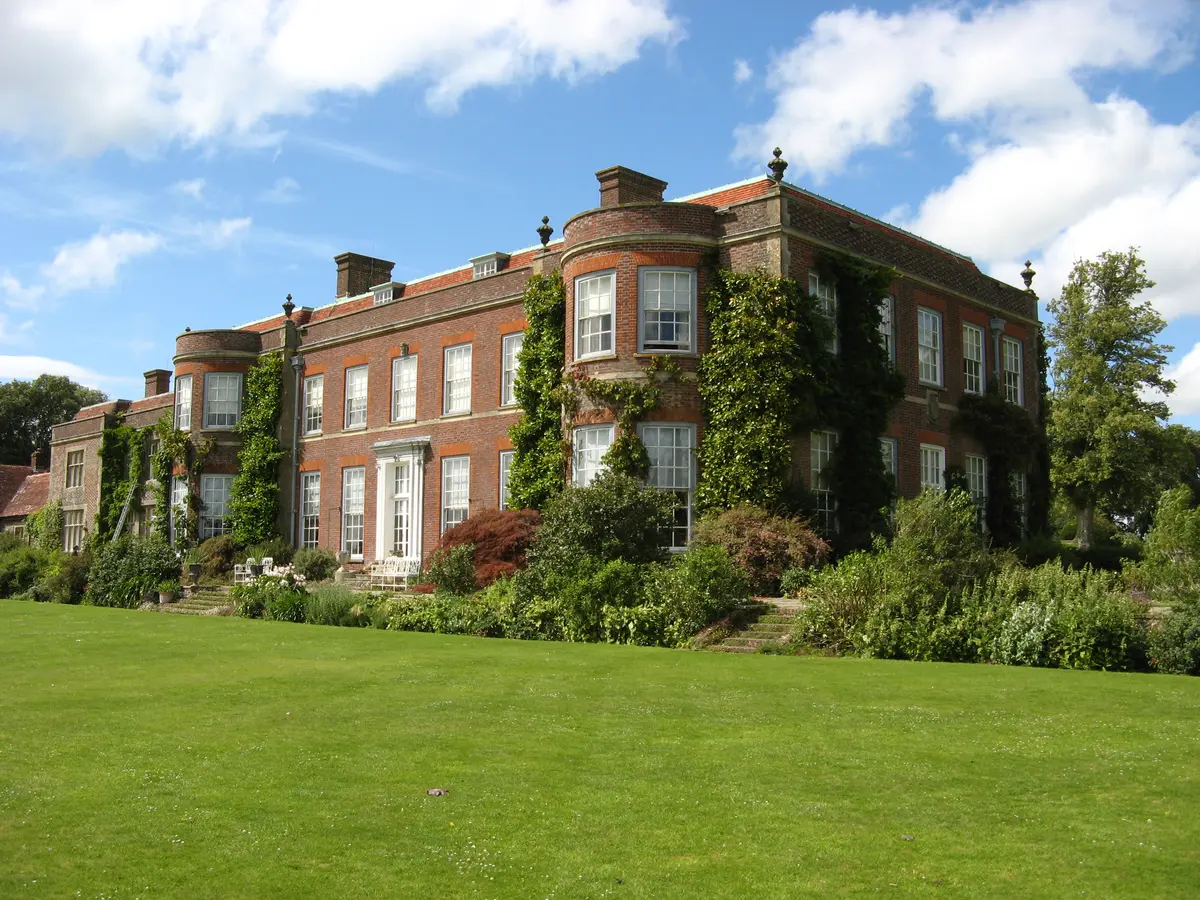
The first thing to be clear about: the haunted house is gone, and the house the National Trust opens is not it. The Tudor manor where Mary Ricketts lived was pulled down in the 1790s and never rebuilt on its own footprint. The Georgian house that replaced it went up in 1793 on a different site close by, and even that survives only in part — the Buildings of England volume for northern Hampshire records that "of the plain Georgian box built in 1793 only cellars remain". It was enlarged and remodelled in the 1860s, recast in Neo-Georgian style in the late 1930s for Ralph Dutton, and then gutted by fire in 1960 and rebuilt by Dutton, who left the estate to the National Trust on his death in 1985. Visitors come for a twentieth-century interior and one of the best formal gardens in Hampshire; nobody is walking the lobby where the footsteps were heard.
The property is at Hinton Ampner, near Alresford, Hampshire SO24 0LA, on the A272 about a mile west of Bramdean and eight miles east of Winchester (telephone 01962 771305). Sat-nav users are directed to SO24 0NH, the pub just west of the main gates. Parking is free; the nearest stations are Alresford (4 miles), Winchester and Petersfield, and the Stagecoach 67 between Winchester and Petersfield stops within five minutes' walk, with no Sunday service.
On 12 August 2026 the garden, estate and second-hand bookshop opened 10:00-17:00, the house 11:00-15:30, the shop 11:00-17:00 and the café 10:00-16:30, with last entry an hour before closing; the house keeps shorter hours than the garden all year, so check the calendar before travelling. Peak-season admission was £18.00 for an adult house-and-garden ticket (£19.80 with Gift Aid) and £9.00 for a child aged 5-17, with garden-only and off-peak rates lower and under-fives and National Trust members free.
There is ramped access to reception, to the house by a side entrance and to the café, accessible parking and a drop-off point, six manual wheelchairs for loan, an induction loop, Braille guides and large-print maps. Dogs on short leads are welcome in the garden, on the estate and in the shops, but only assistance dogs indoors. Three waymarked estate walks run from the property into the South Downs National Park, including a five-mile route over the Battle of Cheriton ground. All Saints church, where Ralph Dutton is buried and where Lord Stawell's old housekeeper Mrs Parfait was buried in February 1771, stands between the house and the village cottages.
One last note for anyone hoping for a ghost tour: on the National Trust's own visitor pages, consulted on 12 August 2026, the case is not mentioned at all. The Trust presents Hinton Ampner as Ralph Dutton's house and garden.
Sources consulted
- Mary Ricketts, John Jervis and others; edited by Mrs W. Henley Jervis, «A Hampshire Ghost Story (part 1: family letters of August–September 1771 and the opening of Mrs Ricketts's narrative)» — The Gentleman's Magazine, November 1872, vol. 233 (n.s. IX), pp. 546–560, 1872 newspaper archive
- Mary Ricketts, Martha H. G. Jervis and others; edited by Mrs W. Henley Jervis, «A Hampshire Ghost Story (part 2: continuation of Mrs Ricketts's narrative, the later narratives and the 1818 notes)» — The Gentleman's Magazine, December 1872, vol. 233 (n.s. IX), pp. 666–678, 1872 newspaper archive
- Andrew Lang, «The Book of Dreams and Ghosts, chapter "Hinton Ampner", pp. 221–227» — Longmans, Green & Co., London, 1897 book
- John H. Ingram, «The Haunted Homes and Family Traditions of Great Britain, "Hinton Ampner Manor House", pp. 481–502» — Gibbings & Company, London (illustrated edition), 1897 book
- Jedediah Stephens Tucker, «Memoirs of Admiral the Right Hon. the Earl of St Vincent, vol. 1 (includes Jervis's letter datelined "Hinton, July 7th, 1771" and his command of the frigate Alarm)» — Richard Bentley, London, 1844 book
- Michael Bullen, John Crook, Rodney Hubbuck and Nikolaus Pevsner, «Hampshire: Winchester and the North (The Buildings of England) — "of the plain Georgian box built in 1793 only cellars remain"» — Yale University Press, 2010 book
- National Trust, «Hinton Ampner — visitor information, opening times, prices and access» — Official visitor pages, consulted 12 August 2026, 2026 web
- Parks & Gardens UK, «Hinton Ampner — site record (Tudor origins; the Georgian house built on a different site)» — Parks & Gardens UK database, 2026 web
Reviewed by V. Serrano on 2026-08-12 · How we verify our content
💬 Field testimonies (0)
No testimonies yet. Add the first.
Add your testimony
🔒 Log in to add a testimony