👻 HAUNTED PLACE · EXP. Nº9476
ACTIVE
HM Prison Castle Huntly
Castle Huntly is a fifteenth-century tower house on a volcanic mound in the Carse of Gowrie, seven miles west of Dundee.
Where is HM Prison Castle Huntly?
- Location
- Perth and Kinross, Scotland, United Kingdom
- Type
- Prison
- Coordinates
- 56.449, -3.134
- Last updated
LOCATION
Why is HM Prison Castle Huntly said to be haunted?
It is also HMP Castle Huntly, Scotland's only open prison — an operating establishment with around two hundred men living in it, and no visitor access of any kind. The ghost attached to it is a White Lady: a daughter of the Lyon family who, the story goes, took a manservant as her lover and was shut in a bedroom at the top of the tower. The oldest printed telling we have been able to date is from 1982, a paperback whose author sourced it to "Longforgan Parish records and ex-member of staff". Two detailed nineteenth-century histories of the castle, and the standard 1923 book on the hauntings of the Dundee district, say nothing about her at all. What the archive does hold is stranger than the legend: a dowager Countess of Strathmore who really did marry a servant of her own household here, openly, in 1745 — and a nine-year-old boy, the last Paterson heir, drowned in the Tay in 1939.
What is the history of HM Prison Castle Huntly?
Castle Huntly stands on a volcanic outcrop in the flat farmland of the Carse of Gowrie, about seven miles west of Dundee. Historic Environment Scotland dates its origins to the fifteenth century and records that in 1452 Andrew, Lord Gray, was granted a royal licence to build a castle; construction probably began soon afterwards. The Reverend Adam Philip, whose parish history of Longforgan appeared in 1895, adds that the first firm documentary mention of "the tower and fortalice of Huntly" comes in a charter of 1508-9, that the walls are ten feet thick in places, and that the stone came from the quarries at Kingoodie. He also punctures the pretty local explanation of the name — that Andrew Gray married a daughter of Lord Huntly and called the house after his bride: "The unfortunate thing for this pretty story is that no such marriage took place."
The castle was never much of a fortress. Earl Patrick of Strathmore, who inherited it, wrote in his Book of Record that when his grandfather bought it from Lord Gray it was "a place of no consideratione, fit for nothing else but as a place of refuge in the time of trouble, wherein a man might make himself a prisoner" — a sentence that reads oddly now.
Patrick, first Earl of Kinghorne, bought the estate in 1613. His son John remodelled the house in the 1630s as a summer seat, and it became known as Castle Lyon after the family surname; Philip notes that the change of name is usually dated instead to 1672, when Charles II erected the barony into the Lordship of Lyon. The third Earl of Kinghorne, later first Earl of Strathmore, arrived on 30 May 1660 as an eighteen-year-old student and found the place stripped: there was "not so much as on bed to ly doune in", the garden was a marsh, and his father had left debts of 400,000 merks. He rebuilt it and laid out the terraced gardens whose brick terraces and three Renaissance statues still survive.
The darkest chapter belongs to Lady Susanna Cochrane, second daughter of the fourth Earl of Dundonald, who married the Earl of Strathmore in 1725. Her husband was run through in a Forfar tavern brawl after a funeral in May 1728 and died two days later. Widowed and childless, she lived for seventeen years at Castle Lyon, which was the jointure house of the countesses. Then, on 2 April 1745, aged thirty-six, she married George Forbes, a young man who — as Robert Scott Fittis put it in 1879, drawing on Sir Bernard Burke — "had originally filled a humble station in her own household". The couple left Scotland, quickly proved incompatible, and lived apart; she died in Paris on 24 June 1754.
In 1777 the widow of the seventh Earl sold the estate for £40,000 to George Paterson, newly returned from India, who had married a daughter of Lord Gray and restored the castle's older name in her honour. He and his successors gave the building most of the silhouette it has today: castellated wings in 1777-83, and in 1792-5 a block with a top-lit oval saloon.
The Paterson line ended abruptly. Their only son, Richard David Charles Paterson, born in 1930, was drowned in a yachting accident on the Tay in 1939; his father, Colonel Adrian Paterson, died in 1940. During the Second World War the castle was used as a girls' probation school. The Scottish Home and Health Department bought it in 1946, and it opened as a borstal — 1947 by most accounts, 1946 by the Scottish Prison Service's own. It later became a young offenders' institution and is today HMP Castle Huntly, Scotland's only open prison. It was listed at Category A on 5 October 1971.
Timeline: the documented record of HM Prison Castle Huntly
- 1452 Andrew, Lord Gray, is granted a royal licence by James II to build a castle on the barony of Longforgan. Historic Environment Scotland records the licence and dates the start of building to shortly afterwards; Adam Philip's parish history calls the grantee the second Lord Gray, and the numbering of the early Grays is not agreed between sources.
- 1508-9 The first firm documentary mention of "the tower and fortalice of Huntly" appears in a charter, according to Adam Philip, who notes that the castle's supposed name origin — a Gray marrying a daughter of Lord Huntly — never happened.
- 1613 Patrick, first Earl of Kinghorne, buys the estate from the Grays. His son John remodels the house in the 1630s as a summer seat and it becomes known as Castle Lyon.
- 30 May 1660 Patrick, third Earl of Kinghorne and later first Earl of Strathmore, arrives aged eighteen to find the house stripped — "not so much as on bed to ly doune in", by his own account in the Book of Record — and a debt of 400,000 merks. He rebuilds it and lays out the terraced gardens.
- 13 May 1672 Charles II erects the barony of Castle Huntly into a lordship to be called the Lordship of Lyon. Philip notes that the change of the castle's name to Castle Lyon is usually dated to this moment rather than to the purchase.
- 9 May 1728 After a funeral at Forfar, the Earl of Strathmore is mortally wounded in a drunken tavern brawl by James Carnegie of Finhaven and dies two days later. His widow, Lady Susanna Cochrane, is left childless.
- 2 April 1745 After seventeen years of widowhood at Castle Lyon, her jointure house, Susanna Cochrane marries George Forbes, who Fittis says "had originally filled a humble station in her own household". The couple leave Scotland and soon live apart. This is the documented event closest to the White Lady legend — and no one died in it.
- 24 June 1754 Susanna Cochrane dies in Paris, a Roman Catholic, having borne a daughter and lived apart from her husband. She did not jump from any battlement.
- 1777 The widow of the seventh Earl of Strathmore sells the estate for £40,000 to George Paterson, returned from India, who restores the name Castle Huntly in honour of his wife, a daughter of Lord Gray, and remodels the house in 1777-83 and again in 1792-5.
- 1939 Richard David Charles Paterson, born 1930 and the only son of Colonel Adrian Gordon Paterson, is drowned in a yachting accident on the Tay. Grant Campbell quotes the family gravestone at Longforgan parish church: "His only son Richard David Charles 1930-1939".
- 1940 Colonel Adrian Paterson dies, a year after his son. The estate passes out of the family that had held it since 1777. During the Second World War the castle is used as a girls' probation school.
- 1946-47 The Scottish Home and Health Department buys the castle for use as a borstal. Most accounts date the opening to 1947 after refurbishment; the Scottish Prison Service's own page says 1946. It later becomes a young offenders' institution and then an open prison.
- 5 October 1971 The castle is listed at Category A. The record was revised on 23 October 2015 as part of the Scottish Prison Service Listing Review, and covers the tower, the garden terraces and three late seventeenth-century Renaissance statues.
- 1982 Grant Campbell publishes "The White Lady of Castle Huntly" in Scottish Hauntings, sourcing it to "Longforgan Parish records and ex-member of staff". It is the earliest printed telling of the legend that I have been able to date, and the only book in Open Library's full-text corpus to use that phrase.
- 11 July 2024 The Independent Prison Monitoring team publishes its annual report on HMP Castle Huntly for 2023-24: fifty-two visits, all nine standards rated green, no key issues, and prisoners describing the freedom to move around unescorted as good preparation for release.
Is there a rational explanation for HM Prison Castle Huntly?
The oldest printed telling of this ghost story that I have been able to date is from 1982.
It is a chapter called "The White Lady of Castle Huntly" in Grant Campbell's paperback Scottish Hauntings (Piccolo/Pan). Searching the full text of Open Library's book corpus, the exact phrase "White Lady of Castle Huntly" returns exactly one book — Campbell's — and the result is stable when the query is repeated. As a control in the same corpus and the same session, "Castle Huntly" alone returns 1,096 books and "White Lady of Claypotts", a rival Dundee ghost, returns eight. The single hit is not a failed search.
Campbell tells it this way: while the Lyon family held the castle "it is said that a daughter of the house became the lover of a manservant", and when her parents found out "the daughter was banished to a bedroom high up on the tower looking out on to the battlements". What became of the manservant, he writes, "is not recorded but it is a good guess that he was thrown alive into the vaulted dungeon" — an author telling you, mid-story, that he is filling a gap. The castle does have such a space: the Historic Environment Scotland record notes vaulted basement storerooms, one giving access to a pit-prison. For his sources Campbell cites "Longforgan Parish records and ex-member of staff".
Older books that ought to carry the story do not. Robert Scott Fittis devoted a long chapter to Castle Huntly in his Book of Perthshire Memorabilia (1879): across some 206,000 words the phrase "white lady" appears not once, although he happily relates the Green Lady of another house and uses the word "superstition" fourteen times. Adam Philip's Parish of Longforgan (1895) gives the castle its own chapter and never mentions a ghost, spectre, apparition or white lady — checked on two independent scans — while using "tradition" more than twenty times and "witch" ten. And A. H. Millar's Haunted Dundee (1923), the standard collection for this district, spends thirty-five mentions on Claypotts and its White Lady but names Castle Huntly once, as a place where a gardener once worked.
The second ghost is even easier to trace, because Campbell shows his working. In the borstal years a tower bedroom overlooking the battlements was a dormitory for inmates who worked in the cookhouse. One of them told the Matron he had woken to see a figure at the foot of his bed, "bareheaded and dressed in a double-breasted jacket in the fashion of the 1930s", which floated away into a cupboard. "The Matron paid no attention to the story and suggested to the boy that he had been dreaming." He finished his sentence and left; the room stayed in use and no further reports followed. Campbell then records that Colonel Adrian Gordon Paterson's only son drowned in a yachting accident on the Tay, quotes the family gravestone at Longforgan parish church — "His only son Richard David Charles 1930-1939" — and ends with a question: could the drowned boy have been wearing such a jacket and "taken over the haunting from the White Lady?" That question, asked once in 1982, is the whole basis of the identification.
Two details in the version that circulates online do not survive contact with the source. The ending in which the young woman throws herself from the battlements is not in Campbell's Castle Huntly chapter; a sentence of that shape appears ten pages earlier in his book, in a different story with an army cook, a Green Lady and a "Governor's block". And the archive offers a better original: a woman of the Lyon household really did take a servant, but she was Susanna Cochrane, Dowager Countess of Strathmore, she married him openly in the castle on 2 April 1745, and she died in Paris nine years later. The legend turned a scandalous marriage into a suicide.
Finally, neither institution responsible for the place claims a ghost. The Scottish Prison Service page for Castle Huntly gives the castle's history — Lord Gray, the 1776 reconstruction, the wartime girls' probation school, the borstal — and never mentions the White Lady. The Historic Environment Scotland listing runs to several hundred words on the tower, the terraces and the statues, and does not mention her either.
Can you visit HM Prison Castle Huntly?
HMP Castle Huntly is an operating prison at Castle Huntly, Longforgan, near Dundee, DD2 5HL. The Scottish Prison Service describes it on its establishment page as "Scotland's only open prison accommodating a capacity of 184 low supervision adult male prisoners", gives 01382 319 333 as the switchboard and 01382 319 425 for the Family Contact Officer. Those details were on the page when it was read on 9 September 2026.
Access to the establishment is for prisoners' visitors. The prisoner books his own visit and tells his visitors when to come; the Scottish Prison Service asks them to book in at the Links Centre at least ten minutes before the session and to bring two forms of identification, one of which must be photographic. Weekend visits run for two hours with a maximum of three adults, and children are not counted in that maximum. Evening visits run for an hour and a half.
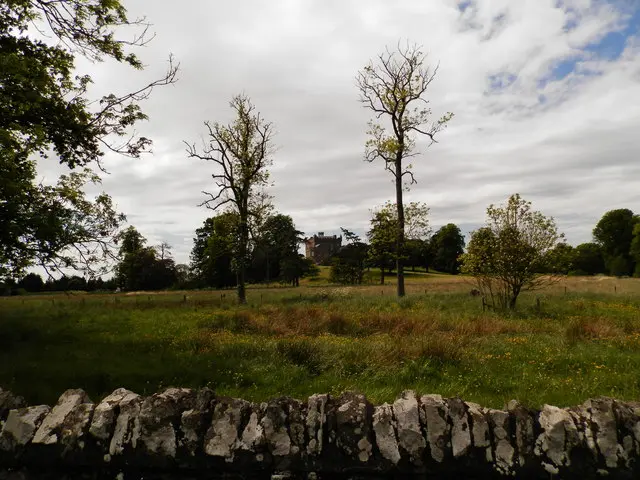
The castle is a category A listed building on the Historic Environment Scotland designation register, reference LB12868, added to the list on 5 October 1971 in Perth and Kinross, at national grid reference NO 30194 29105. The listing takes in the garden terraces and the three late seventeenth-century statues on the upper terrace as well as the tower. That listing carries no right of entry with it. The tower stands on its volcanic mound above open farmland and reads at a distance from the public roads around Longforgan, which is where the photograph on this page comes from.
The gravestone that Grant Campbell quoted in 1982 is a family grave in Longforgan parish churchyard, a burial ground still in use. The name cut on it, Richard David Charles Paterson, belonged to a boy who drowned in 1939 at the age of nine.
Sources consulted
- Historic Environment Scotland, «HMP Castle Huntly including Garden Terraces and Statues, Longforgan, near Dundee (LB12868) — listed building record» — Designations Portal, 2015 report
- Adam Philip, «The Parish of Longforgan: A Sketch of its Church and People» — Oliphant, Anderson & Ferrier, Edinburgh and London, 1895 book
- Robert Scott Fittis, «A Book of Perthshire Memorabilia» — Constitutional Office, Perth, 1879 book
- Grant Campbell, «Scottish Hauntings (chapter: The White Lady of Castle Huntly)» — Piccolo / Pan Books, London, 1982 book
- Alexander Hastie Millar, «Haunted Dundee» — M. C. Macleod, Dundee, 1923 book
- Christopher Johnston, «Independent Prison Monitoring Findings — Annual Report, HMP Castle Huntly 2023-24» — HM Inspectorate of Prisons for Scotland, 2024 report
- Scottish Prison Service, «Castle Huntly — establishment page (role, population, visiting arrangements, history)» — sps.gov.uk, 2026 web
Reviewed by V. Serrano on 2026-08-12 · How we verify our content
💬 Field testimonies (0)
No testimonies yet. Add the first.
Add your testimony
🔒 Log in to add a testimony