👻 HAUNTED PLACE · EXP. Nº9476
ACTIVE
Huntingtower Castle
Huntingtower Castle, on the western edge of Perth, was the Place of Ruthven until the Parliament of November 1600 renamed it, after the 3rd Earl of Gowrie and his brother were killed at Gowrie House.
Where is Huntingtower Castle?
- Location
- Perth and Kinross, Scotland, United Kingdom
- Type
- Castle
- Coordinates
- 56.409, -3.488
- Last updated
LOCATION
Why is Huntingtower Castle said to be haunted?
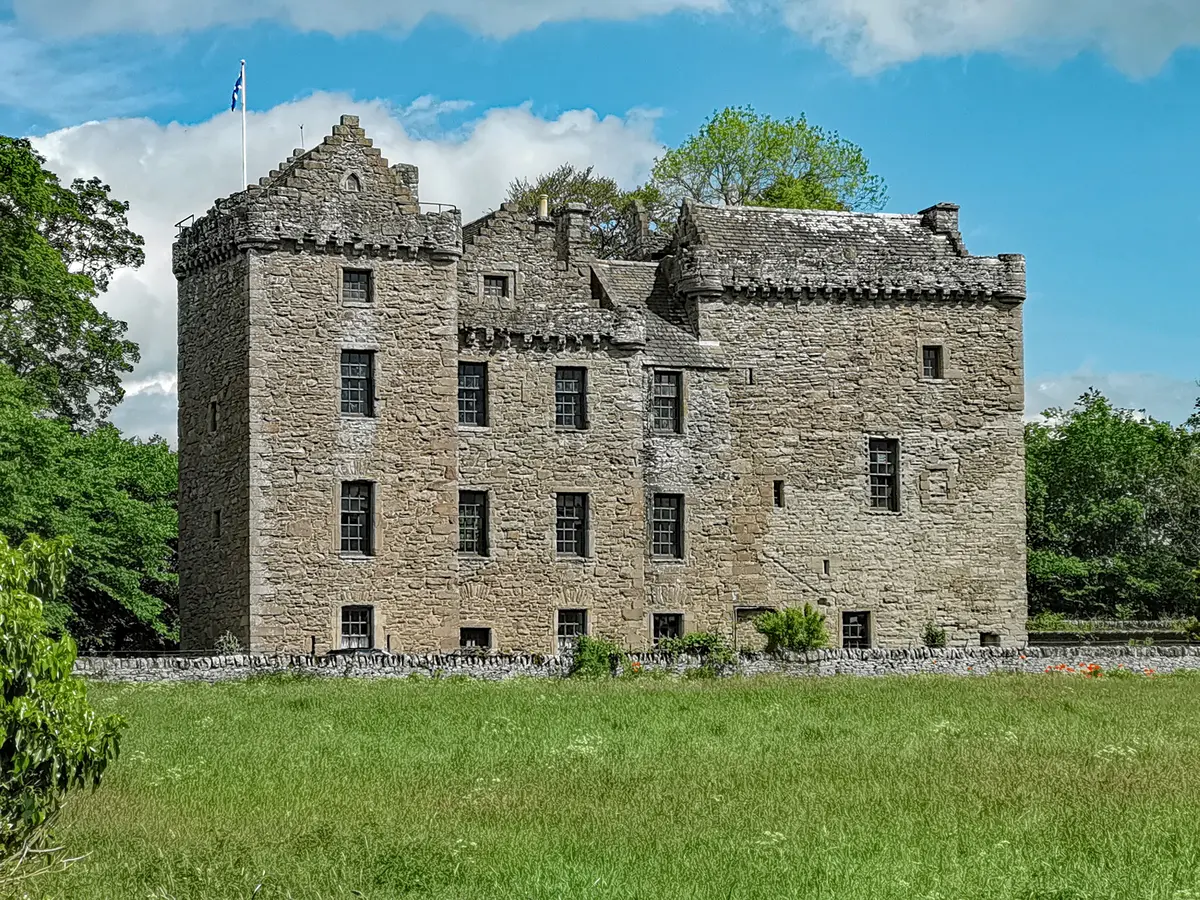
Its two tower houses, about 3 m apart and joined in the late seventeenth century, gave rise to the Maiden's Leap, which Thomas Pennant printed in 1776: a daughter of the first Earl of Gowrie, about to be caught in her lover's tower by her mother, jumped nine feet four inches to the other tower and eloped the next night. A ghost called My Lady Greensleeves appears in twentieth-century folklore books, and in 1618 the Kirk Session of Perth censured women who left pins at a well on the bank at Huntingtower. In 1582 the sixteen-year-old James VI was seized here in the Raid of Ruthven. The castle, with one of Scotland's earliest surviving painted ceilings, is in the care of Historic Environment Scotland.
What is the history of Huntingtower Castle?
Huntingtower Castle stands on a river terrace above the River Almond on the western edge of Perth. Until 1600 it was the House or Place of Ruthven, the principal residence of a family that, according to Historic Environment Scotland's Statement of Significance, came to Perthshire from East Lothian towards the end of the twelfth century. The oldest standing work is the lower part of the east tower, the remains of a gatehouse thought to date from the fifteenth century. The Scots Peerage (vol. IV, 1907) records that on 2 July 1480 William, Master of Ruthven, and his brother John received letters of legitimation under the Great Seal, and that on 12 July the lands of Ruthven were granted to William on his father's resignation; the father was created Lord Ruthven in 1488. The Statement of Significance calls the 1480 grant a division of the estate between the brothers and places shortly afterwards the rebuilding of the gatehouse as a tower house and the building of a second tower 3 m to the west. HES's visitor page suggests the two sons may explain the two towers; the Statement itself judges separate residences for them "unlikely" when large estates were available.
The first-floor hall of the east tower keeps a painted ceiling that the Statement dates to about 1540, with a later date of about 1580 proposed in a 1989 report. Ten areas of painted plaster were uncovered in 1912-13, among them a hare, an Adam, a deer, an angel, a trompe l'oeil cube pattern and an Erskine and Ruthven coat of arms that seems to predate 1513.
David Moysie's memoirs record that James VI came back from hunting in Atholl to Ruthven on 22 August 1582 and that the next day "the erles of Mar, Govry and thair freindis interprysed the takin of the King at Ruthuen". Born on 19 June 1566, the king was sixteen. HES says he was held against his will for ten months; Moysie has him riding suddenly from Falkland to St Andrews on 27 June 1583 and shutting himself in the castle there. William Ruthven, 1st Earl of Gowrie, was beheaded at Stirling in May 1584 (4 May in The Scots Peerage, 2 May in the 1911 Britannica), and the forfeited estates were restored to his son in 1586.
That summer the king came back. Moysie, as quoted in the Chronicles of Strathearn (1896), writes that after 24 August 1584 he went from Falkland to Ruthven and had been there ten days "or ever he knew there wes sex houssis infectit in Perthe"; that same night he left with a few men for Tullibardine and Stirling, "leavand his haill housald and seruandis encloisit in Ruthven". The German traveller Lupold von Wedel, at Perth on 17-20 September, wrote that the king kept his court "in a house outside the town".
On 5 August 1600 John Ruthven, 3rd Earl of Gowrie, and his brother Alexander were killed at Gowrie House in Perth. The Parliament of November 1600 abolished the surname of Ruthven and ordained "the name of the barony and place of Ruthven to be changed and called in all time coming the place and barony of Huntingtower". Murrays then held it as constables for the Crown, among them William, later Earl of Dysart, from 1643; James, fourth Earl of Tullibardine, constable from 1649, acquired it outright in 1663, and the late seventeenth-century link block with its grand stair is probably the work of John, second Earl of Atholl. After Mary, widow of the first Duke of Atholl, died in 1767 the castle ceased to be a noble residence; between 1805 and 1815 James Buchan lodged cloth-printing workers in it. Major Lindsay Mercer placed it in State care in 1912, and a steward lived in a flat in the west tower until early 2004. HES's visitor page adds that Mary, Queen of Scots, stayed here in 1565 on her honeymoon with Lord Darnley.
Timeline: the documented record of Huntingtower Castle
- 2 and 12 July 1480 William, Master of Ruthven, and his brother John receive letters of legitimation, and the lands of Ruthven are granted to William on their father's resignation.
- c. 1540 The painted ceiling of the first-floor hall in the east tower is made, by HES's dating; a later date of about 1580 has also been proposed.
- 1565 Mary, Queen of Scots, stays at Ruthven while on honeymoon with Lord Darnley.
- 22–23 August 1582 James VI, aged sixteen, returns from hunting in Atholl to Ruthven on 22 August; the next day the earls of Mar and Gowrie take him into their keeping, the Raid of Ruthven.
- May 1584 William Ruthven, 1st Earl of Gowrie, is executed for high treason and his estates forfeited; they are restored to his son in 1586.
- August–September 1584 After ten days at Ruthven, James VI learns that six houses in Perth are infected with plague and leaves that night for Tullibardine and Stirling, leaving his household shut in at Ruthven.
- 5 August 1600 John Ruthven, 3rd Earl of Gowrie, and his brother Alexander are killed at Gowrie House in Perth, in what became known as the Gowrie Conspiracy.
- November 1600 Parliament abolishes the surname of Ruthven and orders the place and barony of Ruthven to be called Huntingtower.
- 4 May 1618 The Kirk Session of Perth censures women who drank from "the well in the bank of Huntingtower" and each left a pin there.
- 1663 James, fourth Earl of Tullibardine, constable of Huntingtower for the Crown since 1649, acquires the castle outright.
- 1767 Mary, widow of the first Duke of Atholl, dies; the castle, already run down, ceases to be a noble residence.
- 1772 (published 1776) Thomas Pennant visits Ruthven House and records the Maiden's Leap: a daughter of the first Earl of Gowrie jumps nine feet four inches between the towers and elopes the next night.
- 1912 Major Lindsay Mercer places the castle in State care; the works of 1912-13 remove the 17th-century stair and panelling and uncover the painted ceiling and plasterwork.
- 1943 edition Helen Drever's The Lure of the Kelpie describes "My Lady Greensleeves", a ghost of Ruthven Castle, as "a kindly phantom".
Is there a rational explanation for Huntingtower Castle?
The leap is in print by 1776: Thomas Pennant, who toured Scotland in 1772, told the story in the second part of his Tour (p. 108): "a daughter of the first Earl of Gowrie" was courted by "a young gentleman of inferior rank in the neighbourhood"; warned by the countess's footsteps, she "ran to the top of the leads, and took the desperate leap of nine feet four inches over a chasm of sixty feet", got back into her own bed, and "the next night eloped, and was married". His account names nobody and mentions no apparition, and the paragraph was reprinted almost word for word in The Edinburgh Magazine and Review in July 1776 and in British and American magazines into the 1830s. Nine feet four inches is 2.84 m, close to the 3 m between the towers that HES gives.
The version told today calls the girl Dorothea and her lover a servant; The Scots Peerage lists, among the first Earl's children, a Dorothea "married, before 8 June 1609, to John Wemyss of Pittencrieff", and gives the countess herself as Dorothea Stewart, daughter of Henry, first Lord Methven. Pennant's "eloped, and was married" fits a recorded marriage; nothing in either text links that marriage to the leap.
The green lady comes into print in the twentieth century as a separate figure. Helen Drever's The Lure of the Kelpie (edition of 1943 in the Internet Archive) speaks of "another ghost, called 'My Lady Greensleeves', which haunted Ruthven Castle", "on the whole ... a kindly phantom" who "helped to defend an old frail man"; country folk also said she "had come to warn him of his fate". R. Macdonald Robertson (edition of 1966) adds that she "also acted as an augurer of the future". In Grant Campbell's Scottish Hauntings (Piccolo, 1982 printing) her appearance "foretold a calamity or death", and a traveller who stayed overnight "with the then custodian at Huntingtower" saw her in "a passageway of the dwelling house attached to the castle" before taking the ferry at Dundee for the Fife shore.
The well appears in a record of 1618: the Kirk Session register of Perth for 4 May of that year, printed in The Spottiswoode Miscellany (1844), questioned two women about "the well in the bank of Huntingtower": they "drank thereof, and that each of them left a prin (pin) thereat, which was found a point of idolatry, in putting the well in God's room". The dedication to St Convall rests on later authors, and J. M. Mackinlay (1910), citing Grose's Antiquities, describes a ruined chapel near the mill-lade "probably dedicated to St. Convall" and a spring "formerly known as St. Conwall's Well"; he gives Convall as the son of an Irish prince who came to Strathclyde in the second half of the sixth century, with his relics at Inchinnan in Renfrewshire.
HES treats the legend as a story: its Statement of Significance and the scheduling record for SM90164 say nothing about ghosts, while its visitor page calls the Maiden's Leap "one of our favourite castle stories" and its weddings text says the castle "has long been associated with tales of romance". The same Statement records a summer roost of about 200 pipistrelle bats that hibernate in the castle from October to March; HES also lists long-eared and Natterer's bats and barn owls.
Can you visit Huntingtower Castle?
Huntingtower Castle is in the care of Historic Environment Scotland at Castle Brae, off the A85 Crieff Road on the western edge of Perth, postcode PH1 3JL, national grid reference NO 082 251; it is scheduled monument SM90164. The details below are from HES's "Plan your visit" page as read on 4 October 2026.
From 1 April to 30 September it opens from 10am to 4.30pm every day except Tuesday. From 1 October to 31 March it opens from 10am to 3pm on Saturday, Sunday, Monday, Tuesday and Wednesday. It shuts for lunch from 12.30 to 1pm, last entry is 30 minutes before closing, and it is closed from 24 December to 4 January. An adult ticket (16-64) costs £7.50 online or £8.50 at the door; a concession (65 and over) £6 or £6.80; a child (7-15) £3.50 or £4. Historic Scotland members and Explorer Pass holders get in free, Young Scot and National Entitlement Card holders aged 7 to 25 pay £1, members of English Heritage, Cadw and Manx National Heritage get free or discounted entry, and up to two carers per booking go free. HES gives 25% off to visitors arriving by train, bus or bike who book online with the code GOOD25.
Bus 15, which links Perth, Crieff and Stirling, stops at Castle Brae/A85, about 20 minutes from Perth city centre. National Cycle Network Route 77 passes within half a mile, the ride from Perth station is 5.5 miles, and there are racks for four bicycles. The small car park is level tarmac with no access for campervans or larger vehicles; HES points to a paid public car park at the nearby Tesco.
The visitor centre is 12 m from the car park and step-free. The West Tower is reached by 13 stone steps to its great hall, with a 37-step spiral stair to its battlements. In the East Tower a ramp leads to the Laigh Hall, with one step at the door that the steward can bridge; a 26-step spiral stair climbs to the first-floor hall with the painted ceiling, then 19 steps to the bedroom and 18 more to the battlements. A wooden walkway of 12 steps joins the two towers at first-floor level, the battlement walk has an uneven surface, and there is an adapted toilet. Dogs on a lead are allowed outside and kept out of roofed areas; assistance dogs are allowed throughout. HES's overview mentions the "cupboard within a cupboard, hidden behind a stone" used for Ruthven valuables, and HES offers the castle as a wedding venue; the site telephone is 01738 627 231.
Sources consulted
- Historic Environment Scotland, «Huntingtower Castle: Statement of Significance» — Official heritage assessment, 2019 archive
- K.M. Brown et al. (eds.), «The Records of the Parliaments of Scotland to 1707» — St Andrews, 2007–2020, 2007 archive
- John Duncan Mackie (ed.), «Calendar of State Papers: Scotland, vol. 13» — Edinburgh, 1969, 1969 archive
- David Moysie, «Memoirs of the Affairs of Scotland (David Moysie)» — Edinburgh, 1830, 1830 book
- Gottfied von Bülow (ed.), «Journey Through England and Scotland (Lupold von Wedel, 1584–85)» — Transactions of the Royal Historical Society, vol. 9, London, 1895, 1895 book
- Ronald John McNeill, «The Gowrie Conspiracy» — Encyclopædia Britannica, 11th ed., vol. 12, 1911 book
- Alexander Courtney, «James VI, Britannic Prince: King of Scots and Elizabeth's Heir, 1566–1603» — Routledge, 2024 book
- Nigel Tranter, «Tales and Traditions of Scottish Castles» — Neil Wilson Publishing, 2000 book
- Grant Campbell, «Scottish Hauntings» — Piccolo, 1976 book
- Various, «Chronicles of Strathearn» — Crieff, 1896, 1896 book
- Office of Works / Frank Baines, «National Records of Scotland, MW1/501» — Conservation records, 1912–1914, 1912 archive
- Historic Environment Scotland, «Huntingtower Castle — History and stories» — historicenvironment.scot, visitor pages (read 4 October 2026), 2026 web
- Historic Environment Scotland, «Huntingtower Castle — Plan your visit (opening times, prices, access)» — historicenvironment.scot, visitor pages (read 4 October 2026), 2026 web
- Sir James Balfour Paul (ed.), «The Scots Peerage, vol. IV: Ruthven, Earl of Gowrie» — Edinburgh: David Douglas, 1907, pp. 254-267, 1907 book
- Thomas Pennant, «A Tour in Scotland, and Voyage to the Hebrides, 1772, Part II — Ruthven House and the Maiden's Leap (p. 108)» — Chester: John Monk, 1774-1776, 1776 book
- Helen Drever, «The Lure of the Kelpie: Fairy and Folk Tales of the Highlands — 'My Lady Greensleeves and the Green Ghost of Newton'» — Moray Press (1943 edition; lending copy read through the Internet Archive full-text index), 1943 book
- R. Macdonald Robertson, «Selected Highland Folktales — 'My Lady Greensleeves'» — Edinburgh: Oliver and Boyd (1966 edition; lending copy read through the Internet Archive full-text index), 1966 book
- James Maidment (ed.), «Extracts from the Kirk-Session Register of Perth: 'Well of Ruthven or Huntingtower', 4 May 1618» — The Spottiswoode Miscellany, vol. II, Edinburgh: Spottiswoode Society, 1844, p. 289, 1844 archive
- James Murray Mackinlay, «Ancient Church Dedications in Scotland: Non-Scriptural Dedications — St Convall (pp. 188-190)» — Edinburgh: David Douglas, 1910, 1910 book
- Encyclopædia Britannica, «James I. of Great Britain and Ireland» — Encyclopædia Britannica, 11th ed., vol. 15, 1911 book
- Historic Environment Scotland, «Huntingtower Castle (SM90164) — scheduled monument designation» — Historic Environment Scotland Portal (designated 31/12/1921, last amended 02/12/1999), 1999 archive
- The Edinburgh Magazine and Review, «Ruthven House: a curious anecdote» — The Edinburgh Magazine and Review, vol. 5, July 1776, 1776 newspaper archive
Reviewed by V. Serrano on 2026-08-22 · How we verify our content
💬 Field testimonies (0)
No testimonies yet. Add the first.
Add your testimony
🔒 Log in to add a testimony