👻 HAUNTED PLACE · EXP. Nº9477
ACTIVE
Hylton Castle
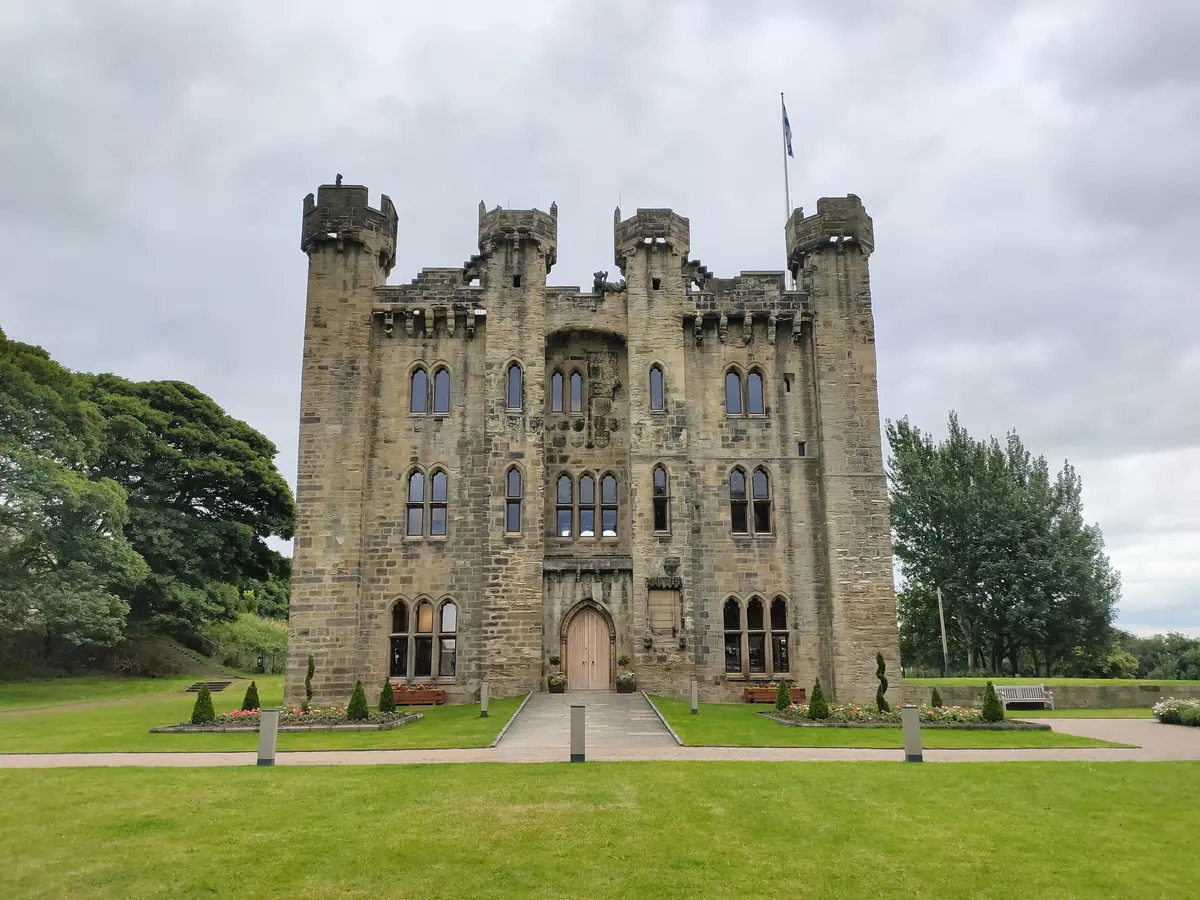
What stands at Hylton today is one building: a gatehouse-tower raised for Sir William Hylton around 1400, with the arms of the king, Richard II's white hart and the stars and stripes of the Washingtons carved across its front.
Where is Hylton Castle?
- Location
- Tyne and Wear, United Kingdom
- Type
- Castle
- Coordinates
- 54.923, -1.443
- Last updated
LOCATION
Why is Hylton Castle said to be haunted?
The hall, chambers, barns and kitchen it once guarded are gone, and so are the Georgian wings, which William Briggs pulled down in the 1860s. The ghost that made it famous is the Cauld Lad, a household brownie who wrecked a tidy kitchen and tidied a wrecked one until the servants left out a green cloak and hood. Robert Surtees printed the story in 1820 from oral evidence collected by his friend John Brough Taylor, and it ends in a couplet: Here's a cloak, and here's a hood, the cauld lad of Hilton will do no more good. A boy did die here. An inquest sat on the body of Roger Skelton at Hilton on 3 July 1609 and found that Robert Hilton, gentleman, had killed him with a scythe; he was pardoned that September. The stable, the hayfork and the pond belong to the folklore, and the folklore can be dated.
What is the history of Hylton Castle?
What stands at Hylton is the single surviving building of a manor that has otherwise vanished, and knowing that changes how the ghost story reads.
Sir William Hylton raised the gatehouse-tower around 1400 — the date Historic England gives in the Grade I listing, made on 25 February 1949. English Heritage describes the display carved across its front: the arms of the king, of the Hyltons and of families married into them, Richard II's white hart, and the stars and stripes of the Washingtons of Washington Old Hall, a few miles up the Wear. It was a statement of rank, built to be seen from the west, and it was never the house.
The house itself is itemised in the inquest taken after Baron William's death in 1435, which the antiquary W. H. D. Longstaffe transcribed in 1876: in the manor there are a hall, four chambers, a chapel, two barns, a kitchen, a house constructed of stone, called Gate-house, which are nothing worth yearly beyond outgoings by reason of the cost of their repairs. Household inventories of 1559 and 1600 still call the gatehouse simply the Tower, and list what was stored in it — eight suits of armour from the knee up, a great cauldron, a pan, an iron spit; by 1600, four corslets and twenty-six shillings and eightpence worth of hay. The Hyltons lived in the buildings to the east.
Those buildings went first. Camden's Britannia was calling the place Hilton Hiltoniorum Castrum by 1587, but Gibson's 1722 edition of Camden already notes that the Gate-house, which is all that remains of the old castle, shews how large it hath been. The last Baron, John Hylton, died in 1746 and the male line ended with him. In 1809 Robert Surtees wrote to Walter Scott that the tower had just been rescued by its occupant Simon Temple, who came in the fortunate crisis to prevent the demolition of this fine structure, which was already condemned to be taken down for the materials. Georgian wings had been added north and south in the first half of the 18th century; the timber merchant and shipbuilder William Briggs bought the estate in 1862 and pulled them down again, enlarging the windows and rebuilding the interior. Then a coal company, then the Ministry of Works in 1950. The listing describes what was left by then: the floors removed except in the rear tower, and no roof.
There was also a real boy. Sir Cuthbert Sharp, reprinting Surtees's account of the Cauld Lad in The Bishoprick Garland in 1834, added a footnote that almost nobody now quotes accurately. The story, he wrote, may possibly have had its foundation in the fact of the inquest held on the body of Roger Skelton, at Hilton, 3d July, 1609; when Robert Hilton, of Hilton, gentleman, was found to have killed him with a scythe, for which he received a pardon, 6th September, 1609. Longstaffe, working from the same palatinate records in 1876, put it the same way: Robert Hilton, in mowing hay, as moneyless younger brethren thought it right to do, slew Roger Skelton with his scythe by accident.
The record gives a scythe, a hayfield, a younger son of the house and a verdict of accident, with the pardon coming nine weeks after the inquest. The stable, the hay fork and the baron belong to the oral version Surtees printed in 1820.
Timeline: the documented record of Hylton Castle
- 1157 The earliest Hylton whose name is known, Romanus, knight of Helton, appears in a document that also names the chapel of the vill — the consecrated ground on which the ruin of St Catherine's Chapel still stands beside the tower.
- c. 1400 Sir William Hylton builds the fortified tower-house in the form of a gatehouse that is all anyone now means by Hylton Castle. Historic England's list entry dates it c1400 and names him as the patron.
- 1435 The inquest after Baron William's death lists the manor: a hall, four chambers, a chapel, two barns, a kitchen, and a house of stone called Gate-house. The gatehouse is one item on a list, not the castle itself.
- 3 July 1609 An inquest sits on the body of Roger Skelton at Hilton and finds that Robert Hilton, of Hilton, gentleman, killed him with a scythe. He receives a pardon on 6 September 1609. This is the only documented killing of a boy at Hylton, and the record says scythe and accident.
- 1722 Gibson's edition of Camden records that the gatehouse is already all that remains of the old castle, and that its size shows how large the whole once was.
- 1746 John Hylton, the last Baron, dies. The family had held Hylton for some six centuries; the estate passes out of their hands.
- 1809 In a letter to Walter Scott, Robert Surtees gives the first known description of the ghost — and calls it the spectre of a Hylton who killed himself, not a murdered servant. He adds that the occupant Simon Temple has just saved the tower, which was condemned to be taken down for its materials.
- 1820 Surtees prints the classic version in the second volume of his History of Durham, crediting the whole of it to oral evidence gathered from the oldest residents of Hilton and Wearmouth by his friend John Brough Taylor. The stable, the hayfork, the straw, the pond and the green cloak all enter the record here at once.
- 1834 Sir Cuthbert Sharp reprints Surtees's account in The Bishoprick Garland and adds the footnote that ties the legend to the 1609 inquest. His wording is cautious — the story may possibly have had its foundation in it — and later retellings dropped the caution.
- 1848 Longstaffe interviews neighbours around Hylton and finds them agreeing on nothing: hayfork, pitchfork, bootjack, a hot ladle, a scalded head, a headless boy, a starved daughter. He inspects the stains in the Cauld Lad's room and calls them blood or ink or other dye.
- 1862 The timber merchant William Briggs buys the estate and demolishes the 18th-century north and south wings, enlarges most of the windows and rebuilds the interior, leaving the free-standing silhouette visitors photograph today.
- 1876 Longstaffe publishes his two papers on Hylton in Archaeologia Aeliana and concludes that the brownie was a relic of ancient heathendom unconnected with any event, and that the killing was tacked on to it late.
- 1879 William Henderson gives the Cauld Lad a national audience in the Folk-Lore Society edition of his Notes on the Folk-Lore of the Northern Counties, with the couplet in the form Here's a cloak and there's a hood.
- 25 February 1949 The tower is listed Grade I and is also a scheduled monument. The listing describes a shell: all floors removed except in the rear tower, and no roof. It passes into state care the following year.
- 2020 The Hylton Castle Trust announces on its website that it is awaiting news of an official opening ceremony: three new floors, a lift, a café and learning spaces have been fitted inside the medieval shell.
Is there a rational explanation for Hylton Castle?
The Cauld Lad's paper trail is short enough to lay out year by year, and that is the most useful thing about him.
He first appears in 1809, in a letter from Surtees to Walter Scott, and there he is no stable boy: he is "supposed to be the spectre of one of the family who killed himself", living in a small room under the staircase. Longstaffe, who went through the printed histories that followed, found that neither Sharp's Hartlepool (1816) nor Garbutt's Sunderland (1819) speaks of the Cauld Lad, "unless his history is merged in that of the mad lady". In 1820 Surtees printed the version everybody now repeats — the goblin who smashed the plates in a tidy kitchen and tidied a wrecked one, the green cloak and hood laid before the fire, the couplet on the way out — and he was scrupulous about where it came from: "For the whole evidence of the Lad of Hilton, I am indebted to the indefatigable zeal of my worthy friend I. B. Taylor, … who collected and collated all the floating oral evidence which all the seniors of Hilton and Wearmouth could afford." Surtees also flagged his own ending as suspect. The frisking and the somersaults "seem apochryphal", he wrote, because "the genuine Brownie always received the present which was to banish him from his long-loved haunts with tokens of deep regret".
After that the story grows in public and in print. John Fawcett published a verse romance at Sunderland in 1830. A Gateshead chapbook of 1831 gave the Kow'd Lad a woodcut in which he carries his own severed head. Roxby was staging a melodrama about him by 1838. And in those same years, Longstaffe records, the castle's keeper Mrs Fitzpatrick was going round collecting subscriptions to have the Cauld Lad laid again, because the last of the nails a priest had once driven to hold him was about to drop out.
When Longstaffe did his own fieldwork around Hylton in 1848, his informants agreed on almost nothing. The boy had been killed with a hayfork, a pitchfork or a bootjack; or the cook had banged him on the head with a hot iron ladle and he came back scalded; or he had no head at all; or he was an orphan scullion who simply sickened and died and was called Cowed Lad for his cropped hair, which is what Spearman of Eachwick had written in 1818. William Howitt, shown round in 1842, assumed the cupboard was where the boy used to hide and was firmly corrected by the woman guiding him: "No, no," she insisted, "where they used to put him." Longstaffe's own reading was linguistic — that cowed was merely a dialect form of cauld, and that in Northumberland cauld means dead.
Longstaffe's verdict was that the brownie "was a relic of ancient heathendom and unconnected with any event", and that "the manslaughter or mischance or murder or suicide which has been tacked on to the superstition is of recent date". The one documented death at Hilton fits the tradition badly. Sharp's footnote records that Robert Hilton "was found to have killed him with a scythe", and Longstaffe, from the same palatinate records, adds that it happened "in mowing hay" and "by accident"; the stable, the loitering boy and the hay fork come from the oral version Surtees printed in 1820. It was Sharp who first hooked the record to the legend, in 1834, with the words "may possibly".
The couplet has drifted too, and so has the spelling of the place. The oldest printed text, Surtees's by way of Sharp in 1834, runs "Here's a cloak, and here's a hood, / The cauld lad of Hilton will do no more good". Henderson's Folk-Lore Society text of 1879 keeps Hilton and changes the first line to "Here's a cloak and there's a hood"; the Denham Tracts print "The Cauld Lad o' Hylton will do na' mair good"; and the variant Longstaffe collected in 1848 runs "I've taken your cloak, I've taken your hood, / The Cowed Lad of Hylton will do no more good".
The physical evidence held up no better. Longstaffe examined the marks by the window of the third-storey room shown as the Cauld Lad's and could only call them "large stains of blood or ink or other dye"; the reddish tinge in the lime on the outside wall below that window he dismissed as "a remarkable coincidence, and nothing more". That room no longer exists in the form he saw it: the Ministry of Works consolidated the tower as a roofless shell with its floors gone, and the floors visitors walk on today were inserted in the 21st century.
Can you visit Hylton Castle?
Hylton Castle stands on Craigavon Road, Castletown, Sunderland, SR5 3PA, about 4.2 kilometres (2.6 miles) west-north-west of Sunderland city centre and inland from the Wear, in a residential suburb with the wooded Hylton Dene behind it. English Heritage owns the castle and Sunderland City Council owns the land under it, while the Hylton Castle Trust, an independent charity registered as number 1180548, runs the site day to day in partnership with the council, English Heritage and Historic England. The gatehouse-tower is listed Grade I on the National Heritage List for England as entry 1207073, first listed on 25 February 1949. The castle together with St Catherine's Chapel forms a scheduled monument.
Entry is free, and the interior keeps no fixed opening hours. The Trust states that Hylton Castle is a multi-use community venue and that it cannot therefore operate to set opening hours; it posts dates for guided tours, Heritage Open Days, afternoon teas and other events on its booking page, and the English Heritage listing for the site gives the castle as open for bookable guided tours and sends enquiries about dates to the Trust. A visit made without a booking reaches the lawn and the outside of the tower.
The interior anyone walks through dates from this century. The restoration inserted three floors, a staircase and a lift into the shell, along with a café, learning rooms, exhibition space and access to a viewing gallery on the roof. The Trust was still announcing on its own website in 2020 that it was waiting to fix a date for the official opening ceremony. The masonry is medieval, Georgian and Victorian; the floors standing inside it are new.
Access is unusually good for a building of this age. Parking on site is free and includes Blue Badge spaces. The castle and the gardens in front of it are reachable by wheelchair from the car park, and the lift serves every floor except the roof gallery, which is up a stone spiral stair. There is an accessible toilet on the ground floor, and other parts of the grounds are steep enough to defeat a wheelchair. Dogs on leads are welcome outside and assistance dogs indoors. The tearoom opens for walk-in visits on Wednesday, Thursday, Friday and Saturday from 11.30 to 14.30, with exceptions posted to the Trust's Facebook page at least a day ahead, and the telephone number is 0191 537 3231. Opening arrangements and access were checked on 22 September 2026.
The ruin of St Catherine's Chapel stands in the grounds and can be walked up to freely. A chapel dedicated to St Catherine of Alexandria is recorded on the site from 1157, when the Prior of Durham allowed Romanus de Hilton to appoint his own chaplain, and it was rebuilt in stone in the early fifteenth century. The Cauld Lad's room cannot be shown: the third-storey chamber Longstaffe inspected in 1848, stains and all, went when the floors did.
Sources consulted
- Sir Cuthbert Sharp, «The Bishoprick Garland, or a Collection of Legends, Songs, Ballads, &c. Belonging to the County of Durham (pp. 35-37: 'The Cauld Lad of Hilton', reprinting Surtees, with the footnote on the inquest of 3 July 1609 into the death of Roger Skelton)» — London: Nichols, and Baldwin & Cradock, 1834 book
- W. H. D. Longstaffe, «The Manor House and Tower or Castle of Hilton (pp. 143-152) and Legends connected with Hylton Castle (pp. 153-169), in Archaeologia Aeliana, New Series, vol. VII» — Society of Antiquaries of Newcastle-upon-Tyne, 1876 academic
- William Henderson, «Notes on the Folk-Lore of the Northern Counties of England and the Borders, new edition (pp. 266-267)» — Folk-Lore Society, London, 1879 book
- Michael Aislabie Denham, «The Denham Tracts, vol. I, ed. Dr James Hardy (pp. 55-57: 'The Cauld Lad o' Hylton')» — Folk-Lore Society, London, 1892 book
- Historic England, «Hylton Castle — National Heritage List for England, entry 1207073 (Grade I, first listed 25 February 1949; scheduled ancient monument)» — National Heritage List for England, 1949 report
- English Heritage, «Hylton Castle: history and visitor information» — english-heritage.org.uk, 2026 web
- Hylton Castle Trust, «Opening times, access and about us» — hyltoncastle.org.uk, 2026 web
- Internet Archive Wayback Machine, «Hylton Castle Trust website, capture of 2020 ('2020 Update: Watch this space for news on our official opening ceremony announcement')» — web.archive.org, 2020 archive
Reviewed by V. Serrano on 2026-08-11 · How we verify our content
💬 Field testimonies (0)
No testimonies yet. Add the first.
Add your testimony
🔒 Log in to add a testimony