👻 HAUNTED PLACE · EXP. Nº9476
ACTIVE
Inveraray Castle
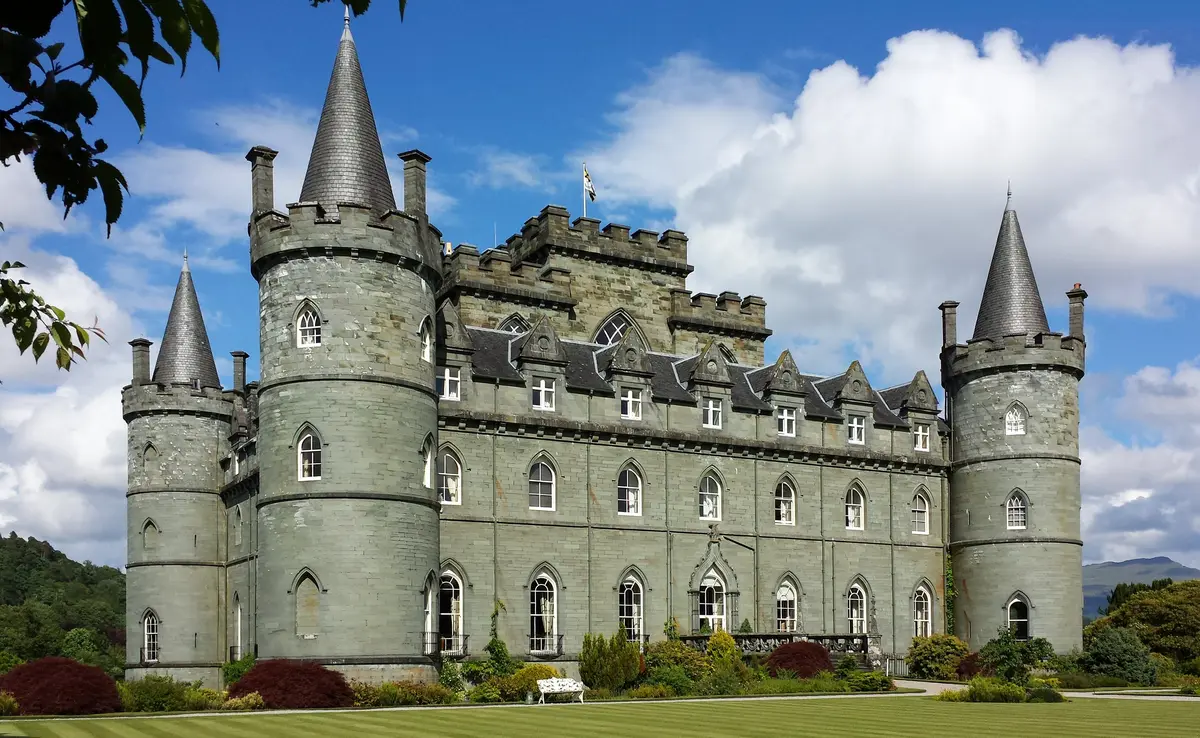
Inveraray Castle stands on the shore of Loch Fyne, the seat of the Dukes of Argyll and chiefs of Clan Campbell, who still live in it.
Where is Inveraray Castle?
- Location
- Argyll and Bute, Scotland, United Kingdom
- Type
- Castle
- Coordinates
- 56.238, -5.074
- Last updated
LOCATION
Why is Inveraray Castle said to be haunted?
Its most persistent ghost is the Harper of Inveraray, said to have been hanged when the Marquess of Montrose's men came up the glen in pursuit of the Marquess of Argyll in the winter of 1644. The tale was first put into print in Lord Halifax's Ghost Book, published in 1936, where H. W. Hill described stays at the castle around Easter 1913 and in October 1922 and reported the family's own words: the Harper always appears in the Campbell tartan and is a harmless little old thing. A second tradition warns of the death of a chief, though it has changed shape in print within living memory, from ravens in 1956 to a ghostly galley in 1973 that one of its own chroniclers noticed resembles the ship on the family coat of arms. The present castle was begun in October 1746, burned twice, in 1877 and on 5 November 1975, and opens to visitors from late March to October.
What is the history of Inveraray Castle?
A castle has stood at the mouth of the river Aray since the fifteenth century, but almost nothing a visitor sees today is older than 1746. The listed building record kept by Historic Environment Scotland puts it plainly: seat of the Dukes of Argyll, built for the 3rd Duke, foundation stone laid in October 1746. Archibald Campbell, Earl of Ilay, had started improving the estate in 1743 and succeeded to the dukedom that same year. The design was Roger Morris's; William Adam and then his son John acted as masters of works; and the interiors were completed between 1772 and 1785 under Robert Mylne, who gave Inveraray the state Dining Room and Drawing Room that visitors still walk through. The old burgh was pulled down and rebuilt half a mile away so that the new house could sit alone in its park, which is why Inveraray reads less like a fortress than like a very large Gothic villa in blue-green stone.
The castle's own website tells the last part differently, crediting the completion to "Adam's sons, James and Robert" rather than to Mylne. The same website's room guide credits the papier-mâché ceiling of the China Turret to "Robert Mylne in 1773".
The event the ghost story hangs on happened a century before any of that. In the winter of 1644 James Graham, Marquess of Montrose, and Alasdair MacColla brought an army into Argyll. John L. Roberts records that Archibald Campbell, Marquess of Argyll, had left Edinburgh by 13 December 1644 and gone home to Inveraray, where he learnt that the invaders were already in his country; he got away down Loch Fyne by boat, and the town was burned behind him. It is to that fortnight, and to no other, that the printed tradition assigns the hanging of a harper.
That much of the story is at least plausible in its setting. Lord Archibald Campbell, collecting Argyllshire tradition in 1885, noted in a footnote that "the house of Argyll seems to have been famed for its harpers", and that the Earl of Argyll took a harper with him in 1594 to animate his troops. Harpers at Inveraray are documented; a hanged one is not.
Fire has shaped the building more than any army. On 12 October 1877 the first fire drove the 8th Duke and his family out to another house, and the rebuilding that followed added the dormered attic storey and the conical roofs on the four corner towers that give Inveraray the silhouette every modern photograph shows. The castle opened to the public in 1953, Coronation year. Then, on 5 November 1975, a second fire ravaged the top storey, destroying pictures and furniture stored there. The castle's own guidebook records what happened next: while the people of the town gave invaluable assistance in salvaging furniture and works of art, the vast torrents of water from the fire hoses cascaded down through the State Rooms. Much of what a visitor now admires on the ground floor was rescued by neighbours and then restored.
Inveraray is still a home. The 13th Duke of Argyll, chief of Clan Campbell, succeeded in 2001 and lives here with his family in private apartments, while more than 90,000 people a year walk through the state rooms — a figure the estate itself published in January 2026 when it advertised for seasonal guides.
Timeline: the documented record of Inveraray Castle
- 1594 Lord Archibald Campbell notes in Records of Argyll that "the house of Argyll seems to have been famed for its harpers", and that the Earl of Argyll took a harper with him this year to animate his troops. Harpers in the Campbell household are documented history; the hanged one is not.
- December 1644 Montrose and Alasdair MacColla invade Argyll. John L. Roberts records that the Marquess of Argyll had left Edinburgh by 13 December and gone home to Inveraray, learnt the invaders were already in his country, and escaped down Loch Fyne by boat; the town was burned. Every printed version of the legend places the harper's hanging in this raid.
- October 1746 The foundation stone of the present castle is laid, for Archibald Campbell, 3rd Duke of Argyll, to Roger Morris's design. The building the ghost is said to haunt did not exist when he is supposed to have died.
- 12 October 1877 The first fire. The 8th Duke and his family move out to another house; the rebuilding adds the attic storey with dormers and the conical roofs on the corner towers, completed in 1878. That is the silhouette every modern photograph of Inveraray shows.
- 1885 Lord Archibald Campbell publishes Records of Argyll, more than five hundred pages of Argyllshire legend. It contains no ghost at Inveraray and no galley omen, though it does print a clan death-warning for another family, the bloodhounds of the MacDougalls.
- Easter 1913 Lord Archibald Campbell (1846-1913) dies at Inveraray. H. W. Hill, secretary of the English Church Union, later wrote that he saw the announcement that Lord Archibald was very ill and had gone from Coombe to Inveraray, and that his son Niall was in France for Easter and came home when he heard.
- October 1922 Hill stays at the castle again. In his account Lady Elspeth Campbell says she has seen "the old man" in the library before tea that day; the family tell him the Harper "always appears in the Campbell tartan and is a harmless little old thing", that she generally both sees and hears him, and that the Duke only hears him.
- June 1936 Lord Halifax's Ghost Book appears, compiled by the 2nd Viscount Halifax (1839-1934) and published after his death with a preface dated this month. "The Harper of Inveraray" is its opening chapter. This is the earliest printed appearance of the legend that can be dated — some 292 years after the raid it describes.
- 1953 The castle opens to the public in Coronation year.
- 1956 Elizabeth Stucley, in A Hebridean Journey, retells the Harper from Halifax and adds a second Inveraray omen: ravens "are supposed to come down from the glen and to hover about the castle" when the chief or a close relation is about to die. No galley yet.
- 1973 Antony D. Hippisley Coxe, in Haunted Britain, gives the earliest datable printing of the galley: before the death of the chief or a near relative "a ghostly galley - resembling the ship on the coat of arms". In the same entry he objects that the house was not built until the mid-eighteenth century, and suggests the harper was hanged on the site once called Gallows Foreland Point.
- 5 November 1975 A second fire ravages the top storey, destroying pictures and furniture stored there. The castle's guidebook records that the people of the town gave invaluable assistance in salvaging furniture and works of art while torrents of water from the fire hoses cascaded through the State Rooms.
- 1995 Dane Love, in Scottish Ghosts, has the boat sail up Loch Fyne towards the castle "and which continues to sail across the land. On it are three men, standing upright." Peter Underwood had already added the three standing figures in 1984. In under forty years of print the omen has gone from ravens to a heraldic ship crossing dry ground.
- January 2026 Advertising for seasonal guides, the estate states that the working season runs March to October and that more than 90,000 visitors a year come to Inveraray Castle.
Is there a rational explanation for Inveraray Castle?
The first objection to the Harper of Inveraray was published fifty-three years ago by a writer who believed in ghosts. Antony D. Hippisley Coxe, listing the castle in Haunted Britain (1973), wrote that it is "haunted by the ghost of a harper who was hanged at Inveraray by Montrose; but as the house was not built until the mid-eighteenth century, presumably he was hanged on the site which was, in fact, once known as Gallows Foreland Point." The chronology is the problem: the building the harper is said to walk through was begun in October 1746, roughly a century after he is supposed to have died. His "presumably" marks the suggestion as a guess, and the place-name does not lie under the castle: Ian G. Lindsay and Mary Cosh, in Inveraray and the Dukes of Argyll (1973), caption the headland as "Gallows Foreland Point, site of the New Town", the burgh that was rebuilt away from the castle.
The second test is heavier. Lord Archibald Campbell, a son of the ducal house, published Records of Argyll in 1885: more than five hundred printed pages of "legends, traditions, and recollections of Argyllshire Highlanders", gathered chiefly from Gaelic informants. In the Internet Archive's full text of that book, the words "ghost", "phantom" and "wraith" appear zero times; "harp", "harps", "harper" and "harpers" appear eight times between them and "galley" or "galleys" twenty, none of them as an apparition — the Galley for Lorne on the family arms, harpers in the Earl's household. The control matters: the same book is perfectly willing to print a clan death-omen, and does, under the heading "Apparition of the Bloodhounds of the MacDougalls", two hounds that rise from a hearthstone before a MacDougall dies. Lord Archibald recorded a supernatural warning for another family and none for his own house.
So the earliest telling anyone can fix is much later, and it is not anonymous. "The Harper of Inveraray" is the opening chapter of Lord Halifax's Ghost Book, compiled by Charles Lindley Wood, 2nd Viscount Halifax (1839-1934) and published after his death with a preface dated June 1936. The chapter is signed testimony from H. W. Hill, secretary of the English Church Union, of which Halifax was president: Hill describes staying at the castle around the death of Lord Archibald Campbell at Easter 1913 and again in October 1922, and reports what the family told him. It is the family that supplies the Montrose story and the description — the Harper "always appears in the Campbell tartan and is a harmless little old thing" — and Lady Elspeth Campbell who says she saw "the old man" in the library before tea. The chapter is a named account of what a household believed in the 1910s and 1920s; the hanging it refers to is set in 1644, 269 years before Hill's first stay.
The second Inveraray omen has visibly changed shape in print. In 1956 Elizabeth Stucley wrote that ravens "come down from the glen and hover about the castle" when the chief or a close relation is about to die. In 1973 Hippisley Coxe reported instead "a ghostly galley — resembling the ship on the coat of arms", and that ship is the family's own heraldic lymphad, the Galley of Lorne quartered in the Argyll arms and carved and painted all over the building. Peter Underwood repeated it in 1984 with three standing figures aboard, and by 1995 Dane Love had the galley sailing up Loch Fyne and then on across dry land. Ravens to heraldry to a ship crossing a lawn, in under forty years.
The property tells its own version. The castle's website gives a room-by-room account of the state rooms — Armoury Hall included, which it calls the highest ceiling in Scotland — and a history page that covers the 1877 fire without the ghost; but its first-floor guide places the harper in the MacArthur Room, where "legend has it that a young Irish harpist was murdered by the Duke of Montrose's men in 1644" on the carved bed that was later moved from the old castle, and its timeline lists him under 1644 as "one of the castle's many ghosts". In the family's version he dies murdered on the bed; in Hippisley Coxe's he is hanged.
Can you visit Inveraray Castle?
Inveraray Castle, Inveraray, Argyll PA32 8XE; telephone +44 (0)1499 302203. It is a Category A listed building, entry LB11552 on the Historic Environment Scotland register, listed on 20 July 1971, and the family home of the Dukes of Argyll.
The castle's website, read on 24 September 2026, publishes the 2026 season as 26 March to 30 September, Thursday to Monday from 10:00 to 17:00, and 1 to 26 October on the same days from 10:00 to 16:00. It is closed on Tuesdays and Wednesdays throughout. A recruitment notice the estate published in January 2026 gives the guides' season as March to October.
Prices on that page, for the castle and gardens: adult £18.50; senior over 60 or student £16.00; child aged 5 to 15 £12.00. Entry to the gardens alone is £10.00 for any of those tickets. Children under five go free, and a family ticket for two adults and three children to the castle and gardens is £60.00. Disabled visitors, their carers and Historic Houses members enter free. Parking costs a separate £4.00, paid by card at the machine or through the JustPark app. A private guide costs £75.00 and has to be booked in advance.
The castle's accessibility guide of July 2023 describes the entrance as four stairs or a ramp followed by two more stairs or a ramp. The ground floor is on one level with no stairs inside, and has an accessible toilet. The first floor is reached by 40 carpeted stairs; the tearoom and gift shop are in the basement, 24 uncarpeted stairs down from inside the castle or 19 from outside, where the floor is worn and uneven in places. Blue-badge holders and one assistant are admitted free, with designated bays on hard standing in a car park that is otherwise gravel, and free parking at the front door on request. In April 2026 the visit page offered pre-booked video tours of the basement and first floor for anyone who cannot use the stairs. The gardens have level access and a wide gate over gravel paths. The Dun na Cuaiche woodland walk, 1.5 miles of uneven and sometimes slippery ground, is not accessible to wheelchairs.
The harper is on the castle's own first-floor guide, in the MacArthur Room, where a carved four-poster bed that belonged to the MacArthurs of Loch Awe stands. The guide says that "legend has it that a young Irish harpist was murdered by the Duke of Montrose's men in 1644". It adds that the bed was moved from the old castle with the boy's ghost attached to it, and that harp music is said to come from the room when a member of the family is about to die. The same text was on the site in January 2025, and the castle's timeline lists the harpist under 1644 as "one of the castle's many ghosts". Antony Hippisley Coxe, writing in 1973, has the harper hanged by Montrose.
Sources consulted
- Charles Lindley Wood, 2nd Viscount Halifax, «Lord Halifax's Ghost Book: a collection of stories made by Charles Lindley, Viscount Halifax (chapter "The Harper of Inveraray", contributed by H. W. Hill)» — First published 1936, preface dated June 1936; read in the Cedric Chivers reprint, Bath, 1972, 1936 book
- Lord Archibald Campbell, «Records of Argyll: legends, traditions, and recollections of Argyllshire Highlanders, collected chiefly from the Gaelic» — W. Blackwood, Edinburgh, 1885 book
- Antony D. Hippisley Coxe, «Haunted Britain: a guide to supernatural sites frequented by ghosts, witches, poltergeists and other mysterious beings» — Hutchinson, London, 1973 book
- Peter Underwood, «This Haunted Isle: the ghosts and legends of Britain's historic buildings» — Harrap, London, 1984 book
- Elizabeth Stucley, «A Hebridean Journey» — London, 1956 book
- Dane Love, «Scottish Ghosts» — Robert Hale, London, 1995 book
- Historic Environment Scotland, «Inveraray Castle, listed building record LB11552 (Category A, listed 20 July 1971)» — Designations portal, 1971 report
- Countryside Commission for Scotland and Historic Buildings and Monuments Directorate, «An Inventory of Gardens and Designed Landscapes in Scotland, vol. 2, entry for Inveraray Castle» — Countryside Commission for Scotland, Perth, 1987 report
- Duchess of Argyll and Nick McCann, «Inveraray Castle (official illustrated guidebook, text by the Duchess of Argyll, designed by Nick McCann); and Nick McCann, Inveraray Castle: ancestral home of the Dukes of Argyll, Heritage House Group, 2010» — Heritage House / Nick McCann, 2010 book
- John L. Roberts, «Clan, King and Covenant: history of the Highland clans from the Civil War to the Glencoe Massacre» — Edinburgh University Press, 2000 book
- Argyll Estates / Inveraray Castle, «Inveraray Castle, Seasonal Tour Guide job description, March-October 2026» — Published on the castle website, January 2026, 2026 report
- Inveraray Castle, «Inveraray Castle official website: visit information and prices, castle history, and room-by-room guide to the ground floor (consulted 12 August 2026)» — inveraray-castle.com, 2026 web
- Inveraray Castle, «Inveraray Castle and Gardens Accessibility Guide» — PDF published on the castle website, 2023 report
- Ian G. Lindsay and Mary Cosh, «Inveraray and the Dukes of Argyll (caption: "Gallows Foreland Point, site of the New Town")» — Edinburgh University Press, Edinburgh, 1973 book
Reviewed by V. Serrano on 2026-08-12 · How we verify our content
💬 Field testimonies (0)
No testimonies yet. Add the first.
Add your testimony
🔒 Log in to add a testimony