👻 HAUNTED PLACE · EXP. Nº9476
ACTIVE
Kellie Castle
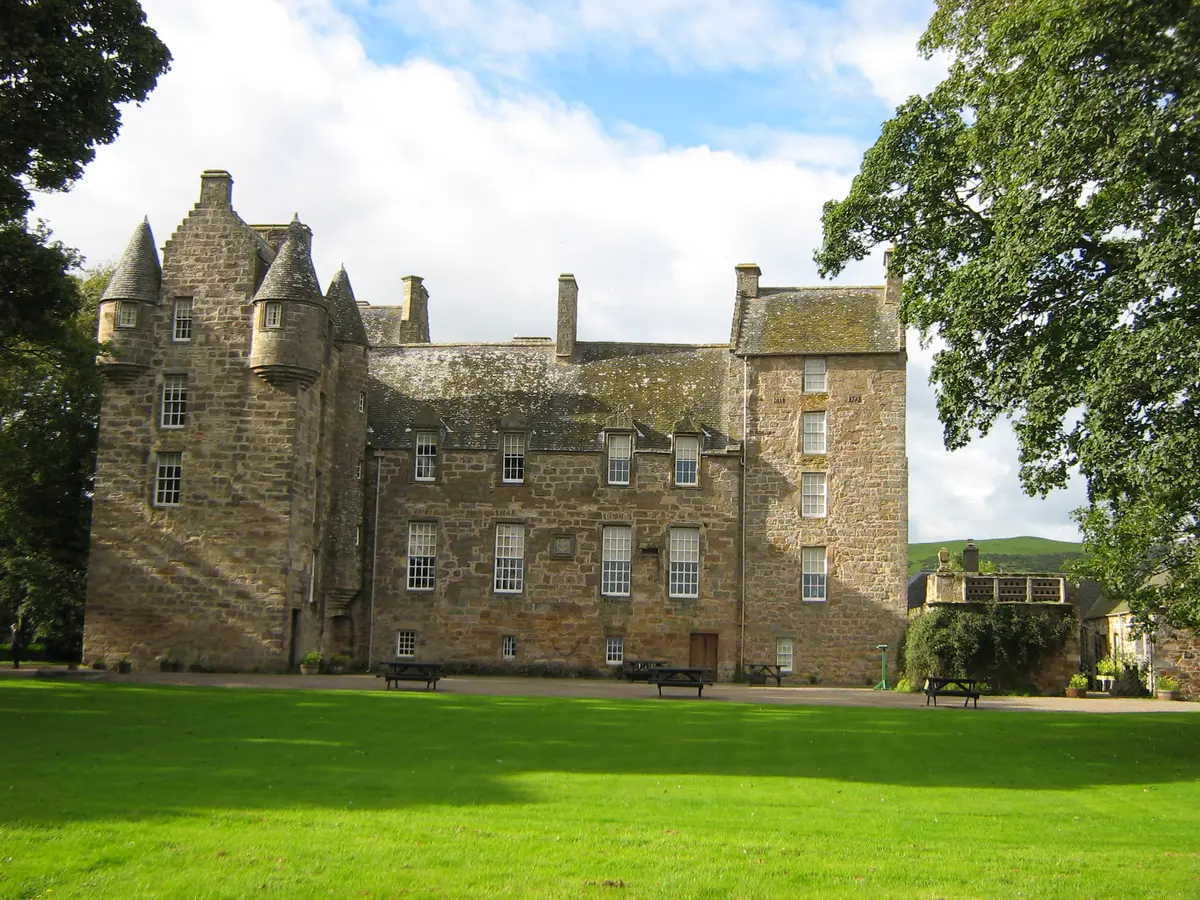
Kellie Castle stands below Kellie Law in the East Neuk of Fife: its oldest walls raised about 1360, its east tower dated 1573 for Margaret Hay, and the range that links them finished in the first years of the 17th century.
Where is Kellie Castle?
- Location
- Fife, Scotland, United Kingdom
- Type
- Castle
- Coordinates
- 56.237, -2.776
- Last updated
LOCATION
Why is Kellie Castle said to be haunted?
By 1878 it was, in the words of the two architects who surveyed it, an utter wreck, nearly floorless and roofless, the home of rooks and owls. That September an Edinburgh professor of public law, James Lorimer, moved his wife and six children in under a thirty-eight-year lease and had a Latin inscription cut over the door: this dwelling, snatched from the crows and the owls, is dedicated to honourable leisure amid labours. Two of those children became famous, the architect Robert Lorimer and the painter John Henry, and the Arts and Crafts garden the family made is now protected in its own right. Kellie is often listed as haunted. The claim is real but thin: it traces to a single unsourced clause, and nothing in the published accounts of the castle, including the guidebook written by its last private owner, mentions a ghost.
What is the history of Kellie Castle?
The best-documented fact about Kellie Castle is carved over its front door. When Walter Wood published The East Neuk of Fife in 1887 he copied the inscription: "Hoc domicilium corvis et bubonibus ereptum, honesto inter labores otio consecratum est." MacGibbon and Ross, surveying the building the same year for their Castellated and Domestic Architecture of Scotland, copied it too, and added the date and initials cut beneath it: A.S. M.D.CCC.LXXVIII, J.A.H.L. The two transcriptions differ by a single letter in the numeral; MacGibbon and Ross read 1878, which is the year the family's own account gives. The Latin was composed by Sir Alexander Grant, Principal of Edinburgh University and a colleague of the new tenant, and it says that this dwelling, snatched from the crows and the owls, is dedicated to honourable leisure amid labours.
Crows and owls were not a figure of speech. "Previous to 1878 the house had been abandoned for many years, and had become an utter wreck, nearly floorless and roofless, and choked full of ruins and rubbish, the home of rooks and owls," wrote MacGibbon and Ross, who drew the plans. The oldest walls, the lower stage of the north-west tower, go back to about 1360, when Helena Siward, lady of Kellie, resigned the lands to her kinsman Walter Oliphant, married to a daughter of Robert the Bruce. The east tower carries the initials M H and the date 1573, for Margaret Hay, daughter of the Earl of Errol, whom the fourth Lord Oliphant married that year; the range that links the two towers was finished in the first years of the 17th century. The Oliphants sold in 1613 to Sir Thomas Erskine, who had killed Alexander Ruthven during the Gowrie conspiracy of 1600 and was made Earl of Kellie in 1619. After the contents were sold at a "muckle roup" in 1829 the castle was left to the weather: the Great Hall served the home farm as a granary, and part of the building was let as lodgings for the manager of a coal mine at Balcormo.
James Lorimer, Regius Professor of Public Law at Edinburgh, was asthmatic and had found that the air of the East Neuk suited him. By 1876 the family were taking holidays as far east as Crail, and it was from The Priory in Pittenweem that they came upon Kellie. Lorimer already knew the owner: the two were co-trustees of the estate of an orphan called Forbes. A lease of thirty-eight years was agreed on the terms of an improving tenant. The Earl would make the castle wind- and weather-proof; Lorimer would pay a modest rent and do the interiors himself. In September 1878 the family slept there for the first time: the professor, his wife Hannah Stodart, and their six children, Jim, John, Hannah, Alice, Louise and Robert.
The first-hand description of what they found was written by the youngest daughter. "It was left to the rooks and the owls who built in its crumbling chimneys and dropped down piles of twigs which reached far out into the rooms," Louise Lorimer wrote. "Great holes let the rain and snow through the roofs, many of the floors had become unsafe, every pane of glass was broken, and swallows built in the coronets on the ceilings... The garden still encircled by a tumble-down wall, was a wilderness of neglected gooseberry bushes, gnarled apple trees, and old world roses, which struggled through the weeds, summer after summer, with a sweet persistence."
Louise did not only describe the garden. The statutory record of it, the Inventory of Gardens and Designed Landscapes entry maintained by Historic Environment Scotland, states that the garden "was laid out by Sir Robert Lorimer, helped by his mother, Hannah Lorimer, his sister Louise, and brother John". Robert's plan for it is dated 1888, and by 1905 it had matured enough for Gertrude Jekyll to write about it. The eldest daughter, Hannah Cassels Lorimer, took a University of Edinburgh Certificate for Women in moral philosophy and geology in 1880 - a certificate and not a degree, because women could not yet graduate - and her youngest sister, Caroline Louise - the Louise of the garden and of the account above - took three more in 1882 and 1886. Both chose geology. Hannah ran a European art course out of the small Pittenweem post office; according to a recollection by David Sladen, reported by the historians Sara Albuquerque and Luciana Martins, she "caught the trick of the beautiful moulded plaster ceilings at Kellie" from the craftsmen working in the house and was on that basis entrusted with the moulded plaster ceilings of Lord Bute's house in Fife. She married Everard im Thurn in 1895; the orchid watercolours she painted in British Guiana are at Kew.
Professor Lorimer died in 1890 and his widow held the tenancy after him. In the Dictionary of Scottish Architects' list of Robert Lorimer's commissions, Kellie appears three times: survey drawings in 1887, the doocot and the garden house in 1900, and "alterations and additions" in 1916, the year his mother spent her last summer there. His elder brother John Henry, the painter, then held the lease, with his studio in one of the towers, until he died at the age of eighty.
A second muckle roup followed and the castle stood empty again. What saved it, Hew Lorimer wrote in 1971, was "almost entirely... the creative gift, the perfect taste and the sheer industry of Mary McLeod Wylie", who had married him in 1937. The young couple took the lease on the old terms. Mary lined nearly forty pairs of curtains by hand, recovered most of the upholstered furniture herself, and kept more than twenty flower arrangements fresh through the house from spring to autumn. In the garden she was helped by Jim Dowie, the former gardener, who came back at seventy, replanted from memory, relaid the whole box edging of the herbaceous borders, and died at eighty at work in the garden.
When the Lorimers bought Kellie is less certain than it looks. Hew Lorimer's guidebook says 1948, and that year has been copied ever since. The same paragraph, however, says the purchase followed an agreement with the Historic Buildings Council for Scotland - a body created by section 2 of the Historic Buildings and Ancient Monuments Act 1953 - and that the sale happened because "the old Earl" had died and his grandson decided to sell. Walter John Francis Erskine, 12th Earl of Mar and 14th of Kellie, died in 1955 and was indeed succeeded by his grandson. Historic Environment Scotland's Inventory record dates the purchase to 1958. On the guidebook's own account, 1948 cannot stand.
Mary Lorimer died in 1970. Hew offered Kellie to the National Trust for Scotland and it was bought that year for 20,000 pounds - castle, garden, a cottage and eleven acres - of which the Secretary of State for Scotland found 15,000 from the National Land Fund, the balance coming from the Pilgrim Trust and from an anonymous life member of the Trust who also gave 50,000 towards the endowment. The contents cost a further 10,000 and were placed in the Trust's care on condition that they stayed at Kellie. Hew Lorimer set down plainly why the sale had happened at all: "It is in the hope that her achievement, within the context of the great house, can be given some permanence that it has been acquired with contents by the National Trust for Scotland. For it was the life's work of a rare artist." He kept part of the east tower until 1990, was appointed OBE in 1986, and died on 1 September 1993 in a nursing home in St Andrews. The castle is listed category A; the garden entered the Inventory of Gardens and Designed Landscapes in 1987, rated outstanding as a work of art and outstanding both historically and architecturally. It has been worked organically for about three decades and reached full Soil Association organic status in 2025, after its vegetables were certified in 2023 and its apples, pears and plums in 2024.
Timeline: the documented record of Kellie Castle
- c. 1360 Helena Siward, lady of Kellie, resigns the lands to her kinsman Walter Oliphant, husband of a daughter of Robert the Bruce. The lower stage of the north-west tower dates from about this time; the Oliphants hold Kellie for the next 250 years.
- 1573 The initials M H and the date 1573 are cut in bold relief high on the south front of the east tower, for Margaret Hay, daughter of the Earl of Errol, whom the fourth Lord Oliphant married that year.
- 1613 The Oliphants sell Kellie to Sir Thomas Erskine, who had killed Alexander Ruthven during the Gowrie conspiracy of 1600; he is made Earl of Kellie in 1619 and James VI stays at the castle in 1617.
- 1829 On the death of Methven Erskine, tenth Earl, the contents are sold at a 'muckle roup' and the house is abandoned. For the next half-century the Great Hall serves the home farm as a granary and part of the building is let to the manager of a coal mine at Balcormo.
- September 1878 Professor James Lorimer, his wife Hannah Stodart and their six children sleep at Kellie for the first time under a thirty-eight-year lease. The Latin inscription over the door, composed by Principal Sir Alexander Grant, is transcribed by MacGibbon and Ross with the date M.D.CCC.LXXVIII.
- 1888 Robert Lorimer draws up the plan that still governs the garden. Historic Environment Scotland's Inventory record states that it was laid out by him 'helped by his mother, Hannah Lorimer, his sister Louise, and brother John'.
- 1916 Hannah Stodart Lorimer, who had held the tenancy since her husband's death in 1890, spends her last summer at Kellie. The Dictionary of Scottish Architects dates Robert Lorimer's 'alterations and additions' at the castle to the same year.
- 1937 After the death, aged eighty, of the painter John Henry Lorimer and a second sale of the contents, the sculptor Hew Lorimer marries Mary McLeod Wylie and the couple take on the lease on the old terms. Hew later wrote that the Lorimer connection survived 'almost entirely' because of her.
- 1955 Walter John Francis Erskine, 12th Earl of Mar and 14th of Kellie, dies and is succeeded by his grandson, who decides to sell and gives his tenants first refusal. The Inventory record dates the Lorimers' purchase to 1958; the guidebook's 1948 is not compatible with this, nor with the 1953 statute that created the body it says the sale was agreed with.
- 1970 Mary Lorimer dies and Hew offers Kellie to the National Trust for Scotland, which buys the castle, garden, a cottage and eleven acres for 20,000 pounds, with 15,000 from the Secretary of State for Scotland out of the National Land Fund. Hew Lorimer wrote that the aim was to give permanence to his wife's work.
- 1 July 1987 The garden is added to the Inventory of Gardens and Designed Landscapes as GDL00234, rated outstanding as a work of art and outstanding in historical and architectural interest. The castle itself is listed category A.
- 1 September 1993 Hew Lorimer, appointed OBE in 1986, dies in a nursing home in St Andrews. He had kept part of the east tower until 1990; his studio in the old stables is preserved as it was at his death.
- 27 December 2005 The first draft of the English Wikipedia article on Kellie Castle says the north-west tower 'is said to be haunted'. No source is attached to the clause in the 129 revisions that follow, down to 28 May 2026. This is the oldest datable printed claim of a haunting at Kellie that this review could find.
- 2025 The garden, worked organically for some thirty years, receives full organic status from the Soil Association, after its annual vegetable crops were certified in 2023 and its apples, pears and plums in 2024.
Is there a rational explanation for Kellie Castle?
Kellie turns up on lists of haunted Scottish castles. The claim has a traceable footprint, but it is far thinner than the lists imply.
The oldest printed version I have been able to date is a single clause in the very first draft of the English Wikipedia article, saved on 27 December 2005: the lower north-west tower "is the oldest part of the castle, dating from around 1360, and is said to be haunted". In 129 revisions between that day and 28 May 2026, nobody has attached a source to it. That same clause, by way of Wikipedia's list of reportedly haunted locations in Scotland, is also how Kellie entered this site's catalogue.
Against it stand the people who wrote at length about the building and mentioned nothing of the sort.
Walter Wood's The East Neuk of Fife (1887) gives Kellie and its neighbourhood a chapter of their own. In the volume the word Kellie appears 129 times, Erskine 74 and Oliphant 40. The word ghost appears once, inside a quotation about a dying man; haunted, haunt and spectre do not appear at all. This is not a squeamish book: it prints at length an apparition seen by Lord Balcarres and its index carries entries for "Apparition of Viscount Dundee" and "Devil, apparition of the". It simply has no ghost at Kellie.
MacGibbon and Ross surveyed and described the castle the same year, working partly from a private monograph on Kellie written by Professor Lorimer himself. Their volume uses the word castle 1,688 times and the word ghost once, nowhere near Kellie.
The strongest witness is the last owner. The National Trust for Scotland's Kellie guidebook of July 1971 was written by Hew Lorimer, who by then had lived in the castle for thirty-four years. It names Kellie 34 times and Lorimer 26, walks the reader through every principal room, and contains no ghost, no haunting and no apparition. The one castle anecdote he thought worth telling is a joke. An Earl liked to entertain; Lady Kellie would set out what wine she judged proper, pocket the cellar key and go to take tea with the minister's wife at Carnbee; on one such afternoon the two women heard a commotion outside and saw four men carrying the cellar door up to the manse - "With the Earl's compliments an' it had come to look for the key".
There is nothing in the statutory record either. Historic Environment Scotland's Inventory entry names Lorimer forty times and gardens seventy-one, and uses neither ghost nor haunt. The Trust's current pages, checked on 12 August 2026, name Lorimer fifteen times and hauntings not once - worth noting, because the same charity does advertise ghost content at other properties. The Gazetteer for Scotland and Undiscovered Scotland are silent too.
Two specific claims that this page used to carry - a baby heard crying in an upper room with no child present, and a "Blue Lady" glimpsed in the older corridors at dusk - have no source I can find anywhere, and neither does the statement that Hew Lorimer spoke about his family accepting the castle's odd noises. His own published writing about the house says nothing of the kind. The only blue thing named in the literature is the Blue Room, a panelled bedchamber in the south-west tower described in the 1971 guidebook.
One honest limit on all of this: general web searching was unavailable while this page was rewritten, so a mention in some 20th-century popular ghost book cannot be ruled out. What can be said is that no ghost appears in the three fullest published accounts of the building (1887, 1887 and 1971), in its statutory designation record, or on its owner's website.
As for what a visitor might actually notice: Kellie is a corridorless tower house of three building periods, climbed by four turnpike stairs, where rooms open directly into rooms; its original Arbroath stone roof tiles were swapped for Ballachulish slate; and rooks and owls really did nest in its chimneys within the memory of the family who wrote the guidebook. None of that requires a ghost, and no published investigation of the building attributes anything to anything.
Can you visit Kellie Castle?
Kellie Castle and Garden belongs to the National Trust for Scotland. Its postal address is Kellie Castle, Anstruther, Pittenweem, Fife KY10 2RF, with the telephone number 01333 720271, and Historic Environment Scotland gives the national grid reference of its designed landscape as NO 52026 05259, in the parish of Carnbee. The Trust places the castle 3 miles north-west of Pittenweem; in a straight line it is about 4 km (2.5 miles) from the centre of the village. The Trust's page warns that some route planners and satellite navigation systems give directions to the wrong place from the postcode, and directs drivers to the brown National Trust for Scotland signs; a Flexibus from local villages can be pre-booked on 01382 540624.
The opening details that follow come from the Trust's planning page as archived on 13 August 2026. From 7 March to 31 October the castle was open daily from 10.30 to 16.30, with guided tours on the hour and last entry at 15.30, and from 1 November to 24 December at weekends from 10.00 to 16.00. Tours could be booked in advance through the Trust's events listing or on the day at the welcome desk, and the page adds that visits are offered either as guided tours or as open guiding. In the March to October season the shop opened from 09.45 to 17.00 and the tearoom from 10.00 to 16.30, with last orders at 16.15; the garden was open from dawn to dusk and the estate all year. Groups of more than twelve were asked to contact the property.
The prices on that page were £14 for adults, £11 concession, £8 for children, £38 for a family, £25 for a one-adult family and £1 with a Young Scot card, plus £4 for the car park, with Trust members admitted free. The Trust said that those prices carried a temporary VAT rate of 5 per cent instead of 20 per cent from 25 June to 1 September 2026; the castle's main page, archived on 17 September 2026, still listed the same figures.
The planning page lists the shop, tearoom, toilets and garden as wheelchair-accessible, with disabled parking beside the castle signposted from the main car park, and links to a separate accessibility guide for the castle. Toilets open from 10.00 to 17.00 between 1 April and 31 October. Dogs on a lead are allowed in the garden and across the grounds, honeybees are kept in hives on the site, and there is an adventure playground in the woodland beside the castle. According to the Trust's main page, the stables house an exhibition on the sculptor Hew Lorimer with his studio reconstructed as it was at the time of his death.
Sources consulted
- Walter Wood, «The East Neuk of Fife: its history and antiquities» — David Douglas, Edinburgh (2nd edition), 1887 book
- David MacGibbon and Thomas Ross, «The Castellated and Domestic Architecture of Scotland, vol. II (Kellie Castle, Fifeshire)» — David Douglas, Edinburgh, 1887 book
- Hew Lorimer, «Kellie Castle, near Pittenweem, Fife (official guidebook)» — The National Trust for Scotland, 1971 book
- Historic Environment Scotland, «Kellie Castle: Inventory of Gardens and Designed Landscapes, GDL00234» — Designation record, added 1 July 1987, 1987 report
- National Trust for Scotland, «Kellie Castle & Garden: planning your visit» — nts.org.uk (opening times, prices and access consulted 12 August 2026), 2026 web
- Nicola Law, edited by Antonia Laurence Allen, «Hannah Lorimer and the pursuit of education» — National Trust for Scotland, 2021 web
- Sara Albuquerque and Luciana Martins, «Place, gender and the making of natural history: Hannah im Thurn in British Guiana, 1895-1897» — Journal of Historical Geography, vol. 62, pp. 1-14, 2018 academic
- Dictionary of Scottish Architects, «(Sir) Robert Stodart Lorimer: architect biography and job list» — scottisharchitects.org.uk (archived 7 February 2022), 2022 web
- Wikipedia contributor Cactus.man, «Kellie Castle, first revision of the article (revid 32899390)» — English Wikipedia, 27 December 2005, 2005 web
- Parliament of the United Kingdom, «Historic Buildings and Ancient Monuments Act 1953, section 2: Historic Buildings Council for Scotland» — legislation.gov.uk, 1953 archive
- National Trust for Scotland, «Kellie Castle's historic garden receives organic stamp of approval» — nts.org.uk, 2025 web
Reviewed by V. Serrano on 2026-08-12 · How we verify our content
💬 Field testimonies (0)
No testimonies yet. Add the first.
Add your testimony
🔒 Log in to add a testimony