👻 HAUNTED PLACE · EXP. Nº9476
ACTIVE
Kinnaird Head
Scotland's first lighthouse did not replace the castle on Kinnaird Head — it was built straight through it.
Where is Kinnaird Head?
- Location
- Aberdeenshire, Scotland, United Kingdom
- Type
- Lighthouse
- Coordinates
- 57.698, -2.004
- Last updated
LOCATION
Why is Kinnaird Head said to be haunted?
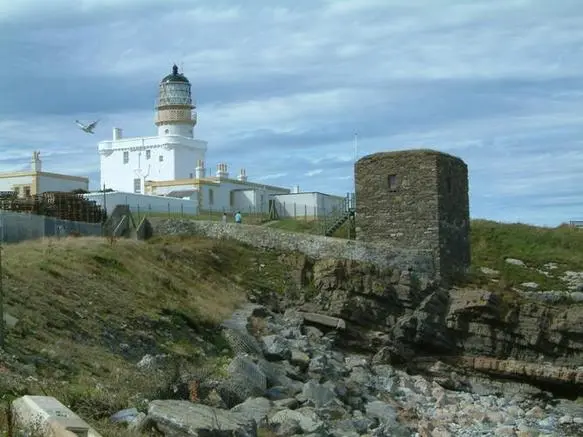
Sir Alexander Fraser founded the tower in 1570; in 1787 the Commissioners of Northern Lights set their first light on its roof, and in 1824 Robert Stevenson drove a light tower through its heart. Fifty metres away, over a sea cave the tide still fills, stands the older Wine Tower, a stack of three vaulted rooms with no staircase and no recorded purpose, its upper chamber hung with carved bosses of the Fraser arms and the Instruments of the Passion. The legend attached to it keeps changing shape: in the oldest printed version, an 1870 poem, a laird's daughter leaps into the sea clasping the corpse of a lover starved in the cave; today the site tells of Isobel Fraser's piper, chained below and drowned by the tide, still heard playing in storms, while red paint on the rocks marks where she fell. The old lighthouse is now the Museum of Scottish Lighthouses, and the cave mouth can be seen from the headland path.
What is the history of Kinnaird Head?
The headland of Kinnaird Head shoulders the town of Fraserburgh out into the North Sea, and everything built on it belongs to one family's ambition. On 6 March 1570 Sir Alexander Fraser, 8th laird of Philorth, laid the foundation of “the Tower of Kynnaird’s head”, as the old account quoted by John B. Pratt puts it. Over the following decades the same laird raised a new church, turned the fishing village of Faithlie into the burgh of Fraserburgh, and in 1592 obtained a Crown charter to found a university there — a scheme that stalled by 1597, most probably for want of funds. The building spree ruined him: he was forced to sell Philorth, the family seat.
Some fifty metres from the castle, on a rock the storms wash over, stands an older and stranger building: the Wine Tower. Nobody knows what it was for. It is three vaulted chambers stacked without a staircase; the habitable upper room was reached through an outside door at third-storey level, by a ladder that could be pulled up at will. Historic Environment Scotland dates the work to after 1559 on the evidence of its carvings: seven freestone pendant bosses hang in the upper chamber, among them an eagle grasping a key in its beak over the quartered arms of Fraser and Abernethy, ringed by the motto “The glory of the honourable is to feir God”; the royal arms of Scotland; and the crown of thorns, pierced hands and feet and scourge of the Passion. That last, defiantly Roman Catholic device, carved decades after the Reformation, underpins the theory published by Bryce and Roberts in 1993 that the chamber served as a covert chapel for Magdalen Ogilvie, Sir Alexander's Catholic wife — though the scheduling record itself notes the room has a fireplace and no ecclesiastical arrangement. Even the name is disputed: the parish minister writing in the New Statistical Account in 1845 took the tower for the castle's wine cellar, while Lord Saltoun derived it from “The Wynd”, the winding path that once linked castle and tower.
In 1787 the newly created Commissioners of Northern Lights acquired the castle tower as their first lighthouse property. Thomas Smith of Edinburgh mounted a whale-oil lamp with seventeen reflectors on the roof, first lit on 1 December 1787 — the first lighthouse in Scotland lit by the Commissioners. In 1824 Robert Stevenson drove a proper light tower, with its own foundations and spiral stair, straight through the heart of the castle. The Wine Tower was meanwhile demoted to powder magazine during the Napoleonic invasion scare, when most of its windows were bricked up, and again for the Volunteers in 1860, ending as a lighthouse store. Keepers watched from Kinnaird Head until 1991, when the Northern Lighthouse Board raised a new automatic tower alongside and retired the old light; since 1995 the castle-lighthouse has housed the Museum of Scottish Lighthouses.
The legend belongs to the Wine Tower and to the sea cave beneath it, which Fraserburgh people called the Selch's — the seal's — Hole. In the oldest version this research could date in print, the anonymous verse “Legend of the Wine Tower” published in the third edition of Pratt's Buchan in 1870, a laird's daughter loves beneath her station; her father's hired men fetter the lover in the cave, where he dies slowly, “a hapless prey to hunger gaunt”; the father shows the girl the corpse to bend her toward a rich old suitor, and she leaps into the sea clasping the body. John Cranna, Fraserburgh's harbour treasurer, retold the story in prose in 1914: his lover is “a handsome, well-made menial” who dies in a dungeon about the castle, while the daughter is held prisoner in the Wine Tower itself. The version told at the site today — by the museum, the Northern Lighthouse Board and the scheduling record alike — has recast the lover as a piper: Sir Alexander Fraser chained his daughter Isobel's sweetheart in the cave, the rising tide drowned him, and Isobel threw herself from the tower onto the rocks, where a splash of red paint is still kept up to mark the fall. In the Piper's Cave, the modern telling goes, he can be heard playing for his lost love when storms drive the sea in.
Timeline: the documented record of Kinnaird Head
- 6 March 1570 Sir Alexander Fraser, 8th laird of Philorth, lays the foundation of the tower of Kinnaird Head, the castle that will one day carry the lighthouse. The nearby Wine Tower, dated after 1559 by its heraldic carvings, already stands or rises around the same years.
- 1 December 1787 Thomas Smith's seventeen-reflector lamp is lit on the castle roof: Kinnaird Head becomes the first lighthouse in Scotland lit by the Commissioners of Northern Lights, and their first property.
- 1803 During the Napoleonic invasion scare the Wine Tower is turned into a powder magazine and most of its windows are bricked up, as the town council minutes record; it will serve the Volunteers again in 1860 and end as a lighthouse store.
- 1824 Robert Stevenson completes the rebuilding that drives a proper light tower, with its own foundations and spiral stair, through the middle of the sixteenth-century castle.
- 1845 The parish minister's account in the New Statistical Account describes the Wine Tower as probably the castle's wine cellar, over a cave of more than a hundred feet — and prints no legend of any kind.
- 1870 The anonymous poem “Legend of the Wine Tower” appears in the third edition of John B. Pratt's Buchan: the lover fettered in the cave dies of hunger and the daughter leaps into the sea clasping his corpse. It is the oldest printing of the legend this research could verify.
- 1914 John Cranna, Fraserburgh's harbour treasurer, retells the legend in prose — the lover now a castle servant dying in a dungeon, the daughter imprisoned in the tower itself — and records that coasting crews used to watch the cave mouth for a light “keeping rhythmic time with the movements of the sea”.
- 19 February 1941 A wartime near miss damages the lantern panes, the radio-beacon aerial — Scotland's first, installed here in 1929 — and the keepers' windows.
- 1991 The Northern Lighthouse Board commissions a new automatic tower beside the castle and retires the original light after 204 years of service.
- 1995 The Museum of Scottish Lighthouses opens in the old castle-lighthouse, with guided tours to the lamp room.
- 22 June 2007 The drowned-lover version of the legend enters Wikipedia without a source; the daughter's leap and the red paint follow in 2010, and in 2013 an editor attaches Cranna's 1914 book with the edit summary “ref (sort of)” and a hidden note admitting the book tells a different story.
Is there a rational explanation for Kinnaird Head?
No document of the sixteenth or seventeenth century records any of these deaths. Cranna himself, the legend's most careful local teller, admitted in 1914 that “not a single vestige of writing has ever been found bearing upon this ancient pile”. The parish minister's account in the New Statistical Account of 1845 describes tower and cave in some detail and prints no legend at all; the earliest appearance in print this research could verify is the anonymous poem in the 1870 third edition of Pratt's Buchan (whether it already stood in the 1858 first edition could not be checked).
No two tellings agree on a checkable fact. The lover is a castle servant in Cranna and a piper in the modern version; his prison is a dungeon in one and the sea cave in the other; he dies of starvation in the poem and by drowning today; the ghost-sign the cave gives is a light watched for by fishermen in 1914 and piping heard in storms now. The names — Isobel, and Sir Alexander Fraser as the cruel father — belong only to the modern telling: the nineteenth- and early twentieth-century versions name nobody. Each generation has recut the story, and the red paint on the rocks is not evidence but scenery: the Northern Lighthouse Board's own account notes it is kept there so visitors “can see the place where she fell”.
How the internet version formed can be dated to the day. On 22 June 2007 a Wikipedia editor added, without source, that a Fraser imprisoned his daughter's boyfriend in the cave and left him to drown; on 6 September 2010 an anonymous editor added the daughter's leap and the red paint; on 12 September 2013 another attached Cranna's 1914 book as reference with the candid edit summary “ref (sort of)” and a hidden note admitting the book tells a different story. The text this page previously carried had drifted further still: it drowned the daughter herself and invented a priest too absorbed in saying Mass to hear her cries — a garbled echo of the covert-chapel theory about the carved bosses — and called her a Green Lady, a title no source on this site uses. Those details are withdrawn here. What remains checkable is a sea cave that the tide genuinely fills and that storm surf genuinely makes sound and spray in — the ordinary raw material from which a tower with no recorded purpose got its ghost.
Can you visit Kinnaird Head?
The former lighthouse and castle are run as the Museum of Scottish Lighthouses, at Kinnaird Head, Stevenson Road, Fraserburgh AB43 9DU (tel. +44 1346 511022). At the time of writing it opens daily from 10am to 4pm, with 45-minute guided tours of the castle and lighthouse tower on the hour from 10am to 3pm; admission is £12.50 for adults, £10.50 concessions and students, £6 for under-16s, free under 5, £26 for a family ticket. The museum holds a major collection of lighthouse lenses and keepers' effects, and there is a tea room overlooking the sea.
The Wine Tower is not part of the standard tour: it is a scheduled monument in the care of the state, and its interior is normally closed. It stands in plain view a short walk from the lighthouse, however, and the shore below — including the mouth of the Piper's Cave and the red-painted mark on the rocks — can be seen from the headland path. Take care near the cliff edge in wind and swell; the cave itself floods with the tide, which is the whole point of the story. The working 1991 lighthouse beside the museum is a plain white automatic tower and is not open to visitors. Fraserburgh is about 40 miles north of Aberdeen by the A90/A98, with regular buses from the city.
Sources consulted
- John B. Pratt, «Buchan (3rd edition), pp. 195–198» — Lewis Smith, Aberdeen, 1870 book
- John Cranna, «Fraserburgh: Past and Present, pp. 389–396» — Fraserburgh, 1914 book
- Rev. John Cumming, «The New Statistical Account of Scotland, vol. XII (Aberdeen), parish of Fraserburgh, p. 251» — William Blackwood and Sons, 1845 book
- Historic Environment Scotland, «Wine Tower, Fraserburgh — scheduled monument record SM90344» — Historic Environment Scotland, 2019 report
- RCAHMS / Historic Environment Scotland, «Fraserburgh, Wine Tower (Canmore site 20780) — archaeological notes» — Canmore, 2011 archive
- Northern Lighthouse Board, «Kinnaird Head — lighthouse history» — nlb.org.uk, 2026 web
- Museum of Scottish Lighthouses, «Kinnaird Head Castle» — lighthousemuseum.org.uk, 2026 web
- Museum of Scottish Lighthouses, «Plan your visit» — lighthousemuseum.org.uk, 2026 web
- Live Life Aberdeenshire, «Museum of Scottish Lighthouses» — Aberdeenshire Council, 2026 web
- Wikipedia contributors, «Kinnaird Head — revision history» — en.wikipedia.org, 2013 web
Reviewed by V. Serrano on 2026-08-17 · How we verify our content
💬 Field testimonies (0)
No testimonies yet. Add the first.
Add your testimony
🔒 Log in to add a testimony