👻 HAUNTED PLACE · EXP. Nº9476
ACTIVE
Knock Castle (Isle of Skye)
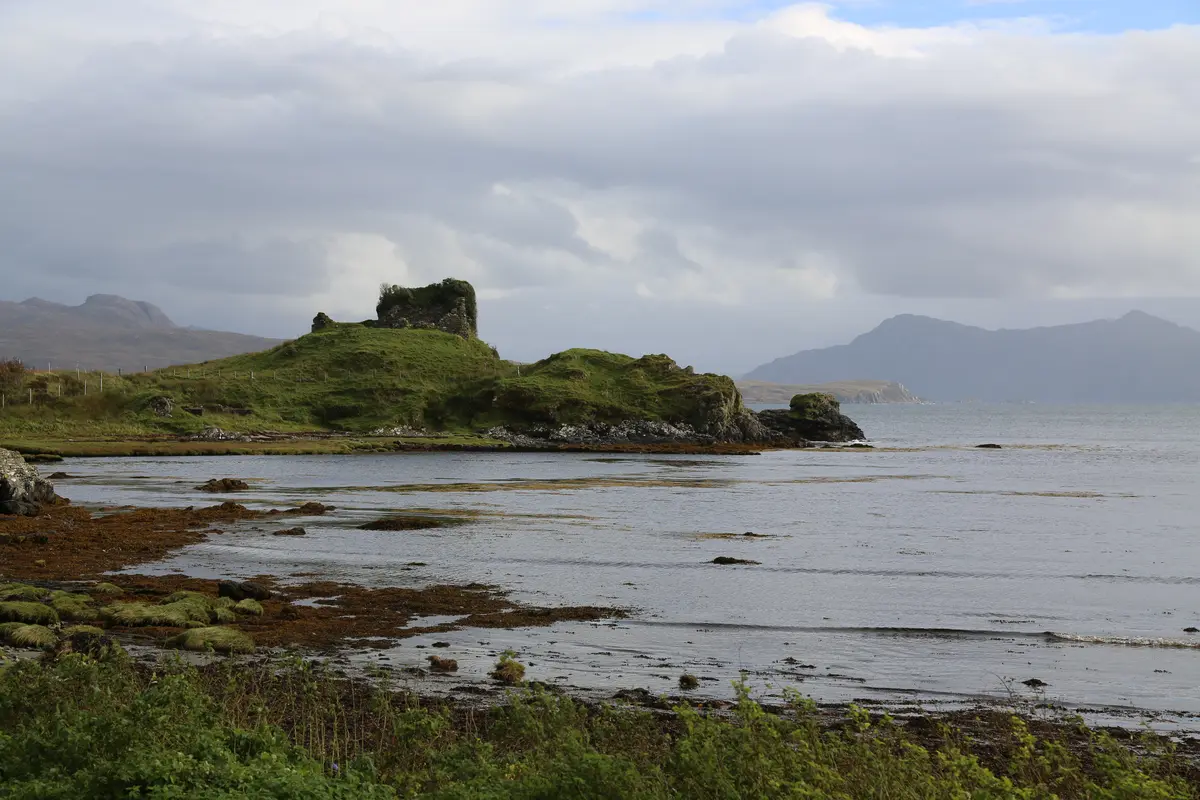
On a crag above Knock Bay, on the Sleat coast of Skye, stand the ivy-grown remains of Knock Castle — Caisteal Chamuis, the castle of the bay, built over an Iron Age dun.
Where is Knock Castle (Isle of Skye)?
- Location
- Isle of Skye, Scotland, United Kingdom
- Type
- Castle
- Coordinates
- 57.11, -5.847
- Last updated
LOCATION
Why is Knock Castle (Isle of Skye) said to be haunted?
A MacLeod castle stood here by 1402; the MacDonalds of Sleat held it from the late fifteenth century, and clan histories remember a siege broken by a woman, Mary of the Castle, who rallied the defence against the MacLeods. A royal charter of 1596 demanded the castle be kept ready for the king; the last record of anyone living here is from 1632, and its stones have been feeding the surrounding farms ever since. The resident spirit belongs to an older economy than the ghost tour. In Gaelic tradition the glaistig — the Green Glaistig, a little grey woman dressed in green — watched the house and the cattle and was paid in milk poured into a hollowed stone; in 1905 the folklorist J. A. MacCulloch recorded that she used to be seen at the ruined castle of Knock, where libations of milk were poured out for her. The Green Lady of later webpages is her diminished, copy-pasted echo.
What is the history of Knock Castle (Isle of Skye)?
The crag above Knock Bay was fortified long before any castle stood on it: Historic Environment Scotland records that the medieval ruin overlies an Iron Age dun, Dun Horavaig, and the site's official name is still "Caisteal Camus or Knock Castle, on site of Dun Horavaig". The bay gave the castle its Gaelic name — Caisteal Chamuis, the castle of the bay — and its strategic point: from here a garrison watched the Sound of Sleat, the sea lane between Skye and the mainland hills of Knoydart.
There was a MacLeod castle here by 1402, when William, fourth chief of the MacLeods, died at Knock. Sleat was contested ground between the MacLeods and the MacDonalds, and the castle changed hands with the peninsula: royal troops overran it in 1431, during the crown's campaign against the Lordship of the Isles, and by the end of the fifteenth century it belonged to the MacDonalds of Sleat.
Its most memorable episode has a heroine. After the king's death at Flodden in 1513, a rising sought to restore the Lordship of the Isles, and Alexander Cameron's History and Traditions of the Isle of Skye (1871) records that "about this time Castle Camus, in Sleat, was besieged by the Macleods for a long time. The siege was raised by the intrepidity of a lady, styled Mary of the Castle." J. A. MacCulloch, retelling the tradition in 1905, compared her to "another Joan of Arc" who inspired the defenders to hold out and defeat the rival clan. She is the one person the castle's story remembers by name.
The paper trail of the sixteenth century is unusually good. In 1549 Donald Monro, High Dean of the Isles, listed among the five castles of Skye "the castill of Camus in Sleit, perteining to Donald Gormeson". James Macdonald, son of the chief Donald Gruamach, resided at Knock until the family's lands were forfeited to the crown in 1581; around 1578 his son John, held prisoner by the Earl of Argyll at Inchconnell, lodged a formal complaint against his captor. In 1596 a royal charter confirmed Donald Gorm Mor in Sleat on the condition that Caisteal Camus be kept available as a residence for the king, and MacCulloch notes that in 1617 Donald Gorm was still bound by the terms of his tenure to have the castle "always ready to receive the king or his lieutenants". The last record of Knock as an occupied house dates to 1632. After that the castle was left to the weather and the neighbours: much of its masonry was carried off for nearby buildings, and the deterioration since Horatio McCulloch painted the ruin in watercolour in 1854 is, in Historic Environment Scotland's word, marked.
The castle's other tenant comes from the Gaelic tradition of household spirits. In Superstitions of the Highlands and Islands of Scotland (1900), John Gregorson Campbell describes the glaistig: a tutelary being in the shape of "a thin grey little woman... dressed in green", called the Green Glaistig from her wan looks and fairy colour, attached not to a family but to a building — so faithfully that she "continued her occupancy... even after the building was deserted and had become a nesting place for wild birds". She watched the house and the cattle, broke into cries of joy or sorrow when fortune or misfortune was coming to the household, and was paid in milk poured into a hollowed stone. In Skye, Campbell adds, most of her duties passed to a male counterpart, the gruagach, pictured as a tall young man with long yellow hair, dressed like a gentleman of a bygone age with a switch in his hand. MacCulloch tied the tradition to this exact spot in 1905: "The Glaistig used to be seen at the ruined castle of Knock. There, and at Braes, libations of milk were poured out for her." A writer on Skye in the 1790s reported gruagach stones — the cup-stones that received the milk — in every district of the island, and Dr Johnson had already heard of such a being on the islet of Trodda in 1775. The ruin was designated a scheduled monument on 19 December 2002.
Timeline: the documented record of Knock Castle (Isle of Skye)
- 1402 There is a MacLeod castle at Knock by this date: William, fourth chief of the MacLeods, dies here, according to Historic Environment Scotland's designation record.
- 1431 Royal troops overrun Knock during the crown's campaign against the Lordship of the Isles.
- c. 1513-1517 During the rising that follows Flodden, the MacLeods besiege Castle Camus for a long time; Cameron's 1871 history records that the siege is raised "by the intrepidity of a lady, styled Mary of the Castle". MacCulloch later compares her to "another Joan of Arc".
- 1549 Donald Monro, High Dean of the Isles, lists "the castill of Camus in Sleit, perteining to Donald Gormeson" among the five castles of Skye.
- 1596 A royal charter confirms Donald Gorm Mor in Sleat on condition that Caisteal Camus be kept available as a residence for the king; in 1617 the obligation to receive "the king or his lieutenants" is still attached to the lands.
- 1632 Last record of Knock as an occupied site. The abandoned castle is quarried for building stone in the following decades.
- 1775 Dr Johnson's published account of his Hebridean journey mentions a "Greogaca" (gruagach) on the islet of Trodda off Skye — the earliest print mention Campbell cites for the island's tutelary spirit.
- 1854 Horatio McCulloch paints the ruin in watercolour; Historic Environment Scotland later uses the picture to measure how much masonry has been lost since.
- 1900 John Gregorson Campbell's Superstitions of the Highlands and Islands, collected from oral sources, describes the glaistig — "the Green Glaistig" — and Skye's male gruagach, both paid in milk poured into hollowed stones.
- 1905 J. A. MacCulloch anchors the tradition to this spot: "The Glaistig used to be seen at the ruined castle of Knock. There, and at Braes, libations of milk were poured out for her."
- 19 December 2002 The castle and the underlying dun are designated a scheduled monument (SM8480); the designation text describes the site without any mention of ghosts.
- 24 April 2006 The English Wikipedia article is created with an unsourced paragraph on a "Green Lady" — the earliest datable appearance of that name at Knock. Later revisions swap which spirit is the gruagach and which the glaistig.
Is there a rational explanation for Knock Castle (Isle of Skye)?
There is no dated sighting and no named witness in the whole record of Knock Castle. What the sources document is not a haunting but a household cult: milk poured into a cup-stone for a tutelary being, part of the ordinary economy of a Hebridean farm. The fortune-telling trait — a spirit that rejoices before good news and weeps before bad — is not a Knock testimony either; Campbell describes it in 1900 as a generic attribute of the glaistig type, wherever she lived.
The "Green Lady" label is measurably modern here. The plain texts of the three standard early books, as served by the Internet Archive and Project Gutenberg and searched on 4 October 2026 — Cameron's history of Skye (1871), Campbell's Superstitions (1900) and MacCulloch's Misty Isle of Skye (1905), about 250,000 words between them — contain no "Green Lady", at Knock or anywhere else; in the same files "Dunvegan" returns 85 hits in Cameron and 75 in MacCulloch, and "glaistig" 90 in Campbell. The earliest appearance of a Green Lady at Knock that can be dated is the English Wikipedia article created on 24 April 2006, whose folklore paragraph carried no source then and carries none now. Its drift is itself measurable: the 2006 text called the fortune-mirroring spirit a gruagach and the cattle-keeper a glaistig; the current revision has swapped the two labels. MacCulloch had already noted in 1905 that the folklore of the two beings "is inextricably mixed up"; the Wikipedia swap, though, happened between revisions of one unsourced paragraph, and neither version cites any collector or book.
Even the colour has a rational core: glas, the root of glaistig, means grey, wan or pale-green, and Campbell derives her "Green Glaistig" byname from her dress and pallor. A grey-green woman glimpsed at dusk is what the being's own name promises. As for the setting, an ivy-grown ruin on a sea crag supplies wind, birds nesting in the masonry — Campbell's own image for a deserted glaistig house — and failing light. No one sells tickets to this story: the ruin is free, unstaffed and unlit, and Historic Environment Scotland's designation record describes a multi-phase medieval building without a word about spirits. Nobody profits from the Green Lady of Knock; she survives because webpages copy each other.
Can you visit Knock Castle (Isle of Skye)?
Knock Castle stands on the east coast of the Sleat peninsula, above Knock Bay, just off the A851 between Broadford and Armadale, near the townships of Knock and Teangue and about 8 km north of the Armadale ferry. There is no visitor infrastructure: the ruin is free to visit, unstaffed, unlit and open at all times.
Access is on foot along a farm track leading from the A851 past the buildings of Knock farm, then a rough path to the knoll; the ground is muddy after rain. Treat the structure with caution — the medieval walls stand more than 10 m high in places but are unconsolidated, the crag falls away steeply on three sides, and wet grass and seaweed-covered rocks around the bay are slippery. The site is a scheduled monument, so disturbing or removing stones is an offence.
The reward is the setting more than the fabric: an ivy-grown fragment of keep on a green knoll, the sweep of Knock Bay below, and across the Sound of Sleat the mainland hills of Knoydart — the view MacCulloch called magnificent in 1905. The Clan Donald Centre at Armadale Castle, with its Museum of the Isles, is a short drive south and tells the story of the MacDonalds who held Knock; Broadford, to the north, has the nearest full range of services.
Sources consulted
- Alexander Cameron, «The History and Traditions of the Isle of Skye» — E. Forsyth, Inverness, 1871 book
- John Gregorson Campbell, «Superstitions of the Highlands and Islands of Scotland» — James MacLehose and Sons, Glasgow, 1900 book
- J. A. MacCulloch, «The Misty Isle of Skye: Its Scenery, Its People, Its Story» — Oliphant Anderson & Ferrier, Edinburgh, 1905 book
- Historic Environment Scotland, «Caisteal Camus or Knock Castle, on site of Dun Horavaig (SM8480)» — Scheduled monument designation record, 2002 report
- Wikipedia contributors, «Knock Castle (Isle of Skye) — article and revision history» — Wikipedia (English), 2006 web
Reviewed by V. Serrano on 2026-08-17 · How we verify our content
💬 Field testimonies (0)
No testimonies yet. Add the first.
Add your testimony
🔒 Log in to add a testimony