👻 HAUNTED PLACE · EXP. Nº0482
ACTIVE
Mary King's Close
Mary King's Close is a location reputed to be haunted in Scotland, GB. Its reputation comes from reported apparitions, unexplained phenomena and eyewitness accounts gathered over time.
Where is Mary King's Close?
- Location
- Scotland, GB
- Type
- Other
- Coordinates
- 55.95, -3.191
- Testimonies
- 0
- Last updated
LOCATION
Why is Mary King's Close said to be haunted?
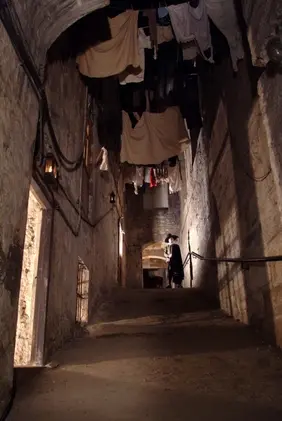
Mary King's Close is a warren of old streets and dwellings buried beneath the City Chambers on Edinburgh's Royal Mile, in the heart of the Old Town. It takes its name from Mary King, a merchant burgess who lived and traded there in the 17th century. In 1753 the close was partially demolished and built over during the construction of the Royal Exchange, and the surviving lower levels were sealed away from public view for generations. Cut off beneath the city, the close accumulated a dense layer of myth: stories of murders committed in its passages and of hauntings in its abandoned rooms circulated in Edinburgh for well over a century. Its last resident, Andrew Chesney, received a compulsory purchase order of £400 in 1897 and finally left in 1902. The underground complex is now run as a guided tourist attraction by Continuum Attractions, and its darkened chambers remain among the most visited reputedly haunted sites in Scotland.
What is the history of Mary King's Close?
Mary King's Close is a genuine seventeenth-century Edinburgh street that survives underground, and the reason it survives has nothing to do with plague.
A close in the Old Town was a narrow alley running steeply down from the High Street, lined with tall tenements. Mary King's Close was one of these, home to around 500 people in the seventeenth century: merchants, tradesmen and their families, living in stacked flats with the shops at street level.
The plague reached it in 1644, and it killed a substantial proportion of the residents. That much is real, and it is the seed of everything that came afterwards.
What actually happened to the close is more prosaic and much stranger. In the 1750s — more than a century after the plague — the city built the Royal Exchange, now the City Chambers, directly on top of the close. The upper storeys of the tenements were demolished, the lower storeys were incorporated as foundations, and part of the street was roofed over; the last of the close was sealed only in 1902, when the building was extended. It was not entombed as a punishment or a quarantine. It was built over, because Edinburgh's Old Town had run out of room and building upwards and over was what the city did.
The result is a preserved seventeenth-century street underneath a working municipal building: rooms, fireplaces, doorways and the slope of the original alley, all intact because a Georgian civic project happened to need them as a base.
It opened to the public as The Real Mary King's Close and is today one of Edinburgh's most visited attractions.
Timeline: the documented record of Mary King's Close
- 1644 Plague reaches Mary King's Close. Healthy families are moved to Burgh Muir; those who cannot be moved hang white flags in their windows so food and coal are left at their doors.
- 1750s More than a century after the plague, the city builds the Royal Exchange — now the City Chambers — over the close. The upper storeys are demolished, the lower ones become foundations and part of the street is roofed over. Residents remain in the rest of the close until 1902.
- 1990s A Japanese psychic claims to encounter in one of the chambers a girl called Annie who wanted a doll. Visitors have left toys there ever since and a pile of dolls has accumulated: a legend born within the lifetime of the people telling it.
- 2003 The site opens to the public as The Real Mary King's Close, with guided tours of the preserved underground street.
Is there a rational explanation for Mary King's Close?
The story everyone tells about Mary King's Close is that in 1644 the authorities sealed the street with its residents inside, condemning some six hundred people to die of plague walled up. It is an extremely powerful image. And it is an urban myth.
What the record describes is precisely the opposite: a system of care — clumsy and desperate, like every system of that period, but a system of care. Families healthy enough to be moved were taken to Burgh Muir, outside the city. And those who could not be moved had a way of asking for help: they hung white flags in their windows so that food and coal would be left at their doors.
That is not entombment. It is a household quarantine with supply deliveries, run by a seventeenth-century city that had no idea what caused the disease but did know that isolation reduced its spread. That many people died does not make the living their executioners.
The myth also fails on timing. The close was not closed in 1644: it was partly built over from the 1750s, more than a hundred years later, when the Royal Exchange went up on top of it, and its last residents, the Chesney family of saw-makers, stayed until 1902, when the building was extended and the last of the close was sealed. The confusion between those two dates is the whole trick.
And there is a second case, better still, because it can be dated to living memory: Annie's room. A Japanese psychic claimed to have encountered in one of the chambers a young girl called Annie, a plague victim abandoned by her parents, who wanted a doll so as not to feel so lonely. Since then visitors from all over the world have left toys there, and a pile of dolls and teddy bears has accumulated.
There is no historical record of Annie. What there is is a legend born within the lifetime of people who are still alive, documented from its origin, and a mountain of soft toys that grows every week. It is probably the best available demonstration of how a tradition gets manufactured.
Can you visit Mary King's Close?
The Real Mary King's Close is run by Continuum Attractions and gives its address as 2 Warriston's Close, Edinburgh EH1 1PG. The entrance is on the Royal Mile, across from St Giles' Cathedral and the Mercat Cross, next to the arches of the City Chambers. What survives of the close lies under the City Chambers, a building listed at Category A by Historic Environment Scotland since 14 December 1970 (LB17597). The listing records that Mary King's Close "was partly overlaid in 1753-61, and further by the northwest extension in 1901, but 17th and early 18th century sections of the Close survive under the building." The operator puts Waverley station a ten-minute walk away. Its shortest route climbs the hundred steps at the foot of Warriston's Close from Cockburn Street; the route without stairs goes on up Cockburn Street to the High Street.
Entry is by guided tour only. The operator's pages, read on 24 September 2026, describe a one-hour tour led by a costumed guide playing a character based on a real resident, leaving about every ten minutes. In September and October the first tour is at 9am and the last at 9pm; in November they run from 9.30am to 6.30pm and in December from 9.30am to 7.30pm. The 2026 prices, valid from February, are £25.00 for an adult and £18.00 for a child aged 5 to 15 with an Essential ticket, and £28.50 and £21.00 with a Standard ticket, which can be changed free of charge up to four hours before the tour. From 1 June to 31 August only Standard tickets are sold. Payment is by card, and American Express is not accepted. Children under five are not admitted "for safety reasons". Tours are given in English, and the free audio and multimedia guides cover ten other languages as well as British and International Sign Language.
The route has 58 steps down and 38 up, on uneven surfaces with steep inclines. The operator states that, because the site is a listed building, it cannot add a lift, and that wheelchairs cannot be taken round; the ground-floor toilets and the Burgh Courtroom gift shop, reached from the Royal Mile, are accessible. One carer goes free with each paying visitor, and visitors with a visual or hearing impairment pay half price for the Signature Tour. Photography and filming are not allowed during the tour, and food and drink are not allowed on the close.
One of the rooms on the tour is Annie's Room. Lucy Dodsworth, in an article on her travel site On the Luce last updated in January 2026, traces its name to a Japanese psychic who said she had met there the ghost of a girl called Annie, a plague victim who wanted a doll, and describes the pile of dolls and teddies that visitors have left in the room since. The BS Historian, writing in 2009, put the question to the person who had overseen the tour's historical research and was told that the records mention a family with a little girl who "wasn't left to die, wasn't called Annie or Anne", with no evidence that the family lived in that house.
Sources consulted
- The Real Mary King's Close, «Opening times and prices — información oficial de visita» — Información oficial, 2026 archive
- The BS Historian, «“Wee Annie” at Mary King's Close — la historia de Annie rastreada hasta una médium japonesa, y el abandono gradual del close» — The BS Historian, 2009 web
- Mysterious Britain & Ireland, «Mary King's Close — historia del close y de su sellado» — Mysterious Britain, 2008 web
- Lucy Dodsworth, «Mary King's Close: the secrets of Edinburgh's underground street» — On the Luce, 2026 web
- Historic Environment Scotland, «City Chambers, 245-249 High Street, 253, 323 and 329 High Street, 2 Warriston's Close and 14 Cockburn Street, Edinburgh - listed building record LB17597 (Category A, 14 December 1970)» — Historic Environment Scotland Portal, 2026 archive
- The Real Mary King's Close, «Accessibility - 58 steps down and 38 up, no lift or wheelchair access, carers and concessions» — Official site of the operator, 2026 web
Reviewed by V. Serrano on 2026-07-28 · How we verify our content
📎 Source: Wikipedia (CC BY-SA)
💬 Field testimonies (0)
No testimonies yet. Add the first.
Add your testimony
🔒 Log in to add a testimony