👻 HAUNTED PLACE · EXP. Nº9476
ACTIVE
Meggernie Castle
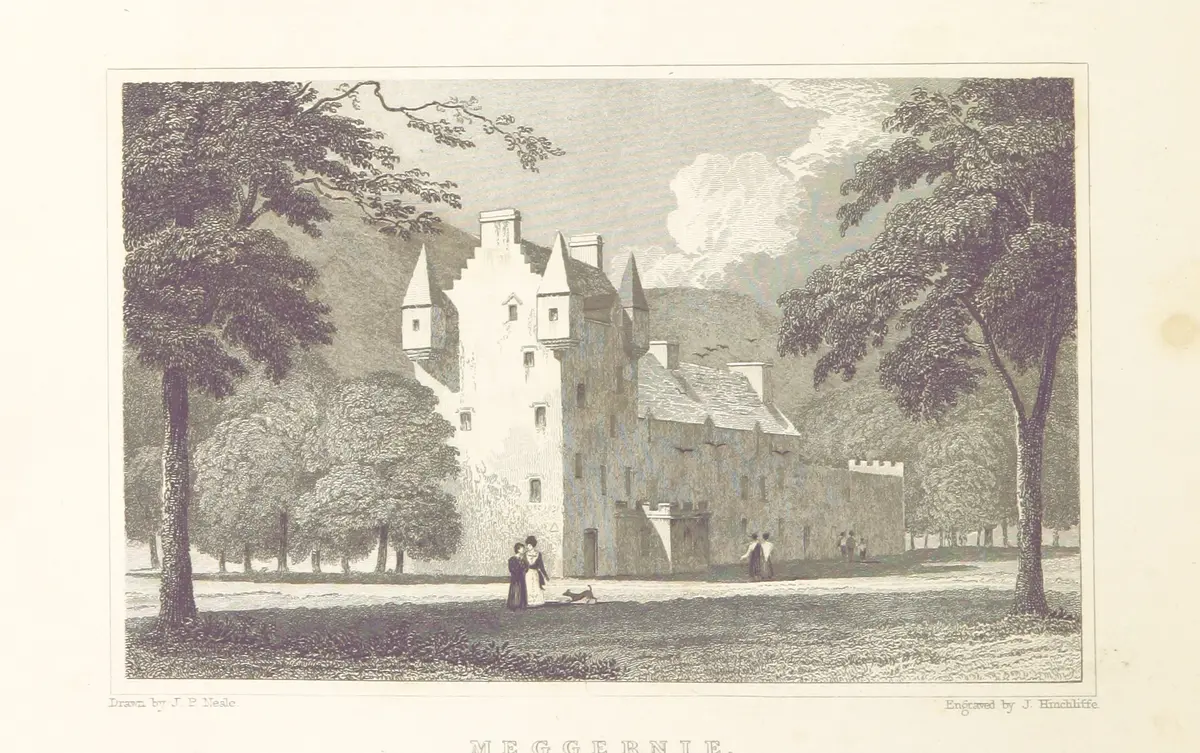
Meggernie Castle sits near the head of Glen Lyon, twenty-two miles west of Aberfeldy: a square tower of five storeys with turrets at its corners, a Victorian mansion grafted on to it, and an avenue of lime trees running the best part of a mile along the river.
Where is Meggernie Castle?
- Location
- Perth and Kinross, Scotland, United Kingdom
- Type
- Castle
- Coordinates
- 56.584, -4.356
- Last updated
LOCATION
Why is Meggernie Castle said to be haunted?
Its legend is among the strangest in Scotland. Tradition holds that a Menzies of Culdares killed his young wife in a fit of jealousy, cut the body in two and buried only half of it, and that ever since the ghost has appeared in detached halves — the upper part in one wing of the house, the lower elsewhere. Every version dates the events to 1862 and to a shooting party given by the tenant Herbert Wood, yet the story cannot be found in print before the 1950s. The oldest local record, left by a Glen Lyon man who had worked on the estate, describes something else entirely: a ghost in mail armour whose reputation dated from Queen Anne's reign, and which the Innerwick schoolmaster laid with a Bible and a pistol. Meggernie is a private house and cannot be visited.
What is the history of Meggernie Castle?
Meggernie Castle stands near the head of Glen Lyon, about twenty-two miles west of Aberfeldy, in the long single-track glen that runs west from Fortingall towards the Argyll border. The oldest part of the house is a square tower of five storeys with turrets at the angles and ornamental dormers. When David MacGibbon and Thomas Ross surveyed it for "The Castellated and Domestic Architecture of Scotland" (1889) they described "an ancient keep, with a modern mansion added to it", approached "by a fine avenue of lime trees", and wrote that Glen Lyon "was for long the property of the Campbells, by whom this keep was probably erected in the beginning of the seventeenth century". Popular guides usually give a firmer date of about 1585 and the builder as "Mad Colin" Campbell of Glenlyon; the two Victorian surveyors, working from the fabric itself, would not go that far.
By the later seventeenth century the castle and the greater part of Glen Lyon belonged to the Menzies family of Culdares, a branch of the Menzies of Weem. In October 1689, with the Jacobite rising still alive in the hills, the government turned Meggernie into a barracks. Major-General Hugh Mackay wrote to the young Laird of Weem on 7 October desiring him "to establish a sufficient garrison in the house of Miggernie in Glenlyon, should the said house be capable to secure it, for the better protection of the country against the rebels". Five days later Mackay wrote again, brushing aside a complaint from the neighbouring laird: "'Tis no matter what Glenlyon says bout the fitness of the house of Miggernie for a garrison… Glenlyon grumbled because he was not placed in trust of the house himself." Both letters were printed in 1894 from the charter room at Castle Menzies.
That neighbour was Robert Campbell of Glenlyon, who in February 1692 commanded the soldiers quartered on the MacDonalds of Glencoe. The Glencoe link that gets repeated about Meggernie is real, but it is this one: a documented quarrel over who should hold the house, not a residence and not a massacre planned under its roof.
The Menzies lairds left a gentler mark too. James Menzies of Culdares, "Old Culdares", brought larch plants back from the Tyrol around 1737 and planted them near Meggernie Castle — among the first larches grown in the Highlands. He was also a Jacobite who survived by double-dealing. After Culloden he had the glen's firearms gathered and secretly buried near the castle in case of another rising, and through the summer of 1746 an "important fugitive" from the battle lay hidden in the ravine of the Gallin Burn while government patrols from Weem, Fortingall and the head of Loch Lyon were "often visiting Meggernie Castle", where Old Culdares received them "with a show of loyal welcome and Highland hospitality". The account comes from Duncan Campbell, born in Glen Lyon in 1828, whose own great-grandfather was drawn into the episode one night and then curtly sent home before he could see too much.
Old Culdares died in 1775 and his son, Commissioner Archibald Menzies, in 1776; the contents of the castle were then sold off. Campbell, rummaging as a boy through the farmhouses of the glen, believed the odd Reformation-era books he found there had come from that sale.
The castle's modern character was set in the nineteenth century, when Highland lairds discovered that letting a house was more profitable than living in it. In 1851 Herbert Byng Hall published a long description in "Scottish Sports and Pastimes": walls "of immense thickness", doors "defended by iron gratings of prodigious size and weight", a dungeon "adorned with hooks" on which, he was told, executions had been carried out, and a position fourteen or fifteen miles from the house of any other laird "and about the same distance from a medical man or post-office". The owner, Byng Hall noted, had "very recently attained his majority" and wisely preferred to let the castle and its shootings to English sportsmen. Duncan Campbell, who helped plant the wood on Meggernie hill and spent several seasons as gillie to the Earl of Sefton — who held the Meggernie shootings for fifteen years — remembered the young laird's coming-of-age feast and the ball that followed it in the estate peat-house.
By the 1860s the shooting tenant was Herbert Wood, an Englishman of Bitteswell Hall who later bought the island of Raasay. The sporting writer Augustus Grimble shot capercaillie with him and remembered it precisely: "during a visit to the late Mr. Herbert Wood, at the time he rented Meggernie Castle 'by' Aberfeldy; the said 'by' meaning twenty-two miles from the railway station". Thirty years later Grimble was still writing about "the happy days spent at Meggernie with the late Mr. Herbert Wood, prior to his purchasing the island of Raasay". It is one of Wood's house parties that the famous ghost story is hung on.
In 1883 the estate went to auction. The sale was reported as far away as North Carolina as "the largest estate ever sold in Scotland in one lot at public auction": upwards of 32,000 acres in an area of fifty square miles, a salmon fishery running "to the almost unprecedented length of over 40 miles", knocked down to Mr John Bullough for 515,000 dollars, timber to be paid for separately. Bullough was the Lancashire cotton-machinery manufacturer whose family would later build Kinloch Castle on Rùm; he died in 1891. In the twentieth century Meggernie passed to the Wills family of Bristol — Sir Ernest Wills held it from 1920 — and it remains a private, working estate today.
Timeline: the documented record of Meggernie Castle
- c. 1600 MacGibbon and Ross, surveying the building itself in the 1880s, judge the square five-storey keep to have been raised by the Campbells 'in the beginning of the seventeenth century'. They decline to endorse the popular date of about 1585.
- 7 October 1689 Major-General Hugh Mackay orders the young Laird of Weem to establish 'a sufficient garrison in the house of Miggernie in Glenlyon… for the better protection of the country against the rebels'. The order survives in the charter room at Castle Menzies.
- 12 October 1689 Mackay writes again: "'Tis no matter what Glenlyon says bout the fitness of the house of Miggernie for a garrison… Glenlyon grumbled because he was not placed in trust of the house himself." The complainant is Robert Campbell of Glenlyon, who in February 1692 would command at Glencoe.
- c. 1737 James Menzies of Culdares brings larch plants back from the Tyrol and has them planted near Meggernie Castle — among the first larches grown in the Scottish Highlands.
- Summer 1746 After Culloden, Old Culdares has the glen's firearms buried near the castle against a future rising, and shelters an unnamed 'important fugitive' in the Gallin Burn ravine while government patrols visit Meggernie and are received 'with a show of loyal welcome'. Recorded by Duncan Campbell, whose great-grandfather acted as a lookout.
- 1776 Commissioner Archibald Menzies dies a year after his father; the furniture and library of Meggernie Castle are sold off. Duncan Campbell, as a boy, traced the old books scattered through the glen's farmhouses back to that sale.
- 1851 Herbert Byng Hall publishes the fullest early description of the house: immense walls, iron-grated doors, and a dungeon 'adorned with hooks' on which, he was told, executions had been carried out. He records that the owner had just come of age and preferred to let the castle to English sportsmen. He mentions no ghost.
- 1862 The year to which every twentieth-century collector dates the Meggernie haunting, and to a house party given by the shooting tenant Herbert Wood. No contemporary document from 1862 has been located for this file.
- 19 October 1883 American papers report the auction of the Meggernie estate — 'the largest estate ever sold in Scotland in one lot at public auction', upwards of 32,000 acres with a salmon fishery of over forty miles — to John Bullough for 515,000 dollars, timber extra.
- 1892 Augustus Grimble, who had shot capercaillie there, publishes his recollection of 'a visit to the late Mr. Herbert Wood, at the time he rented Meggernie Castle "by" Aberfeldy' — first-hand confirmation that Wood was a tenant, not the owner.
- 1910 Duncan Campbell, born in Glen Lyon in 1828, publishes his memoirs. The only Meggernie haunting he knows dates from the reign of Queen Anne, wears mail armour and clanking chains, and was laid by the Innerwick schoolmaster with a Bible and a pistol. He records no murdered wife and no ghost in halves.
- 1957 A. M. W. Stirling devotes several pages of 'Ghosts Vivisected' to Meggernie, describing a visit to 'his friend Mr. Herbert Wood at Meggernie Castle, Perthshire' and a spectre that, unlike others in her book, 'appeared in detached halves'. It is the earliest printed version of the story located for this file.
- 1973 Peter Underwood's Scottish gazetteer gives the haunting a name — 'the Meggernie Ghost' — and quotes a correspondent who believed she had seen 'the ghost of a former Lady of Meggernie', and who added in her letter that the churchyard at Meggernie was a secluded place.
Is there a rational explanation for Meggernie Castle?
The oldest written account of a Meggernie ghost that this file has been able to locate does not describe a lady in two halves at all.
Duncan Campbell was born in Glen Lyon in 1828, worked with his own hands on the Meggernie estate, and later became editor of the Northern Chronicle. In his 1910 memoirs he disposed of the castle's reputation in a single dry sentence: "Although in Queen Anne's reign Meggernie Castle won the repute of being haunted, until a bold schoolmaster, with Bible and pistol, undertook to lay the troubled spirit with his mail-armour and clanking chains — and did it — the Glenlyon dead gave so little trouble to the living that there was no other story about them in my early days."
Three things follow from that. The ghost he had grown up hearing about was armoured and clanked chains, not a bisected woman. Its reputation belonged to the reign of Queen Anne, 1702-1714. And it stopped when the schoolmaster from Innerwick arrived with a Bible in one hand and a pistol in the other — a detail that, in Highland telling, almost always means somebody was caught dressing up.
Campbell was equally frank about where his own scepticism came from. Aged twelve or thirteen, sent out on a frosty night past the churchyard to fetch help for his dying grandmother, he found himself followed by "the ghostly head of an old woman which was not attached to any appearance of body", which held its position beside his right cheek however fast he ran or turned. In desperation he reached up "and lo! I caught my ghost": the ribbon of his Glengarry bonnet had worked forward behind his ear, and its indented end, frozen white by his own breath, had taken on "the appearance of this ghostly head of an old woman with a weird gap between a big nose and a prominent chin". Years later he gathered a large batch of supernatural stories from across highland Perthshire, classified them, and concluded that the ones about the returning dead were "not nearly so well vouched for" as the wraith and second-sight stories.
The bisected lady cannot be traced in print anywhere near as far back as the night it describes. Every version dates the events to 1862 and to a house party given by Herbert Wood; the earliest printed telling located for this file is A. M. W. Stirling's "Ghosts Vivisected" (1957), followed by Alasdair Alpin MacGregor's "Phantom Footsteps" (1959), Peter Underwood's Scottish gazetteer (1973) and Archie McKerracher's "Perthshire in History and Legend" (1988). That is a gap of roughly ninety-five years between the alleged night and the first known publication, and none of the accounts consulted here names the two guests or points to a contemporary letter, diary or newspaper report. Nor is there a murdered wife anywhere in the family's own printed record: the "Red and White" Book of Menzies (1894), a work in no way shy of drama, has nothing.
The retellings do not even agree on the basics. McKerracher calls the tenant "Herbert Woods"; one popular anthology says he owned the castle. Augustus Grimble, who was actually there and knew the man, wrote plainly that Wood rented it.
None of this proves the story false. A genuine household anecdote can circulate for a century before anyone writes it down, and Underwood's version rests on a letter from a correspondent describing her own experience. It does mean that what survives is a legend rather than evidence — and that the setting flatters it. A five-storey tower with small turret bedrooms and walls of immense thickness, twenty-two miles from the nearest railway station, full every autumn of guests who had been out on the hill since dawn, is an efficient machine for producing things seen at night.
Can you visit Meggernie Castle?
Meggernie Castle is a private house. L. J. Macgregor's historical guide to North Perthshire (2000) gives its grid reference as NN 554 460 and describes it as "privately occupied"; the pin on this file, 56.5839 N, 4.3563 W, lies within a few metres of the castle as OpenStreetMap maps it, about 2.5 km (1.5 miles) west-south-west of the hamlet of Bridge of Balgie. On 24 September 2026 the Meggernie Estate's website described an estate of about 22,400 acres with farming, forestry and sporting lets that include red deer stalking and salmon fishing on the River Lyon, booked through Managed Estates on 01786 849272. The site offers holiday cottages and sporting lets but no visits to the castle.
The house lies up Glen Lyon, 30 km (19 miles) west of Aberfeldy in a straight line; Fortingall, at the mouth of the glen, is 18.6 km (11.5 miles) to the east. Its remoteness was already a subject in the nineteenth century. Herbert Byng Hall wrote in 1851 that the castle stood "some fourteen or fifteen miles from the residence of any but one other laird or proprietor, and about the same distance from a medical man or post-office", and described the approach from the east as "a noble avenue, principally of lime-trees, running parallel with the river Lyon for the best part of a mile". Augustus Grimble, recalling a visit to the shooting tenant Herbert Wood, explained in 1892 that the "by Aberfeldy" of the castle's address meant "twenty-two miles from the railway station". The estate's website now places the Glen Lyon post office, which has a shop and a lunch room, 200 yards from its Gatehouse cottage, and sells the estate's permits for trout fishing on river and loch at the post office in Bridge of Balgie.
Sources consulted
- Herbert Byng Hall, «Scottish Sports and Pastimes (bound after H. B. Hall's translation of Elzéar Blaze's The Sportsman and His Dog, 1850, under whose title the Internet Archive catalogues the volume)» — John and Daniel A. Darling, London, 1851 book
- David MacGibbon and Thomas Ross, «The Castellated and Domestic Architecture of Scotland, vol. III (Meggernie Castle, p. 457)» — David Douglas, Edinburgh, 1889 book
- David Prentice Menzies, «The "Red and White" Book of Menzies: The History of Clan Menzies and its Chiefs» — Glasgow (printing the Castle Menzies charter room papers, nos. 141 and 143), 1894 book
- Augustus Grimble, «Shooting and Salmon Fishing: Hints and Recollections» — Chapman and Hall, London, 1892 book
- Unsigned news item, «"The largest estate ever sold in Scotland in one lot at public auction…" (report of the Meggernie sale to John Bullough)» — Charlotte Home and Democrat (Charlotte, North Carolina), 19 October 1883, p. 2, 1883 newspaper archive
- Duncan Campbell, «Reminiscences and Reflections of an Octogenarian Highlander» — Northern Counties Newspaper and Printing and Publishing Co., Inverness, 1910 book
- A. M. W. Stirling, «Ghosts Vivisected: An Impartial Inquiry into their Manners, Habits, Mentality, Motives and Physical Construction (Meggernie Castle, p. 56 ff.)» — Robert Hale, London, 1957 book
- Alasdair Alpin MacGregor, «Phantom Footsteps: A Second Ghost Book (chapter "Haunted Meggernie", pp. 57-63)» — Robert Hale, London, 1959 book
- Peter Underwood, «A Gazetteer of Scottish and Irish Ghosts» — Souvenir Press, London, 1973 book
- Archie McKerracher, «Perthshire in History and Legend ("The Haunting of Meggernie Castle", p. 58)» — John Donald, Edinburgh, 1988 book
- Augustus Grimble, «The Salmon Rivers of Scotland (the Lyon and the Meggernie water)» — Kegan Paul, Trench, Trubner and Co., London, 1899 book
- L. J. Macgregor, «Atholl and Gowrie, North Perthshire: A Historical Guide (Meggernie, NN 554 460, "privately occupied")» — Birlinn, Edinburgh, 2000 book
- Meggernie Estate, «Welcome to Meggernie Estate (estate of about 22,400 acres: farming, forestry, red deer stalking, rough shooting, loch and salmon fishing on the River Lyon)» — meggernie-estate.com, consulted 24 September 2026, 2026 web
- Meggernie Estate, «Things to do (stalking and salmon fishing booked through Managed Estates; Glen Lyon Post Office, shop and lunch room 200 yards from Gatehouse; trout permits from the Post Office at Bridge of Balgie)» — meggernie-estate.com, consulted 24 September 2026, 2026 web
Reviewed by V. Serrano on 2026-08-11 · How we verify our content
💬 Field testimonies (0)
No testimonies yet. Add the first.
Add your testimony
🔒 Log in to add a testimony