👻 HAUNTED PLACE · EXP. Nº9476
ACTIVE
Neidpath Castle
Neidpath Castle is a location reputed to be haunted in Scottish Borders, Scotland, GB. Its reputation comes from reported apparitions, unexplained phenomena and eyewitness accounts gathered over time.
Where is Neidpath Castle?
- Location
- Scottish Borders, Scotland, GB
- Type
- Castle
- Coordinates
- 55.652, -3.215
- Testimonies
- 0
- Last updated
LOCATION
Why is Neidpath Castle said to be haunted?
Neidpath Castle is an L-plan tower house on a rock above the River Tweed, about a mile west of Peebles in the Scottish Borders. It is not the ruin it is usually called: the Category A listing records a slate roof of about 1938 over the main block, and the estate rents a suite inside the tower. Fraser land first, it passed to the Hays in 1312; Mary, Queen of Scots slept here in 1563, and in December 1650 Lord Yester, a Covenanting loyalist, was battered out of it by cannon sited across the river during Cromwell's invasion. Its ghost is a literary one. In 1811 Walter Scott printed "The Maid of Neidpath" with a prose note that has the dying girl carried to a balcony in the town of Peebles, not to the castle; his verse moved her to the battlements. He named no one. The county historian William Chambers, writing in 1864, describes the window and never once uses the word ghost. The name Jean Douglas and the brown dress arrive much later.
What is the history of Neidpath Castle?
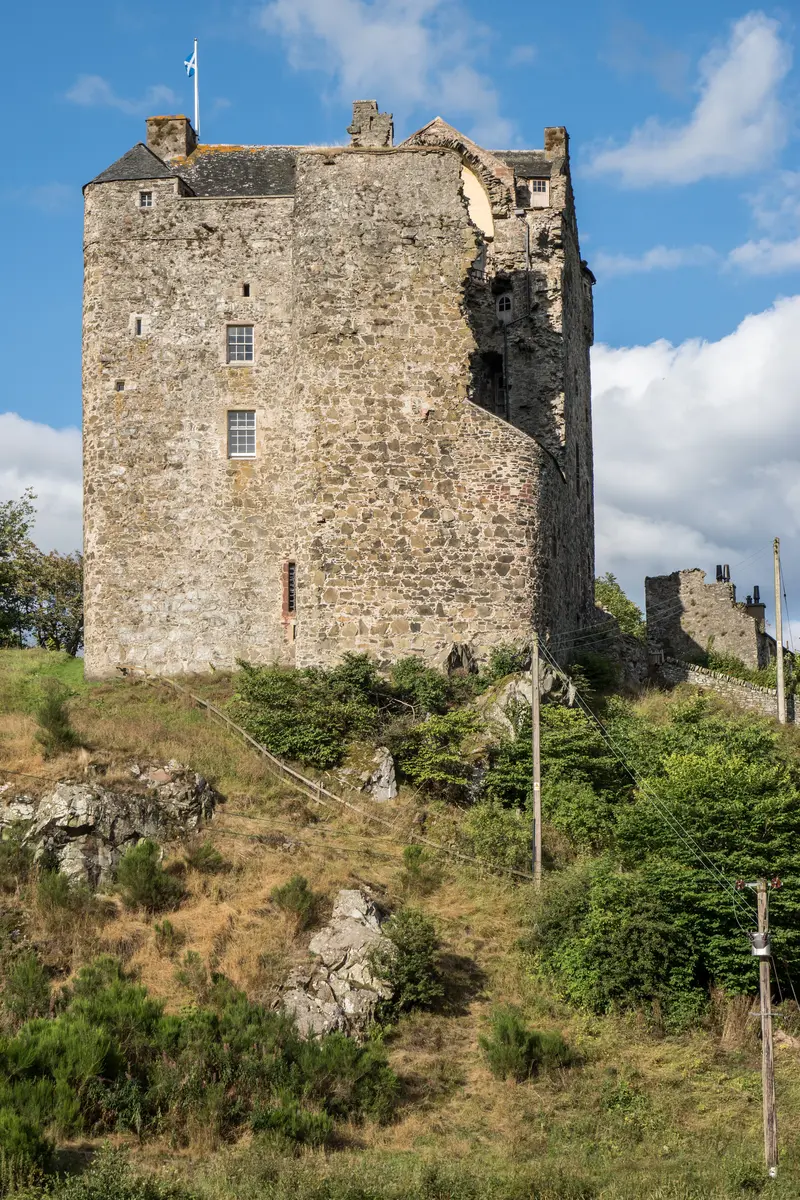
Neidpath stands on a rock above a bend of the River Tweed about a mile west of Peebles, and the first thing that has to be said about it is the thing most short accounts get wrong: it is not a ruin. The Historic Environment Scotland listing that made it a Category A building on 23 February 1971, last revised on 19 March 2018, records over the main block a "circa 1938 grey slate roof on open timbers", eight-, twelve- and sixteen-pane sash-and-case windows, an entrance up six radial steps into a bolection-moulded door surround, and an interior of vaulted chambers, a turnpike stair in the wall thickness, a scale-and-platt stair with bottle-nosed treads and a prison pit reached through a hatch in the floor above. Only the upper floors of the short west wing are ruinous, and the listing notes that even those carry "a later pitched roof protecting lower floors". The photograph on this page shows exactly that: a slated, glazed, flag-flying tower with a broken wing at one shoulder.
The land was Fraser land first. The estate's own history credits Sir Gilbert Fraser with an early castle "around 1190"; Wikipedia, following Maurice Lindsay's gazetteer, instead dates an earlier castle to Simon Fraser of Oliver between 1263 and 1266, while he was sheriff of Tweeddale. No source we have read carries both, and the listed building record describes no fabric earlier than the tower, so the founding date should be treated as unsettled. What the sources do agree on is the end of the Fraser line: Sir Simon Fraser, who had beaten the English at Roslin in 1303, was captured and executed in London in 1306, a year after William Wallace. The barony passed to the Hays by the marriage of his daughter in 1312 — the accounts that give her a name do not agree on it, calling her Mary in one place and Margaret in another. Sir William Hay is thought to have raised the present tower late in the fourteenth century. The archway still carries both families side by side: the goat's head of the Hays and the strawberries of the Frasers.
Mary, Queen of Scots stayed at Neidpath in 1563 as a guest of the Hays, and her son James VI came in 1587. The castle's hardest day came on the other side of those visits. In the summer of 1650 Cromwell invaded Scotland and won at Dunbar on 3 September; John Hay, Lord Yester — whom William Chambers, writing the county history in 1864, calls "a Covenanting loyalist" — fortified Neidpath against him. This is the point at which most retellings go backwards. The Covenanters were not the besiegers at Neidpath; the man holding the castle was one of them, for a Scottish government that had crowned Charles II. Chambers says the defence was made "with an extraordinary degree of energy and courage", but that the old peel was assailable with cannon from the south side of the river and was therefore given up sooner than it might have been; the listing places the guns in the flat field called the Deer Park and records the damage to the west wing. Chambers could find no contemporary letter naming the English commander and guessed at Major-General Lambert in late December 1650. Martin Coventry's gazetteer states, on the other hand, that Neidpath "held out against Cromwell's army longer than any other stronghold south of the Forth", and Mike Salter is cited as saying it surrendered without a fight. The three accounts cannot all be right, and none of them is contemporary.
What followed was recovery, not abandonment. In 1654 the Earl of Tweeddale enlarged the building, put up stables and laid out the terraced gardens whose steps survive east of the castle, and planted the yew avenue — Taxus baccata 'Neidpathensis' — that still runs beside the old walled garden. A gateway of about 1672 carries his arms, a goat's head erased with a coronet of five points. Debt undid him, and in 1686 he sold Neidpath to William Douglas, 1st Duke of Queensberry, for a sum Chambers gives as just over £21,000 sterling. Queensberry handed it in 1693 to his second son, later the 1st Earl of March. Neglect came with the 4th Duke, "Old Q", who in 1795 felled the trees and destroyed the hanging gardens above the Tweed; by 1790 the upper storeys of the wing had already fallen. Walter Scott and William Wordsworth both came in 1803, and Wordsworth left a furious sonnet beginning "Degenerate Douglas! oh, the unworthy Lord". On Old Q's death in 1810 the castle went with the earldom of March to the Earl of Wemyss, whose family holds it still, and the name of this rock is still carried in the family as a courtesy title.
Timeline: the documented record of Neidpath Castle
- 1306 Sir Simon Fraser, the last Fraser lord of Neidpath and the victor over the English at Roslin in 1303, is captured and executed in London, a year after William Wallace.
- 1312 The barony passes to the Hay family through the marriage of Sir Simon's daughter; the accounts that name her disagree, calling her Mary in one and Margaret in another. Sir William Hay is thought to have built the present tower late in the same century.
- 1563 Mary, Queen of Scots stays at Neidpath as a guest of the Hays; her son James VI comes in 1587. The estate still names a suite in the tower after her.
- December 1650 John Hay, Lord Yester - 'a Covenanting loyalist' in William Chambers's words - has fortified Neidpath against Cromwell's invasion and is forced to surrender after cannon sited across the river batter the old peel. Chambers finds no contemporary letter naming the English commander and guesses at Major-General Lambert.
- 1654 The Earl of Tweeddale enlarges the castle, builds stables and lays out the terraced gardens east of it; the yew avenue beside the walled garden, Taxus baccata 'Neidpathensis', dates from about this year.
- 1686 Bankrupt, the Earl of Tweeddale sells Neidpath to William Douglas, 1st Duke of Queensberry, for a price Chambers gives as just over 21,000 pounds sterling; in 1693 Queensberry passes it to his second son, later 1st Earl of March.
- 1811 Walter Scott prints 'The Maid of Neidpath' with a prose headnote. The note has the dying girl carried to the balcony of a house in Peebles, where she dies in the arms of her attendants; the verse moves her to the castle battlements. Scott gives her no surname and calls her Mary, and points out a similar incident in Count Hamilton's 'Fleur d'Epine'.
- 1864 William Chambers, a native of Peebles, describes the castle in the care of a gamekeeper, the kitchen turned into a dog kennel, and 'a window which is now gone' where tradition placed the dying maid; he quotes Campbell's verses. The words ghost, spectre and apparition do not appear once in his 207,000-word county history.
- 23 February 1971 Neidpath Castle, with its courtyard buildings, gateway, former walled garden and boundary wall, is listed Category A. The record, revised in March 2018, describes a slate roof of about 1938 over the main block and ruinous upper floors only in the short west wing.
- 24 August 2006 An editor signing as Horis adds a 'Traditions' section to the Wikipedia article in a single unsourced edit, introducing the haunting, the name Jean Douglas and the full-length brown dress with a large white collar. The sentence is still reproduced word for word in the Getty Images caption of a photograph dated about 1900.
Is there a rational explanation for Neidpath Castle?
The ghost of Neidpath is a literary object with a datable paper trail, and the trail does not lead where the popular version says it does.
The oldest text is Walter Scott's. In the 1811 second edition of "The Vision of Don Roderick, and Other Poems" he prints a poem called "The Maid of Neidpath" with a prose headnote, and the two disagree with each other. The note says there is "a tradition in Tweeddale" that when Neidpath was inhabited by the Earls of March a daughter of the family loved a son of the laird of Tushielaw; the match was thought unsuitable, the young man went abroad, the lady fell into a consumption, and on the day he was expected back she had herself carried "to the balcony of a house in Peebles, belonging to the family" so as to see him ride past. He did not recognise her, and she "died in the arms of her attendants". In Scott's note she does not die at the castle at all — she dies in a town house in Peebles. It is Scott's verse that moves her to the tower: "Though now she sits on Neidpath's tower, to watch her love's returning", and "o'er the battlement did bend". The window at which visitors are told to look is a stanza, not a memory. Scott names no one: the girl in his poem is called Mary. Thomas Campbell wrote four verses on the same incident and calls her Ellen. Scott himself flagged the plot as a travelling one, adding that "there is an incident similar to this traditional tale in Count Hamilton's Fleur d'Epine".
There is no ghost in the nineteenth-century record. William Chambers, born in Peebles and author of "A History of Peeblesshire" (1864), devotes pages to Neidpath, mentions the maid at "a window which is now gone", and prints Campbell's verses in full — and in the whole book, some 207,000 words, the words "ghost", "spectre" and "apparition" appear zero times, with "Neidpath" appearing 76 times, "tradition" 44 and "Cromwell" 24 in the same text. The word "haunt" occurs three times and never in a supernatural sense. The county history edited by J. W. Buchan is the same: its literature chapter (1925) records the poem as "the Maid of Neidpath, written in 1806" and notes in a footnote that "Thomas Campbell has a four verse ballad, not without merit, on the same incident", with no ghost attached.
The name "Jean Douglas" and the brown dress cannot be traced further back than the twentieth-century castle literature. Martin Coventry's gazetteer gives her as "Jean Douglas, the youngest of the three daughters of Sir William Douglas, Earl of March", born in 1705, appearing "clad in a full-length brown frock with a large white collar". The identification is difficult: three successive Earls of March were all called William Douglas, and no source we have read cites a document for the birth year. There was a real Jean Douglas in the family — the volume of Buchan's county history dealing with Broughton prints a Court of Session process of 1734 in which "Isabella, Mary, and Jean Douglas, the Earl's sisters" are called as creditors — but nothing in that record connects any of the three to the story. The wording that carried the ghost to the wider internet can be dated exactly: it was added to the Wikipedia article on 24 August 2006, in a single unsourced edit by an editor signing as Horis, and Getty Images' Hulton Archive still repeats that sentence, word for word, as the caption of a photograph dated about 1900.
The people who make money from the castle do not sell the ghost. Neidpath is a wedding, events and film venue and lets rooms; across thirteen pages of its own website read on 7 September 2026 — home, history, weddings, stay, events, filming, contact, the wedding gallery, two of the let properties and three blog posts — the words ghost, haunted, spectre, apparition and phantom appear zero times, and the single hit for "spirit" is "the spirit of tradition" in a paragraph about the Peebles Beltane Festival. The only mention is on the history page, and it is more careful than most published accounts: one of the daughters of the 1st Earl of March and Lady Jean Hay "may have been the sorrowful 'Maid of Neidpath', who inspired the verse of both Sir Walter Scott and Thomas Campbell". Two other claims should be retired with the ghost. The castle is repeatedly called a ruin — the Wikipedia infobox says "Ruined", a popular walking guide calls it "the dramatic ruins of Neidpath Castle" — against a listing that records a slate roof of about 1938 and an owner who rents a suite inside the tower. And the well below the walls is described in some retellings as a wishing well tied to the ghost; the only nineteenth-century name we can find for it is Chambers's, who calls it simply "the 'Lady's Well', a rill trickling by the wayside", with no offering, no wish and no maid.
Can you visit Neidpath Castle?
Neidpath is private property: it belongs to the Wemyss and March estate rather than to Historic Environment Scotland, and there is no turnstile. The estate's own site states that the castle is "open by appointment all year" and asks visitors to make contact to arrange a visit. The address is Neidpath Castle, Peebles EH45 8NW; the office telephone is +44 (0)1721 400701 and the email is [email protected]. The castle trades as a wedding and events venue and as a filming location. Martin Coventry's gazetteer summarises the access in one line — "Weddings and events. Tours by groups can be arranged" — and places the castle on a minor road just off the A72, about a mile west of Peebles. The listed building record confirms that the boundary wall follows the A72 and that the former walled garden now serves as a coach park. That record also describes a "circa 1938 grey slate roof on open timbers" over the main block, so the tower stands roofed.
The estate lets a room inside the tower: Queen Mary's Chamber is described on the castle's site as "an exclusive suite within the castle", sleeping two, from £375 a night, with an antique four-poster bed, a roll-top bath and an open log fire. It carries Scottish short-term-let licence number SB-00254-F, and both the price and the licence number were still published on 22 September 2026. Six further properties are let through the same office: Neidpath Barmkin, in the castle grounds, and Townhead of Lyne, Barns Tower, Barns Library, Barns Bothy and Barns Study on the Barns estate upstream.
The castle can also be seen from the riverside path, which runs upstream — that is, westward — from the centre of Peebles, with the tower high above the north bank. Walkhighlands describes a circuit that uses it, starting at the Kingsmeadows car park in Peebles, at grid reference NT 251402. From there the route crosses the Tweed by the road bridge and turns upstream past the swimming pool; it then follows the bank below the castle to the old railway viaduct and returns over Manor Bridge. Walkhighlands gives the round trip as 6.25 km (4 miles) with 89 metres of ascent and a walking time of two to two and a half hours, over riverside and woodland paths that are "rough in places". Glentress lies downstream, in the opposite direction.
The interior is not step-free: the listing records an entrance up six radial steps and a turnpike stair set in the thickness of the wall. It also records a scale-and-platt stair to the upper floors, and a pit prison reached only through a hatch. In Peebles itself, about 1.6 km (1 mile) east, the Chambers Institution on the High Street (EH45 8AG) houses the Tweeddale Museum together with the John Buchan Story; entry there is free.
Sources consulted
- Historic Environment Scotland, «Neidpath Castle including Courtyard Buildings, Gateway, former Walled Garden and Boundary Wall (LB13857), Category A listed building record» — Historic Environment Scotland Designations Portal, 2018 report
- Walter Scott, «The Maid of Neidpath (poem and prose headnote), in The Vision of Don Roderick, and Other Poems, 2nd edition, pp. 139-143» — Edinburgh: John Ballantyne and Co., 1811 book
- William Chambers, «A History of Peeblesshire (Neidpath and the siege of 1650, pp. 319-325)» — Edinburgh: W. and R. Chambers, 1864 book
- J. W. Buchan (editor), «A History of Peeblesshire, volume I: 'The Literature of the County', p. 192» — Glasgow: Jackson, Wylie and Co., 1925 book
- J. W. Buchan (editor), «A History of Peeblesshire, volume III: Broughton, the 1734 Court of Session process over the debts of John Douglas of Broughton, pp. 254-255» — Glasgow: Jackson, Wylie and Co., 1927 book
- Wemyss and March Estate, «Neidpath Castle: history, Queen Mary's Chamber and visiting information (official site of the castle)» — neidpathcastle.com, 2026 web
- Martin Coventry, «Neidpath Castle, Peebles (gazetteer entry, with the Jean Douglas ghost account and access details)» — The Castles of Scotland, Goblinshead, 2026 web
- Wikipedia contributor 'Horis', «Neidpath Castle, Wikipedia revision of 24 August 2006 (oldid 71627759): the edit that first added the ghost, the name Jean Douglas and the brown dress» — Wikipedia, 2006 archive
- Walkhighlands, «Neidpath Castle and the Tweed walk, Peebles (route, distance, ascent and start grid reference)» — walkhighlands.co.uk, 2024 web
Reviewed by V. Serrano on 2026-09-07 · How we verify our content
💬 Field testimonies (0)
No testimonies yet. Add the first.
Add your testimony
🔒 Log in to add a testimony