👻 HAUNTED PLACE · EXP. Nº9476
ACTIVE
Newark Castle, Selkirkshire
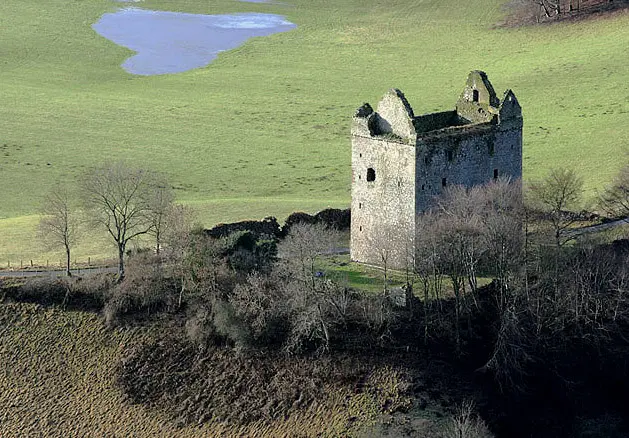
Newark Tower, a roofless fifteenth-century tower house on the Bowhill estate above the Yarrow Water, is remembered for what happened after the Battle of Philiphaugh on 13 September 1645, when David Leslie's Covenanters broke a promise of quarter and killed the survivors of Montrose's Irish infantry along with the women and children of his baggage train.
Where is Newark Castle, Selkirkshire?
- Location
- Scottish Borders, Scotland, United Kingdom
- Type
- Castle
- Coordinates
- 55.555, -2.919
- Last updated
LOCATION
Why is Newark Castle, Selkirkshire said to be haunted?
Whether any of that happened inside Newark is a different question. The fullest near-contemporary account, by the Royalist Patrick Gordon of Ruthven, never names the tower; the minister of Selkirk in 1833 placed the killings in the field beside it, still called Slain Man's Lea, where bones were being dug up; and the earliest datable source to put them in the courtyard is Walter Scott, in 1803, who wrote only that it "is said to have been the spot". The ghost came later still, and from print rather than from any witness: the annual 13 September cries repeated all over the web trace back to a blog post of 2014. This is the story of a real atrocity and of how it moved indoors.
What is the history of Newark Castle, Selkirkshire?
Newark is not a castle in the curtain-wall sense. It is a tower house: an oblong block of five storeys and a garret, 64 ft 10 in by 40 ft, set inside a walled barmkin of roughly 165 ft by 202 ft on a knoll above the Yarrow Water. The Royal Commission on the Ancient and Historical Monuments of Scotland surveyed it in 1946 and measured the barmkin wall at about five feet thick, standing eleven feet high at its best corner near the south-east angle and pierced by sixteenth-century gun-loops.
Newark is referred to as the "new werke" in a charter of 1423 to Archibald, Earl of Douglas, and the Canmore record explains the name: it was so called to distinguish it from an older castle nearby, which survives only as the place-name Auld Wark and has never been located. This was a royal hunting seat, and the royal arms are carved on a stone high up on the western wall. The Forest of Ettrick had been recovered from the English by Sir James Douglas and erected into a free regality by Robert Bruce; when the Douglases were attainted in 1455 the lands were forfeited to the Crown, and part of them went to the Sir Walter Scott who was ancestor of the Buccleuchs. Building went on: the Royal Commission attributes the large, lofty addition that once stood against the tower's east gable to work carried out in 1473 by John de Moravia. In 1503 James IV endowed his queen, Margaret, with the Forest of Ettrick and the Tower of Newark, which had earlier been the dowry of Mary of Guelders. In 1547-48 an English force under Lord Grey of Wilton got into the "barbacanne" and burnt the stables, but reported the house not "pregnable" without ordnance; it was burnt the following year all the same. In 1650, after Dunbar, Cromwell's men garrisoned it for a while.
The episode that made Newark notorious happened on and after 13 September 1645. David Leslie, back from the English campaign, surprised the Marquis of Montrose at Philiphaugh, a mile north of Selkirk, and destroyed his army in an hour. What followed is the part that concerns this tower, and the sources disagree about where it happened. The fullest near-contemporary narrative, written within a few years by the Royalist Patrick Gordon of Ruthven, says the victors fell on some three hundred Irish infantry, killed two hundred and fifty of them, took the surrender of the rest "upon promise of sawe quarters; but it was not keept", sent their commanders O'Cahan and MacLachlan to be hanged in Edinburgh, and murdered the surviving fifty "by the way at Lithgoe". Gordon then describes the baggage train — "boyes, cookes, and a rable of rascalles, and woemen with there childrin in there armes" — being cut to pieces, among them "three hundreth woeman, that being natiues of Ireland, ware the maryed wyfes of the Irishes". Gordon never once names Newark.
The tower was unroofed about the middle of the eighteenth century and its accessible facework stripped. Early in the nineteenth century the Duke of Buccleuch's factor pulled down more of the walls and the enclosing fence to build a farmhouse on the field in front — the field called Slain Man's Lea. James Russell, minister of Yarrow, recorded that the 5th Duke was so disgusted that on succeeding he swept the modern house away and put the stones back. Newark had a gentler afterlife too: Anne, Duchess of Buccleuch and Monmouth, retired to it with her children after her husband's execution in 1685, and it is to her that Walter Scott's Last Minstrel recites his Lay in the poem of 1805. And it was on an excursion to Newark, in the autumn of 1831, that Wordsworth conceived "Yarrow Revisited" — he told the story himself, years later, to James Russell.
Timeline: the documented record of Newark Castle, Selkirkshire
- 1423 Newark is called the "new werke" in a charter to Archibald, Earl of Douglas. The Canmore record explains the name: it distinguished the tower from an older castle nearby that survives only as the place-name Auld Wark and has never been located.
- 1455 The Douglases are attainted and the Forest of Ettrick, with Newark, is forfeited to the Crown; part of the lands goes to the Sir Walter Scott who was ancestor of the Buccleuchs, the family that owns the tower today.
- 1503 James IV endows his queen, Margaret, with the Forest of Ettrick and the Tower of Newark, which had earlier been the dowry of Mary of Guelders. Thirty years earlier, in 1473, John de Moravia had built the large addition against the tower's east gable.
- 1547-48 An English force under Lord Grey of Wilton enters the "barbacanne" and burns the stables, but reports the house not "pregnable" without ordnance. Newark is burnt the following year regardless.
- 13 September 1645 David Leslie destroys Montrose's army at Philiphaugh, a mile north of Selkirk. Patrick Gordon of Ruthven, writing within a few years, records that about 300 Irish infantry were attacked, 250 killed, the rest surrendered on a promise of quarter that "was not keept", their commanders hanged at Edinburgh and the 50 survivors murdered at Linlithgow, and the baggage train — including some 300 Irish women — cut to pieces. He never names Newark.
- 1650 After the battle of Dunbar, Cromwell's men garrison Newark for a time — the last military use of the tower, and one that no ghost story has ever bothered with.
- After 1685 Anne, Duchess of Buccleuch and Monmouth, retires to Newark with her children after her husband's execution, and the tower is altered for her. It is to her that the Last Minstrel recites his Lay in Walter Scott's poem of 1805.
- About the middle of the 18th century The tower is unroofed and much of its accessible facework removed, according to the Royal Commission survey; the upper floors fall in. Most of the damage is roughly repaired in the following century.
- 1803 Walter Scott prints "The Battle of Philiphaugh" in the Minstrelsy of the Scottish Border, with the earliest datable claim that "the courtyard of Newark Castle is said to have been the spot upon which they were shot". The piece is absent from the two-volume first edition of 1802, and Scott's footnote there is dated 1803.
- 1810 Human remains are recorded at Slain Men's Lea during the building of a school, according to the Historic Environment Scotland battlefield record; the New Statistical Account confirms a school at Newark funded by the Duke of Buccleuch from that year. Around the same time the Duke's factor robs stone from the tower to build a farmhouse on the same field.
- Autumn 1831 Wordsworth comes to Abbotsford with his daughter to say goodbye to Scott before his journey to the Continent. "The first day's excursion was to Melrose, the next to Newark. It was then and there the idea occurred to me of 'Yarrow Revisited.'" He told this to James Russell at Rydal Mount in September 1842, and Russell wrote it down.
- September 1833 The Rev. John Campbell, minister of Selkirk, signs the parish account for the New Statistical Account: the killing ground is "a field called the Slain Man's Lee" close to Newark, where the prisoners were put to death "a day or two after", and "some bones are yet occasionally dug up on the spot". He places it beside the tower, not inside it.
- 1894 James Russell, minister of Yarrow, publishes his Reminiscences: the prisoners were "cut to pieces on a piece of ground near Newark Castle, still known as 'Slain Man's Lea'", and the Covenanting preachers are reported "(slanderously doubtless)" to have said "Eh, but the wark gaes bonnily on!". He also records the stone-robbing and the 5th Duke's repair of the tower.
- 27 September 2014 A blog post claims that the cries of the dead are heard at Newark every 13 September. It is the only citation given for the haunting sentence in the English Wikipedia article, and from there the detail has spread across the ghost-tourism web.
Is there a rational explanation for Newark Castle, Selkirkshire?
The killings after Philiphaugh are as well documented as anything in the Scottish civil wars; their location is another matter. Gordon of Ruthven, writing within a few years and sparing no detail of the slaughter, never mentions the tower: in the Internet Archive text of his Short Abridgement, Montrose appears on 212 lines, Philiphaugh on six and Newark on none. A search of the Internet Archive's full-text index on 8 October 2026 for the phrase "courtyard of Newark" returns 65 books, the oldest of them dated 1838, among them later editions of Walter Scott's Minstrelsy of the Scottish Border, whose 1803 edition carries the claim with a hedge: "the courtyard of Newark Castle is said to have been the spot upon which they were shot by his command." That sentence belongs to "The Battle of Philiphaugh", which is absent from the two-volume first edition of 1802 and appears with the 1803 edition; Scott's own footnote there is dated 1803. Local writers who knew the ground put the killing not in the tower but in the field beside it: the Rev. John Campbell, in his account of Selkirk parish dated September 1833, wrote that "close to Newark, on the Yarrow, is a field called the Slain Man's Lee, where the Covenanters, a day or two after, are said to have put to death many of their prisoners. Some bones are yet occasionally dug up on the spot." Historic Environment Scotland's battlefield record follows the same reading, calling Slain Men's Lea the traditional massacre site and noting human remains recorded there in 1810 during the building of a school — the New Statistical Account confirms that a school at Newark was being funded by the Duke of Buccleuch from that year. The same record observes that Slain Men's Lea lies almost two miles north-west of Philiphaugh along the Yarrow, too far from the main action unless there was a long pursuit, "which the primary accounts do not support", or the Royalist camp or baggage train stood there.
The ballad is a weak witness: Scott said it was "preserved by tradition in Selkirkshire" and "coincides accurately with historical fact"; his 1902 editor T. F. Henderson answered in a bracket, "The ballad is clearly modern." It cannot be earlier than 1650 in the form Scott printed, because its aged informant says "Again I was at curst Dunbar, / And was a prisoner ta'en" — a battle fought five years after Philiphaugh, an anachronism Scott flagged himself, and it never mentions Newark at all. Scott himself rejected a Newark tradition when he judged it wrong: in the 1802 Minstrelsy he printed "The Sang of the Outlaw Murray", noted that "the scene is, by the common people, supposed to have been the Castle of Newark, upon Yarrow", and answered flatly that "this is highly improbable, because Newark was always a Royal fortress".
The famous quotation should be handled with tongs: "This wark gaes bonnilie on", put in the mouth of a Covenanting minister at the executions, was taken by Scott from the memoirs of Wishart, Montrose's own chaplain — a hostile witness. Russell, minister of Yarrow, printed the same words and added "(slanderously doubtless)". Wishart's account also has prisoners flung from a high bridge over the Tweed; Malcolm Laing pointed out there was no bridge over the Tweed between Peebles and Berwick, and Scott accepted the correction.
The heritage record says nothing supernatural: the Canmore entry for Newark (site 54273) runs to about a thousand words on the tower, the barmkin and the 1547-48 siege, from surveys of 1946, 1966 and 1979, and never mentions the massacre or a ghost; the scheduled monument record SM1729 and the former listed building record LB15197 are equally silent. The haunting itself is a modern publishing artefact, and the clearest printed claim is Martin Coventry's ghost guide, which says only that the ghosts of those executed "are said to haunt the courtyard of Newark Castle"; the widely repeated detail that cries are heard every 13 September rests, in the Wikipedia article that spread it, on a single blog post of 27 September 2014. No witness is named and no sighting is dated.
Can you visit Newark Castle, Selkirkshire?
Newark Tower stands on the Bowhill estate of the Duke of Buccleuch, whose address is Bowhill House, Selkirk, Scottish Borders TD7 5ET (telephone 01750 22204). It has been a scheduled monument since 14 May 1937 (SM1729), and the Historic Environment Scotland portal lists a completed scheduled monument consent for structural repairs to its masonry and internal vault, with "protective barriers" at openings where there is a risk of falling from height. The estate's printed walks sheet of 2025 marks it on the map as "Newark Castle (ruin)".
That sheet takes two of the estate's walks past the tower. The Duchess' Drive, seven miles on forest tracks over Fastheugh and Newark hills and graded "moderate/strenuous", ends with a descent "past the ruins of Newark Tower". On the Lady's Walk, three miles along the Yarrow Water on single-track paths, "a short detour" at the furthest point leads to the ruins. The sheet asks walkers to keep dogs "on a short lead or under close control". The estate names General's Bridge car park as the start for both walks, at £3 per car with no overnight parking; on 24 September 2026 its car-park page gave the hours as "Dusk til Dawn" while the plan-a-visit page said "7am to 7pm".
The other way in is through the Grounds and Adventure Playground ticket, which in 2026 cost £8 for adults and £6 for children, with under-threes free; the grounds opened daily from 1 June to 31 August and at weekends in September. Bowhill House itself was shown in 2026 only on "The Victorian Home" tour, from 2 to 5 May and from 1 to 31 August, at £17 for adults and £8.50 for children.
The walks sheet dates the building of the tower to 1423 and to the Douglas family. Andrew and John Lang, in 1913, read the charter of that year to Archibald, Earl of Douglas, which already calls it the "new werke", as evidence that it was "built sometime before 1423".
Sources consulted
- Historic Environment Scotland, «Battle of Philiphaugh (BTL14), Inventory of Historic Battlefields designation record» — Historic Environment Scotland Portal, 2011 report
- Patrick Gordon of Ruthven, «A Short Abridgement of Britane's Distemper, from the yeare of God M.DC.XXXIX. to M.DC.XLIX (Book IV, pp. 158-161)» — Spalding Club, Aberdeen, 1844 book
- Walter Scott, «"The Battle of Philiphaugh", in Minstrelsy of the Scottish Border (added in the edition of 1803); cited from the edition of T. F. Henderson, vol. II, pp. 204-221» — Oliver and Boyd / William Blackwood, Edinburgh, 1902 book
- Walter Scott, «"The Sang of the Outlaw Murray", in Minstrelsy of the Scottish Border, first edition, vol. I (Scott rejects the local belief that the ballad's castle was Newark)» — James Ballantyne, Kelso, 1802 book
- Rev. John Campbell, «Parishes of Selkirk (account signed September 1833, pp. 1-10) and Yarrow (pp. 27-56), in The New Statistical Account of Scotland, vol. III: Roxburgh, Peebles, Selkirk» — William Blackwood and Sons, Edinburgh, 1845 book
- James Russell, «Reminiscences of Yarrow (Philiphaugh, pp. 248-249; the towers of Yarrow, pp. 253-254; Wordsworth's own account of the 1831 visit to Newark, pp. 198-199)» — George Lewis & Son, Selkirk; edited by Prof. John Veitch, 1894 book
- Andrew Lang and John Lang, «Highways and Byways in the Border, chapter XII: Newark Tower, pp. 315-317» — Macmillan, London, 1913 book
- Royal Commission on the Ancient and Historical Monuments of Scotland, «Newark Castle, Canmore ID 54273 / site number NT42NW 1 — archaeology notes from RCAHMS survey (visited 1946), with Ordnance Survey revisits of 1966 and 1979» — Canmore, Historic Environment Scotland, 1957 archive
- Historic Environment Scotland, «Newark Castle, Philiphaugh (SM1729), scheduled monument record, scheduled 14 May 1937» — Historic Environment Scotland Portal, 1937 report
- Martin Coventry, «A Wee Guide to Scottish Ghosts and Bogles ("the ghosts of those executed after the battle are said to haunt the courtyard of Newark Castle")» — Goblinshead, Musselburgh, 2000 book
- Bowhill House & Country Estate, Buccleuch, «Plan a Visit, Walking and Hiking, and General's Bridge Car Park (2026 opening dates and prices, consulted 13 August 2026)» — bowhillhouse.co.uk, 2026 web
- Wikipedia contributors, «"Newark Castle, Selkirkshire", English Wikipedia (revision consulted 13 August 2026): the only citation offered for the haunting is the blog post "Haunted Newark Castle, Selkirk - a September haunting", Haunted Isles, 27 September 2014» — en.wikipedia.org, 2026 web
- Bowhill House & Country Estate, Buccleuch, «Bowhill Walks (printed walks sheet: Duchess' Drive, 7 miles, descending "past the ruins of Newark Tower"; Lady's Walk, 3 miles, with "a short detour" to the ruins)» — bowhillhouse.co.uk (PDF, 2025), 2025 web
Reviewed by V. Serrano on 2026-08-13 · How we verify our content
💬 Field testimonies (0)
No testimonies yet. Add the first.
Add your testimony
🔒 Log in to add a testimony