👻 HAUNTED PLACE · EXP. Nº9476
ACTIVE
Ordsall Hall
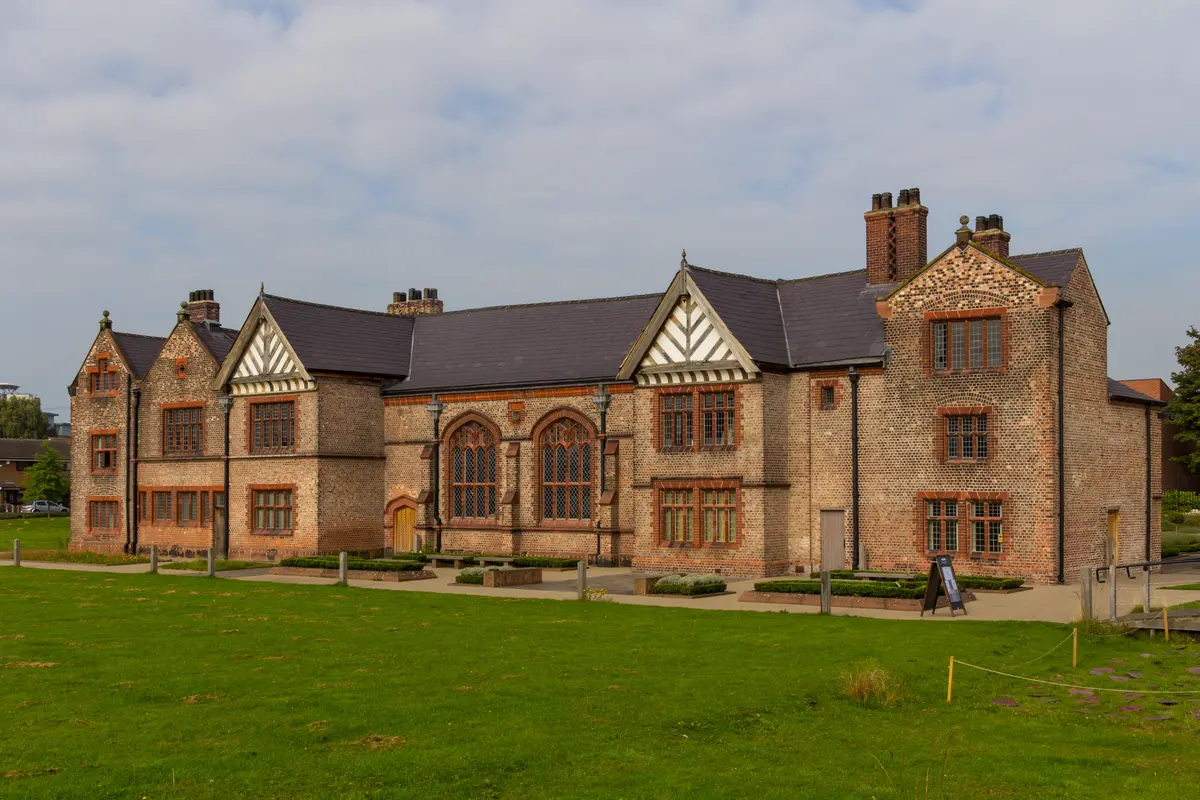
Ordsall Hall is a timber-framed manor house in Salford, free to visit, whose Great Hall was under construction in 1512 and whose owners, the Radclyffes, held it for more than three centuries.
Where is Ordsall Hall?
- Location
- Greater Manchester, United Kingdom
- Type
- House / mansion
- Coordinates
- 53.469, -2.278
- Last updated
LOCATION
Why is Ordsall Hall said to be haunted?
Two stories cling to it. One says the Gunpowder Plot was hatched in its Star Chamber; that comes from a novel, William Harrison Ainsworth's Guy Fawkes of 1841, and neither Historic England's list entry nor the museum's own website mentions Guy Fawkes at all. The other says a White Lady walks the Great Hall, usually identified as Margaret Radclyffe, maid of honour to Elizabeth I, who died in 1599 shortly after her twin brother Alexander was killed in Ireland. That death is real and better documented than the ghost: a courtier's letter describes her refusing food for days, and an autopsy ordered by the Queen that found the body sound except for strings drawn across the heart. The earliest ghost text we can date is the museum's own website of the year 2000, which also offered Ainsworth's fictional heroine as a candidate.
What is the history of Ordsall Hall?
Ordsall is older than the house that carries the name. Ordsall Hall's own history dates the first written appearance of the place to 1177, when "Ordeshala" paid two marks towards a feudal aid, and derives the name from the Old English personal name Ord and halh, a nook or corner — a fair description of a manor whose southern boundary was a great loop of the River Irwell, later dug out to make the docks of the Manchester Ship Canal. There was probably a house here by 1251, when William de Ferrers, Earl of Derby, exchanged the manor for land in Pendleton.
The Radclyffes of Radclyffe Tower, near Bury, acquired it in about 1335 on the death of the childless Richard de Hulton, but several claimants disputed the inheritance and Sir John Radclyffe only made his title good in 1354, on his return from the French wars. The family motto that came out of those campaigns — Caen, Crecy, Calais — is a battle honour worn as a name. The architect Henry Taylor, surveying the house in 1884, quoted Canon Raines for the detail that in 1360 the Radclyffe of Ordsall obtained a licence from the Bishop of Lichfield to have divine service celebrated by a fit priest in his oratory at Ordsall for two years. When Sir John's son Richard died in 1380 the property was recorded as a hall, five chambers, a kitchen and a chapel, with two stables, three granges, two shippons, a garner, a dovecote, an orchard and a windmill.
The building most visitors come for is Tudor and precisely dated. Tree-ring analysis places the present Great Hall under construction in 1512, the year Sir Alexander Radclyffe (d. 1549) first became High Sheriff of Lancashire — an office he held five times. It is one of the largest open timber-framed halls in north-west England, and the quatrefoil panelling blazoned inside and out is a southern fashion that Ordsall appears to have introduced to the region. Historic England, which listed the building Grade I on 31 January 1952 (list entry 1386169), describes it flatly as a "Large house. Substantially early C16 with additions of c1639, restored and extended 1896-7 by Alfred Derbyshire" — the architect's name is actually spelt Darbyshire.
The Radclyffes were courtiers as well as sheriffs, and one generation of them is the reason anybody tells ghost stories here. Sir John Radclyffe (c.1536-1590), Member of Parliament, married Anne, daughter of Thomas Asshawe, in May 1572; the bed he bought for the marriage, at a cost of £20, is the only original piece of furniture still in the house. Of their children, Margaret came to court with her twin brother Alexander and became a maid of honour and a favourite of Elizabeth I. Rowland Whyte, writing to Sir Robert Sidney, noted that on 27 February 1598 "Mrs Radcliffe" wore a white satin gown, embroidered and cut on cloth of silver, that cost £180. Ordsall Hall's own history adds that the gown was a gift from Alexander and a symbol of the Queen's purity; Whyte records only the gown and the price.
Then the family was gutted in a few years. Two brothers, Thomas and Edmund, died of fever in Flanders. Alexander was killed in Ireland in August 1599 at the Curlew Pass in Connacht, in the defeat in which Sir Conyers Clifford also died: John Chamberlain, writing from London on 23 August 1599, reported that "besides himself and Sir Alexander Ratcliffe there were eight or nine commaunders lost and above 240 men". Ben Jonson later addressed an epigram to the surviving heir, Sir John Radcliffe, that reads like a casualty list in verse: "Two bravely in the battle fell and died, / Upbraiding rebels' arms, and barbarous pride: / And two that would have fall'n as great as they, / The Belgic fever ravished away."
Margaret did not survive her twin by three months. She died on 10 November 1599 at Richmond, and her death was reported at once as a death by grief. Ben Jonson wrote her an acrostic epitaph whose initials spell MARGARET RATCLIFFE and whose fifteenth line is "Few so have rued / Fate in a brother". Gawdy adds that the Queen was present at the death and that "All the maydes euer synce haue gone in blacke". She was buried in St Margaret's, Westminster; the parish register gives 23 November, while the lost monument said she "was buried with solemnity the 22nd of the same month" — a day apart, and the register is the better witness. The monument raised in the south aisle is gone, but Westminster Abbey preserves the transcribed inscription, which ends: "Thou dyd'st a virgin pure and spotless liver, / Grief caused thy death, death make thee live for ever."
The house outlived the family's fortune. A modest brick wing was added at right angles to the timber frame in 1639 by another Sir Alexander Radclyffe (d. 1654), who was already in difficulties; as a Royalist he was imprisoned and impoverished in the Civil War, and in 1662 his heir John sold Ordsall to a Colonel Birch. It passed to the Oldfields of Leftwich, to John Stock in 1704, to Samuel Hill of Shenstone in 1756 and, two years later, to his nephew Samuel Egerton of Tatton, in whose family it stayed for two centuries. The Stocks were probably the last owners to live in it. The dais canopy of the Great Hall was destroyed when a floor and lath-and-plaster partitions were inserted, and the east wing was demolished before the earliest estate map of 1812.
By the nineteenth century Ordsall was a tenement in a forest of mill chimneys. Taylor found it in 1884 "in so deplorable a condition that it requires some effort of the imagination to picture it as it must have appeared in the days of its ancient grandeur". Between 1872 and 1875 the Pre-Raphaelite painter Frederic Shields (1833-1911) worked in a first-floor room here and told John Ruskin it was "the happiest refuge I have ever nested in". In 1875 the hall was let to Haworth's Mill as a working men's club: the Great Hall became a gymnasium, with billiards, a skittle alley and a bowling green elsewhere on the site. When that lease ran out, Earl Egerton of Tatton paid the Manchester architect Alfred Darbyshire (1839-1908) about six thousand pounds to convert the building into a clergy training school; St Cyprian's Church was built in the north forecourt at the same time, and a servants' wing on the south. The school moved to Egerton Hall in 1908; a men's social club survived until 1940; the war put the building to other uses. The servants' wing came down in 1962 and St Cyprian's in 1967.
Salford Corporation bought the hall from Lord Egerton's executors in 1959 and opened it to the public in April 1972 as a period house and local history museum. In 2007 the Extraordinary Ordsall campaign applied to the Heritage Lottery Fund; supporters raised a million pounds, the Fund added £4.1 million, the building closed in early 2009 and reopened on 15 May 2011 after a restoration costing just under £6.5 million. It bought two lifts, the reopening of the medieval east wing's upper floor and roof space, the conservation of a sixteenth-century Italianate plaster ceiling and six panels of medieval armorial glass, and the stripping of Victorian blacking from the oak.
Timeline: the documented record of Ordsall Hall
- 1177 The place-name first appears in writing: 'Ordeshala' pays two marks towards a feudal aid. Ordsall Hall's own history gives this as the earliest record of the manor.
- 1354 Sir John Radclyffe makes good his claim to the manor, disputed since about 1335, on returning from the French wars. Six years later a Radclyffe of Ordsall obtains a licence from the Bishop of Lichfield for divine service in his oratory, recorded by Canon Raines and quoted by Henry Taylor in 1884.
- 1512 Tree-ring analysis dates the present Great Hall under construction, in the year Sir Alexander Radclyffe first became High Sheriff of Lancashire.
- 27 February 1598 Rowland Whyte reports to Sir Robert Sidney that 'Mrs Radcliffe' wore a white satin gown, embroidered and cut on cloth of silver, costing £180. It is the documentary root of the White Lady in white; the museum adds that it was a gift from her twin brother, which Whyte does not say.
- August 1599 Sir Alexander Radclyffe, Margaret's twin, is killed at the Curlew Pass in Connacht. John Chamberlain reports it from London on 23 August: 'besides himself and Sir Alexander Ratcliffe there were eight or nine commaunders lost and above 240 men'.
- 10 November 1599 Margaret Radclyffe dies at Richmond after refusing food. Philip Gawdy, writing on the following Friday, says she had 'gone about to starue her selfe' and that the Queen 'commaunded her body to be opened and founde it all well and sounde, sauing certeyne stringes striped all ouer her harte'.
- 23 November 1599 She is buried in St Margaret's, Westminster, according to the parish register; the lost monument gave the 22nd. Her monument is lost, but the inscription was transcribed: 'Grief caused thy death, death make thee live for ever.' Ben Jonson writes an acrostic epitaph spelling MARGARET RATCLIFFE.
- 1662 John Radclyffe, ruined by his Royalist father's imprisonment in the Civil War, sells Ordsall to a Colonel Birch, ending more than three centuries of family ownership.
- 1841 William Harrison Ainsworth publishes Guy Fawkes; or, The Gunpowder Treason (Bentley, dedication dated 26 July 1841), setting its opening at Ordsall Hall with an invented Sir William Radcliffe and his daughter Viviana. His preface explains that Manchester was chosen because recusants were imprisoned there.
- 1884 Henry Taylor surveys the house for Old Halls in Lancashire and Cheshire. He names Ordsall 38 times, corrects Ainsworth on the moat and the fireplace, calls the Star Chamber 'clearly a comparatively modern apartment cut out of the old lord's chamber' — and never once uses the words ghost or haunted.
- 1896-1897 Earl Egerton of Tatton pays Alfred Darbyshire about £6,000 to convert the hall into a clergy training school. St Cyprian's Church goes up in the north forecourt and the Great Hall gets the 'churchy' south windows visible in most photographs. The church is demolished in 1967.
- 31 January 1952 Ordsall Hall is listed Grade I (list entry 1386169). The description runs to well over a thousand words and mentions neither ghosts nor the Gunpowder Plot; it dates the star-panelled ceiling of the Star Chamber to 'probably late C16'.
- 2000-2001 The museum's website, copyright 'City of Salford 2000' and archived on 28 May 2001, runs a live GhostCam and offers three identities for the White Lady: Margaret Radclyffe, a bride jilted at St Cyprian's, and Viviana Radclyffe — a character invented by Ainsworth in 1841.
- 15 May 2011 The hall reopens after a restoration costing just under £6.5 million, £4.1 million of it from the Heritage Lottery Fund, which added two lifts and reopened the medieval east wing's upper floor.
- 19 May 2020 Last working capture of the GhostCam pages in the Wayback Machine; by 9 November 2020 the address returns 404. In August 2026 the words 'webcam' and 'ghost cam' appear nowhere on the hall's website.
Is there a rational explanation for Ordsall Hall?
Two things are usually said about Ordsall Hall: that the Gunpowder Plot was hatched in its Star Chamber, and that a White Lady walks there. Both can be dated, and dating them changes them.
Start with the plot. The story is not folklore that a novelist picked up; it is a novel that a town adopted. William Harrison Ainsworth published Guy Fawkes; or, The Gunpowder Treason with Richard Bentley in 1841 — the dedication is dated 26 July 1841 — and set its opening chapters at Ordsall Hall, complete with an invented owner, Sir William Radcliffe, and an invented heroine, his daughter Viviana. Ainsworth himself explained the choice in his preface, and the explanation is entirely practical: Manchester was where recusants were imprisoned, so "the scene of the early part of this history has been laid in that town and its immediate neighbourhood". He was a Manchester man writing about Manchester. Wikipedia calls his 1842 novel; the first edition is 1841, and Ordsall Hall's own website in 2001 dated it 1861. Nobody seems to have checked.
Nothing outside the novel puts Guy Fawkes at Ordsall. Historic England's list entry for the building, which runs to well over a thousand words of description, contains the word "Fawkes" nought times, "gunpowder" nought times and "ghost" nought times. More striking still, neither does the hall itself: a sweep of every page in ordsallhall.com's sitemap on 13 August 2026 — 79 pages and 52 news posts, about 14 MB of HTML — returned nought hits for "Fawkes" and nought for "gunpowder", against 78 pages mentioning "Radclyffe", 21 mentioning "Tudor" and 8 mentioning the Star Chamber. The museum that would profit most from the claim does not make it. Wikipedia, which does repeat it, calls it "plausible although unsubstantiated". The surviving physical trace of the legend is a street sign: Guy Fawkes Street, named after the novel, runs down the east side of the house.
The room itself is shakier than the story. Ordsall Hall's website says the Star Chamber was built by Sir John Radclyffe in the 1360s. Historic England agrees that a crown-post roof of the fourteenth century survives above it, but dates the thing the room is named for — "the panelled ceiling, embellished with gilded stars" — to "probably late C16". Henry Taylor, measuring the house in 1884, went further: for him the Star Chamber was "clearly a comparatively modern apartment cut out of the old lord's chamber", and he attributed the very name to Ainsworth, describing it as the part of the lord's chamber "described by Harrison Ainsworth as the 'Star Chamber'". Ainsworth, for his part, wrote in 1840 that the ceiling was moulded and painted to resemble the night sky and that the name was "retained to this day", so the name is older than the novel. But if Taylor is right about the partition, the room where Fawkes is supposed to have plotted may not have been a room in 1605.
Now the White Lady, and here the archive is unusually clean. Taylor's Old Halls in Lancashire and Cheshire (1884) devotes a chapter to Ordsall and names the house 38 times in 523 KB of text: occurrences of "ghost" and "haunted", nought and nought, against 1,037 uses of "hall" as a control. Harland and Wilkinson's Lancashire Legends, Traditions, Pageants, Sports (1873), the standard Victorian collection for the county, does not mention Ordsall once — controls in the same file: "Manchester" 76 times, "boggart" 16. Nor is the ghost Ainsworth's: across the whole novel, 989 KB, the word "ghost" appears nought times, with "Catesby" 796 times as a control. Two Victorian antiquarian books that should have caught a local ghost story, and the novel usually blamed for inventing it, are all silent.
Where the White Lady is loudly present is on the hall's own website — and the oldest version I can date is from the year 2000. The archived Ordsall Hall Online, captured by the Wayback Machine on 28 May 2001 and copyright "City of Salford 2000", opened with the sentence the museum still uses today, word for word: "Every self respecting Tudor Manor House of distinction has a ghost ... and Ordsall Hall is no exception". It then offered three candidates. One was Margaret Radclyffe. One was a bride jilted at the altar of St Cyprian's Church, who threw herself from the stairs — a church that was not built until 1896-97 and was demolished in 1967, which caps that version's age at about 130 years. And the third was "the legendary Viviana Radclyffe, with whom Guy Fawkes fell in love with when he supposedly came to Ordsall Hall to plot the Gunpowder Plot" — that is, a character Ainsworth made up in 1841, offered by a municipal museum as a possible identity for its ghost. The current site has quietly dropped Viviana and the jilted bride and kept Margaret, along with a child called Cecily and an amorous Sir John Radclyffe in the Star Chamber. To its credit it hedges every one: "most say", "is said to roam", "said to inhabit".
The odd part is that the documented death needed no improving. Philip Gawdy, a Norfolk lawyer with court connections, wrote to his brother on 16 November about "the tragycall death of M[rs] Ratcliffe the mayde of honor who euer synce the deathe of S[ir] Alexander her brother hathe pined in suche straunge manner, as voluntarily she hathe gone about to starue her selfe and by the two dayes together hathe receyued no sustinaunce, whiche meeting withe extreame greife hathe made an ende of her mayden modest dayes at Richmonde vppon Saterdaye last". The Queen, he adds, "commaunded her body to be opened and founde it all well and sounde, sauing certeyne stringes striped all ouer her harte". The editor of Gawdy's letters, printing them in 1906, dated this one "[1600.]" with a query. The calendar settles it: in the Julian calendar then used in England, 16 November 1599 was a Friday and 10 November 1599 — the date on Margaret's lost monument — was the Saturday before it, exactly as Gawdy says; in 1600 the 16th was a Sunday and the arithmetic collapses. The letter is from 1599. A young woman starved herself to death after her twin was killed, the Queen ordered an autopsy, and the anatomists reported strings drawn over the heart. No White Lady is required.
One more borrowed detail deserves retiring. Wikipedia has Erasmus staying at Ordsall Hall in 1499 and describing floors of clay strewn with rushes "harbouring spittle, vomit, the urine of dogs and men". The passage is real, but it is Erasmus's general complaint about English floors, from a letter to John Francis, physician to Cardinal Wolsey — a man who was not a cardinal until 1515, sixteen years after the visit the quotation is used to illustrate. It says nothing about Ordsall, nothing about Lancashire, and nothing about any particular house. Taylor's 1884 survey, which quotes Leland three times, never mentions Erasmus; neither does a single one of the 131 pages and posts on the hall's own website.
Can you visit Ordsall Hall?
Ordsall Hall is a working municipal museum at 322 Ordsall Lane, Ordsall, Salford, M5 3AN. Salford Community Leisure runs it and the hall is free to enter, as it has been for at least a quarter of a century: the museum's own site said "Admission is Free! Not a lot more to be said really" in 2000.
What has changed is the week. In 2001 the hall opened Monday to Friday from 10:00 to 16:00 and on Sunday from 13:00 to 16:00. Checked on 22 September 2026, the published hours are Monday to Thursday 10:00-16:00 with bank holiday Mondays closed, and Sunday 11:30-16:00. Friday opening has gone, and Saturday is the closed day of the weekend.
There is a private gated pay-and-display car park on site with 48 spaces: £2.50 up to three hours, £5.50 for three to six, £9.00 beyond six; Blue Badge holders park free. The visit page gave five accessible bays on 22 September 2026 and another page of the site has given four, a discrepancy the museum's own number settles: 0161 686 7440. By tram the Eccles/MediaCityUK-Ashton line stops at Exchange Quay. The walk from there is two or three minutes, and the what3words reference for the entrance is bank.arts.strict. There is a café and shop, there are gardens, the 2009-11 restoration installed two lifts, and the hall lists itself as wheelchair accessible with accessible toilets. A virtual tour sits on the website for anyone who cannot get there.
The hall does not run ghost hunts itself and does not hire itself out for them. Its Ghost Nights page, read again on 22 September 2026, names two outside operators — Paranormal City Events and Flecky Bennett's Ghost Walks — directs ticket sales to them, and then states plainly: "We only host ghost investigations with the above mentioned organisations and we do not allow Ordsall Hall to be hired for private paranormal groups, events, or filming."
The famous GhostCam is gone, and a lot of what is written about Ordsall online has not noticed. It was one of the earliest ghost webcams anywhere: a live streaming feed was already running in 2000, listed by webcamworld.com, EarthCam and A1 Webcams, and by the 2010s Salford Community Leisure was running three cameras — Great Hall, Great Chamber and Star Chamber — with a discussion forum, a Flickr gallery of viewers' captures, a shop and a Twitter account, @TheOrdsallGhost. The last Wayback Machine capture that returns a working page is 19 May 2020; by 9 November 2020 the address returns 404. Checked on 13 August 2026, the words "webcam" and "ghost cam" do not appear anywhere in the 79 pages and 52 posts of the current ordsallhall.com. Twenty years of amateur ghost-watching ended quietly and nobody announced it.
The three rooms with the most in them are the Great Hall, the Star Chamber with the Radclyffe bed, and the Frederic Shields gallery. The Historic England list entry, number 1386169, is free and short, and it separates the Tudor walls from the 1897 ones.
Sources consulted
- Historic England, «Ordsall Hall, Salford — list entry 1386169, Grade I» — The National Heritage List for England, 1952 report
- Isaac Herbert Jeayes (ed.), «Letters of Philip Gawdy of West Harling, Norfolk, and of London, to various members of his family, 1579-1616 (p. 103)» — Roxburghe Club, London, 1906 book
- Ben Jonson, «Epigrams XL, 'On Margaret Ratcliffe', and XCIII, 'To Sir John Radcliffe'» — The Works of Ben Jonson, 1616 book
- Sarah Williams (ed.), «Letters written by John Chamberlain during the reign of Queen Elizabeth (Letter XXIV, 23 August 1599)» — Camden Society, London, 1861 book
- Henry Taylor, «Old Halls in Lancashire and Cheshire, chapter on Ordsall Hall (pp. 47-52)» — J. E. Cornish, Manchester, 1884 book
- William Harrison Ainsworth, «Guy Fawkes; or, The Gunpowder Treason: An Historical Romance (preface and chapters I-III)» — Richard Bentley, London, 1841 book
- John Harland and T. T. Wilkinson, «Lancashire Legends, Traditions, Pageants, Sports» — George Routledge, London, 1873 book
- Dean and Chapter of Westminster, «Margaret Radcliffe or Ratcliffe — commemoration and transcribed monument inscription, St Margaret's Westminster» — Westminster Abbey, 2026 report
- Salford Community Leisure, «Ordsall Hall: History, The Building, Ghosts, Ghost Nights and Visit pages (consulted 13 August 2026)» — ordsallhall.com, 2026 web
- City of Salford, «Ordsall Hall Online: 'Haunted Ordsall Hall and GhostCam' and 'Guy Fawkes at Ordsall Hall' (City of Salford, 2000), archived 28 May 2001» — Internet Archive Wayback Machine, 2001 archive
- Salford Community Leisure, «Ordsall Hall GhostCam pages, archived captures 2013-2020 (last working capture 19 May 2020)» — Internet Archive Wayback Machine, 2020 archive
Reviewed by V. Serrano on 2026-08-13 · How we verify our content
💬 Field testimonies (0)
No testimonies yet. Add the first.
Add your testimony
🔒 Log in to add a testimony