👻 HAUNTED PLACE · EXP. Nº9476
ACTIVE
Plas Teg
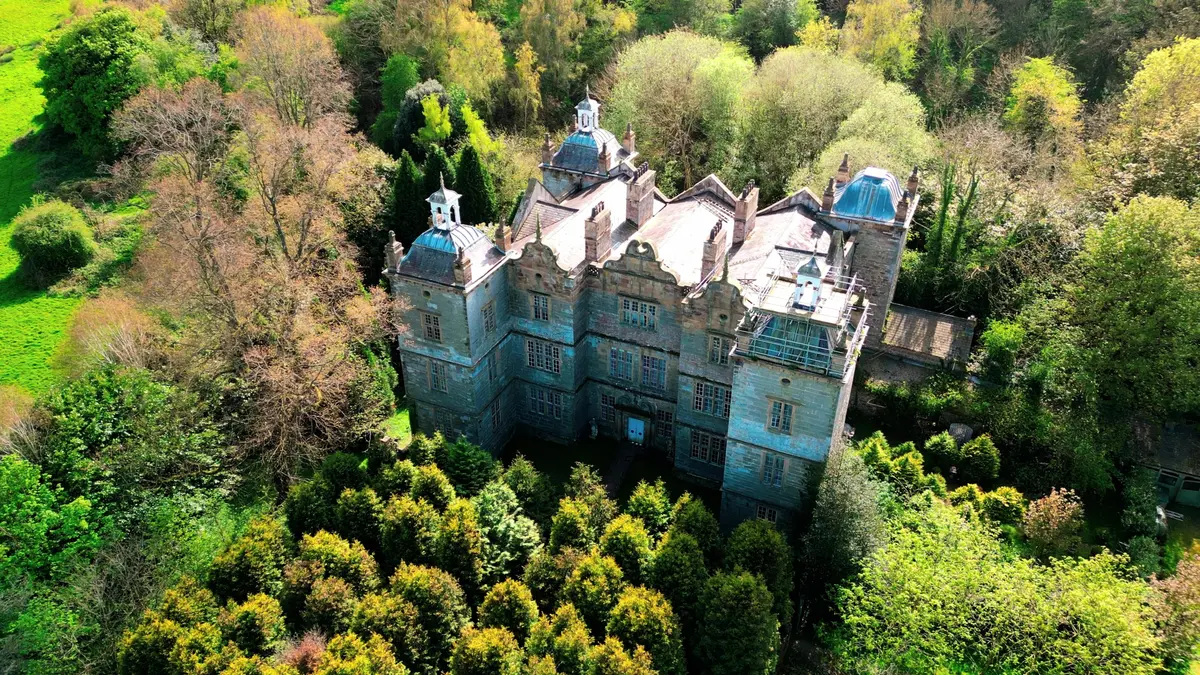
Plas Teg stands back from the A541 between Mold and Wrexham: a square, four-towered Jacobean mansion rebuilt around 1610 by Sir John Trevor I, Surveyor of the Navy, on a manorial site already named in fifteenth-century Welsh bardic verse.
Where is Plas Teg?
- Location
- Flintshire, Wales, United Kingdom
- Type
- House / mansion
- Coordinates
- 53.13, -3.067
- Last updated
LOCATION
Why is Plas Teg said to be haunted?
Cadw listed it Grade I in 1952 to stop an auction firm demolishing it, and neither Cadw's listing nor the Royal Commission's record mentions a ghost. The hauntings belong to a much younger stream of material. The best-known figure is an old woman said to glide across the dual carriageway outside the gates, named as the region's most famous grey lady by the Mold author Richard Holland in a BBC piece in 2009; the Daily Post and the auctioneers who emptied the house in 2025 tell a different story, of Dorothy Trevor, who fell into the well while eloping and is now, in the paper's words, 'imagined' to be the Woman in White seen by visitors. Every book about ghosts that mentions Plas Teg in the Open Library full-text corpus is later than 1986, the year the antiques dealer Cornelia Bayley bought the wreck for 75,000 pounds, restored it and began running tours and 45-pound paranormal nights. The house closed to visitors in 2022, its contents were auctioned in 2025, and it is not open today.
What is the history of Plas Teg?
Plas Teg is not the first house on its site. Cadw's Grade I listing describes a medieval manorial site already commemorated in fifteenth-century Welsh bardic poetry; the estate was bought from a cousin in the late 1590s by Sir John Trevor I, and the building that stands today is his rebuilding of it.
Trevor (1563-1630) was a second son who made his money at court. The Dictionary of Welsh Biography records him as secretary to Lord Admiral Howard of Effingham and surveyor of the queen's ships from 21 December 1598 at forty pounds a year; he farmed the duties on Newcastle coals and sat in Parliament from 1592 to 1614 for boroughs in his patron's gift. Cadw adds that after his knighthood in 1603 he accumulated the stewardship of the royal palaces of Windsor and Oatlands and the receivership of the customs of Chester and Liverpool, and that Plas Teg was conceived as a lodge-scale house meant chiefly for lavish entertaining rather than as a working estate centre.
The date everybody repeats - about 1610 - deserves a sentence of its own. The Royal Commission on the Ancient and Historical Monuments of Wales records that the completion date of 1610 comes from the eighteenth-century antiquary Thomas Pennant, and that the attribution of the design to Robert Smythson, the court surveyor, comes from the same tradition. Its verdict on both is blunt: "Both suggestions are plausible but are not substantiated by any documentary evidence." Mark Girouard, writing on Smythson, places Plas Teg in the same family as Wollaton and Hardwick: nearly square in plan, with extruded corner towers carried a storey above the roofline and topped with lead ogee roofs and wooden cupolas.
Sir John died at Plas Teg on 20 February 1630 and was buried in the neighbouring church at Hope. (Cadw's listing gives 1629; the difference is the old-style year, which then began in March.) His widow, Dame Margaret, died in 1643, and two years later the empty house was twice sacked by parliamentarian troops during General Brereton's invasion of Flintshire - despite the fact that the owner, Sir John Trevor II, was himself a parliamentarian. The family's main seat moved to Glynde in Sussex, and for most of its life Plas Teg was tenanted or empty.
Lady Jane Dacre took a renewed interest in the Flintshire house late in the eighteenth century, and around 1823-24 Charles Blayney Trevor-Roper carried out a Tudorbethan restoration that raised the upper floor, rebuilt the gables and replaced the main entrance, while leaving the Jacobean well stair and its strapwork doorcases intact.
The twentieth century almost finished it. The War Office requisitioned the house to billet soldiers; in 1945 it was sold to Dodds the auctioneers, who used it as a furniture store; by the mid-1950s Dodds applied to demolish it, the application was refused after a public outcry, and the derelict shell was listed Grade I on 14 February 1952. Patrick Trevor-Roper, a descendant, bought it back and partially restored it with Historic Buildings Council money, then let it to tenants until 1977, when Mr and Mrs William Llewelyn bought the house and lived in part of the ground floor while the rest collapsed around them.
In 1986 the antiques dealer Cornelia Bayley bought Plas Teg for 75,000 pounds. The roof had effectively gone, trees were growing through the building and the flagstones, lead, chimneypieces and panelling had been stolen. She restored it - about 400,000 pounds, roughly half of it from Cadw, according to the auctioneers Rogers Jones & Co and the Daily Post, although a history page written for her own website by Mark Baker in 2006 gave the higher figures of 750,000 pounds and a 250,000-pound Cadw grant - and opened the house to the public ten months after buying it, furnishing it from her own trade.
Timeline: the documented record of Plas Teg
- 21 December 1598 Sir John Trevor I is appointed surveyor of the queen's ships at forty pounds a year, the post that funds the house he is about to build; he had already bought the Plas Teg estate from a cousin.
- c. 1610 The traditional completion date of the house. The Royal Commission attributes it to the antiquary Thomas Pennant and records that neither the date nor the attribution of the design to Robert Smythson is substantiated by documentary evidence.
- 20 February 1630 Sir John Trevor I dies at Plas Teg and is buried at Hope, according to the Dictionary of Welsh Biography. Cadw's listing dates the death to 1629, the old-style year.
- 1645 Two years after the death of Dame Margaret Trevor, the empty house is sacked twice by parliamentarian troops during General Brereton's invasion of Flintshire, although its owner Sir John Trevor II was a parliamentarian himself.
- 14 February 1952 Cadw lists the derelict house Grade I after a demolition application by Dodds the auctioneers, who had bought it in 1945 as a furniture store, is refused following public outcry.
- 1986 The antiques dealer Cornelia Bayley buys Plas Teg for 75,000 pounds with the roof gone and trees growing inside, restores it with Cadw help and opens it to the public ten months later.
- 1990 The photographer Simon Marsden publishes Phantoms of the Isles, whose plates include the gardens and the Great Chamber at Plas Teg and Cornelia Bayley herself. Every book with ghosts or hauntings in its title that the Open Library full-text search returns for Plas Teg is of this date or later.
- 13 June 2004 Date of the earliest archived capture of the BBC North East Wales page in which the medium Carl Fletcher describes a vigil at Plas Teg with the Cheshire Paranormal Society, a group he says had been visiting the house for about seven years.
- November 2006 The pop group Girls Aloud film an episode of ITV2's Ghosthunting With... at Plas Teg, the appearance that carries the house's reputation beyond north-east Wales.
- 17 September 2009 BBC North East Wales publishes Nick Bourne's survey of the region's grey ladies, in which the Mold author Richard Holland names the A541 figure outside Plas Teg as the best known of them and tells the story of the driver who called the police.
- 2022 Plas Teg closes to visitors for stabilisation work; its official domain plasteg.com is suspended by its host in May of the same year.
- 21 January 2025 Rogers Jones & Co begin selling the contents of Plas Teg on power of attorney instruction; the house is emptied, placed under round-the-clock security, and Cornelia Bayley moves into a care home.
Is there a rational explanation for Plas Teg?
Two of the most detailed descriptions of Plas Teg ever written say nothing at all about ghosts. Cadw's Grade I listing runs to some two thousand words on plan, fabric, staircase, doorcases and fireplaces; the Royal Commission's site record adds the architectural history and the scholarly literature. Neither mentions a haunting, and neither records any judicial use of the house. Everything supernatural attached to Plas Teg comes from other material, and that material can be dated.
An Open Library full-text search for the phrase "Plas Teg", run on 1 October 2026, returns 410 pages in 409 digitised books. Of those books, 265 were published before 1986, going back to Thomas Pennant's history of the parishes of Whiteford and Holywell (1796); Thomas Nicholas's Annals and Antiquities of the Counties and County Families of Wales (1872), J. Y. W. Lloyd's history of Powys Fadog (1881) and Henry Taylor's Historic Notices (1883) are among them. The books in the set whose titles announce ghosts or hauntings all come later: Simon Marsden's Phantoms of the Isles, with photographs of the gardens and of Cornelia Bayley in the Great Chamber (the scanned copy is the 1993 Boxtree edition); The Ghosthunter's Almanac (1993); The Good Ghost Guide (1994); The International Directory of Haunted Places (2000); Susan Smitten's Ghosts of the World (2006), whose entry says Bayley bought the house "almost 20 years ago"; and Richard Holland's Haunted Wales (2011). The same index cannot pair words: on the same day a search for "Plas Teg" together with ghost, ghosts or haunted returned nothing, although Smitten's page carries both. The test is therefore by title, and by title the first ghost books on the shelf follow Bayley's purchase of the house in 1986.
A first-hand account survives on a page of the BBC's North East Wales "Weird" guide, archived on 13 June 2004, in which the medium Carl Fletcher describes a vigil at the house. In his second paragraph Fletcher explains that before the public arrived he took "the layout and itinerary" from John of the Cheshire Paranormal Society, whose members "have visited for about seven years", and then writes: "The point of mediumship is to prove survival of the physical, so information should never be fed to a medium." He goes on to report a figure "in long blue clothes" on the stairs, and a few lines later notes that "the figure in the blue dress has her portrait in one of the bedrooms". The same page already tells of the daughter who loved a farmer and was found dead in one of the two wells, and of the farmer who hanged himself. It also says the house was once a "sanitorium" for women "who had children out of wedlock", and calls one room "the Judge's bedroom", "once also supposedly a hanging room". Neither Cadw's listing nor the Royal Commission's record mentions either use.
The road ghost has a named source and an unstable description. Richard Holland, of Mold, told BBC North East Wales in September 2009 that the region's best-known grey lady is "an old woman said to be seen gliding across the A541 dual carriageway" outside Plas Teg. In his telling a driver was so sure she had run someone over that she phoned the police, who searched with tracker dogs and a helicopter, and the officers "already knew about the ghost" and reassured her on that basis; the story as printed carries no date, no name for the driver and no police record. The women of the house's own stories are younger. In January 2025 the Daily Post made Dorothy Trevor, who fell into the well while eloping, the Woman in White "occasionally reported by visitors", hedging it with "it is now imagined"; the auctioneers Rogers Jones & Co told the same elopement on their sale page under the heading "If you believe in that sort of thing…".
The Judge Jeffreys connection has the same shape. The house's own website had a page on "Judge George Jeffreys" by 1 May 2004, the date of its earliest archived capture: a straight biography giving his birth on 15 May 1648 at Acton Park in Wrexham, about nine and a half kilometres south-east of the house, and never placing him at Plas Teg. In Smitten's Ghosts of the World, another entry mentions "the notorious Judge Jeffries" and points to "the story of Plas Teg". The auctioneers' timeline of 2025 says the house "served as a courthouse during and after the Monmouth Rebellion" of 1685, and the Daily Post the same year speaks of its "reputed use as a local court"; neither names a source. The Daily Post also gives, as something that "reputedly" happened, the 1815 drowning in the well of a sixteen-year-old Elizabeth Trevor-Roper, again without a source. An Open Library full-text search for that name on 1 October 2026 returns six pages, in peerages and directories, all of them about women of later generations; the control in the same index, "Charles Blayney Trevor-Roper", returns 39 pages, among them his birth on 22 September 1799 in Ruvigny's Plantagenet Roll of 1905.
Finally, the income. The Daily Post reported in January 2025 that Bayley, "dependent on her small pension", supplemented it by holding paranormal evenings in her home. The house's own site in 2021 priced them at 45 pounds a head for about six hours, from 8 pm to a 2 am finish, over-18s only, usually eight to twenty guests. The same page opens with the phrase the press would later repeat, "Plas Teg is said to be one of the most haunted houses in Wales", and closes with "We employ no tricks ~ we don't need to. Whatever happens is for real!"
Can you visit Plas Teg?
Plas Teg stands at grid reference SJ 2870 5970 in the community of Hope, Flintshire, and has been listed Grade I by Cadw since 14 February 1952 (Cadw record 7). Cadw places it "set-back from the main Wrexham to Mold road", the A541, and "accessed from the road via a pair of gated, sweeping drives"; the milestone listed with it stands "on a central reservation on the main road, immediately opposite the N entrance drive". The house is private and has been closed to visitors since 2022.
An Internet Archive capture of plasteg.com dated 20 April 2022 opens with "Plas Teg is closed to the public until further notice". The Daily Post wrote in January 2025 that a fundraiser to repair the roof and timberwork was launched in 2021, the year Cornelia Bayley turned 80, and that "Plas Teg closed to visitors in 2022". That January the auctioneers Rogers Jones & Co announced that they had been "instructed by Power of Attorney to sell the contents of Plas Teg", that the items had been removed to a warehouse and that "24 hour security is now in place at Plas Teg"; the ceramics were offered across their sales from 21 January 2025. The Daily Post reported the auctioneer's statement that Bayley had entered a care home.
Mark Baker, an architectural historian and director of the Plas Teg Trust, told The Leader on 21 January 2025 that "Cornelia has willed the house to National Trust - who have covenants of the building - and the Landmark Trust", and named the roof, the water and heating systems and "a dry rot outbreak" among the work needed. The Daily Post adds that the National Trust had bought the surrounding estate, "including its parkland and walled garden". Companies House showed Plas Teg Trust Limited (company 08574442, incorporated on 18 June 2013, registered office Brithdir Hall, Berriew) as active on 24 September 2026, with accounts filed to 30 June 2025. The Internet Archive has plasteg.com showing a hosting-suspension page on 25 May 2022. On 24 September 2026 plasteg.co.uk, which in 2006 was a frame around plasteg.com, returned a 404 error, and plasteg.com did not respond.
The last archived version of the house's own website, from 27 February 2021, priced private daylight tours at £10 an adult and £5 a child, lasting "1 hour – 1 1/2 hours", on most days except Sundays, and said that "there are no facilities for wheelchairs as the property is a listed building". Paranormal nights cost £45 a head for over-18s, usually for 8 to 20 guests, with a start "usually" at 8pm and a 2am finish, and the house was "not insured for overnight stays".
Coflein records that the grounds "include a walled garden and a replanted lime avenue", and they are on Cadw's Register of Parks and Gardens of Special Historic Interest in Wales under PGW(C)24. Sir John Trevor I, who built the house, "died at Plas Têg 20 February 1630, and was buried in the neighbouring church of Hope", according to the Dictionary of Welsh Biography.
Sources consulted
- Cadw, «Plas Teg, Hope (Cadw listed building record, Grade I, listed 14 February 1952, Cadw ID 7)» — Cadw / British Listed Buildings, 1952 report
- J. Wiles and R. F. Suggett, RCAHMW, «Plas Teg, Mansion (site record NPRN 36160)» — Coflein, Royal Commission on the Ancient and Historical Monuments of Wales, 2015 archive
- Dictionary of Welsh Biography, «TREVOR family, of Trevalun, Denbighshire, Plas Teg, Flintshire, and Glynde, Sussex» — National Library of Wales, 1959 book
- Carl Fletcher, «Medium sees Plas Teg's ghosts (BBC North East Wales Weird guide, archived 13 June 2004)» — BBC Wales, via the Internet Archive, 2004 archive
- Nick Bourne, «Myths and legends about ghostly grey ladies» — BBC North East Wales, 2009 newspaper archive
- North Wales Live Property Insider, «Inside the 'most haunted' mansion transformed into dazzling treasure trove soon to be cleared out» — Daily Post (North Wales Live), archived 16 January 2025, 2025 newspaper archive
- Mark Baker, «Plas Teg: Exploring the hall's history» — BBC North East Wales, 2010 newspaper archive
- Plas Teg Trust, «Plas Teg official website: Paranormal Nights, Tours and Donate pages (archived 27 February 2021)» — plasteg.com, via the Internet Archive, 2021 archive
- Rogers Jones & Co, «Plas Teg: Once in a Generation Welsh House Clearance» — Rogers Jones & Co auctioneers, 2025 report
- Mark Girouard, «Robert Smythson and the Elizabethan Country House» — Yale University Press, 1983 book
- Companies House, «PLAS TEG TRUST LIMITED, company 08574442 (incorporated 18 June 2013, status active)» — UK Companies House register, 2026 report
- Open Library / Internet Archive search inside, «Full-text search of digitised books for 'Plas Teg': 410 pages in 409 books on 1 October 2026, 265 of the books published before 1986; the books whose titles are about ghosts or hauntings are all later. The same index returns nothing for 'Plas Teg' combined with ghost, ghosts or haunted, even on pages that carry both» — Internet Archive, 2026 archive
- Claire Pierce, «Mansion contents sale towards care of house and its owner» — The Leader (Wrexham), 2025 newspaper archive
- RCAHMW, «Plas Teg Garden, Leeswood (site record NPRN 86737; Cadw Register of Parks and Gardens PGW(C)24)» — Coflein, Royal Commission on the Ancient and Historical Monuments of Wales, 2026 archive
- Plas Teg Trust, «Plas Teg official website, home page: "Plas Teg is closed to the public until further notice" (archived 20 April 2022)» — plasteg.com, via the Internet Archive, 2022 archive
- plasteg.com host, «plasteg.com hosting suspension page (archived 25 May 2022)» — Internet Archive Wayback Machine, 2022 archive
- Plas Teg, «plasteg.co.uk home page: a frameset loading www.plasteg.com (archived 19 May 2006)» — plasteg.co.uk, via the Internet Archive, 2006 archive
- Plas Teg, «Judge George Jeffreys (house website page, earliest archived capture 1 May 2004): a biography giving his birth on 15 May 1648 at Acton Park, Wrexham, without mentioning Plas Teg» — plasteg.com, via the Internet Archive, 2004 archive
- Open Library / Internet Archive search inside, «Full-text search of digitised books for 'Elizabeth Trevor-Roper' (6 pages, all about women of later generations) with the control 'Charles Blayney Trevor-Roper' (39 pages, including his birth on 22 September 1799 in Ruvigny's Plantagenet Roll, 1905), run on 1 October 2026» — Internet Archive, 2026 archive
Reviewed by V. Serrano on 2026-08-13 · How we verify our content
💬 Field testimonies (0)
No testimonies yet. Add the first.
Add your testimony
🔒 Log in to add a testimony