👻 HAUNTED PLACE · EXP. Nº9477
ACTIVE
Prestbury, Gloucestershire
Prestbury, Gloucestershire is a location reputed to be haunted in Gloucestershire, England, GB. Its reputation comes from reported apparitions, unexplained phenomena and eyewitness accounts gathered over time.
Where is Prestbury, Gloucestershire?
- Location
- Gloucestershire, England, GB
- Type
- Village / settlement
- Coordinates
- 51.914, -2.042
- Testimonies
- 0
- Last updated
LOCATION
Why is Prestbury, Gloucestershire said to be haunted?
Prestbury, a village on the north-eastern edge of Cheltenham, is advertised as the most haunted village in England. The book usually cited for that line says something narrower. In The Penguin Book of Ghosts (2008) Jennifer Westwood and Jacqueline Simpson write that Prestbury "claims to be the most haunted village in Gloucestershire (though painswick might well say the same)", and credit every one of its ghosts to a single title: Roy Palmer's Folklore of Gloucestershire of 1994, drawn from twentieth-century printed and oral sources. The superlative reached Wikipedia in the article's first sentence on 15 April 2005 with no source at all; the two book citations now attached to it were added six years later, in the same edit that deleted a list of sixteen hauntings. Behind the slogan lies a documented village: a Domesday manor of the bishops of Hereford, a market granted in 1249, a street still called The Burgage, and a house beside the church that belonged to Llanthony Priory. Its own local history society has published a great deal about all of that and nothing whatever about the Black Abbot.
What is the history of Prestbury, Gloucestershire?
Prestbury lies about a mile and a half north-east of the centre of Cheltenham, at the foot of Cleeve Hill. The Gloucestershire Historic Towns Survey, the county council's archaeological assessment of the village, follows A. H. Smith's place-name volume of 1964 in reading the name as "the priests' fortified place", from Anglo-Saxon preost and burh, and gives the sequence of forms: "The name first appears as into Preosdabyrig c.899-904; by the time of the Domesday survey it had developed into Presteberie and by the thirteenth century it was Presbery." The fortification meant is a manor house of the bishops of Hereford rather than a burial ground.
In 1086 Prestbury appears among the lands of the church of Hereford, in the hundred of Cheltenham, with eighteen villagers, five smallholders, a priest, a riding man and eleven slaves; the manor was valued at twelve pounds before the Conquest and sixteen at the survey. The bishops held it until 1560, when the Crown seized it during a vacancy in the see. Their residence stood 0.8 km north of the village centre inside two moated enclosures. The western end was dug in 1951 and produced the foundations of an aisled ground-floor hall with a solar and chapel above, and a kitchen beside the moat; the accounts record a mill, a brewhouse and a dairy inside the western enclosure and, in the eastern one, three barns, an ox house, a great stable and a fishpond. In 1289 the bishop kept Christmas at Prestbury, and the repairs that year covered a new chimney in the kitchen and work on a drawbridge.
The monastic thread is documented and narrow. In 1136 bishop Robert of Hereford gave the church of Prestbury, with its dependent chapel at Sevenhampton, to Llanthony Priory, which also appropriated the rectory; the prior held lands in the parish, was granted free warren in 1292, and was leasing the bishop's mill by 1389. His house in the village was known by the mid-thirteenth century as The Court, and by 1538 it stood beside the church under a new name. The Historic England entry for The Priory, a Grade II building on the High Street listed on 25 February 1987, describes a fourteenth-century hall of four bays and adds under History: "By 1538 the house known to be in the ownership of Llanthony Priory and was called the manor house or rectory." The county survey is careful about how far that goes: of a suggestion that the ground in front of Reform Cottage was the monks' private burial ground it says only that "there is no information available at present to support this theory".
In 1249 the bishop obtained a weekly market and a three-day fair at the beginning of August. The market was held in The Burgage, where thirty tenants each held a burgage around 1285. It slipped in the fifteenth century, and John Leland, passing in 1546, found the place reduced: "The Town hath been larger than it is now, and hath be sumwhat defacid with chaunce of fier." By about 1700 it had lapsed for good. Samuel Rudder blamed the departure of the bishops in 1779, writing that the town "soon fell into the condition of a country village, and has continued so ever since". A mineral spring was found in the mid-eighteenth century and Lord Craven was letting bathing and lodging by 1751, but the venture did not outlast the century, and Cheltenham took everything the village had been. Gloucestershire County Council designated the old village a conservation area on 15 August 1971, and Cheltenham Borough Council revised its boundary on 26 July 2001.
The ghost material is younger and has a named chain. Jennifer Westwood and Jacqueline Simpson set it out in The Penguin Book of Ghosts (2008), attributing it to one book: the traditions "are listed by Roy Palmer in his Folklore of Gloucestershire (1994), from a variety of printed and oral sources of the twentieth century". Their chief ghost is "a barely visible horseman, whose mount can be heard galloping wildly down the Burgage, then halting abruptly", explained locally by the Roundheads who occupied Prestbury House during the Civil War. A "Black Abbot", they write, "has been frequently seen in the church, the churchyard, and in many parts of the village"; there is "a Phantom Strangler at Cleeve Corner, where a young bride is said to have been asphyxiated by a burglar who was after her jewels"; a girl plays a spinet in one cottage and a woman sings in another. They quote Palmer directly: "There are still more ghosts in Prestbury, including headless horsemen, phantom shepherds and sheep, an old lady in antique dress, and a misty form, identified as a former Mrs Preece, which drifts across the fields." The only line of speech in the whole corpus belongs to a builder's job: when Walnut Cottage was being renovated, they report, the ghost of a former owner appeared, saying, "Here's Old Moses. You see I likes to look in sometimes."
Timeline: the documented record of Prestbury, Gloucestershire
- c. 899-904 The earliest recorded form of the name, Preosdabyrig, appears in a land document; the county survey reads it with A. H. Smith as "the priests' fortified place", from preost and burh.
- 1086 Domesday Book records Presteberie among the lands of the church of Hereford: eighteen villagers, five smallholders, a priest, a riding man and eleven slaves, the manor rising in value from twelve pounds to sixteen.
- 1136 Bishop Robert of Hereford gives the church of Prestbury, with the chapel at Sevenhampton, to Llanthony Priory, which appropriates the rectory.
- 1249 The bishop of Hereford is granted a weekly market and a three-day August fair; the market is held in The Burgage, where about thirty burgage tenants are recorded around 1285.
- By 1538 The house of the prior of Llanthony is recorded standing beside the church and renamed the manor house or rectory; the Historic England entry for The Priory repeats the date verbatim.
- 1546 John Leland finds the borough shrunken and burnt: "The Town hath been larger than it is now, and hath be sumwhat defacid with chaunce of fier."
- 1951 Excavation of the western moated enclosure north of the village uncovers the foundations of the bishops' manor house, with pottery showing a building on the site from the eleventh century.
- 4 July 1960 The church of St Mary, Mill Street, is listed Grade II*; the entry dates the fabric to the thirteenth century and the restoration to G. E. Street in 1864-8.
- 15 August 1971 Gloucestershire County Council designates the old village a conservation area of 26 hectares; Cheltenham Borough Council revises the boundary on 26 July 2001.
- November 1990 The photographer Derek Stafford works in the floodlit churchyard and, in the account BBC Gloucestershire published thirteen years later, "found a hooded figure on his last slide".
- 1994 Roy Palmer publishes The Folklore of Gloucestershire (Tiverton), the single book Westwood and Simpson credit for the Prestbury material, drawn "from a variety of printed and oral sources of the twentieth century".
- May 2003 BBC Gloucestershire writes that the village "has been dubbed the most haunted village in England" on one page and "Britain's most haunted village" on another, naming nobody, and counts "more than two dozen spirits".
- 15 April 2005 The first revision of the English Wikipedia article, written from an anonymous address, states that the village is "famous for being one of the most haunted in England" with no source attached.
- 2008 Westwood and Simpson scope the claim to the county and name a rival: Prestbury "claims to be the most haunted village in Gloucestershire (though painswick might well say the same)".
- 28 October 2011 The Wikipedia editor Smalljim deletes the list of sixteen hauntings — "Rm 16 hauntings, per WP:COAT and WP:EXAMPLES" — and in the same edit attaches the two book citations that the sentence had lacked since 2005.
Is there a rational explanation for Prestbury, Gloucestershire?
The superlative has no author anywhere in the chain. BBC Gloucestershire's "Ghostly Gloucestershire" feature, filed under May 2003 and archived on 20 July 2003, used the passive: "Prestbury is so packed with spooks that it's been dubbed the most haunted village in England." The index page of the same feature wrote "dubbed Britain's most haunted village". Neither page says who did the dubbing, and the two pages disagree about the territory.
The printed authority that everyone cites says a third thing. Westwood and Simpson's entry opens: "Prestbury This claims to be the most haunted village in Gloucestershire (though painswick might well say the same)." The county, and with a rival named in the same breath. Elsewhere in the book they treat the whole genre as a competition: "It is a curious trait in twentieth-century attitudes that tales of haunting can be either a cause of fear or, very frequently, a matter of pride for the people in the area concerned. It is rarely possible to ascertain the age of such stories, yet they circulate vigorously in the press, in guidebooks, and of course orally. And where there is one, there are likely to be more, for publicity generates imitation." They list the other claimants: "others that do so include painswick and prestbury, both in Gloucestershire, and pluckley, Kent".
The sourcing runs backwards. The English Wikipedia article on Prestbury opened, in its first revision of 15 April 2005, with "The village is famous for being one of the most haunted in England", written by an anonymous address and carrying no source. The two books now attached to that sentence were published in 2007 and 2008, and were bolted on six years after the claim, on 28 October 2011, by the editor Smalljim, whose summary reads "Rm 16 hauntings, per WP:COAT and WP:EXAMPLES". The list of sixteen ghosts deleted in that same edit had been added on 18 August 2011 with the summary "Added details of the villages alleged ghosts. Reference given", and contained no reference tag of any kind; another editor had already marked it "cite please" on 11 October.
The count moves with the telling. The BBC in 2003 had "more than two dozen spirits"; the Wikipedia list of 2011 had sixteen; the version of this page withdrawn in August 2026 had "around fifteen", a figure it credited to ghost-walk guides.
The village's own record-keepers are silent, and they are prolific. A sweep of the Prestbury Local History Society website on 7 September 2026 covered 120 pages and 26,297 words and returned zero hits for ghost, haunt, abbot, spook and apparition; in the same sweep Prestbury appeared 1,198 times, village 63, church 12 and Burgage 10. The society's catalogue sells the manor court rolls of 1726 to 1871, a study of the nine open fields and a WWI memorial trail. The parish council's Parish History page, which covers Domesday, the 1249 market, the Reformation and the Civil War, mentions no ghost. The parish magazine for August 2026 runs to 6,892 words and contains one "haunting", applied to the theme tune of Captain Corelli's Mandolin.
The Roman soldier that some versions add to the village has nothing to walk out of. The Gloucestershire Historic Towns Survey, 13,556 words on Prestbury, gives ghost, haunt and abbot at zero while giving Prestbury 103 times, market 45 and Burgage 41, and it is explicit about the Roman remains: "The only direct evidence for Roman activity in Prestbury itself to date is in the form of eight sherds of pottery, part of a thick glass bottle or flask and a piece of iron slag found at SO 967239 at the southern end of The Burgage." Neither a villa nor a signal station appears anywhere in the county record.
The hooded monk is the reverse case, and the reverse is the interesting one. A house belonging to Llanthony Priory stood next to the church by 1538, two listed buildings on the High Street are still called The Priory and The Little Priory, and the prior of Llanthony drew tithes here from 1136. The habit needs no invention. What the record does not supply is a dead abbot, a burial ground, or a sighting older than the twentieth-century oral and printed sources that Palmer collected in 1994.
Can you visit Prestbury, Gloucestershire?
Prestbury is a residential village inside the borough of Cheltenham, roughly a mile and a half from the town centre; there is no admission charge and no visitor centre. Cheltenham Borough Council records the status of its historic core: "Designated by Gloucestershire County Council on 15 August 1971, its boundary was revised by Cheltenham Borough Council on 26 July 2001. It covers 26 hectares." The listing index for the parish runs to 67 entries, churchyard monuments included.
The parish church of St Mary stands on the south side of Mill Street and was listed Grade II* on 4 July 1960. The National Heritage List entry describes it as an "Anglican parish church. C13, probably largely rebuilt C14, C15 Perpendicular, restored 1864-8 by G.E. Street", with a four-stage tower, a battlemented parapet with gargoyles at each corner and a fifteenth-century bellcote at the east end of the nave. The August 2026 parish magazine gives the regular pattern at St Mary's as Eucharist at 0800 on Sundays, Sung Eucharist at 1100, Evening Prayer at 1800 on most Sundays with Benediction on the second, and a Said Eucharist at 1030 on Thursdays. Some services are streamed on the North Cheltenham Team Ministry's YouTube channel. The ministry office is at 5 High Street, Prestbury, Cheltenham GL52 3AR.
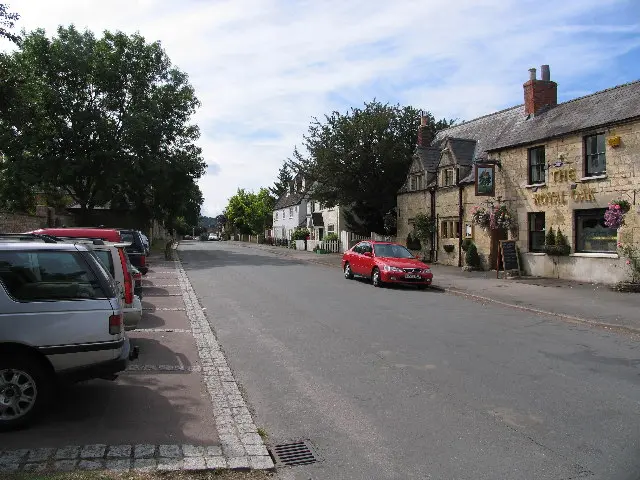
The Burgage, the street where the market granted in 1249 was held, runs north to south west of the church and is lined with listed houses; the Royal Oak and the Plough are both listed, and the magazine locates the Plough "in Mill Street, just behind St Mary's". Prestbury Library stands in The Burgage and sells the Local History Society's books: "PLHS Publications can be purchased at our regular indoor meetings or from: Prestbury Library, The Burgage" and Budgens Prestbury Stores in the High Street, or by post from [email protected]. The society holds monthly indoor meetings. The parish council office is at The Pavilion, New Barn Close, Prestbury, Cheltenham GL52 3LP, telephone 01242 805990, open Monday to Friday from 9am to 12 noon. Cheltenham Racecourse, still called Prestbury Park, lies inside the parish and takes over the village every March for the Gold Cup.
No ghost walk could be confirmed on 7 September 2026. The address prestburyghostwalk.co.uk, which the withdrawn version of this page gave as a booking site, has no DNS record and no capture in the Wayback Machine. In 2003 BBC Gloucestershire routed enquiries to a counter rather than to an operator: "For details of ghost walks call Cheltenham Tourist Information Centre, 77 Promenade, Cheltenham, GL50 1PJ." Prestbury House, the hotel at the centre of the Westwood and Simpson entry, has 158 archived HTML captures of its own domain in the Wayback Machine, running from February 2001 to a last-minute-bookings page of August 2009 and then thinning to 372- and 400-byte stubs in 2014 and 2015; the domain no longer resolves.
Sources consulted
- Antonia Douthwaite and Vince Devine (text and maps updated by Tim Grubb, 2007), «Gloucestershire Historic Towns Survey: Cheltenham Borough Archaeological Assessments — Prestbury» — Gloucestershire County Council Archaeology Service / Archaeology Data Service, 1998 report
- Jennifer Westwood and Jacqueline Simpson, «The Penguin Book of Ghosts: Haunted England — entry "Prestbury", pp. 146-7 in the index of the digitised edition» — Penguin, 2008 book
- BBC Gloucestershire, «Our haunted county: Prestbury (BBC Gloucestershire, "Ghostly Gloucestershire" feature, filed under May 2003; read in the Wayback capture of 20 July 2003)» — BBC, 2003 web
- Historic England, «National Heritage List for England 1153687: Church of St Mary, Prestbury, listed 4 July 1960 (Historic England text, read via British Listed Buildings because historicengland.org.uk returns 403)» — National Heritage List for England, 1960 archive
- Historic England, «National Heritage List for England 1091902: The Priory, Prestbury, listed 25 February 1987 (Historic England text, read via British Listed Buildings)» — National Heritage List for England, 1987 archive
- English Wikipedia contributors, «Revision history of "Prestbury, Gloucestershire", English Wikipedia: 191 revisions read in full, including oldid 12344475 (15 April 2005), 445502866 (18 August 2011) and 457877856 (28 October 2011)» — Wikimedia Foundation, 2026 archive
- North Cheltenham Team Ministry, «Prestbury Parish Magazine, August 2026: times of regular church services and parish directory» — Prestbury Parish Magazine, 2026 report
- Prestbury Parish Council, «Parish History» — prestbury-pc.gov.uk, 2026 web
- Prestbury Local History Society, «Publications and Our Archive (site swept in full, 120 pages, on 7 September 2026)» — prestburyhistory.com, 2026 web
- Terry Jacombs, «The Burgage and Royal Oak, Prestbury (photograph taken 11 August 2005, CC BY-SA 2.0)» — Geograph Britain and Ireland / Wikimedia Commons, 2005 archive
- Cheltenham Borough Council, «Conservation areas: Prestbury conservation area (designation and boundary revision dates, area and character summary)» — cheltenham.gov.uk, 2026 web
Reviewed by V. Serrano on 2026-09-07 · How we verify our content
💬 Field testimonies (0)
No testimonies yet. Add the first.
Add your testimony
🔒 Log in to add a testimony