👻 HAUNTED PLACE · EXP. Nº9477
ACTIVE
Queensberry House
Queensberry House stands at the foot of Edinburgh's Canongate, absorbed since 2004 into the Scottish Parliament complex.
Where is Queensberry House?
- Location
- Scotland, United Kingdom
- Type
- House / mansion
- Coordinates
- 55.952, -3.176
- Last updated
LOCATION
Why is Queensberry House said to be haunted?
Its fame rests on a single story: that on 16 January 1707, while the 2nd Duke of Queensberry was in the Parliament House putting the final touch to the Act of Union, his eldest son James Douglas, Earl of Drumlanrig — a boy with a severe intellectual disability, kept confined in a ground-floor room — broke out, killed the kitchen boy who turned the spit, and was found roasting the body when the household returned. The tale was first printed by Robert Chambers in Traditions of Edinburgh (1824-25), who presented it plainly as something preserved by tradition; no source from 1707 has been found. The peerage record complicates it badly. James Douglas was born on 2 November 1697, which made him nine years old that January, and his father had already passed him over in an entail signed on 26 December 1705, thirteen months before the supposed crime. What survives at Queensberry House is not evidence but a fireplace — and a story Edinburgh told about the Union.
What is the history of Queensberry House?
Queensberry House was not built by the Queensberrys, and for its first twenty years it had nothing to do with them. It went up in 1667-70 for Margaret Douglas of Balmakelly as a 'Grand Lodging' at the foot of the Canongate, a few hundred metres uphill from the Palace of Holyroodhouse, and was modified in 1681 by Charles Maitland of Hatton. William Douglas, 1st Duke of Queensberry, bought it in 1686 to give himself an Edinburgh residence to match his offices, and died in it in 1695.
It is his son James, the 2nd Duke, who made the house famous. Born at Sanquhar Castle on 18 December 1662, he became the politician his own countrymen called the Union Duke. Reinstated in office in 1705 after a period in the political wilderness, he devoted himself entirely to carrying the Treaty of Union, and was appointed Queen Anne's High Commissioner to the last Parliament ever held in Scotland so that he could, in the words of The Scots Peerage, 'put the final touch to the Act, on 16 January 1707'. He did it under guard: Robert Chambers records that throughout the crisis the duke drove daily between his lodgings at Holyrood and the Parliament House on the High Street despite repeated warnings that his life was in danger, and that the mob directed its fury at the Canongate house itself. When he left Scotland weeks later he was execrated at home and given something close to an ovation in London.
The duke had four sons. The eldest surviving one, James Douglas, styled Earl of Drumlanrig, was born on 2 November 1697. He had a severe intellectual disability, and the family dealt with it in the way great houses did: on 26 December 1705 his father entailed the estates on the second surviving son, Charles, 'for family reasons, including the mental incapacity of his eldest surviving son'. In March 1706 the duke resigned his titles into Queen Anne's hands and in June received them back under the new entail. James never inherited and never assumed the titles that were his by right. He died unmarried and was buried on 17 February 1715, as Earl of Drumlanrig, in Yorkshire among his mother's Boyle ancestors. He was seventeen.
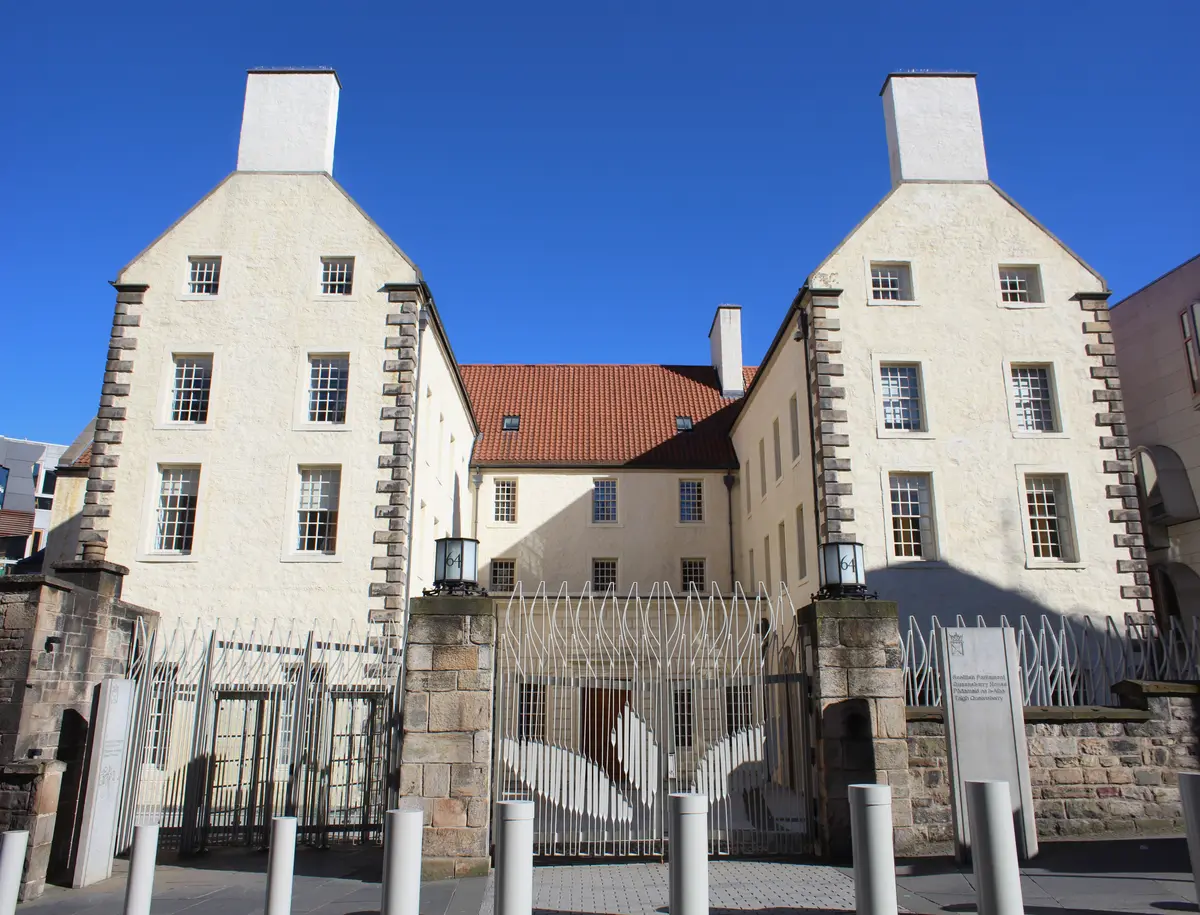
The house outlived them all. The 2nd Duke had James Smith remodel it around 1700, adding pavilions at each end of the garden front and the rusticated entrance porch on the Canongate. The family sold it to the Board of Ordnance in 1801; in 1808 it was converted into an army barracks, with an extra storey piled on and the gardens flattened into a parade ground. It went on to serve as a fever hospital, a House of Refuge for destitute people, and finally a geriatric hospital that closed in 1995. Between 1999 and 2004 it was stripped back to its original three-storey height, re-harled, re-roofed and absorbed into Enric Miralles's Scottish Parliament complex, where it is now the oldest structure on the site and houses the office of the Presiding Officer.
Timeline: the documented record of Queensberry House
- 1667-70 The house is built for Margaret Douglas of Balmakelly as a 'Grand Lodging' at the foot of the Canongate. Charles Maitland of Hatton modifies it in 1681.
- 1686 William Douglas, 1st Duke of Queensberry, buys the mansion as his Edinburgh residence. He dies in it in 1695.
- 2 November 1697 James Douglas, styled Earl of Drumlanrig, is born, eldest surviving son of the 2nd Duke of Queensberry and Mary Boyle. The date is recorded in The Scots Peerage and makes him nine years old in January 1707.
- 26 December 1705 The 2nd Duke entails his estates on his second surviving son Charles, expressly 'for family reasons, including the mental incapacity of his eldest surviving son James, Earl of Drumlanrig'. The disinheritance is signed thirteen months before the crime the legend describes.
- 16 January 1707 As Queen Anne's High Commissioner, the 2nd Duke puts the final touch to the Act of Union in the Parliament House on the High Street — not at Queensberry House. This is the day on which the legend places the killing.
- 6 July 1711 The 2nd Duke dies in London and is buried at Durisdeer. The titles pass to his younger son Charles under the 1705 entail; James is bypassed.
- 17 February 1715 James Douglas is buried in Yorkshire, among his mother's Boyle ancestors, as Earl of Drumlanrig. He died unmarried at seventeen, having never assumed the titles that were his by right.
- August 1792 Robert Burns's 'Such a Parcel of Rogues in a Nation' appears unsigned as no. 378 in volume IV of James Johnson's The Scots Musical Museum. Its line 'We're bought and sold for English gold' is written eighty-five years after the Union and is routinely misquoted as a rhyme from 1707.
- 1801-1995 The Queensberrys sell the house to the Board of Ordnance. It becomes an army barracks in 1808, with an extra storey and a parade ground where the gardens were, then a fever hospital, a House of Refuge for destitute people and finally a geriatric hospital, which closes in 1995.
- 1824-25 Robert Chambers prints the tale in Traditions of Edinburgh (Edinburgh: W. & C. Tait), calling it 'a tale of mystery and horror ... preserved by tradition' and reporting that ordinary Edinburgh read it as 'the judgment of God' on the duke for his part in the Union. This is the earliest printed version located, roughly 118 years after the event.
- 1832 William Hone reprints the passage almost verbatim in The Year Book (London: T. Tegg), crediting 'Mr. Chambers' by name. He rejects one variant outright: the claim that the duke had his son smothered on the spot 'is a mistake'. Pollock's New Guide Through Edinburgh copies it again in 1834.
- 1999-2004 The house is returned to its original three-storey height and incorporated into Enric Miralles's Scottish Parliament complex. Excavation of three basement rooms, including the former kitchen, is published in 2010: pottery, iron fittings, a hearth-pan, a culvert and a brick floor, 'much of the material ... of 19th-century date'. The report never mentions the legend.
Is there a rational explanation for Queensberry House?
The story is not documented. It is dated, and the dating is the problem.
The earliest printed version located is Robert Chambers's Traditions of Edinburgh, first published in Edinburgh by W. & C. Tait in 1824-25 — around 118 years after the events. Chambers made no claim to evidence. He introduced it as 'a tale of mystery and horror ... preserved by tradition', and closed it by reporting what it meant to people rather than whether it happened: the killing was, 'according to the common sort of people, the judgment of God upon him for his wicked concern in the Union'. William Hone reprinted the passage almost word for word in The Year Book (London, 1832), crediting 'Mr. Chambers' by name and carrying over his '(1825)' aside about the building's then use; Pollock's New Guide Through Edinburgh lifted it again in 1834. Every later retelling traces back through that chain. No source contemporary with 1707 has been found.
Two documented dates make the tale difficult to sustain. James Douglas, Earl of Drumlanrig, was born on 2 November 1697, so on 16 January 1707 he was nine years old — not the enormous, full-grown man of the legend. And his father had already passed him over: the entail settling the estates on his younger brother Charles, expressly 'for family reasons, including the mental incapacity of his eldest surviving son', was signed on 26 December 1705, thirteen months before the supposed crime. The disinheritance cannot have been caused by a killing that had not yet happened. Hone was already correcting one branch of the story in 1832, noting that the claim the duke had the boy smothered on the spot 'is a mistake'.
The verse usually attached to the tale is also misplaced. 'Bought and sold for English gold' is not an old rhyme from 1707: it is Robert Burns's line, from 'Such a Parcel of Rogues in a Nation', published unsigned as no. 378 in volume IV of James Johnson's The Scots Musical Museum in August 1792 — eighty-five years after the Union. The exact wording is 'We're bought and sold for English gold — / Such a parcel of rogues in a nation!' (some editions print 'We've'). As Burns's editors Henley and Henderson noted, only the refrain is older, borrowed from the name of the air the song was set to.
What the legend does have is institutional repetition. The Historic Environment Scotland listing for the building states flatly that Drumlanrig 'roasted and ate a kitchenboy in 1707 on the same night his father signed the Act of Union', and identifies the surviving bolection-moulded kitchen fireplace as the place 'where this notorious event took place' — while giving his dates in the same sentence as 1697-1715. The Scottish Parliament, which owns and occupies the house, does not repeat the story at all in its own published history of the building. And the archaeology is silent: when the basement was excavated during the 1999-2004 works, three rooms including the former kitchen were dug and published in Scottish Archaeological Internet Reports vol 40 (2010). The report describes pottery, iron brackets, a hearth-pan, a culvert and a brick floor, notes that 'much of the material is of 19th-century date', and never mentions the legend.
One last thing worth saying plainly. The subject of the story was a disabled child who was locked in a ground-floor room, written out of his own inheritance, and then remembered by Edinburgh as a cannibal. The tale did political work — it turned the Union into a house cursed by God — and it did it at his expense.
Can you visit Queensberry House?
Queensberry House stands at the foot of the Royal Mile, opposite the Palace of Holyroodhouse. Historic Environment Scotland lists it at 64 Canongate as LB28440, category A. The listing, dated 14 December 1970, describes "a substantial, 3-storey and attic, F-plan mansionhouse" of "1667-70 with later additions and alterations by James Smith", lime-harled rubble with ashlar dressings, its north elevation carrying "a rusticated single-storey entrance hall ... flanked by full-height advanced 2-bay gabled wings". That front is what the Canongate pavement shows at any hour and for nothing.
The building itself belongs to the Scottish Parliament, and has done since 2004; the postal address is Horse Wynd, Edinburgh EH99 1SP. The ground floor was gutted and rebuilt in steel and concrete during the works of 1999-2004, the surviving kitchen fireplace sits inside what is now an office, and the house holds the office of the Presiding Officer. The Parliament's own page on the building says nothing about visiting it, and no tour goes to the room in the story. That story has one named figure and one unnamed. The named one is James Douglas, Earl of Drumlanrig, the 2nd Duke's disabled eldest surviving son, who was seventeen when he was buried in 1715. The unnamed one is a kitchen boy whose name no source records.
What can be visited is the Parliament, and "All visits to the Scottish Parliament are free." It opens Monday, Friday and Saturday, public holidays included, from 10:00 to 17:00 with last entry at 16:30, and Tuesday, Wednesday and Thursday from 09:00 to 18:30 with last entry at 18:00; a closure to the public from 9 to 12 October 2026 was posted on the page. Walking into the public areas needs no booking. Guided tours are free, last 45 minutes and are booked through CitizenTicket; they run on those same three days and cover how the Parliament works and the architecture of the Miralles building. Tickets for First Minister's Questions, chamber debates and committee meetings are free as well.
Everyone goes through security screening, and the Parliament recommends arriving twenty minutes before the event time, or an hour for First Minister's Questions.
Lothian Buses service 35 stops outside the building, at the stop called Scottish Parliament on the Royal Mile in the Canongate, and Waverley station is a fifteen-minute walk away. The nearest public cycle racks are next to the Holyrood Lodge house building on Horse Wynd. The nearest car parks are St John's Hill and the one adjacent to Waverley station, and a small number of spaces on Horse Wynd are reserved for disabled drivers. The boundary of the Edinburgh Low Emission Zone takes in the Canongate, the Dynamic Earth turning circle and the entrance and exit of the Parliament's underground car park. The building has accessible and gender-neutral toilets and a Changing Places facility, described as "a specialist space with a hoist and changing bench".
The visitor information above was read on parliament.scot on 22 September 2026.
Sources consulted
- Robert Chambers, «Traditions of Edinburgh» — W. & C. Tait, Edinburgh (first published 1824-25; text cited from the W. & R. Chambers edition), 1825 book
- William Hone, «The Year Book of Daily Recreation and Information (entry for 6 July, cols 793-798)» — T. Tegg, London, 1832 book
- Sir James Balfour Paul (ed.), «The Scots Peerage, volume VII: Douglas, Duke of Queensberry, pp. 140-143» — David Douglas, Edinburgh, 1910 book
- Historic Environment Scotland, «64 Canongate, Queensberry House (LB28440), Category A listed building record» — Historic Environment Scotland designations portal, 2008 report
- W. E. Henley and T. F. Henderson (eds.), «The Poetry of Robert Burns, notes on 'Such a Parcel of Rogues in a Nation', p. 391» — T. C. & E. C. Jack, Edinburgh, 1896 book
- Holyrood Archaeology Project Team, «Artefactual, environmental and archaeological evidence from the Holyrood Parliament Site excavations» — Scottish Archaeological Internet Reports, vol. 40, 2010 academic
- The Scottish Parliament, «Queensberry House» — History of the Scottish Parliament, 2026 archive
- The Scottish Parliament, «Plan your visit and guided tours» — Official visitor information, 2026 archive
- Pollock & Co., «Pollock's New Guide Through Edinburgh» — Pollock & Co., Edinburgh, 1834 book
Reviewed by V. Serrano on 2026-08-11 · How we verify our content
💬 Field testimonies (0)
No testimonies yet. Add the first.
Add your testimony
🔒 Log in to add a testimony