👻 HAUNTED PLACE · EXP. Nº9476
ACTIVE
RAF East Kirkby
RAF East Kirkby opened on 20 August 1943 as a No. 5 Group bomber station and was home to Nos.
Where is RAF East Kirkby?
- Location
- Lincolnshire, England, United Kingdom
- Type
- Airfield / air base
- Coordinates
- 53.139, -0.001
- Last updated
LOCATION
Why is RAF East Kirkby said to be haunted?
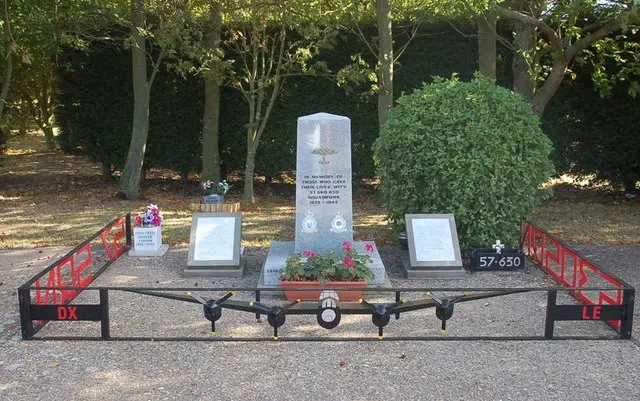
57 and 630 Squadrons, whose Lancasters flew until the last operational sortie on 25 April 1945. Its worst night in the air was the Wesseling raid of 21/22 June 1944, when eleven aircraft failed to return. Its worst hour never left the ground: at about 17:40 on 17 April 1945, three weeks before the war in Europe ended, an explosion tore through a Lancaster being bombed up, set fully loaded aircraft alight on adjacent dispersals and went on detonating. Four men were killed — Corporals Thomas Stanley Dixon, George William Johnson and Matthew Bulmer, and Leading Aircraftman Arnold Price — and six officers and airmen were later decorated for going back in while the bombs were still exploding. The airfield is now the Lincolnshire Aviation Heritage Centre, opened in 1988 by two Lincolnshire farmers in memory of a brother killed over Germany, with the Grade II listed control tower restored and Lancaster NX611 'Just Jane' under restoration to fly. Its ghost stories are third-hand and datable to 2003; the museum itself tells none of them.
What is the history of RAF East Kirkby?
East Kirkby began as a deception. From 1940 the flat farmland beside the village carried a decoy site — a dummy airfield built to draw German bombs away from targets that mattered. The real station was laid over it from 1942 by the contractor John Laing & Sons: three intersecting concrete runways across requisitioned Lincolnshire farmland, and a control tower built to Air Ministry drawing 12779/41 in rendered brick under an asphalt roof, with the watch office, duty pilot's rest room and meteorological office below and the control room and signals office above. The station opened on 20 August 1943 as a heavy bomber base in No. 5 Group, Bomber Command.
No. 57 Squadron's advance party arrived on 27 August 1943, and the squadron flew its first operation from the new airfield on 30 August, fourteen Lancasters detailed for Mönchengladbach. On 15 November 1943 the squadron's B Flight was expanded into a unit of its own, No. 630 Squadron, and the two shared East Kirkby for the rest of the war.
The station's worst night in the air is precisely dated. On 21/22 June 1944 No. 5 Group attacked the synthetic oil plant at Wesseling and lost close to a third of the force despatched. Eleven Lancasters failed to return to East Kirkby, six from 57 Squadron and five from 630, and the 630 Squadron losses are documented crew by crew. ND531 'K-Kitty' went down with Squadron Leader Arthur Edgar Foster DFC, aged 23, and all seven of his crew, who have no graves and are commemorated at Runnymede. ME782 'N-Nan' was shot down by a night fighter near Turnhout, killing Pilot Officer Thomas George Hart RCAF, 21, and everyone aboard, buried at Schoonselhof. ME843 'U-Uncle' was shot down between Hamont and Bocholt by Hauptmann Heinz-Wolfgang Schnaufer, killing Pilot Officer Robert Cecil Hooper DFC, 22, and all seven of his crew, buried at Heverlee. LM118 'V-Victor' crashed south of Boxtel with Pilot Officer John Henry George Smith, 21, and his crew, buried at Eindhoven. Only ME795 'G-George' came down over England, where Flying Officer Lionel Norman Rackley RAAF was injured and six of the crew parachuted clear; Flight Sergeant William Alfred Cecil Davis was killed. Twenty-eight men from one squadron, in one night.
Across the war 57 Squadron lost 90 aircraft and 630 Squadron 72. No. 630 Squadron's own operational history — compiled from the squadron Operations Record Book, AIR 27 at The National Archives, which its compilers warn contains many flaws, and from testimony gathered from former members between 1982 and 2019 — counts 2,513 sorties, 1,218 men who flew operationally, 446 killed or missing, 67 taken prisoner, 29 who evaded, six interned in Sweden and 17 more killed in training accidents. Of 162 operational crews, 64 were lost: just under forty per cent. A claim often repeated about this airfield is that its losses were among the heaviest of any Lincolnshire bomber base. Lincolnshire held dozens of airfields, no published ranking has been found that supports the comparison, and so it is not made here; the figures above are the ones that can be cited.
The airfield's worst hour, though, never left the ground.
At about 17:40 on the evening of Tuesday 17 April 1945, three weeks before the war in Europe ended, 57 Squadron aircraft were being bombed up at dispersal for a 5 Group attack on railway targets near the German-Czech border. Bombing up was almost complete when an explosion tore through one of the aircraft. The official citation for the awards that followed, published in the London Gazette on 27 November 1945, describes what happened next in flat administrative English: 'A number of airmen and soldiers working in the vicinity were injured, two of them fatally. Two, and eventually three, aircraft already fully bombed up on adjacent dispersal positions caught fire, and shortly afterwards the bombs on these aircraft started to explode.'
What set it off is not settled, and the confident versions in circulation are more confident than the record. Several accounts state that a fused 1,000 lb bomb was dropped on the tarmac; 630 Squadron's history says the cause has been speculated as a petrol spillage; the Gazette citation says only that 'an explosion occurred in an aircraft which was being prepared for operations'. Nine 1,000 lb and thirty-four 500 lb medium capacity bombs detonated. Four Lancasters were burning at the height of it, and 57 Squadron's loss tables record six aircraft written off that day with the cause given as bomb explosion: ND765, PD347, RF195, LM763, ND472 and PB360.
Four men were killed, and they have names. Corporal Thomas Stanley Dixon RAFVR, 30, of Dukinfield. Leading Aircraftman Arnold Price RAFVR, 24, of Chorlton-cum-Hardy, buried in Manchester Southern Cemetery. Corporal George William Johnson RAFVR, 33, of Wombwell. And Corporal Matthew Bulmer of the Pioneer Corps, 29, son of Matthew and Miriam Bulmer and husband of Alice May Bulmer of Prendergast, Pembrokeshire, buried in Lincoln (Newport) Cemetery — a soldier, not an airman, killed on a bomber station. Among the injured were Leading Aircraftman A. Daley, Corporal R. J. Piper, Private E. Turner, Corporal Dougherty, Leading Aircraftman F. Challis, Corporal J. Martin and Leading Aircraftman R. Stubbs.
Six men were decorated for what they did while the bombs were still going off. Flying Officer John Aidan Hastings Gott GM (154963) and Flying Officer Courtenay Cecil Grebby (133289), the station fire officer, were appointed Members of the Order of the British Empire; the British Empire Medal went to Corporal Raymond Graham Forster (916695), Corporal Leslie John Daniel Friswell (1184210), Leading Aircraftman Frederick Phillip Brown (1863590) and Leading Aircraftman William Edward Thaxton (1037853). The citation is worth reading for the detail. Gott and Grebby found a soldier lying near the blazing wreckage with his clothing on fire, put out the flames and gave him first aid, then extinguished fires that had taken hold in the tyres of loaded bomb trolleys. Ordered to evacuate, Grebby stayed and asked permission to recover a body lying by a burning aircraft; a bomb went off and opened a deep wound in his thigh. Lying on a stretcher in great pain, he 'asked to be assured that no injured persons were being left in danger while he was being given a place in the ambulance'. Gott was the last to leave the scene, taking the last of the injured out in his own car. Forster, in charge of the men servicing the aircraft in which the first explosion happened, was in a hut fifty yards away; injured and severely shaken, he went straight back. Brown was knocked down by the blast and had to dig himself out of the wreckage of a flight hut before he went towards it. Thaxton, arriving with the station fire party, was hit by a bomb burst; his corporal was thrown down and severely injured, and Thaxton carried him to safety and then returned. The citation ends by crediting the six with 'outstanding courage and initiative which resulted in the saving of many lives'.
East Kirkby flew its last operational sortie on 25 April 1945, was worked up as a Tiger Force base for the war against Japan, and passed to care and maintenance in November 1945. It reopened in 1954 in support of RAF and USAF movements to the Far East, housed American transport aircraft, and closed in 1958. The Ministry of Defence disposed of the site in 1970.
What brought it back was a private grief, and not one of this airfield's own. Pilot Officer Christopher Witton Panton, a flight engineer aged 19, was killed on the night of 30/31 March 1944 when his 433 Squadron RCAF Halifax III, HX272, was shot down on the Nuremberg raid; he flew not from East Kirkby but from Skipton-on-Swale in Yorkshire, and he is buried at Durnbach, south of Munich. His younger brothers, the Lincolnshire farmers Fred and Harold Panton, bought the derelict East Kirkby airfield and made it his memorial. In September 1983 Fred Panton bought Lancaster NX611 from Lord Lilford; it arrived at East Kirkby in July 1987 after thirteen years as gate guardian at RAF Scampton, reassembled over some thirteen weeks by RAF Abingdon personnel, and the Lincolnshire Aviation Heritage Centre opened to the public in 1988. The control tower was restored as the centrepiece of the museum and is listed Grade II.
One honest distinction the museum's visitors are owed: NX611 never flew a wartime operation and never served at East Kirkby. It was built at Austin Motors' Longbridge works in April 1945, the third Lancaster B.VII off the line, and was intended for Tiger Force; Japan surrendered and it went into storage at RAF Llandow. Sold to the French Navy in April 1952 as WU15, it flew maritime reconnaissance from Brittany, Morocco and later New Caledonia before withdrawal in 1964. Registered G-ASXX, it was flown from Australia to Biggin Hill in 1965, restored to flight by the Historic Aircraft Preservation Society, and made its last flight on 26 June 1970 to Squires Gate, Blackpool. The name 'Just Jane', after a 1940s newspaper cartoon character, was applied around 1990. It is a genuine Lancaster with a real history — just not this airfield's history, and not a combat one.
Timeline: the documented record of RAF East Kirkby
- From 1940 The farmland beside East Kirkby village is used as a decoy site: a dummy airfield intended to draw German bombs away from real targets.
- 1942 Construction of the real station begins, by the contractor John Laing & Sons. The control tower is built to Air Ministry drawing 12779/41 in rendered brick under an asphalt roof.
- 20 August 1943 East Kirkby opens as a heavy bomber station in No. 5 Group. No. 57 Squadron's advance party arrives on 27 August and the squadron flies its first operation from the airfield on 30 August, fourteen Lancasters detailed for Mönchengladbach.
- 15 November 1943 No. 57 Squadron's B Flight is expanded to form No. 630 Squadron. The two squadrons will share East Kirkby for the rest of the war.
- 30/31 March 1944 Pilot Officer Christopher Witton Panton, a flight engineer aged 19, is killed on the Nuremberg raid when his 433 Squadron RCAF Halifax HX272 is shot down. He flew from Skipton-on-Swale, not East Kirkby; his brothers Fred and Harold will later buy this airfield as his memorial.
- 21/22 June 1944 The station's worst night in the air: on the Wesseling raid eleven Lancasters fail to return to East Kirkby, six from 57 Squadron and five from 630. The 630 Squadron dead include Squadron Leader Arthur Edgar Foster DFC and his whole crew, commemorated at Runnymede; twenty-eight men from that squadron alone are killed.
- 17 April 1945, about 17:40 While 57 Squadron aircraft are being bombed up for a raid on railway targets near the German-Czech border, an explosion tears through one of them and sets fire to fully loaded Lancasters on adjacent dispersals. Nine 1,000 lb and thirty-four 500 lb bombs detonate; four men are killed and six Lancasters are written off. The cause has never been settled.
- 25 April 1945 East Kirkby flies its last operational sortie of the war. The station is worked up as a Tiger Force base for the war against Japan, then passes to care and maintenance in November 1945.
- 27 November 1945 The London Gazette publishes the awards for the April explosion: MBEs to Flying Officers John Aidan Hastings Gott GM and Courtenay Cecil Grebby, and British Empire Medals to Corporals Raymond Graham Forster and Leslie John Daniel Friswell and Leading Aircraftmen Frederick Phillip Brown and William Edward Thaxton, for 'outstanding courage and initiative which resulted in the saving of many lives'.
- 1958 The airfield closes. It had reopened in 1954 to support RAF and USAF movements to the Far East and housed American transport aircraft. The Ministry of Defence disposes of the site in 1970.
- September 1983 Fred Panton buys Lancaster NX611 from Lord Lilford. Built at Longbridge in April 1945 for Tiger Force, it never flew a wartime operation and never served at East Kirkby: it went to the French Navy in 1952, then Australia, and had been gate guardian at RAF Scampton since 1974.
- July 1987 NX611 arrives at East Kirkby and is reassembled on the old airfield by RAF Abingdon personnel. Around 1990 it is named 'Just Jane', after a 1940s newspaper cartoon character.
- 1988 The Lincolnshire Aviation Heritage Centre opens to the public, founded by the Lincolnshire farmers Fred and Harold Panton in memory of their brother Christopher. The 1942 control tower is restored as its centrepiece and is now listed Grade II.
- 7 October 2003 The paranormal television programme Most Haunted broadcasts an episode filmed at RAF East Kirkby. This is the earliest datable public airing of the site's haunted reputation that has been found; the museum itself has never published a ghost claim.
- 2016 The winter restoration programme to return NX611 to airworthy condition begins with a complete paint strip and airframe survey, funded by admissions, donations and taxi rides.
- 17 July 2026 At the last published restoration update, new wing spar booms — the hardest single part of the job — are being manufactured, and the Wings Fund has raised more than £103,900 of a £500,000 target for them. No return-to-flight date has been announced.
Is there a rational explanation for RAF East Kirkby?
The strongest fact about East Kirkby's ghost stories is who does not tell them.
The Lincolnshire Aviation Heritage Centre is a private family museum that sells admission, taxi rides, restoration tours, books, DVDs and mugs, and publishes a sitemap listing its pages. In that sitemap there is no page about ghosts, hauntings or paranormal events: no ghost walk, no night vigil, no resident spirit. The same sitemap does list admission tickets, dated winter restoration tour events, the Panton biography and a shelf of merchandise, so the absence is not a broken index — it is a museum that has had a commercially obvious ghost story available to it for nearly forty years and has never once used it. That silence is the most reliable evidence on the subject, and it points the opposite way from every aggregator page about the site.
Where the stories do come from is traceable, and it is worth being exact about what they actually say. The Paranormal Database's Lincolnshire file carries a single East Kirkby entry. It is dated only 'late twentieth century' and sourced only to 'published media', and it describes a USAAF officer seen several times in the former watch tower, believed to have been killed when a Flying Fortress crash-landed near the site in 1944, and seen on the runway dragging his parachute behind him as he moves slowly towards the control tower. Notice what that is not. It is not a Bomber Command ghost, not a Lancaster crew, and not one of the men who died here; it is an American airman from a crash that could not be confirmed in any record consulted, at a station that in 1944 was an RAF bomber base and did not host American aircraft until the 1950s. An earlier version of this file quietly turned him into 'a figure in flying kit' glimpsed near the runway at dusk, as if one of the airfield's own dead had been seen. That was our error, and naming it matters more than repeating it.
The other datable origin is television: Most Haunted filmed at RAF East Kirkby and broadcast the episode on 7 October 2003. So a reputation repeated across the internet as though it were inherited from aircrew turns out to have, as its earliest datable public airing, a 2003 entertainment programme, and as its only catalogue entry an undated note citing 'published media'. That is a reputation roughly twenty-three years old.
And the site does not need a ghost to feel occupied, because most of what gets reported there is genuinely happening. Four Rolls-Royce Merlin engines are started and run at East Kirkby, for real, on taxi days between March and November; a Lancaster moves under its own power along the old runway; and the sound carries across flat open Fenland farmland with nothing to break it. The restored control tower is a 1942 rendered-brick box with hard internal surfaces under an asphalt roof, standing alone on an exposed airfield in a county where the wind has a long run at it, so noise arriving from the dispersals and the workshops reaches it detached from anything visible. Visitors, meanwhile, have paid to be moved: the place was built as one brother's memorial to another, its centrepiece is a roll of the dead, and the memorial at the gate carries the names of more than a thousand men. Expecting people in that setting to report nothing at all would be strange. What is missing is not atmosphere, or sincerity, or even noise. It is any statement, from the family that owns this airfield and works on it every day, that any of it is a ghost.
Can you visit RAF East Kirkby?
The airfield is open to the public as the Lincolnshire Aviation Heritage Centre, East Kirkby Airfield, near Spilsby, Lincolnshire PE23 4DE, just outside East Kirkby village on the A155. The prices and times below were read on the centre's own pages on 24 September 2026.
The centre opens Tuesday to Saturday and is closed on Sundays and Mondays, apart from some bank holiday Mondays with events. Summer opening, from Easter to October, is 09:30 to 17:00 with last entry at 16:00; winter opening, from October to Easter, is 10:00 to 16:00 with last entry at 15:00. On a normal museum day admission is £13.50 for adults aged 16 and over and £5.50 for children aged 6 to 15; under-sixes go free. The £12.00 rate applies to seniors aged 60 and over and to members of HM Armed Forces. Disabled visitors pay the same, and one carer per disabled visitor enters free on proof of a carer's card or carer's allowance. A family of two adults and two children pays £34.00, and each additional child £4.50. Prices differ on event days, and some of the larger events must be booked in advance. Dogs are allowed on a short lead, and the NAAFI café has tables set aside for them.
The Lancaster taxi rides are booked separately from admission. On 24 September 2026 the booking page priced a standard tail-down ride at £460.00 and a 2027 voucher at £470.00; the same page, read in August 2026, had given £445.00 and £455.00. The experience lasts around 45 minutes, of which the taxi run itself takes about 15. It includes a safety briefing and a tour of the aircraft, and each guest takes home a certificate signed by the pilot. The seating positions named on the page are the rear and mid-upper turrets together with the radio operator's seat and the bomb aimer's position. Standard rides usually run on public holidays and some Saturdays, occasionally midweek, and the restoration page says NX611 taxis from March to November. Solo riders must be 18 or over, while each under-18 needs an adult on board, which restricts the positions available. Bookers must confirm that they have watched the centre's accessibility video.
The centre is restoring NX611 to airworthy condition, a project it estimates at £4 million; the money comes from admission fees and donations as well as the taxi rides. Its restoration page sets out the work winter by winter from 2016 to 2029 and says the aircraft will stay accessible to the public throughout, as what it calls a "peoples memorial" to Bomber Command. The latest update in Vintage Aviation News is dated 17 July 2026, and a search of that site on 24 September returned none later. It reported that the manufacture of new wing spar booms was going ahead despite machining delays, and that the Wings Campaign had raised more than £103,900 of a £500,000 goal. In winter the aircraft is worked on, and the centre sells a Lancaster Winter Restoration Tour.
The centre's directions give four railway stations as the closest (Lincoln and Boston; Skegness and Thorpe Culvert). An hourly bus between Lincoln and Skegness stops at Spilsby, the nearest town. By car the centre puts the journey at about an hour from Lincoln and half an hour from Skegness; from Spilsby it is about ten minutes, and the page gives a taxi firm for each of the three towns. The control tower was built in 1942 to an Air Ministry design. The Lincolnshire Historic Environment Record says it has been restored as the centrepiece of the museum and gives its listing as Grade II (list entry 1392845) at grid reference TF 3379 6204.
The centre was founded by Fred and Harold Panton in memory of their brother Christopher, a 19-year-old flight engineer lost on the Nuremberg raid of 30–31 March 1944. For family research, the squadrons' Operations Record Books are in series AIR 27 at The National Archives at Kew. The Commonwealth War Graves Commission's casualty records give the burial places of the dead; Corporal Matthew Bulmer of the Pioneer Corps, who died on 17 April 1945, the day of the explosion on the airfield, lies in Lincoln (Newport) Cemetery.
Sources consulted
- «Appointments to the Most Excellent Order of the British Empire and awards of the British Empire Medal: joint citation for the explosion on the airfield at East Kirkby, 17 April 1945» — The London Gazette, Third Supplement to the issue of Friday 23 November 1945 (issue 37366), p. 5755, 1945 archive
- «April 1945 — detailed history of No. 630 Squadron, including the East Kirkby explosion of 17 April 1945 with named dead and injured» — No. 630 Squadron (630squadron.wordpress.com), compiled from the squadron Operations Record Book (AIR 27, The National Archives) and members' testimony, 2019 report
- «June 1944 — detailed history of No. 630 Squadron: the Wesseling raid of 21/22 June 1944, aircraft and crews lost» — No. 630 Squadron (630squadron.wordpress.com), compiled from the squadron Operations Record Book (AIR 27, The National Archives), 2019 report
- «Introduction: statistics of No. 630 Squadron — sorties, crews, casualties and sources used» — No. 630 Squadron (630squadron.wordpress.com), 2019 report
- «Nos. 57 and 630 Squadrons: losses operating from RAF East Kirkby (loss tables, including the six Lancasters written off on 17 April 1945 with cause given as bomb explosion)» — Aircraft, Airfields and Airshows (airshowspresent.com), 2020 report
- «Monument record MLI88675 — RAF East Kirkby, and MLI97393 — Control Tower, RAF East Kirkby (Grade II listed, list entry 1392845)» — Lincolnshire Historic Environment Record, Heritage Explorer, 2012 report
- «Opening times and prices» — Lincolnshire Aviation Heritage Centre (official site), consulted 13 August 2026, 2026 web
- «Lancaster restoration: the project to return NX611 to airworthy condition» — Lincolnshire Aviation Heritage Centre (official site), consulted 13 August 2026, 2026 web
- «'Just Jane' Lancaster taxi ride: prices, seating positions, restrictions and season» — Lincolnshire Aviation Heritage Centre (official site), consulted 13 August 2026, 2026 web
- «Avro Lancaster B.VII NX611 'Just Jane' — Restoration Update 260» — Vintage Aviation News, 17 July 2026, 2026 newspaper archive
- «NX611 Lancaster B.VII: construction, French Navy service as WU15, Australia, gate guardian years and the Panton purchase» — On Target Aviation, 2015 web
- «Most Haunted, series 3 episode 1: 'RAF East Kirkby', first broadcast 7 October 2003» — TheTVDB, 2003 web
- «Pilot Officer Christopher Witton Panton, flight engineer, 433 Squadron RCAF: Halifax HX272, Nuremberg, 30/31 March 1944» — Royal Air Force Flight Engineer & Air Engineer Association, 2020 web
- «Lincolnshire entries: East Kirkby Watch Tower (dated only 'late twentieth century', sourced only to 'published media')» — The Paranormal Database, 2024 web
- «Casualty record: Corporal Matthew Bulmer, Pioneer Corps, died 17 April 1945, Lincoln (Newport) Cemetery» — Commonwealth War Graves Commission, casualty 2358592, 1945 archive
- «How to find us: address, directions and public transport» — Lincolnshire Aviation Heritage Centre (official site), consulted 13 August 2026, 2026 web
Reviewed by V. Serrano on 2026-08-13 · How we verify our content
💬 Field testimonies (0)
No testimonies yet. Add the first.
Add your testimony
🔒 Log in to add a testimony