👻 HAUNTED PLACE · EXP. Nº9476
ACTIVE
RAF Elsham Wolds
RAF Elsham Wolds is a chalk plateau in North Lincolnshire that the Royal Air Force used twice and abandoned twice.
Where is RAF Elsham Wolds?
- Location
- Lincolnshire, United Kingdom
- Type
- Airfield / air base
- Coordinates
- 53.606, -0.422
- Last updated
LOCATION
Why is RAF Elsham Wolds said to be haunted?
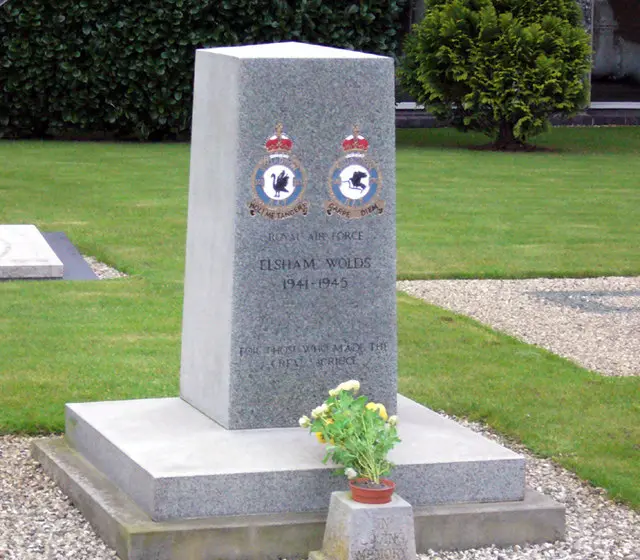
A Home Defence landing ground appeared here in December 1916, against Zeppelins, and was gone by 1919. The airfield that matters opened in the summer of 1941 as a heavy bomber station of No 1 Group: home to 103 Squadron for the rest of the war and, from November 1943, to 576 Squadron, formed on the spot out of one of 103's flights. Between them the two squadrons flew 8,628 sorties with the group and lost 245 aircraft on operations. Don Charlwood, a 103 Squadron navigator who wrote about the place afterwards, put the station's dead at about a thousand. The airfield closed in 1947; today a dual carriageway, an industrial estate and a water treatment works cover it, and a granite memorial dedicated in 1989 stands in a garden of remembrance kept by the veterans' association. The one published ghost story attached to the site is not about airmen at all, and the people who served here have never claimed one.
What is the history of RAF Elsham Wolds?
Elsham Wolds is a chalk plateau that rises steeply north-east of Brigg, in North Lincolnshire. The Royal Air Force used it twice, and the two uses have almost nothing to do with one another.
The first airfield appeared in December 1916. The stretch of coast between the Humber and the Wash had been identified as an entry corridor for German Zeppelins, and 'C' Flight of No 33 Squadron, a Home Defence unit flying Avro 504s and BE2s, put down on the plateau with primitive facilities. By 1919 the land had gone back to farming and stayed that way for twenty years.
The site was surveyed again when Britain needed bomber aerodromes: requisition was approved on 19 June 1940. What went up was an early-war pattern station — a single J-type hangar on the eastern side, technical and administrative buildings grouped behind it, three concrete runways with the main one running north-west to south-east. It opened in the summer of 1941, which is the date carved into the memorial that stands there now.
In July 1941 No 103 Squadron moved in from Newton, near Nottingham, and remained until the end of the war: Wellingtons first, Halifaxes from the summer of 1942, Lancasters from that autumn. Elsham later became the headquarters of No 13 Base, controlling its own squadrons and those at Kirmington and North Killingholme. On 25 November 1943, 'C' Flight of 103 was hived off to form No 576 Squadron under Wing Commander G. T. B. Clayton DFC — thirteen experienced crews, nine Lancasters and an initial seventy-five ground staff. Its first operation, on the night of 2/3 December 1943, was Berlin. Seven Lancasters were detailed and one failed to return. Seven aircraft and their crews were lost in that first month alone.
The arithmetic is the story. By the association's own accounting, 103 Squadron flew 5,840 sorties with No 1 Group for the loss of 179 aircraft on operations, plus twenty-two destroyed in crashes in Britain; 576 flew 2,788 sorties for sixty-six aircraft lost and nine more written off at home. On the Nuremberg raid of 30/31 March 1944, Bomber Command's costliest night, three of the thirty-two Lancasters Elsham sent out did not come back. Don Charlwood, the Australian navigator who flew with 103 in the winter of 1942–43 and later wrote No Moon Tonight, put the station's dead at about a thousand. He also left the coldest sentence anyone has written about the place, describing the moment of setting course outbound: "not the Elsham of the mess and the barracks, but an Elsham that is a spot of ink on the chart before me."
Not everything here ended badly. Lancaster III ED888 joined 103 Squadron in April 1943 coded PM-M, "M-Mother". Passed to 576, she was re-coded as "Mike Squared" (M²), flew her hundredth operation on 20 July 1944 with Flying Officer J. B. Bell against the V-weapon site at Wizernes, returned to 103 after 133 operations and finished with 140 — the highest total recorded for any Lancaster, a figure Norman Franks notes one other aircraft managed to equal.
576 Squadron moved to Fiskerton in October 1944 and disbanded there on 13 September 1945; 103 disbanded at Elsham on 25 November 1945. The airfield closed in 1947, and for a few years afterwards its huts housed mainly Polish displaced persons in a settlement locals called "Little Warsaw".
Timeline: the documented record of RAF Elsham Wolds
- December 1916 'C' Flight of No 33 Squadron, a Home Defence unit flying Avro 504s and BE2s against German Zeppelins, established a landing ground on the Elsham plateau. Facilities were primitive and in 1919 the land reverted to agriculture. A plaque in the memorial garden commemorates this first, unrelated occupation.
- 19 June 1940 Requisition of the site was approved for development as a heavy bomber station. The ground chosen lay just west of the First World War landing ground, on the high plateau north-east of Elsham village, and was built to an early-war pattern with one J-type hangar and three concrete runways.
- July 1941 No 103 Squadron arrived from Newton, near Nottingham, and the station opened as a heavy bomber base in No 1 Group Bomber Command. The squadron stayed for the rest of the war, converting from Wellingtons to Halifaxes in 1942 and then to Lancasters.
- 25 November 1943 No 576 Squadron was formed at Elsham Wolds under Wing Commander G. T. B. Clayton DFC, built around thirteen experienced crews and nine Lancasters transferred from 'C' Flight of 103 Squadron. Its first operation, on the night of 2/3 December, was Berlin: seven Lancasters were detailed and one failed to return. Seven aircraft and crews were lost in that first month.
- 30/31 March 1944 On the Nuremberg raid, Bomber Command's costliest single night of the war, three of the thirty-two Lancasters sent from Elsham Wolds failed to return.
- 20 July 1944 Lancaster III ED888 flew her hundredth operation, piloted by Flying Officer J. B. Bell against the V-weapon site at Wizernes. She had joined 103 Squadron in April 1943 as PM-M, 'M-Mother', became 'Mike Squared' with 576, returned to 103 after 133 operations and ended with 140 — the highest total recorded for any Lancaster.
- 1947 The airfield closed. Most of the land went back to farming, but for a few years the surviving huts housed displaced persons, mainly Polish, in a settlement locally known as 'Little Warsaw' or the Polish Hamlet, occupied into the 1950s.
- 1979 The RAF Elsham Wolds Association was formally established by airmen and ground personnel who had served at the station, after years of informal reunions. It has run continuously since, and marked its fortieth anniversary in 2019.
- 27 August 1989 The present granite memorial was dedicated, replacing an earlier plaque. It carries the crests of 103 and 576 Squadrons and the inscription 'Royal Air Force Elsham Wolds 1941-1945. For those who made the great sacrifice.'
- 1990 Bruce Barrymore Halpenny published Ghost Stations III, which contains the only ghost account tied to Elsham Wolds by name: Cliff Sims, of Mansfield, visiting the old airfield with his wife and being stopped from entering the wartime Admin Block by what Halpenny describes as a huge snarling dog. Halpenny notes that the building has since been demolished.
- c. 2001 The association's Memorial Room opened as a single room off the entrance lobby of the Anglian Water treatment works, alongside the squadrons' honours boards. Five years later an adjacent office became free and the museum was expanded.
- 2018 A marker commemorating the airfield was unveiled by the Airfields of Britain Conservation Trust beside the road that runs past the surviving J-type hangar on the industrial estate.
Is there a rational explanation for RAF Elsham Wolds?
This is a place where the honest answer is that almost nothing attributed to it can be traced.
Only one published ghost story is attached to Elsham Wolds by name, and it is not the one usually retold. In Ghost Stations III (1990), Bruce Barrymore Halpenny recounts that Cliff Sims, of Mansfield in Nottinghamshire, drove with his wife to the old airfield, arriving just before noon, and that something stopped him from going into the wartime Admin Block: an encounter with what Halpenny calls "a huge snarling dog". Halpenny frames it as an open question rather than a verdict, and he adds the detail that settles the matter for anyone hoping to check it — the Admin Block "has been demolished", bulldozed away. There is no date given for the visit in the passage, no second witness, and no independent record. It reaches us at second hand, from a writer who compiled several volumes of airfield ghost stories from correspondence.
The stock claims — the drone of engines with nothing flying, the smell of aviation fuel, a lone airman walking toward the control tower, temperature drops, anomalous radio signals — do not appear in any source we could examine that names Elsham Wolds. They belong to a genre. Simon Marsden's This Spectred Isle (2006) lists Elsham Wolds alongside Hemswell, Binbrook and Scampton as Lincolnshire bomber stations, but the grouping is atmospheric, not evidential: no specific Elsham incident is given. The template is applied to dozens of Lincolnshire airfields more or less interchangeably.
Two further points weigh heavily. The first is the witnesses. The RAF Elsham Wolds Association has existed since 1979, run by the people who served here and by their families; it publishes history pages, newsletters and a museum's worth of documentation, and it records no haunting at all. When the men and women who were on the station have had almost fifty years to say so and have not, that silence is evidence.
The second is the ground. There is very little left to haunt. A dual carriageway runs through the middle of the former airfield, an industrial estate covers much of the rest, the runways are broken up and both the control tower and the Admin Block are gone. An apparition described as walking toward the control tower is walking toward a building that no longer exists.
What visitors do report is atmosphere, and there is a documented, entirely natural version of it. Halpenny quotes a correspondent who declines to offer a ghost story at all and instead describes "the uniquely sad atmosphere" of these places, which draws him back to them. That is the emotion Elsham Wolds produces, and it needs no ghost: roughly a thousand people who took off from this plateau did not land again.
Can you visit RAF Elsham Wolds?
The memorial and the small museum are not on open ground: they sit inside an Anglian Water treatment works occupying the south-west corner of the former airfield, off Middlegate Lane, postcode DN20 0PH. It is a secure site, and access is by prior arrangement only. Do not turn up unannounced.
The association's standing notice sets visiting hours from Monday to Friday, 08:00 to 16:00, with last entry at 15:00, and asks visitors to book through the Assistant Curator, Stuart Altoft, on +44 (0)7879 846922 or by email via the association's contact page. Confirm times before travelling: the arrangement depends on a working water treatment plant and can change.
What is there is worth the phone call. The granite memorial cairn, renovated in 2019, carries the crests of 103 and 576 Squadrons and the inscription "Royal Air Force Elsham Wolds 1941-1945. For those who made the great sacrifice." It was dedicated on 27 August 1989 and replaced an earlier plaque. Around it is a planted garden of remembrance with further plaques, including one to Operation Manna, the food drops over the starving Netherlands in 1945. The honours and awards boards of both squadrons line the entrance lobby of the Anglian Water building, and two former offices house the Memorial Room, opened as a single room around 2001 and expanded five years later, with artefacts, models and photographs.
The rest of the airfield can be seen from public roads without an appointment. The A15 dual carriageway runs straight through it. One J-type hangar survives on the industrial estate, and the estate road east of the main carriageway follows part of the old perimeter track; street names include Halifax Approach and Wellington Way. A marker put up by the Airfields of Britain Conservation Trust was unveiled in 2018 beside the road that passes the hangar. The runways are largely broken up and there is no public access to them.
The nearest railway station is Barnetby le Wold, a couple of miles south, which also has the nearest accommodation. Humberside Airport, a few miles east, is the wartime RAF Kirmington. The association holds a reunion weekend most summers, members only, which includes an open-air service of remembrance at the memorial garden and, weather and availability permitting, a flypast by the Battle of Britain Memorial Flight Lancaster; membership is open to anyone with an interest in the airfield.
For family research, start with the International Bomber Command Centre's Losses Database in Lincoln, which is free, public and searchable by surname, squadron, date and take-off station, and with the Commonwealth War Graves Commission. The squadrons' Operations Record Books are held at The National Archives at Kew in series AIR 27 — for example AIR 27/815 for 103 Squadron in 1943 and AIR 27/2047 for 576 Squadron across its whole existence.
Sources consulted
- Don Charlwood, «No Moon Tonight» — Goodall Publications (ed. 1984); orig. Angus & Robertson, 1956, 1984 book
- Patrick Otter, «Lincolnshire Airfields in the Second World War (ch. 12, Elsham Wolds)» — Countryside Books, 1996 book
- David J. Smith, «Britain's Aviation Memorials and Mementoes (Elsham Wolds entry, p. 234)» — Patrick Stephens, 1992 book
- Norman Franks, «Veteran Lancs: a photographic record of the 35 RAF Lancasters that each completed one hundred sorties» — Pen & Sword, 2016 book
- Bruce Barrymore Halpenny, «Ghost Stations III» — Casdec, Chester-le-Street, 1990 book
- RAF Elsham Wolds Association, «RAF Elsham Wolds Association — Airfield History, 103 Squadron, 576 Squadron and Memorial Room pages» — elshamwolds.org.uk, 2024 web
- International Bomber Command Centre, «Losses Database» — IBCC, Lincoln, 2026 archive
- Airfields of Britain Conservation Trust, «Airfield Finder: Elsham Wolds» — abct.org.uk, 2024 web
- Air Ministry, «No 103 Squadron and No 576 Squadron: Operations Record Books (AIR 27/815, AIR 27/817, AIR 27/2047)» — The National Archives, Kew, 1945 archive
- Simon Marsden, «This Spectred Isle: a journey through haunted England» — Barnes & Noble, 2006 book
Reviewed by V. Serrano on 2026-08-11 · How we verify our content
💬 Field testimonies (0)
No testimonies yet. Add the first.
Add your testimony
🔒 Log in to add a testimony