👻 HAUNTED PLACE · EXP. Nº9476
ACTIVE
RAF Montrose
RAF Montrose is a location reputed to be haunted in Angus, Scotland, GB. Its reputation comes from reported apparitions, unexplained phenomena and eyewitness accounts gathered over time.
Where is RAF Montrose?
- Location
- Angus, Scotland, GB
- Type
- Airfield / air base
- Coordinates
- 56.729, -2.452
- Testimonies
- 0
- Last updated
LOCATION
Why is RAF Montrose said to be haunted?
Montrose was the first operational military air station in Great Britain: five machines of No. 2 Squadron, Royal Flying Corps, reached it from Farnborough on 26 February 1913. Three months later, on 27 May, Lieutenant Desmond L. Arthur fell to his death when the right wing of B.E. biplane No. 205 folded at 2,500 feet. What makes this haunting unusual is the paperwork behind it. The Royal Aero Club found a concealed and badly made repair in the wing spar; a government committee dismissed that finding in 1916 as "quite unfounded"; and two of its members quietly took it back at the end of the year. The apparition in flying kit reported around the officers' mess belongs to those same months of 1916, and the sightings are said to have stopped once the December report appeared. The airfield closed to the RAF in 1950 and now holds a volunteer-run museum whose website never mentions the ghost at all.
What is the history of RAF Montrose?
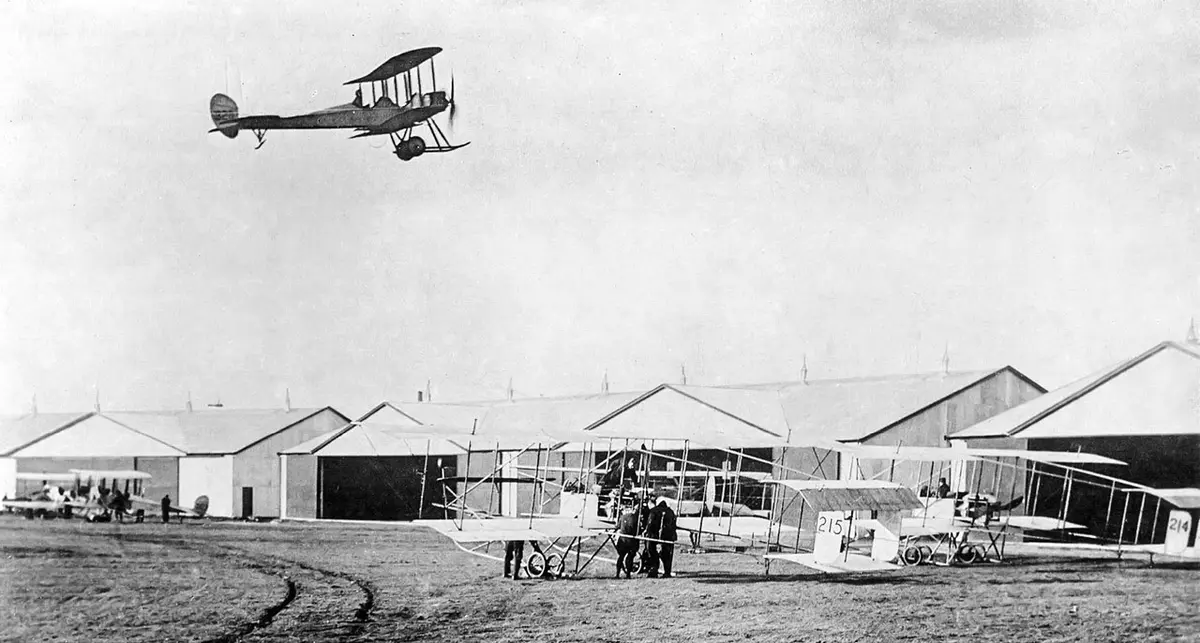
No. 2 Squadron of the Royal Flying Corps flew north from Farnborough in February 1913 with five machines. Flight followed the journey week by week. The pilots were "Capts. C. A. H. Longcroft, J. H. W. Becke, and G. W. P. Dawes, and Lieuts. F. F. Waldron and P. W. L. Herbert", two of them on B.E. biplanes and the rest on Maurice Farmans, and the squadron notes printed on 8 March 1913 record that "On the 26th, all the machines reached Montrose". Their first ground was at Upper Dysart, south of the town. The national record of the historic environment describes what came next: "Montrose (Broomfield) military aerodrome [AS_L1_30] NO75NW 31 succeeded the first Montrose aerodrome at Upper Dysart, which had been built before the First World War." Six side-opening aeroplane sheds went up along the south-west edge of the new ground in 1913-14, and they had been "prefabricated in Glasgow and were originally intended for the Upper Dysart site".
Lieutenant Desmond L. Arthur, an Irishman holding Royal Aero Club aviator's certificate No. 233, left the Montrose flying ground at about 7 a.m. on Tuesday 27 May 1913 in B.E. biplane No. 205 with a 70 h.p. Renault engine. Report No. 12 of the Accidents Investigation Committee of the Royal Aero Club, printed in Flight on 21 June 1913, sets down what the eye-witnesses saw. After about thirty minutes in the air he was "descending in a left-hand spiral at about 2,500 feet"; the aircraft "appeared to change on to the right bank"; then "the outside tip of the top right-hand plane was observed to fail and the planes of the right wing collapsed". Arthur fell from the machine and "struck the ground about 160 yards from the place where the aircraft fell, and was killed instantly".
The Committee examined the wreck and found a repair that no record admitted. The upper right wing tip "had been broken at some time or another and repaired in three places". The splice joining the new wood to the old "was very roughly made and badly fitted, there being places in which the glue was an eighth of an inch thick", bound with whipcord "which was not treated with cobbler's wax or varnished to prevent it becoming loose", and hidden under "new fabric" that was "of different material from that of the rest of the wing". The Royal Flying Corps and the Royal Aircraft Factory "reported that their records contained no entry of this repair having been made to the wing of this aircraft since it was rebuilt". The primary cause, in the Committee's opinion, was "the failure of the faulty joint in the repair to the rear main spar", work so bad "that it could not possibly be regarded as the work of a conscientious and competent workman".
Parliament took it up within days. In the Commons debate reported by Flight on 14 June 1913, William Joynson-Hicks asked "What right had the Government to send a young lieutenant up in a machine whose condition was precarious?", and told the House that Arthur had flown one of the B.E. machines "two days after it was flown to Montrose". Colonel Seely, Secretary for War, replied that "Every machine was most carefully inspected before a flight was made".
Three years later the case was reopened by a committee that went the other way. Noel Pemberton Billing, MP, had accused the air services of criminal negligence, and the committee appointed under Mr Justice Bailhache answered his charges in an Interim Report dated 3 August 1916. Arthur's death is case "(q.) No. 205". The report dates it "May 28th, 1913", one day out; it holds that the suggestion of a concealed patch "depends on the unsupported evidence of one man out of these 23 witnesses"; and it ends: "A perusal of the transcript of the notes of evidence leads to the conclusion that the suggestion of the patch is quite unfounded." Billing read the 1913 report back at the Committee from the floor of the House, in a speech carried by Flight on 31 August 1916: "He gets into this groggy machine to which I have referred and is dashed to death from 4,000 feet."
The correction, when it came, was smaller than the story usually allows. The Final Report was issued on Wednesday 20 December 1916 and disposed of the matter in a sentence: "In our Interim Report, dated August 3rd last, we dealt exclusively with the charge of criminal negligence made by Mr. Pemberton Billing, M.P. We do not refer to that charge again." What changed sits in an appendix signed by two of the seven members, Charles Bright and J. G. Butcher, printed by Flight on 11 January 1917: "it now appears to us to be more than likely that at least one highly defective repair had, in actual fact, been made at some time or another to the machine", probably by a man who "had repaired it as best he (or they) could, to evade detection and punishment". They were amending the Interim Report "so far as we personally are concerned, and to the extent indicated".
The ghost belongs to that same autumn. C. G. Grey, editor of The Aeroplane and a friend of Arthur, attached Arthur's name to a figure in flying kit reported around the old No. 2 Squadron mess in 1916. Dan Paton, then curator of the heritage centre, gave the sequence to The Scotsman in 2013: "It was as if the spirit of this proud pioneer airman had returned to earth at this slight to his reputation as a skilled pilot. The Court of Enquiry eventually cleared Lt Arthur of blame and, once exonerated, the ghost made one last appearance on Christmas Eve 1916 and then disappeared."
The station outlived everyone in the story. By 1918 it was "No. 32 Training Depot Station (NW Area; No. 20 Group, 30th Wing)", with 180 officer and NCO pupils and 659 base staff, "of whom 216 were women". The depot was disbanded in May 1919; the aerodrome passed back to the army in 1920, reopened as an RAF station in 1936, and "The RAF left in 1950", although the museum on the site dates the closure to 1952. In April 1983 a group of local enthusiasts began saving what was left; one of them, Ian McIntosh, set up the trust that in 1992 bought "the former Watch Office and ground".
Timeline: the documented record of RAF Montrose
- 26 February 1913 No. 2 Squadron RFC completes its flight from Farnborough: "On the 26th, all the machines reached Montrose". The first ground is at Upper Dysart, south of the town.
- 27 May 1913 Lieutenant Desmond L. Arthur is killed at about 7 a.m. when the right wing of B.E. biplane No. 205 collapses at about 2,500 feet. He strikes the ground "about 160 yards from the place where the aircraft fell".
- 21 June 1913 Flight prints Report No. 12 of the Royal Aero Club Accidents Investigation Committee: the cause was "the failure of the faulty joint in the repair to the rear main spar", a repair absent from the aircraft's records.
- June 1913 William Joynson-Hicks raises the accident in the Commons: "What right had the Government to send a young lieutenant up in a machine whose condition was precarious?"
- 3 August 1916 The Bailhache committee's Interim Report treats the crash as case "(q.) No. 205", dates it "May 28th, 1913" and rules that "the suggestion of the patch is quite unfounded".
- August 1916 Pemberton Billing reads the 1913 Royal Aero Club findings back to the Commons, paragraph by paragraph, against the committee that had just dismissed them.
- 13 October 1916 Second Lieutenant Morrison is killed at Montrose when his machine "nose-dived from a comparatively low altitude", one of two fatal crashes there in the autumn the apparition is placed in.
- 16 November 1916 A second fatal crash at Montrose: an aeroplane "collided with the chimney of a house and remained fast on the roof" and the petrol tank caught fire.
- 20 December 1916 The committee's Final Report is issued and declines to revisit the negligence charge: "We do not refer to that charge again."
- 11 January 1917 Flight prints the memorandum in which two members, Charles Bright and J. G. Butcher, accept that "at least one highly defective repair had, in actual fact, been made", amending the Interim Report "so far as we personally are concerned".
- 27 May 1963 The date Sir Peter Masefield gives for his flight past Montrose, fifty years to the day after the crash.
- December 1972 Masefield publishes that account in Flight International, which is what fixes Desmond Arthur as the Montrose ghost for the later literature.
- 1992 The trust founded by Ian McIntosh buys "the former Watch Office and ground" and the museum opens on the airfield.
- 27 May 2013 The heritage centre announces a wreath-laying at Arthur's grave for the centenary, "at the behest of Lt Arthur's family", and its curator Dan Paton tells the press the ghost "made one last appearance on Christmas Eve 1916 and then disappeared".
- 2018 Robert Charman publishes a reassessment of Masefield's account in the Journal of the Society for Psychical Research.
Is there a rational explanation for RAF Montrose?
No contemporary document places an apparition at Montrose in 1916. Flight, the weekly that printed the Royal Flying Corps promotion lists, casualty lists and squadron notes, covered Montrose repeatedly through 1916 and 1917 without ever mentioning one. The earliest printed account is credited by later writers to C. G. Grey in The Aeroplane in 1920, seven years after the crash and four after the sightings; the 1920 volumes of that magazine are absent from the digitised runs reachable for this entry, so that first printing remains unverified here.
What the autumn of 1916 did hold at Montrose was fresh dead. Flight of 19 October 1916 reported that "While flying at Montrose on October 13th a machine, piloted by Second Lieut. Morrison, R.F.C., nose-dived from a comparatively low altitude, and the pilot was killed instantly". Its issue of 23 November recorded that on 16 November an aeroplane at Montrose "collided with the chimney of a house and remained fast on the roof", the impact set the petrol tank alight, and the pilot was dead before help arrived. The museum's roll of honour lists thirty-three names, twenty-four of them buried at Sleepy Hillock. An airman's figure on that aerodrome in 1916 required no thirteen-year-old ghost.
The witness usually named does not survive checking either. The ghost literature calls him Major Cyril Foggin, a senior flying instructor. The only Foggin in the Royal Flying Corps lists that Flight printed during 1916 is C. E. Foggin, reported wounded on 11 May 1916, made temporary lieutenant from 1 October 1916 and temporary captain from 10 November 1916 — a rank below the one the story gives him, in the very weeks the story covers. Whether the two are the same man, and whether he ever served at Montrose, could not be established from the documents consulted here.
The exoneration was thinner than the ghost needs. Bright and Butcher wrote "so far as we personally are concerned", two members out of seven, while the Final Report they signed says of the negligence charge: "We do not refer to that charge again."
The most repeated episode has already been taken apart in print. Sir Peter Masefield's account of flying a Chipmunk past Montrose on 27 May 1963 and watching a biplane shed its wing appeared in Flight International in December 1972. Robert Charman reassessed it in the Journal of the Society for Psychical Research in 2018; summarising that paper, Sharon A. Hill wrote that "not only is the primary account by Masefield questionable, but the subsequent retellings included embellishments or added details, even false details, that changed the story".
There is no commercial machinery behind any of this today. The museum's own website, ten pages and 8,645 words read on 7 September 2026, contains no instance of ghost, haunt, apparition, paranormal or Desmond; "Montrose" appears 94 times in the same corpus and "museum" 101. What the site does publish is the roll of honour, whose first line reads "Arthur . D.L. Lieutenant 27/05/1913 Royal Flying Corps, Montrose Sleepy Hillock Cemetery". And nothing in the documents or in the ghost literature read for this entry describes a grey lady at Montrose: every account gives a man in flying clothes.
Can you visit RAF Montrose?
The site is now Montrose Air Station Museum, on the Broomfield ground where the sheds of 1913-14 stand. The address it publishes is "Waldron Road, Broomfield, Montrose, Angus, Scotland. DD10 9BD", the telephone 01674 678 222 and the address for enquiries [email protected]. It is a Scottish Charitable Incorporated Organisation, number SC040375, staffed entirely by volunteers.
Hours as published for 2026: "Friday 10:00 to 16:00, Saturday 10:00 to 16:00, Sunday 12:00 to 16:00", with "Last entry is at 15:00" and no booking required. Admission in 2026 costs £10.00 for adults and £8.00 concessions, or £11.00 and £8.80 under the Gift Aid rate; entry for children under 16 is free, since "we appreciate how important it is that they learn, in an enjoyable way, the history and legacy of those who served at Montrose Air Station". Refreshments come from vending machines. Dogs are admitted on leads. The museum posts closures on its Facebook page and states that "Where there are Met Office weather warnings which give us cause for concern, the museum may close for the safety of visitors and our volunteers".
On access the museum says: "The museum buildings are all single-story and accessible by wheelchairs. Where a building is slightly raised, there are ramps to use. The original RAF wooden buildings have narrow doorways and corridors but can still be used by wheelchairs." A disabled parking space sits outside reception and a disabled toilet is at reception; a carer accompanying a disabled visitor pays nothing.
Arthur's grave is in Montrose itself. The museum's roll of honour lists him first, at "Sleepy Hillock Cemetery", where twenty-three other airmen from the station are also buried. The heritage centre announced a wreath-laying at that grave for 27 May 2013, the centenary of the crash, "at the behest of Lt Arthur's family".
Sources consulted
- Royal Aero Club, Accidents Investigation Committee, «Accidents Investigation Committee of the Royal Aero Club, Report No. 12: Report on the Fatal Accident to Lieut. Desmond L. Arthur, when Flying at Montrose on Tuesday, May 27th, 1913» — Flight, 21 June 1913, 1913 report
- Flight, «Royal Flying Corps notes: No. 2 Squadron completes the flight to Montrose» — Flight, 8 March 1913, 1913 newspaper archive
- Flight, «Aviation in Parliament: the Montrose accident and the repair of Royal Flying Corps machines» — Flight, 14 June 1913, 1913 newspaper archive
- Committee on the Administration and Command of the Royal Flying Corps (chairman Mr Justice Bailhache), «First (Interim) Report of the Committee on the Administration and Command of the Royal Flying Corps, dated 3 August 1916: case (q.) No. 205» — Flight, 17 August 1916, p. 698, 1916 report
- Flight, «Mr Pemberton Billing in the House of Commons on the Montrose accident and the Royal Aero Club report» — Flight, 31 August 1916, p. 743, 1916 newspaper archive
- Charles Bright and J. G. Butcher, «Further Memorandum from Mr. Charles Bright and Mr. J. G. Butcher, appended to the Final Report of the Committee on the Administration and Command of the Royal Flying Corps» — Flight, 11 January 1917, 1917 report
- Flight, «Fatal Accidents: Second Lieut. Morrison killed at Montrose on 13 October 1916» — Flight, 19 October 1916, 1916 newspaper archive
- Flight, «Fatal Accidents: aeroplane strikes a house chimney at Montrose on 16 November 1916» — Flight, 23 November 1916, 1916 newspaper archive
- Flight, «Royal Flying Corps casualty and promotion lists naming C. E. Foggin (wounded 11 May 1916; temporary lieutenant 1 October 1916; temporary captain 10 November 1916)» — Flight, 11 May, 9 November and 30 November 1916, 1916 newspaper archive
- Historic Environment Scotland / RCAHMS, «Montrose, Montrose Airfield, General — Canmore ID 36244, site number NO75NW 31, with the World War One Audit of Surviving Remains (31 May 2013)» — National Record of the Historic Environment (Canmore), archived capture of 5 June 2025, 2013 archive
- Montrose Air Station Museum, «Visiting, Contact Details, Museum Accessibility, History of the Museum and Roll of Honour» — rafmontrose.org.uk, consulted 7 September 2026, 2026 web
- The Scotsman, «'Ghost' of Montrose air base to be honoured (interview with Dr Dan Paton, curator of Montrose Air Station Heritage Centre)» — The Scotsman, 2013, read in the copy reproduced at summers1.co.uk, 2013 newspaper archive
- Sharon A. Hill, «The Doubtful Witness: Masefield's Montrose ghost story (summarising Robert Charman, JSPR 82(2), 2018, 103-115)» — sharonahill.com, 2020 web
- Angus Folklore, «Ghosts of RAF Montrose» — angusfolklore.blogspot.com, January 2017, 2017 web
- Montrose Air Station Heritage Centre Archive, «Montrose Air Station Broomfield 1914 (photograph): "BE.2 flying with two MF.7 aircraft in foreground", credited to the Montrose Air Station Heritage Centre Archive» — Wikimedia Commons, 1914 archive
Reviewed by V. Serrano on 2026-09-07 · How we verify our content
💬 Field testimonies (0)
No testimonies yet. Add the first.
Add your testimony
🔒 Log in to add a testimony