👻 HAUNTED PLACE · EXP. Nº0482
ACTIVE
Red Lion Inn (Southampton)
Red Lion Inn (Southampton) is a location reputed to be haunted in England, GB. Its reputation comes from reported apparitions, unexplained phenomena and eyewitness accounts gathered over time.
Where is Red Lion Inn (Southampton)?
- Location
- England, GB
- Type
- Hotel / inn
- Coordinates
- 50.899, -1.403
- Testimonies
- 0
- Last updated
LOCATION
Why is Red Lion Inn (Southampton) said to be haunted?
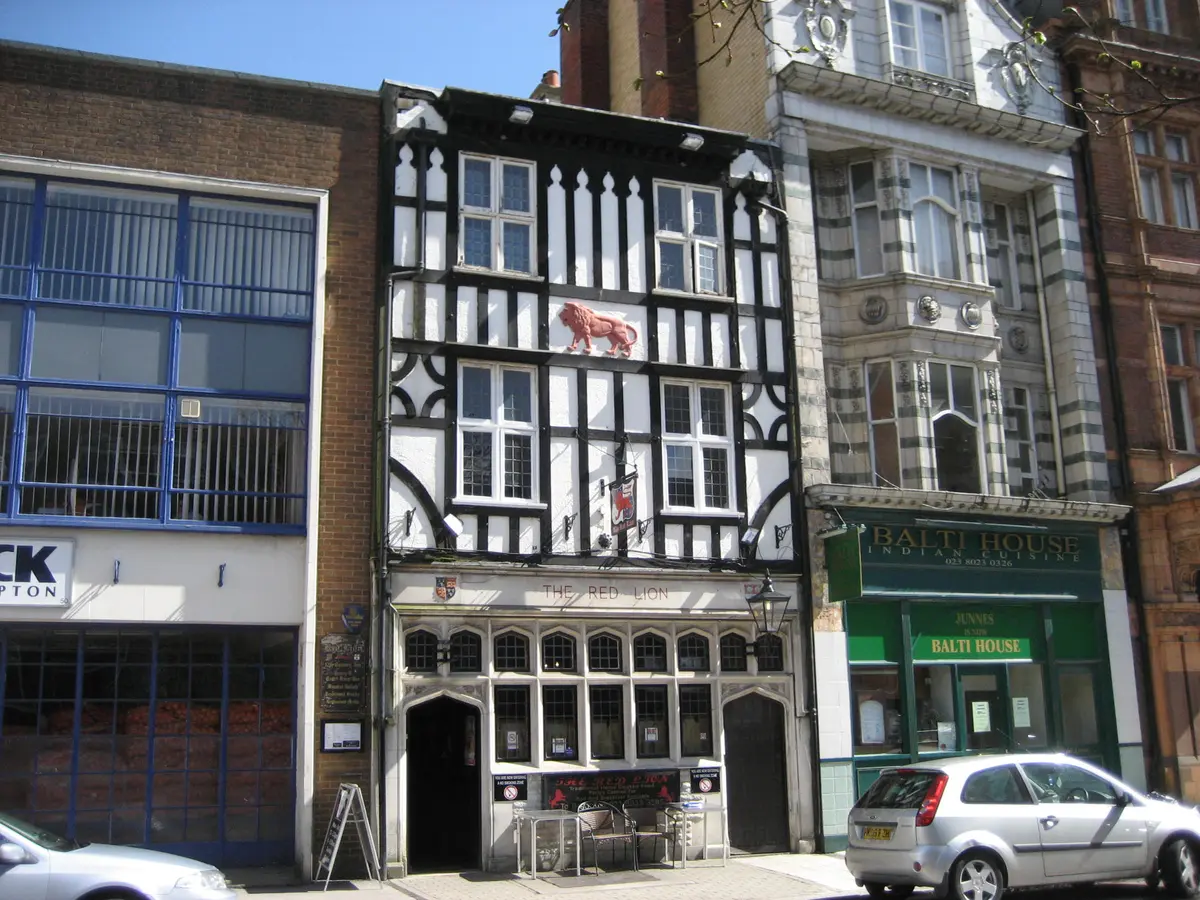
The Red Lion occupies No 55 High Street, on the east side of the street that Southampton's medieval walls enclosed. Historic England listed it Grade II* on 14 July 1953 as “Red Lion Inn including Medieval Vault”, dated the fabric “Late C15 and early C16” and noted that the black-and-white front is “three storeys C20 sham timber-framing”. The same entry carries the claim the pub is known for, and carries it as hearsay: below the hall lies a medieval vault “reputed to be the ‘Court room’” where the men of the Southampton Plot were tried in 1415. Richard of Conisburgh, Earl of Cambridge, Henry Scrope, Lord Scrope of Masham, and Sir Thomas Grey of Heton were real and their trial is documented, but the account of 2 August 1415 puts it in the hall of Southampton Castle, before the king, some seventy-five years before this building was raised. The ghost attached to the story is a procession said to leave the inn for the Bargate, printed by the Daily Echo on 31 October 2002 alongside a ghost walk that took the same route.
What is the history of Red Lion Inn (Southampton)?
The pub stands at No 55 High Street, on the east side of the street that the medieval walls of Southampton once enclosed. The statutory list entry, made on 14 July 1953 and given a minor amendment on 5 March 2021 “to reformat the text to current standards”, is titled “Red Lion Inn including Medieval Vault” and dates the fabric “Late C15 and early C16”. It is blunt about the front that every photograph shows: “Facade is three storeys C20 sham timber-framing but behind is a well preserved late medieval timber-framed hall-house.” Behind that front the surveyor recorded “the very high hall of three bays long which rises the whole height of the building to the tiebeam roof with windbraces”, a screened passageway with a balustraded gallery above it, and two stone fireplaces “probably early C16” with “moulded four-centred arch and rounded tracery patterns in square panels in the front of the overmantel”. Historic England serves the entry under list number 1092055; the text quoted here was read in the verbatim republication at British Listed Buildings.
The same entry carries the claim that made the house famous, and carries it as hearsay, with the transcription damage of the original: “Below the hall is a medieval vault, probably remaining from an earlier house on the site, reputed to be the ‘Court room’ where the intending assassins of Henry V, Lord Scrops of Masham, Sir Thomas Grey and the flatly of Cambridge were tried when Henry V was in Southampton in 1415, preparing for Horfleur and Agincourt.” “Lord Scrops of Masham” is Henry Scrope, third Baron Scrope of Masham, “the flatly of Cambridge” is Richard of Conisburgh, Earl of Cambridge, and “Horfleur” is Harfleur.
Those three men, with Sir Thomas Grey of Heton, are among the best-documented defendants of fifteenth-century England. Historic Southampton, a local history site run by Steve Willey, reproduces the passage in which Ian Mortimer describes 2 August 1415 in his book 1415: Henry V's Year of Glory: “Twelve Hampshire men, selected from an empanelled total of thirty-six, were appointed to the jury. In the castle of Southampton, in the king's presence, they listened to the cases of each man. The constable of the castle, John Popham, led the accused from the dungeon and into the hall where the jury was sitting.” The same page records that Grey was beheaded outside the Bargate that afternoon and that Cambridge and Scrope followed three days later, and it notes that when Shakespeare dramatised the episode around 1599 he set the sentencing in a Southampton “council-chamber”, with no inn in sight.
The licensed history of the house begins much later. Historic Southampton, following Tony Gallaher's Southampton's Inns and Taverns, gives 1552 as the year of its first licence to sell alcohol, and Sotonopedia gives the same date. Gallaher also supplies a name change that runs the other way: George Burcy, landlord of this house, became landlord of a pub further up the High Street in 1740 and appears to have taken the sign with him, which leaves the Red Lion “quite possibly once called the Nag's Head prior to 1740”. Southampton City Council's 1870 map of the town shows the Red Lion and the newer Nag's Head standing separately on the High Street, each with its own tap room.
The Second World War reshaped the building the visitor sees. Southampton's High Street burned in the raids of November 1940 — an eyewitness quoted by Historic Southampton called it “a huge wall of fire and flames” — and Holyrood Church, eighty yards away, lost its roof and is now a merchant navy memorial. The Red Lion was damaged and survived. Sotonopedia dates its restoration to 1952; CAMRA's surveyors date the work to 1950-2 and credit it with reopening the rear gallery, which “had been enclosed at some stage”. The mock-Tudor upper storeys are older than that repair and younger than the hall: CAMRA calls them “redolent of ‘Brewers’ Tudor’ of the 1920s”, and the ground floor was re-fronted after the bombing.
One detail of the legend has moved around the building. In 1953 the state placed the reputed court room in the vault below the hall. CAMRA's National Inventory description, surveyed on 28 July 2015, applies the same sentence to the ground floor instead: “The bar is called the Henry IV Court Room as it is reputed to be the ‘Court room’ where the intending assassins of Henry V… were tried.” Sotonopedia places it higher still, in “the upper room, now called Henry V's Court House”. By February 2026 the sale particulars quoted in the Daily Echo were selling “the ‘fine timbered apartment’ known as Henry V's Court Room”, and adding that “a rubbing from stone describing the execution can be seen in the Court Room”.
Timeline: the documented record of Red Lion Inn (Southampton)
- 2 August 1415 Richard of Conisburgh, Earl of Cambridge, Henry Scrope, Lord Scrope of Masham, and Sir Thomas Grey of Heton are tried for the Southampton Plot. The passage of Ian Mortimer reproduced by Historic Southampton places the hearing in the hall of Southampton Castle, before twelve Hampshire jurors and in the king's presence. Grey is beheaded outside the Bargate that afternoon; Cambridge and Scrope follow three days later.
- 1552 The house receives its first licence to sell alcohol, according to Tony Gallaher's Southampton's Inns and Taverns as cited by Historic Southampton and repeated by Sotonopedia. The date falls roughly a century and a half after the trial the pub advertises.
- 1740 George Burcy leaves this house to take over a pub further up the High Street and appears to carry the Nag's Head sign with him, which leaves the Red Lion, in Historic Southampton's words, “quite possibly once called the Nag's Head prior to 1740”.
- November 1940 Southampton's High Street burns in the Blitz. Holyrood Church, eighty yards from the pub, is gutted; the Red Lion is damaged and survives.
- 1952 The building reopens after restoration. Sotonopedia gives 1952; CAMRA's surveyors date the work to 1950-2 and credit it with reinstating the rear gallery, which “had been enclosed at some stage”.
- 14 July 1953 The building is listed Grade II* as “Red Lion Inn including Medieval Vault”. The entry dates the fabric “Late C15 and early C16” and records the trial claim as hearsay about the vault: “reputed to be the ‘Court room’”.
- 31 October 2002 The Daily Echo prints the oldest ghost report located for this entry, in a box beside a report on a Halloween ghost walk: “Red Lion, High Street, Southampton. A ghostly procession has been witnessed leaving the pub for the Bargate.” No witness is named.
- 28 July 2015 CAMRA surveys the interior for its National Inventory and grades it three star, “a pub interior of outstanding national historic importance”. The survey moves the reputed court room from the vault to the ground-floor bar, which it calls the Henry IV Court Room.
- 5 March 2024 Red Lion Pub Southampton Limited, incorporated on 11 February 2004 and registered at 55 High Street, is dissolved.
- 22 March 2025 A Daily Echo feature on the new manager, Karen Gray, states without qualification that the pub “is believed to date back to 1148 and was Henry V's court room during the 1400s”. The article mentions no ghost.
- 24 February 2026 The freehold is advertised at just under £700,000, with the pub staying on under a lease begun in December 2022. The particulars sell “the ‘fine timbered apartment’ known as Henry V's Court Room” as the most attractive part of the interior.
Is there a rational explanation for Red Lion Inn (Southampton)?
The arithmetic settles the question of the building itself. Historic England dates the hall to the late fifteenth and early sixteenth centuries; the trial happened on 2 August 1415, roughly seventy-five years earlier. The 1953 surveyor was careful about this and wrote “reputed to be”, and the sentence he hedged concerns the vault below the hall, described as “probably remaining from an earlier house on the site”. An earlier house on this plot could in principle have stood in 1415. What no source consulted here supplies is a document from 1415 that puts the proceedings anywhere except the castle, and the passage of Ian Mortimer reproduced by Historic Southampton puts them there explicitly, in the hall, with the constable John Popham fetching the prisoners from the dungeon.
The commercial pressure runs in one direction. The Daily Echo of 22 March 2025 printed the claim without a hedge, in a “Pub of the Week” feature: the Red Lion “is believed to date back to 1148 and was Henry V's court room during the 1400s”, and “was used for the trial of Richard, Earl of Cambridge, Lord Scrope of Masham and Sir Thomas Grey of Heton”. The 1148 date appears in no source located for this entry; the nearest thing to it is the sale particulars of February 2026, which say the cellar “is of Norman origin, dating back to the 12th century”, a dating Historic England does not make. Eleven months after that feature, the freehold went on the market at just under £700,000 with the Court Room named as “the most attractive part of the interior”.
The institutions that describe the building do not mention ghosts at all. The Historic England list entry, in the 817-word page where it is republished, contains no instance of ghost, haunt, apparition, spook, paranormal, poltergeist or legend, against one instance of “Court room”, three of gallery and one of fireplace. CAMRA's page, 4,646 words, gives the same seven terms zero, against eight instances of fireplace and three of “Court room”. Historic Southampton's 1,609-word article gives them zero, against twenty-five instances of “Red Lion”. So do both Daily Echo features about the pub, 664 and 957 words. All counts are case-insensitive on the visible text of each page, with word-initial stems.
The ghost that does exist in print is thin and datable. On 31 October 2002 the Daily Echo, in a box headed SPOOKY SITES beside Kieran Fox's report on a Halloween ghost walk, listed: “Red Lion, High Street, Southampton. A ghostly procession has been witnessed leaving the pub for the Bargate.” No witness is named and no date is given. The walk itself was run by the Sarah Siddons Fan Club, twelve amateur actors, whose secretary Gloria Tack told the paper that at the Bargate “they will be met by Lord Scrope himself as he walks around carrying his entrails in a bucket”, and that “Lord Scrope was tried for treason at the site of the Red Lion Pub, in High Street, Southampton”. The apparition's route is the tour's route. The same interview also has Scrope “hung, drawn and quartered at the Bargate”, where Historic Southampton records a beheading, and it merges into one occasion three deaths that happened on two days: Grey on 2 August, Cambridge and Scrope on 5 August. A single procession of three condemned men leaving anywhere together never took place.
One strand of the story remains unverified here, and Wikipedia is where it circulates: that page attributes a second apparition, a barmaid in her sixties visible only above the knees, to Penny Legg's Haunted Southampton (2011) and Bloody British History: Southampton (2013) and to David Scanlan's Paranormal Hampshire (2009). All three books exist and were confirmed in Open Library by ISBN. None could be read: on 7 September 2026 the Google Books API answered 429 “Quota exceeded”, archive.org served its “Temporarily Offline” page, HathiTrust and the Library of Congress full-text endpoints answered 403, and British History Online answered with a captcha. The barmaid is therefore left out of this entry rather than repeated.
Can you visit Red Lion Inn (Southampton)?
The Red Lion trades at 55 High Street, Southampton SO14 2NS, telephone (023) 8033 3595. CAMRA's WhatPub record for the house, pub ID HAS/00548, last updated on 28 April 2026, gives opening hours of 11:00 to 23:00 from Monday to Saturday and noon to 22:30 on Sunday, with food served noon to 14:30 and 17:30 to 21:00 on weekdays and Saturday, and noon to 17:00 on Sunday. Entry is free, as at any pub.
The room worth the journey is the main bar, which is the medieval hall itself. CAMRA's National Inventory grades the interior “Three star - A pub interior of outstanding national historic importance”, its highest band, and describes a hall that “soars through to its full height and displays its massive timber framing”, two balustraded galleries reached by a staircase, and an early sixteenth-century stone fireplace at the rear. A second fireplace stands in the rear lounge, now used as a dining room. The medieval vault that the 1953 list entry calls the reputed court room lies below the hall and forms part of the cellarage; CAMRA's surveyors noted only “the figure ‘5’ on the door to the cellar”. The half-timbered walls of the rear room “come from a post-war ‘Mock Tudor’ refurbishment”.
Ownership is in motion: the freehold was advertised in February 2026 at just under £700,000 as an investment, with the pub staying on as tenant under a twenty-five-year full repairing and insuring lease that began in December 2022 at £50,000 a year. The company that had run the house from 55 High Street, Red Lion Pub Southampton Limited, number 05040771, incorporated on 11 February 2004 and registered under SIC code 56302 for public houses and bars, was dissolved on 5 March 2024.
The Bargate, where Grey, Cambridge and Scrope were beheaded, stands up the same High Street and is free to see from the street. The shell of Holyrood Church, eighty yards from the pub and gutted in the raids of November 1940, is listed by Historic England as “Former Holy Rood Church, Now a Merchant Navy Memorial”.
Sources consulted
- Historic England, «Red Lion Inn including Medieval Vault, No 55 High Street (list entry 1092055)» — National Heritage List for England, 1953 archive
- Kieran Fox, «Ghost of city's past» — Daily Echo (Southampton), 2002 newspaper archive
- Lucy Blackmur, «Historic Southampton pub on the market for a new owner» — Daily Echo (Southampton), 2026 newspaper archive
- Lorelei Reddin, «Behind the bar at 'Southampton's oldest pub' The Red Lion» — Daily Echo (Southampton), 2025 newspaper archive
- Historic Southampton, «The Duke of Wellington and the Red Lion» — historicsouthampton.co.uk, 2020 web
- Campaign for Real Ale, «Red Lion, Southampton — National Inventory of Historic Pub Interiors (pub ID HAS/00548)» — CAMRA WhatPub, 2015 report
- Sotonopedia, «Red Lion Public House» — sotonopedia.wikidot.com, 2020 web
- Companies House, «RED LION PUB SOUTHAMPTON LIMITED, company 05040771» — Find and update company information, 2024 archive
- British Listed Buildings, «Red Lion Inn including Medieval Vault, Southampton (republication of list entry 1092055)» — britishlistedbuildings.co.uk, 2021 web
Reviewed by V. Serrano on 2026-09-07 · How we verify our content
📎 Source: Wikipedia (CC BY-SA)
💬 Field testimonies (0)
No testimonies yet. Add the first.
Add your testimony
🔒 Log in to add a testimony