👻 HAUNTED PLACE · EXP. Nº9477
ACTIVE
Royal Lyceum Theatre
Edinburgh's Royal Lyceum was built in six months in 1883 by C. J. Phipps for two actor-managers, Howard and Wyndham, and opened on 10 September with the London Lyceum company in Much Ado About Nothing — a week that Bram Stoker, Henry Irving's manager, records as part of the six-week tour the company played before sailing for America.
Where is Royal Lyceum Theatre?
- Location
- Scotland, United Kingdom
- Type
- Theater
- Coordinates
- 55.947, -3.204
- Last updated
LOCATION
Why is Royal Lyceum Theatre said to be haunted?
Its ghost is a woman in blue, seen in the upper gallery and sometimes as a shadowy figure high in the lighting rig above the stage. The oldest dated account of her is a University of Glasgow Library exhibition page of August 2003, which reports the rumour that she is the ghost of Ellen Terry, who played here and died in Kent in 1928; she reached print in a Scotsman feature of 8 November 2004 promoting a book by the owner of Edinburgh's best-known ghost tour. The gallery she is seen in has been shut to the public since 1966, when it was filled with lighting equipment. The theatre's own website, 298 pages of it on 8 October 2026, does not mention her; in 2025 the theatre advertised her for a fundraising ghost hunt at £50 a head, and then postponed it.
What is the history of Royal Lyceum Theatre?
The Royal Lyceum was a speculation by two working actor-managers, James B. Howard and Fred W. P. Wyndham, who commissioned it from C. J. Phipps, the most prolific theatre architect in Britain. Historic Environment Scotland's listing cites a Dean of Guild warrant of 15 March 1883; the building went up in about six months, put up by Messrs W. and D. M'Gregor, and the cost was kept, in the words of the trade paper, "within £17,000".
The Lyceum was built, above all, to resist fire. The Era of 1 September 1883, describing it a fortnight before it opened, records that the building was "designed in three parts, practically cut off from one another": the auditorium with its own staircases; the stage, divided from it by a solid brick wall and an iron curtain; and, outside the main walls, a third block holding twenty-four dressing rooms and the workshops. The safety curtain was two complete screens of boiler plate set eight inches apart, weighing three tons and so counterpoised that one man could lower it by hand if the hydraulics failed. HES records it as the first theatre in Britain fitted with an iron safety curtain, and as lit by electricity from its outset in 1883 — The Era notes it was "to be lighted with incandescent electric lamps". Four years later Phipps's Theatre Royal in Exeter burned with the loss of around 150 lives. The precautions taken at Grindlay Street were not decoration.
The same notice gives the house as built: 121 orchestra stalls, over 600 in the pit, 209 in the dress circle on the architect's registered chairs covered in peacock-blue velvet, 620 in the amphitheatre and about 1,000 in the upper gallery. Those figures add to roughly 2,550, which is close to the "around 2,500" usually quoted and well above the "approximately 2,000" that appears in some recent accounts. Today the auditorium seats 658.
It opened on Monday 10 September 1883 with the London Lyceum company in Much Ado About Nothing. (One 2025 article gives 10 December; The Era of 1 September, announcing the opening "within a fortnight", rules that out.) Bram Stoker, Irving's acting manager, fixes what that company was doing in Scotland: "That provincial tour was a short one of six weeks previous to our leaving for America on our first Trans-Atlantic tour. We had commenced in Glasgow on 28th August." He names Ellen Terry, with her small son, among the party on 1 September 1883. HES gives the opening repertoire as Much Ado About Nothing, Hamlet and The Merchant of Venice — precisely the plays Terry says in her memoirs the company was reviving that summer to prepare for the United States. Edinburgh's new theatre opened with a company using it as a dress rehearsal for New York.
In 1895 Howard and Wyndham's partnership became Howard & Wyndham Ltd, created by Michael Simons of Glasgow. Terry is documented back on the Grindlay Street stage from 8 to 13 February 1904, in Much Ado About Nothing again, with a surviving programme. Alterations followed in 1929, and The Scotsman of 10 October 1935 reported a further scheme costing between £3,000 and £4,000: new cloakrooms, the pit bar turned into a lounge bar, an interior staircase linking stalls to dress circle, and retiring rooms built under the stage for the staff, "including a sound proof rest room for the scene shifters".
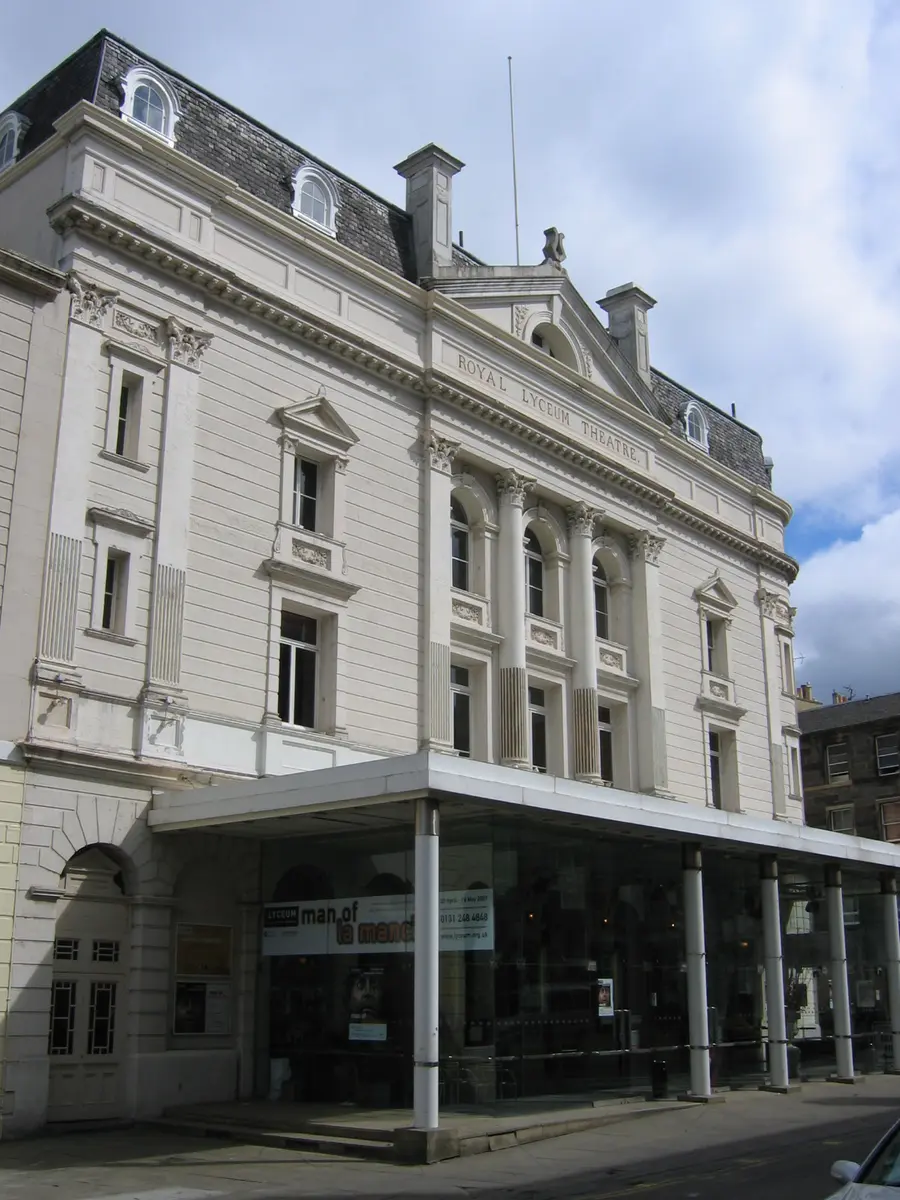
The building passed into public hands in 1965, when it was bought to house the newly formed Royal Lyceum Theatre Company, which is still the resident company and leases it from the City of Edinburgh Council. After a four-month facelift of the auditorium in 1965, the upper gallery — the "gods" — was closed to the public in 1966 to accommodate lighting equipment, cutting capacity to 1,647; a 1996 refit brought it down to 658. The theatre was listed Category A on 12 December 1974, refurbished in 1977 by Edinburgh District Council, and given its single-storey glass foyer extension in 1986 by architects Simpson & Brown. That glass box is what a visitor sees at street level today: the ground floor of Phipps's façade is behind it.
Timeline: the documented record of Royal Lyceum Theatre
- 15 March 1883 The Dean of Guild warrant for the theatre is granted, the document Historic Environment Scotland still lists first in the bibliography of the building's protection record.
- 1 September 1883 The Era describes the almost-finished house a fortnight before opening: three fireproof blocks, a three-ton iron curtain of double boiler plate, twenty-four dressing rooms, incandescent electric lamps, and a cost kept "within £17,000".
- 10 September 1883 The theatre opens with the London Lyceum company in Much Ado About Nothing. Bram Stoker, Irving's acting manager, records that the six-week Scottish tour began in Glasgow on 28 August and preceded the company's first crossing to America; he names Ellen Terry among the party.
- 8–13 February 1904 Ellen Terry plays the Royal Lyceum again in Much Ado About Nothing; the Ellen Terry and Edith Craig Database holds a digitised programme for the week. It is the only documented Lyceum engagement of hers the database records.
- 21 July 1928 Ellen Terry dies in Kent, aged 81, forty-five years after the Edinburgh opening and twenty-four after her last documented week at the building she is later said to haunt.
- 10 October 1935 The Scotsman reports an improvements scheme costing £3,000–£4,000: an interior staircase from stalls to dress circle, new cloakrooms, and retiring rooms under the stage including a sound-proof rest room for the scene shifters.
- 1966 A year after the 1965 auditorium facelift, the upper gallery — the "gods" — is closed to the public to house lighting equipment, cutting capacity to 1,647. Nobody has sat in those green seats since.
- 12 December 1974 The theatre is listed Category A. The record credits it as the first theatre in Britain fitted with an iron safety curtain and notes it was lit by electricity from its outset in 1883.
- 8 November 2004 The Scotsman prints an account of the ghost — a blue lady "believed to be Ellen Terry" and a shadowy figure in the lighting rig — in a listicle promoting Jan-Andrew Henderson's book; Henderson owns Edinburgh's City of the Dead ghost tours.
- 5 April 2015 An anonymous editor adds to Wikipedia, without any source, the sentence that many sightings are "accompanied by a ringing noise". The detail is absent from the 2004 article and from every earlier source; it has been copied outward ever since.
- 4 September 2017 An anonymous editor inserts a line protesting that "there is no such thing as ghosts", with the edit summary that the Lyceum "is an actual place and not just a stop on one of the Edinburgh haunted tours". It is reverted twenty-six seconds later.
- 26 February 2025 The theatre itself announces a fundraising ghost hunt with Scottish Paranormal for the night of 17 March — £50 non-refundable plus a £150 sponsorship target — advertising "the theatre's resident ghost, the infamous Blue Lady". The event is postponed.
Is there a rational explanation for Royal Lyceum Theatre?
The Lyceum's ghost has a name, a date and a price, and none of the three point where the stories do.
The oldest dated account of the ghost is not in print. In August 2003 the University of Glasgow Library's Special Collections put online an exhibition of Scottish playbills, written by Claire McKendrick and captured by the Wayback Machine on 21 August 2003. Its Lyceum section says that "as with many old theatres, rumour has it that the Royal Lyceum has ghosts", one of them believed to be Ellen Terry, and tells of a chalk statue of Terry in the foyer, smashed during the war "when chalk was in demand", whose head was rumoured to be "still rolling around under the stalls as late as 1965". The page lists Donald Campbell's centenary history of the theatre, A Brighter Sunshine (1983), among the works that helped in compiling it, and does not say where the ghost came from. Fifteen months later came a Scotsman listicle of 8 November 2004, "Why you've more than a ghost of a chance of seeing a spook". Its Lyceum entry reads, in full: "Royal Lyceum Theatre, Grindlay Street: Occasional sightings of a blue lady believed to be Ellen Terry, the actress who performed at the Lyceum's first show. A shadowy figure is also sometimes seen in the lighting rig high above the stage." The piece is a book plug: it closes by naming Edinburgh: City of the Dead by Jan-Andrew Henderson, Black & White Publishing, £9.99. Henderson owns Black Hart Entertainment and City of the Dead Tours, Edinburgh's best-known commercial ghost walk. That is the sole citation Wikipedia has ever given for the Lyceum's ghost, and it entered Wikipedia on 12 July 2011.
The identification with Ellen Terry comes without a witness in either text: both say only that she is "believed" to be the ghost. The Paranormal Database logs the same sighting and says flatly that "the woman in blue's history is unknown". Terry died on 21 July 1928, in Kent; her last engagement at the Lyceum recorded by the Ellen Terry and Edith Craig Database is a week in February 1904. Her own memoir, The Story of My Life (1908), is not much help to the legend either: in 126,909 words, "Edinburgh" appears six times and not once about 1883, and her index gives the city a single page — about her father acting with Macready. Control terms in the same file: Lyceum 129, America 88, Much Ado 25, Beatrice 29. She does record what the company was doing that summer, and it was rehearsing for New York.
The ringing noise that now travels with the story everywhere is younger than the internet page it lives on. The Lyceum entry of the 2004 article has no sound in it, and the article's one "ring" belongs to the Museum of Childhood, "reported to ring with the crying of children late at night". An anonymous IP added the ringing to Wikipedia, with no source, on 4 April 2015; it was reverted twenty minutes later, restored by the same address the next day, and has been copied outward ever since.
The "shadowy figure high above the stage in the lighting rig" has a mundane address. The upper gallery, the "gods", was closed to the public in 1966 to house lighting equipment. Since then the highest level of the auditorium has been a place where only technicians go, over the heads of an audience that has no reason to expect anyone up there — and the Paranormal Database places the woman in blue in that same upper gallery.
The institution is measurably silent, and then measurably not. The 298 pages of lyceum.org.uk's sitemap that answered on 8 October 2026 (33 MB; eleven more returned 404) give zero hits for blue lady, Ellen Terry, Irving, Phipps and paranormal; every occurrence of ghost belongs to a play (Banquo's ghost, an adaptation of The Haunting of Hill House, a production blurb). Control: Grindlay appears on all 298 pages. In August 2026 the same site gave 264 pages and the same zeros. The statutory listing LB30031 runs 9,409 characters with ghost, haunt and Terry at zero against Phipps 3 and 1883 3; the fullest theatre-history account of the building, on arthurlloyd.co.uk, has ghost and haunt at zero in 2,671 words. But on 26 February 2025 the theatre announced a fundraising ghost hunt with Scottish Paranormal for the night of 17 March, £50 non-refundable plus a £150 sponsorship target, advertising "the theatre's resident ghost, the infamous Blue Lady". It was postponed. That fundraiser is the one occasion on which the theatre has put its ghost into its own publicity, and the announcement is no longer on the site.
One late accretion comes from Grokipedia, an AI-written encyclopedia, which states that the Blue Lady is seen "in the dress circle during performances" and that paranormal groups "have hosted events at the theatre": the first contradicts every source that gives a location (all of which say the upper gallery or the rig), and the only such event the theatre itself announced, in 2025, was postponed.
Can you visit Royal Lyceum Theatre?
The Royal Lyceum is a working producing theatre and the normal way in is a ticket. It stands at 30b Grindlay Street, Edinburgh EH3 9AX; Lothian Road and the Usher Hall are two minutes away. The box office is on 0131 248 4848 and at [email protected]. Historic Environment Scotland lists the building in category A as LB30031, added on 12 December 1974, and credits the design to C J Phipps in 1883. The auditorium holds 658 over four levels.
The theatre's own access page states: "We have lifts to all levels including the Wyndham Bar (at Grand Circle level) and the downstairs Howard Bar (at Stalls level)." The main lift has a voice synthesiser and infrared-activated doors. There are blue badge parking spaces opposite the theatre and staff in the foyer to help. Guide and hearing dogs can go into the auditorium with their owner, and the page adds that "Front of House staff are also happy to look after them during the performance". An essential companion's ticket is free and is arranged by telephone or through the theatre's free Access Pass for online booking. The theatre keeps one transfer wheelchair, which cannot be pre-booked. The accessible toilet is on the ground floor, in the foyer corridor opposite the lift. Fixed seats are 45 cm wide with 65 cm of legroom on average, and the Stalls Boxes take up to 18 people in wheelchairs or on removable chairs.
Backstage tours run 75 minutes at 8 pounds a head. The minimum is 10 people per booking and the maximum 25 at one time, and they are arranged in advance through [email protected], fitting around production work. A second tour covers the company's workshop and wardrobe archive at 29 Roseburn Street, EH12 5PE, where the library of model boxes is kept.
The upper gallery that the ghost stories point at, the "gods", has been shut to the public since 1966, when the space was given over to lighting equipment, and it appears on no tour. The closure cut the capacity to 1,647 seats; the refit of 1996 brought it to the present 658. The Secret Seats that the theatre does sell are unreserved tickets at 15 pounds plus a booking fee of 1.95, exchanged for a voucher on the day of the performance, and have nothing to do with that closed balcony. No ghost tour of this building is on sale, and the only paranormal night the Lyceum has advertised, in March 2025, was postponed.
Sources consulted
- Bram Stoker, «Personal Reminiscences of Henry Irving» — William Heinemann, London (digitised copy, Internet Archive), 1906 book
- The Era, «The new Lyceum Theatre, Edinburgh (opening notice, reproduced in full on arthurlloyd.co.uk)» — The Era, 1 September 1883, 1883 newspaper archive
- Historic Environment Scotland, «Grindlay Street, Royal Lyceum Theatre (LB30031) — listed building record, Category A» — HES designations portal; listed 12 December 1974, updated in the Theatres Thematic Study 2010, 2010 report
- Ellen Terry, «The Story of My Life: Recollections and Reflections» — Hutchinson / McClure (digitised copy, Internet Archive), 1908 book
- The Scotsman, «Why you've more than a ghost of a chance of seeing a spook» — The Scotsman, 8 November 2004 (read via the Internet Archive capture of 13 October 2012), 2004 newspaper archive
- Wikipedia contributors, «Royal Lyceum Theatre — revision history of the Wikipedia article (Ghosts section created 12 July 2011; "ringing noise" added 5 April 2015; sceptical protest inserted and reverted 4 September 2017)» — English Wikipedia edit history, 2026 archive
- Liam Rudden, «Secret seats: Have you ever visited Edinburgh Royal Lyceum's forgotten ghost gallery?» — Must See Theatre, 20 November 2025, 2025 web
- Katy Grant, «Edinburgh Royal Lyceum's fund-raising Ghost Hunt has been postponed» — Must See Theatre, 26 February 2025, 2025 web
- The Paranormal Database, «Edinburgh — Royal Lyceum Theatre, Grindlay Street (entry: haunting manifestation, date unknown)» — paranormaldatabase.com, Edinburgh hotspots, 2026 web
- Ellen Terry and Edith Craig Database, «Royal Lyceum Theatre, Edinburgh — venue record (performance of 8–13 February 1904, with digitised programme)» — University of Essex, with the support of the University of Hull, 2026 academic
- The Scotsman, «Lyceum Improvements Scheme (reproduced in full on arthurlloyd.co.uk)» — The Scotsman, Edinburgh, Thursday 10 October 1935, 1935 newspaper archive
- The Royal Lyceum Theatre Company, «Access, general information and backstage tours» — lyceum.org.uk (official website, sitemap read in full: 264 pages in August 2026; 298 pages answering, 11 returning 404, on 8 October 2026), 2026 web
- Grokipedia, «Royal Lyceum Theatre (AI-generated article; cited here only as the source of two claims refuted above)» — grokipedia.com, 2026 web
- Claire McKendrick, «Scottish Playbills: Royal Lyceum Theatre, Edinburgh (Book of the Month, August 2003): the rumour that one of the theatre's ghosts is Ellen Terry, and the chalk statue in the foyer smashed in the war, its head 'still rolling around under the stalls as late as 1965'» — University of Glasgow Library, Special Collections (online exhibition; Wayback Machine capture of 21 August 2003), 2003 web
Reviewed by V. Serrano on 2026-08-18 · How we verify our content
💬 Field testimonies (0)
No testimonies yet. Add the first.
Add your testimony
🔒 Log in to add a testimony