👻 HAUNTED PLACE · EXP. Nº9477
ACTIVE
Rufford Old Hall
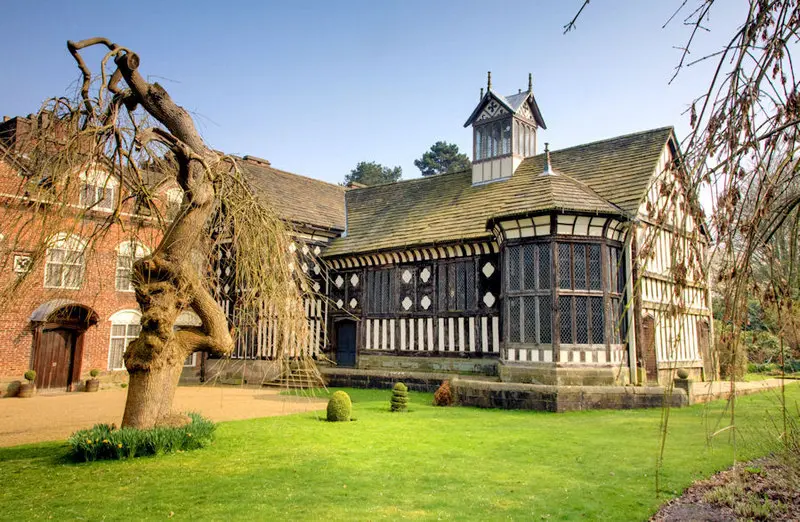
Rufford Old Hall in Lancashire keeps one room of the house Thomas Hesketh probably built before he died in 1523: a timber great hall with five bays of hammer-beam roof, each beam ending in a carved angel, and a free-standing screen of bog oak that is the only known survivor of its kind from the first half of the sixteenth century.
Where is Rufford Old Hall?
- Location
- Lancashire, England, United Kingdom
- Type
- House / mansion
- Coordinates
- 53.638, -2.814
- Last updated
LOCATION
Why is Rufford Old Hall said to be haunted?
The Heskeths were recusant Catholics, there is a hidden chamber behind the canopy over the high table, and a will of 1581 commends a "William Shakeshafte" to Sir Thomas Hesketh — the whole documentary basis for the tradition that Shakespeare came here at seventeen. The ghosts are on record too, and they have names: a Grey Lady said to be Elizabeth Hesketh, a man in Elizabethan dress by the great fireplace, and Queen Elizabeth I in the dining room, all three set down in a BBC page of 2005. In 1907 the rector of Rufford went looking for the parish's ghost, found nobody who had seen it, and blamed the rats.
What is the history of Rufford Old Hall?
The Heskeths were lords of the manor of Rufford long before there was a hall worth arguing about. The Victoria County History traces the descent from William de Hesketh, who came into the land through his marriage to Maud Fitton, through Sir John de Hesketh, who held the consolidated manor from 1318, and Sir William, who obtained a market charter in 1339 and fought at Crecy. The house itself, the county historians concluded, "was probably erected by Thomas Hesketh, who died in 1523" — a man whose will, now British Library Additional MS 32104, provided for chantries at Harwood, Rufford, Croston and Longton, for almshouses and a school at Rufford, for a bridge over the Douglas and for the paving of roads. He was building for the next world as busily as for this one.
What survives of that house is one room. The great hall measures 46 ft 6 in by 22 ft 6 in, its timber walls standing on a low stone base and rising 18 ft to the wall-plate. Five bays of hammer-beam roof end, at both ends of every beam, in a carved wooden angel holding a shield. At the east end the screens passage is divided from the hall by "speres" standing 4 ft out from the walls, and in the 14 ft between them stands a free-standing carved screen of bog oak, 7 ft wide — the only known surviving example from the first half of the sixteenth century. The bog oak came out of the parish itself: the Rev. W. G. Procter, rector of Rufford, opened his 1907 history of the manor by explaining that the district between the Ribble and the Mersey is a drowned forest, and that trunks of oak, beech and fir "are now continually cropping up in large quantities on the reclaimed moss lands". Procter also recorded how the room was heated before the stone chimney was added: by a brazier set in the middle of the floor, with the smoke leaving through a louvre in the roof, "which occupied the position of the present lantern".
The Heskeths stayed Catholic after the Reformation, and it cost them. Sir Thomas Hesketh, knighted in 1553 and dead in June 1588, "adhered to the Roman Catholic religion for some time after the accession of Elizabeth"; his wife and eldest son "seldom or never resorted to church"; a Thomas Hesketh was returned as a recusant in 1594, and the wife of Thomas Hesketh was among those presented at Rufford in 1628. It is against that background that the county historians noted, in 1911, that the carved canopy over the high table is carried up to the roof and forms a "secret chamber" behind it in the gable, "to which there are now no visible means of approach". The BBC page of 2005 says the chamber "was later discovered"; it was already described in print in 1911.
The same recusant household supplies the hall's most famous story. On 3 August 1581 Alexander Hoghton of Lea, a Catholic landowner some miles away, made a will leaving his musical instruments and "play clothes" to his brother, or failing him to Sir Thomas Hesketh, and adding: "And I most heartly require the said Sir Thomas to be friendly unto Fluke Gyllome and William Shakeshafte now dwelling with me and either to take them into his service or else to help them to some good master as my trust is he will." That is the whole documentary basis for the tradition that the seventeen-year-old William Shakespeare spent time at Rufford. E. A. J. Honigmann argued the identification at length in 1985; against it stands the plain fact that Shakeshafte was a common Lancashire surname. The National Trust's 2007 souvenir guide states that he "almost certainly" was the playwright, without saying why.
The family left. Sir Thomas Dalrymple Hesketh abandoned the Old Hall as a residence in about 1798 and built the plain classical New Hall nearby; the old house was let to a tenant farmer and the banqueting hall used as the village school until it was repaired and refitted in 1821 for his eldest son, who lived there until he succeeded to the estates in 1842. The east range had already been rebuilt by Sir Thomas Hesketh in 1662 — the statutory list records a plaque on that wing carved with the Hesketh double-headed eagle and the date 1662 beneath it — and the 1821 work is dated on the rainwater heads. The county historians dated the glazed lantern on the ridge to the same work: it "belongs only to the year of restoration (1821), but that a lantern or louvre formerly occupied the same position is shown by a roughdrawn view of the hall on an 18th-century map". After 1867, when the Heskeths inherited Easton Neston in Northamptonshire, Rufford was a tenanted house: George Holme was living in it when the British Association met at Southport, and Robert Rankin occupied it in 1911. Thomas Fermor-Hesketh, first Baron Hesketh, gave the hall and its contents to the National Trust in 1936. It was listed Grade I on 11 October 1968. Twice, in 1948 and 1958, death-watch beetle attacked the great hall's timbers so badly that the whole roof had to be dismantled and the timbers steeped before they could be put back.
Timeline: the documented record of Rufford Old Hall
- 14 August 1523 Thomas Hesketh dies. The Victoria County History judges that he 'probably erected' the house; his will, British Library Additional MS 32104, endows chantries, almshouses and a school at Rufford and a bridge over the Douglas.
- 3 August 1581 Alexander Hoghton of Lea makes his will, leaving his instruments and 'play clothes' to Sir Thomas Hesketh if his brother will not keep players, and asking him to be friendly unto 'Fluke Gyllome and William Shakeshafte now dwelling with me'. This is the only document behind the Shakespeare tradition.
- June 1588 Death of Sir Thomas Hesketh, knighted in 1553, who 'adhered to the Roman Catholic religion for some time after the accession of Elizabeth'. Members of the household are returned as recusants in 1594 and 1628.
- 1662 The east wing is rebuilt in brick by Sir Thomas Hesketh. The statutory list records a plaque on it carved with the Hesketh double-headed eagle and the date 1662 below; the county history reports the same datestone with his initials.
- about 1798 The hall is abandoned as a residence when Sir Thomas Dalrymple Hesketh builds Rufford New Hall. The old house is let to a tenant farmer and the banqueting hall is used as the village school.
- 1821 The hall is repaired and refitted for the eldest son of the house, who lives there until he succeeds to the estates in 1842. The south wall is largely rebuilt, a new staircase added and the glazed lantern on the ridge installed; the addition is dated 1821 on its rainwater heads.
- 12 December 1907 The Rev. W. G. Procter, rector of Rufford, reads his history of the manor to the Historic Society of Lancashire and Cheshire. He records the parish's haunted house - The Hermitage, of 1673 - and reports that he cannot find anyone who has actually seen the spectre, suggesting rats in the rafters. He attaches no ghost to the Old Hall.
- 1936 Thomas Fermor-Hesketh, first Baron Hesketh, gives the hall, its contents and its Victorian garden to the National Trust.
- 11 October 1968 Rufford Old Hall is listed Grade I (National Heritage List entry 1374141). The listing describes 'a free-standing carved oak screen' and quotes Pevsner on the interior as 'of an exuberance of decoration matched nowhere else in England'.
- 12 September 2005 BBC Inside Out North West films the medium Derek Acorah ghost-hunting at Rufford. Its web page names the three ghosts still repeated today - a Grey Lady identified as Elizabeth Hesketh, a man in Elizabethan clothes and Queen Elizabeth I - and asks whether the camera misting up was the work of spirits or 'just a technical hitch'.
- 25 February 2009 BBC Liverpool publishes the National Trust's own account of the Shakespeare case, by Charles Singleton, quoting the operative clause of Hoghton's will and dating Honigmann's argument to 1985.
Is there a rational explanation for Rufford Old Hall?
What Rufford's ghosts actually are is on record, and the record is short. A BBC Inside Out North West page of 12 September 2005, made when the television medium Derek Acorah went ghost-hunting there, names three: a "Gray Lady", said to be Elizabeth Hesketh, a young woman who fell seriously ill while her husband was away at war and vowed she would not die before saying goodbye to him, seen "usually by the main entrance or on the drive leading up to the house"; a man in Elizabethan costume near the great fireplace, at the spot where "a secret chamber was later discovered"; and Queen Elizabeth I in the dining room, "where she vanishes if anyone tries to approach her". Almost every later account descends from that one page, often word for word. An earlier version of the Wikipedia article carried a fourth, the figure of a man floating above the canal at the back, sourced to a 2006 book; a rewrite in March 2025 removed it.
The BBC put its own caveat in the same paragraph, noting that the camera misted up during filming and asking whether that was the work of spirits or "just a technical hitch". Acorah's methods were tested that same year on Most Haunted, the series that made his name: its resident parapsychologist, Ciarán O'Keeffe, fed him two invented spirits, "Rik Eedles" and "Kreed Kafer" — anagrams of "Derek Lies" and "Derek Faker" — and Acorah channelled them. He left the series in 2005.
Older evidence points the other way. In December 1907 the Rev. W. G. Procter, rector of Rufford, read a long history of the manor to the Historic Society of Lancashire and Cheshire, having been given access to the Hesketh estate papers and permission to photograph the Old Hall. His paper records two local hauntings, and he explained both. The Hermitage, a house of 1673, had "the reputation of being 'haunted', but although I have inquired of several people, who ought to know, I cannot find any one who has actually seen the spectre, though they say they have heard unaccountable noises at the 'witching hour of midnight'. Probably the rats were playing high jinks in the rafters." And near Holmeswood Hall the tenant of the Hall farm told him there were "boggarts and ghosts to be seen in the vicinity" of a pit called King Arthur's pit, "a belief no doubt fostered by the game-keepers for obvious reasons. It is situated close to a favourite pheasant breeding-place." The volume, 133,124 words in the Internet Archive's text, uses "spectre" once and "ghost" twice, in the boggart passage and in a closing line about peopling old streets "with the ghosts of other days"; "headless" and "apparition" do not occur in it. The rector of the parish went after two local ghost stories and attached neither to the Old Hall.
The owner is silent too, and has nothing to sell. The National Trust's visitor page for the hall, read on 4 October 2026, does not contain the words ghost or haunted and advertises no ghost tour, though it does raise the Shakespeare question. The paid ghost-hunt trade that lists Rufford is made up of third parties, and one of them, DeadLive Events, supplies dates that the BBC page of 2005 does not give: in a page published on 12 April 2025 its Grey Lady is "a Hesketh bride who died in 1550", and it adds "The Poacher's Shot, a servant killed in 1700, caught snaring game".
Can you visit Rufford Old Hall?
Rufford Old Hall stands at 200 Liverpool Road, Rufford, near Ormskirk, Lancashire L40 1SG, on the A59. Measured from the coordinate this entry carries, the hall is 9.0 km, or 5.6 miles, north-north-east of Ormskirk town centre in a straight line. Its National Heritage List entry is 1374141, Grade I, first listed on 11 October 1968, at grid reference SD 463 160 in the civil parish of Rufford; the list entry describes "5 hammerbeam roof trusses" and "a free-standing carved oak screen".
The house belongs to the National Trust and members enter free. The Trust's visitor page, read again on 22 September 2026 against a first reading of 18 July 2026, gives the house open 11:00-16:30 with last entry into the house at 16:00, and the garden and tea-room from 10:30 to 16:30. Admission covers the house, the garden, the woodland, the tea-room and the second-hand bookshop in the Coach House.
Both price bands were unchanged between the two readings. From 13 February to 20 December: adult £14.30 with Gift Aid or £13.00 without; child aged 5 to 17, £7.20 or £6.50; under-fives free; two adults and up to three children, £35.80 or £32.50; one adult and up to three children, £21.50 or £19.50. From 1 January to 12 February, with less of the property open, the same four tickets cost £7.20 or £6.50, £3.60 or £3.25, £17.90 or £16.25, £10.95 or £9.75. The group rate from fifteen people is printed as £12.35 for an adult and £6.18 for a child.
The building sets the limits on access. Self-propelled wheelchairs reach the ground floor and the great hall, while electric wheelchairs and mobility scooters reach the great hall alone, and a number of stairs lead to the first floor. Designated parking sits close to the entrance and there is an adapted toilet in the cobbled courtyard. Assistance dogs alone are allowed in the house and the Orchard Paddock; dogs on leads are welcome in the North Woods, the North Paddock, the garden and the cobbled courtyard.
Morning guided tours run on open days, subject to staff and volunteer availability. The events advertised on 22 September 2026 were a free programme included in the price of admission from 22 September to 22 December, a folk-tale quest app called Stranger Folk from 2 October to 1 November, then the Scarecrow Festival from 23 October to 8 November, that year on the theme "Rufford Rocks: pop stars and music legends".
The Rufford Branch of the Leeds and Liverpool Canal was completed in October 1781 and drops through seven locks and a tide lock to meet the Douglas near Sollom. It passes immediately behind the property, dividing house and gardens from the surrounding farmland, and its towpath carries a waymarked circular walk that begins at the hall.
Sources consulted
- William Farrer and J. Brownbill (eds), «Townships: Rufford, in A History of the County of Lancaster, vol. 6» — Victoria County History, 1911 book
- Rev. W. G. Procter, «The Manor of Rufford and the Ancient Family of the Heskeths (read 12 December 1907)» — Transactions of the Historic Society of Lancashire and Cheshire, vol. 59 (new series 23), pp. 91-118, 1907 academic
- Historic England, «Rufford Old Hall, list entry 1374141, Grade I, first listed 11 October 1968» — National Heritage List for England, 1968 report
- BBC, «Haunted Lancashire: Inside Out North West, Monday 12 September 2005» — BBC Inside Out, 2005 report
- Charles Singleton (National Trust), for BBC Liverpool, «Shakespeare at Rufford?» — BBC Liverpool, Places, 2009 report
- Wikipedia contributors, «Rufford Old Hall (article, revision of 22 July 2026; source of the quotations from Pevsner and of the 1948 and 1958 death-watch beetle attacks)» — Wikipedia, 2026 web
- National Trust, «Rufford Old Hall: visitor information, opening times and prices (capture of 18 July 2026)» — nationaltrust.org.uk, 2026 web
- DeadLive Events, «Rufford Old Hall Lancashire's Tudor Haunt — the Grey Lady as 'a Hesketh bride who died in 1550' and 'The Poacher's Shot, a servant killed in 1700'» — deadlive.co.uk (commercial ghost-hunt operator), 2025 web
- Wikipedia contributors, «Derek Acorah (article as read on 4 October 2026; the 2005 'Rik Eedles' and 'Kreed Kafer' test by Ciarán O'Keeffe on Most Haunted, and his 2005 departure from the series)» — Wikipedia, 2026 web
Reviewed by V. Serrano on 2026-08-18 · How we verify our content
💬 Field testimonies (0)
No testimonies yet. Add the first.
Add your testimony
🔒 Log in to add a testimony