👻 HAUNTED PLACE · EXP. Nº9476
ACTIVE
Sker House
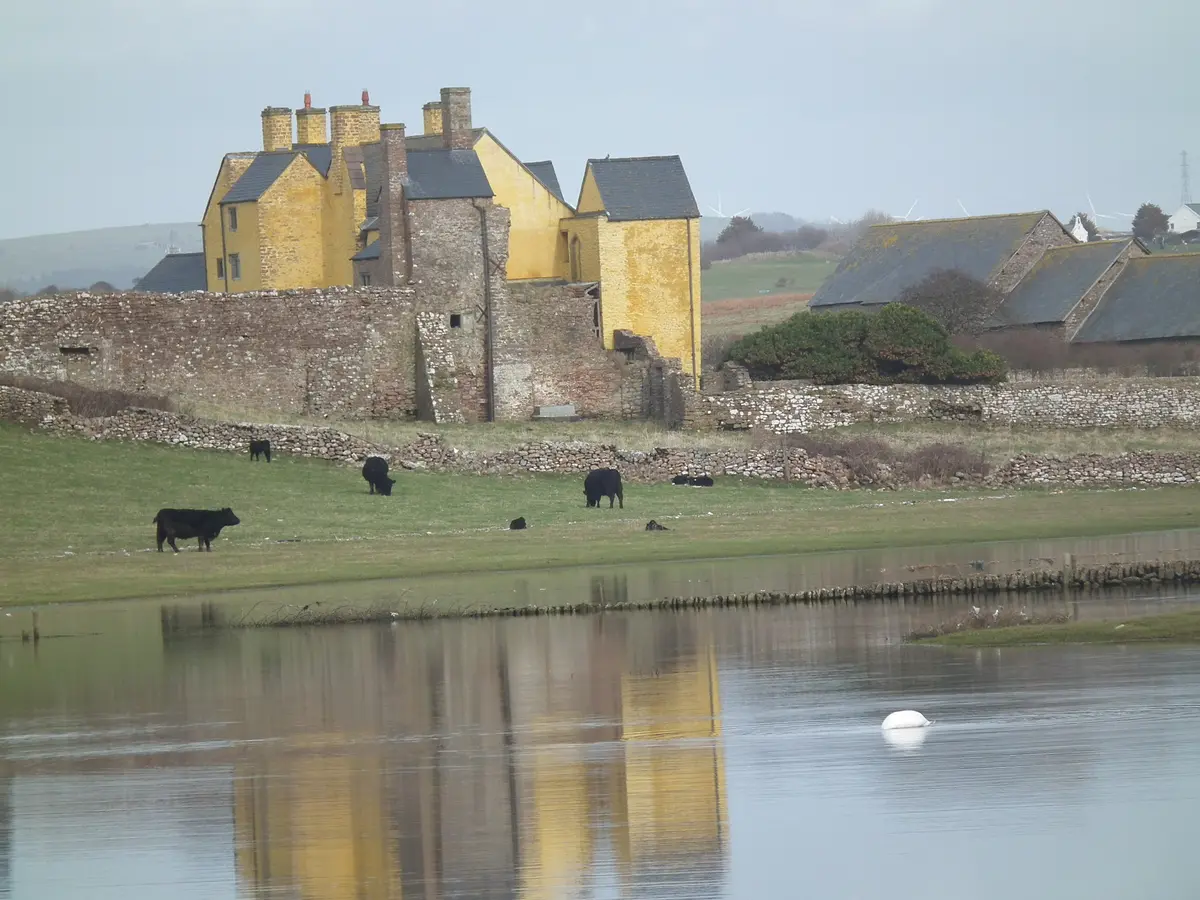
Sker House stands alone on a limestone promontory above Swansea Bay, about 4.2 km north of Porthcawl.
Where is Sker House?
- Location
- Wales, United Kingdom
- Type
- House / mansion
- Coordinates
- 51.505, -3.737
- Last updated
LOCATION
Why is Sker House said to be haunted?
Cadw lists it Grade I as one of the major Elizabethan houses of South Wales: a Cistercian grange that Margam Abbey passed to Neath Abbey between 1173 and 1178, rebuilt as a mansion by the recusant Turbervilles after 1561, and raided in December 1678, when the Jesuit Philip Evans was arrested here. The ghost it is given is Elizabeth "Betsy" Williams, the Maid of Sker, a tenant farmer's daughter kept from the harpist Thomas Evans of Newton Nottage and married off to Thomas Kirkhouse. The registers give a plainer life: married in 1766, four children baptised, buried at Llansamlet on 6 January 1776. And R. D. Blackmore's novel The Maid of Sker (1872), always cited as the fictionalised version of her story, borrows only the title — its heroine is a child washed ashore from a wreck. Declared unsafe in 1977 and left part-collapsed, the house was rescued for about 1.2 million pounds between 1999 and 2003 and is today a private family home with no public access.
What is the history of Sker House?
The land came before the house. A Cistercian grange at Sker — Blakescarre in the medieval documents — belonged to Margam Abbey and passed to Neath Abbey in an exchange that Cadw's listing places between 1173 and 1178. That exchange is the firmest date in the whole file, and it is worth holding on to, because the two heritage records do not agree about what came before it. Cadw says the grange was granted to Margam "by Earl William in the early C12"; the Royal Commission says only that it "originally belonged to Margam Abbey, but passed to Neath Abbey in the twelfth century"; and the Rev. H. Hey Knight, reading the Neath charters in 1853, understood that Robert the Consul had given "the first portion of Sker" to Neath in the first place, with Earl William adding to it later. The popular formula "more than 900 years" rests on the loosest end of that record. In 1291 the grange was assessed at four carucates and twenty acres of arable, and the Royal Commission notes that its buildings stood around a walled court west of the present house, with medieval fabric surviving in the south gable of the barn range, Ty'r-ychen.
By the later fifteenth century the monks were letting Sker out: the Abbot of Neath leased it to Richard Loughan in 1467. When John Leland came through in about 1540 he found a layman in charge, and Knight quotes his words: "There is a Manor place, cawled Skir, a two miles from the shore, where dwelleth one Richard Lougher, a gentleman." After the Dissolution the estate was bought by Richard Williams in 1543 and almost at once re-purchased by Christopher Turberville of Pen-llin, sheriff of Glamorgan in 1550 and 1569. The house standing today was begun after Jenkin Turberville came into the property in 1561: a first-floor great hall open to the roof and lit by mullioned and transomed windows, gabled three-storey wings on the east front, a stair tower behind, all wrapped around the medieval range.
The Turbervilles were, in Cadw's word, recusants, and the isolation that now makes Sker feel haunted made it useful. On 2 December 1678, in the panic that followed Titus Oates's disclosures, the Jesuit Philip Evans was arrested at Sker, the house of Christopher Turberville, after John Arnold offered fifty pounds for his capture; the informer was Edward Turberville. Evans was tried in the Shire Hall at Cardiff on 8 and 9 May 1679 and hanged, drawn and quartered on 22 July, aged thirty-four. He was beatified in 1929 and later canonised among the Forty Martyrs of England and Wales. One detail from his Dictionary of Welsh Biography entry belongs in a file about Sker: after sentence, "he returned to the prison and sang to his own accompaniment on the harp, as a contemporary broadside shows." The only harp player documented at Sker House plays it in a condemned cell, a century before the legendary one.
The family sold up soon after — Cadw dates the sale to Charles Price of Badminton to 1685-87, the Kenfig Society to 1697 — and Sker became a tenanted farm, held by the Margam Estate until 1941. It is from the tenants that the ghost comes. Isaac Williams farmed Sker in the mid-eighteenth century, and his daughter Elizabeth, called Betsy, is the Maid of Sker of the Welsh ballad Y Ferch o'r Sger. In the story she meets Thomas Evans of Newton Nottage — a carpenter who played the harp — at the mabsant held in the guildhall at Kenfig; her father forbids the match, the household dogs betray the elopement, and she is shut in her room and married to Thomas Kirkhouse of Neath. The local historians give a flatter version: four children, nine years of marriage and a burial at Llansamlet on 6 January 1776. There is a second Maid of Sker, told far less often and much happier: Martha, daughter of Morgan Howells, who farmed Sker from about 1772, eloped with a labourer named William David and married him at St James's, Bath, in 1793.
The house did not survive its own fame. Abandoned, declared unsafe in 1977 and left ruinous when the southern gable end fell, it was compulsorily purchased by Bridgend County Borough Council and passed straight on, in a back-to-back agreement, to the Buildings at Risk Trust for one pound in 1997. Repairs ran from 1 March 1999 to autumn 2003 and cost about 1.2 million pounds, including 413,000 from the Heritage Lottery Fund and 250,000 from the Historic Buildings Advisory Council for Wales. The architects, Davies Sutton, deliberately left the collapsed west wing unreconstructed as a record of what had happened and threaded a new external gallery through it; they recovered the decorated plaster frieze and the timber screen of the first-floor hall, and took RIBA awards for both design and conservation in 2004. In November 2004 The Herald reported that the restored house had sold at offers over 900,000 pounds to the historian Niall Ferguson, who moved in with his family.
Timeline: the documented record of Sker House
- 1173-1178 Cadw's listing dates the exchange by which the Cistercian grange at Sker passes from Margam Abbey to Neath Abbey. It is the earliest firm date in the record, and it makes the monastic estate about 850 years old, not the "more than 900" usually quoted.
- 1291 The grange is assessed at four carucates, or ploughlands, and twenty acres of arable. The Royal Commission places its buildings around a walled court west of the present house.
- 1467 The Abbot of Neath leases Sker to Richard Loughan: the monastic estate is already being farmed by laymen more than seventy years before the Dissolution reaches it.
- c. 1540 John Leland passes through. The Rev. H. Hey Knight quotes him in 1853: "There is a Manor place, cawled Skir, a two miles from the shore, where dwelleth one Richard Lougher, a gentleman."
- 1561 Jenkin Turberville comes into the property and begins the remodelling that produces the building we see: a first-floor great hall and gabled three-storey wings wrapped around the medieval range.
- 2 December 1678 The Jesuit Philip Evans is arrested at Sker, the house of Christopher Turberville, informed on by Edward Turberville. Tried at Cardiff that May, he is executed on 22 July 1679; after sentence he sang in prison to his own harp.
- c. 1766 Elizabeth Williams, daughter of the tenant farmer Isaac Williams, marries Thomas Kirkhouse. The Kenfig Society records four children and nine years of marriage.
- 6 January 1776 Elizabeth Williams is buried at Llansamlet, after nine years of marriage. No source I could read gives a cause of death; her gravestone is reported by local historians to have disappeared.
- 1793 The second and much happier Maid of Sker, Martha Howells, elopes with a labourer named William David and marries him at St James's church in Bath, her father pursuing them as far as Bristol.
- 1806 The date local writers give for the earliest English version of the story: a translation of the Welsh ballad Y Ferch o'r Sger by William Davies of Neath. I have not been able to read that text.
- 1853 The Rev. H. Hey Knight publishes his "Account of Newton Nottage", the fullest description of the harpist's own parish before Blackmore. It never mentions the Maid of Sker, Elizabeth Williams, Thomas Evans or any ghost.
- 1872 R. D. Blackmore publishes The Maid of Sker, reprinted from Blackwood's Magazine. It borrows the ballad's title and the local geography; its heroine is a shipwrecked child and Elizabeth Williams is not in it.
- 1977 Sker House is declared unsafe. The southern gable end collapses and the building is left ruinous, with the windows boarded and the great hall's plasterwork exposed to the weather.
- 1997 Bridgend County Borough Council compulsorily purchases the house and passes it on the same day, in a back-to-back agreement, to the Buildings at Risk Trust for one pound.
- 1 March 1999 - autumn 2003 The restoration runs its course: about 1.2 million pounds, with 413,000 from the Heritage Lottery Fund and 250,000 from the Historic Buildings Advisory Council for Wales. Davies Sutton leave the collapsed west wing unrebuilt and win two RIBA awards in 2004.
- November 2004 The Herald reports that the restored house has sold at offers over 900,000 pounds to the historian Niall Ferguson. Sker House becomes a private family home again, and stays one.
Is there a rational explanation for Sker House?
Start with the novel, because our own file had it backwards. R. D. Blackmore's The Maid of Sker — the edition used here is the Blackwood "new edition", reprinted from Blackwood's Magazine, of the book first published in 1872 — is not the story of Elizabeth Williams. Searched right through, about 215,600 words, it returns "Elizabeth Williams" 0 times, "Isaac Williams" 0, "Thomas Evans" 0 and "Kirkhouse" 0. The controls in the same file, run in the same pass, return "Sker" 88, "Bardie" 155 — she is the heroine, a small child washed ashore from a wreck — "Newton" 69 and "Davy Llewellyn", the old fisherman who narrates, 9. So the zeroes are not a failed search. The Kenfig Society says it in one line: "whilst set at Sker, the story it relates has no connection with the one of legend." Blackmore took the title from the ballad and nothing else, and every page that calls the novel a fictionalisation of Betsy Williams — ours until now included — has copied that error from somewhere.
Dating the telling is harder than dating the woman. The fullest account of the district written before Blackmore is the Rev. H. Hey Knight's "Account of Newton Nottage" in Archaeologia Cambrensis for 1853 — the very parish the harpist is supposed to have come from, described field by field, with its ballads and its local verses quoted at length. It never mentions her. In that volume "Nottage" appears 147 times, "Sker" 18 and "Turberville" 32; "Maid of Sker", "Elizabeth Williams", "Thomas Evans", "harper" and "ghost" appear zero times. Local writers date the earliest English version to a translation of the Welsh ballad made by William Davies of Neath in 1806; I have not been able to read it, because the National Library of Wales's full-text services for newspapers and journals refused every request while this file was being written.
The strongest objection is not ours, and it comes from the family. The Kenfig Society records that "descendants claim the story to be a fabrication and that the marriage, although short, was a happy one", and adds that "how much truth there is in this old tale is, and probably always will be, a matter of speculation". The arithmetic points the same way: nine years of marriage and four children leave little room for a girl who died young of grief, and nothing I could read records what she actually died of. The tale is still moving — one widely shared retelling has her locked up for nine years, which is the length of the marriage, not of any confinement.
As for the house itself: neither Cadw's listing nor the Royal Commission's record mentions a ghost; both describe fabric. There is no published acoustic or psychological study of Sker to cite, so no explanation is offered here in anyone else's name. What can be said plainly is that the building stands alone on an exposed promontory a few hundred metres from a coast that really does kill people — the Samtampa was wrecked at Sker Point on 23 April 1947, drowning 39 crew and 8 Mumbles lifeboatmen — and that the name now carries commercial weight, from the hotel that borrowed it to a 2020 video game.
Can you visit Sker House?
Sker House has been a private house since its restoration. The postscript to Jonathan Taylor's case study in The Building Conservation Directory, updated in 2003, records that the conservation work was completed by the autumn of that year after a £1.2 million restoration, and states: "It is now a private house." The Herald reported in November 2004 that the restored house had been sold to the historian Niall Ferguson. Cadw's list description (reference 11217, Grade I, designated on 6 June 1952) places the building "on a limestone promontory jutting west into Swansea Bay, approximately 4.2 kilometres N of Porthcawl, and reached by a long farm road leading W from the minor road from Porthcawl to Kenfig". The Royal Commission's Coflein record gives the grid reference SS 79529 79838, the point that the pin on this file reproduces as 51.5046 N, 3.7371 W.
The Kenfig Society's history notes, written while the repairs were still in progress, said that once they were finished "the building will be sold on the condition that it is opened to the public on a specified number of days in the year". The 2003 case study says only that covenants would be attached to the sale "to ensure that future works will conform to the trust's wishes". Read on 24 September 2026, neither text says whether an opening condition was finally imposed, and neither names an open day.
The Wales Coast Path runs below the house. The Welsh Government's Coast Path site describes a walk of 3 miles (5 km) from the car park at Rest Bay, in Porthcawl, to the visitor centre of Kenfig National Nature Reserve. It follows the shore west past Royal Porthcawl Golf Club to Sker Point, "a rocky headland with fantastic views across Swansea Bay", where "you can take a short detour from the path for a closer look at Sker House"; beyond the point the path continues between Kenfig Sands and the dunes of Kenfig Burrows. The page lists car parks, public toilets and bus stops at both ends of the walk, with a limited bus service, the 265, to the reserve. The Kenfig Society's page names the reserve as the place where its booklet on the house, The House at Sker Point by Barrie Griffiths, was on sale. History Points records a plaque at the shoreline near Sker Point to the eight crew of the Mumbles lifeboat who died in the gale of 23 April 1947 trying to reach the Samtampa, whose 39 sailors also died.
Sources consulted
- Cadw, «Sker House, Cynffig — listed building record, Grade I (Cadw ID 11217, listed 6 June 1952)» — Cadw list description, reproduced by British Listed Buildings, 1998 report
- John Wiles, RCAHMW, «Sker House (NPRN 19972) and Sker Grange / Blakescarre (NPRN 19971)» — Coflein — National Monuments Record of Wales, 2008 report
- Rev. H. Hey Knight, «Account of Newton Nottage, Glamorgan» — Archaeologia Cambrensis, New Series vol. IV, 1853 academic
- R. D. Blackmore, «The Maid of Sker» — William Blackwood and Sons (new edition, reprinted from Blackwood's Magazine), 1872 book
- John Martin Cleary, «EVANS, PHILIP (1645-1679), priest, of the Society of Jesus, and martyr» — Dictionary of Welsh Biography, National Library of Wales, 1959 academic
- Jonathan Taylor, «Sker House, a Compulsory Purchase Case Study» — The Building Conservation Directory (1999, updated 2003), 2003 report
- The Kenfig Society — Cymdeithas Cynffig, «Sker & Sker House» — History Notes, 2026 web
- Graham Loveluck-Edwards, «The Original Maid of Sker» — Glamorgan Star, 25 August 2022, 2022 newspaper archive
- Allan Laing, «Great house of Sker restored for Ferguson» — The Herald, reproduced by History News Network, 2004 newspaper archive
- Alun Morgan (text), posted by Louvain Rees, «The Original Maid of Sker — the legend as told in Alun Morgan's The Legends of Porthcawl and the Glamorgan Coast, with her burial at Llansamlet on 6 January 1776» — hellohistoria, 2014 web
- Davies Sutton Architects, «Sker House — restoration project record» — Davies Sutton Architects, 2004 web
- Wales Coast Path, «Rest Bay to Kenfig Nature Reserve, Bridgend — 3-mile (5 km) coast walk past Sker Point, with a short detour for a closer look at Sker House» — walescoastpath.gov.uk (Welsh Government / Natural Resources Wales), 2026 web
- History Points, «Mumbles lifeboat memorial, Sker Point — plaque at the shoreline to the eight lifeboatmen lost with the Samtampa, 23 April 1947» — historypoints.org, 2026 web
Reviewed by V. Serrano on 2026-08-13 · How we verify our content
💬 Field testimonies (0)
No testimonies yet. Add the first.
Add your testimony
🔒 Log in to add a testimony