👻 HAUNTED PLACE · EXP. Nº9476
ACTIVE
Golden Lion Hotel, St Ives
The Green Lady of the Golden Lion Hotel is one of the best-travelled ghosts in Cambridgeshire, and very little of what is usually said about her survives a check.
Where is Golden Lion Hotel, St Ives?
- Location
- Cambridgeshire, England, United Kingdom
- Type
- Hotel / inn
- Coordinates
- 52.323, -0.073
- Last updated
LOCATION
Why is Golden Lion Hotel, St Ives said to be haunted?
She is not a legend of the town of St Ives but a hotel story, attached to one Grade II listed building on Market Hill that Historic England dates to the earlier-to-mid 19th century - roughly two hundred years after Oliver Cromwell, whose mistress she is supposed to have been, left St Ives in 1636. The room she haunts is Room 14 in a book of 1973, Room 12 in 1993 and Room 13 in 1994. The 1893 railway guide often given as her first appearance in print says nothing of the sort: page 271 lists the Golden Lion as one of the town's two leading hotels, next to the population figure and the names of two local newspapers, and the word ghost does not occur anywhere in its 404 pages. What did happen is stranger and better documented. In 1970 the landlord invited the Cambridge University Society for Psychical Research to keep watch overnight, and, as two separate books report, they experienced absolutely nothing.
What is the history of Golden Lion Hotel, St Ives?
The building guests sleep in is younger than almost everything told about it, and that single fact reorganises the whole story.
Historic England listed the Golden Lion Hotel on Market Hill as Grade II on 24 March 1972, list entry 1128702, and dated the fabric "Earlier-Mid C19". Read beside the ghost story, the description is that of a nineteenth-century commercial hotel: three storeys with two-storey wings, double-fronted with five windows, a slated hipped roof on bracketed projecting eaves, painted brick with block dressings and plain bands at floor levels, round-arched second-floor casements and segmental-arched first-floor sashes with margin lights and cast-iron balconies. At street level a central archway leads into the Inn Yard, "now roofed over, but retaining elaborate cast iron balconies to galleries" - the covered coaching court that guests still walk through. Above the archway, at second-floor level, sits the object that names the house: a figure of a golden lion on a bracketed stand. The listing groups the hotel with the Free Church and the Town Hall as a single architectural set.
An inn trade existed on Market Hill long before that facade. St Ives grew where the Great Ouse could be crossed, and it lived on drovers, barge traffic and a livestock market; the Wikipedia account of the town, drawing on Bob Burn-Murdoch's history of its public houses for the Friends of the Norris Museum, counts 64 pubs in 1838 - one for every 55 inhabitants - falling to 45 by 1899 and to 16 by 1962. The same account records something the ghost books never mention: the Golden Lion has not always been the Golden Lion. It is said to have traded earlier as the Red Lion, exactly as the Nelson's Head was once the Three Tuns. Whenever that change happened, it was done well before living memory, because the modern name is on the page by 1893.
That 1893 page is the one document everyone half-quotes. The Official Guide to the Great Eastern Railway, published by Cassell in 1893, devotes part of page 271 to St Ives, and it reads like what it is - a railway company selling a stop. "St. Ives may be remembered as the birthplace of Mr. Theodore Watts, a well-known authority on literary and art questions. A weekly corn and cattle market is held on Monday. The leading hotels are the 'Golden Lion' and the 'Unicorn.' (Population - 3,037.) Press - Hunts County Guardian, 1860; St. Ives Times, 1883." Then it moves on to the branch line to Ely through Bluntisham, Earith Bridge, Sutton, Haddenham, Wilburton and Stretham. That is the entire St Ives entry as far as the hotel is concerned: a name in a list of two, a population figure and two local newspapers. There is no Green Lady in it. There is no ghost of any kind in it, at St Ives or anywhere else in its 404 pages.
The town St Ives was in 1893 explains why the Golden Lion is the size it is. The Cambridge and St Ives railway line had opened in 1847 and had steadily killed the river trade; in 1886 the cattle market was moved out of Broad Street to a dedicated site next to the station. A commercial hotel on Market Hill with a glazed-over yard, twenty-odd rooms and a Monday corn market at the door was a machine for handling dealers, and the guide is addressed to exactly that traveller.
Oliver Cromwell is the other permanent presence on Market Hill, and he is there in bronze. Cromwell lived in St Ives from 1631 to 1636, farming at Slepe; he had been born in Huntingdon, five miles away, which is where the 1893 guide places him when it reaches page 272 and calls him "the great Lord Protector". In 1901 the town put up a statue of him by the sculptor F. W. Pomeroy on Market Hill, a few paces from the hotel door. Richard Jones opens his 2004 account of the hotel's ghosts by pointing at that statue. It is the visual reason the Cromwell connection feels natural to anyone standing outside: the Protector is literally in the frame.
The hotel that exists today is a going concern and has been continuously since long before any of this was written down. In April 2016 the Coaching Inn Group bought the then 25-bedroom Golden Lion for about 2 million pounds as part of a 20-million-pound expansion; the new owners then refurbished it, adding a coffee house, a bar and eatery and reworking the bedrooms. In May 2026 the Hunts Post marked ten years of that ownership: 27 rooms, around 35 full- and part-time staff, and a managing director, Adam Charity, talking about training programmes rather than apparitions. On 25 September 2026 neither the hotel's own "About" page nor its guest information mentioned a ghost at all, which is a more interesting fact than it looks.
Timeline: the documented record of Golden Lion Hotel, St Ives
- 1631-1636 Oliver Cromwell, born in Huntingdon five miles away, lives in St Ives and farms at Slepe. He leaves in 1636, more than a century and a half before the present hotel building goes up. Every later attempt to make the Green Lady his mistress has to cross that gap.
- Earlier-mid 19th century The present Golden Lion is built: three storeys, painted brick, cast-iron balconies and a central archway into a coaching yard that was later roofed over. This is the date Historic England assigns to the listed fabric, and it is the building every ghost account describes without dating.
- 1847 The Cambridge and St Ives railway line opens. River trade on the Great Ouse enters a long decline and the town's inns start living off rail travellers and market dealers instead of bargemen and drovers.
- 1886 The cattle market is moved out of Broad Street to a dedicated site beside the railway station, reorganising the trade the Market Hill hotels served.
- 1893 Cassell publishes The Official Guide to the Great Eastern Railway. Page 271 names the Golden Lion and the Unicorn as the leading hotels of St Ives, gives the population as 3,037 and lists the Hunts County Guardian and the St Ives Times. It says nothing about a ghost - and neither does any of its other 403 pages: searches of the digitised text for ghost, haunted and apparition return nothing, while hotel and St. Ives return the maximum number of hits.
- 1901 A bronze statue of Oliver Cromwell by the sculptor F. W. Pomeroy is erected on Market Hill, a few paces from the hotel door. From then on, anyone telling a ghost story on this square has Cromwell in their line of sight.
- 1970 The landlord invites the Cambridge University Society for Psychical Research to hold a ghost-watching vigil at the hotel. Sarah Hapgood says the trigger was a guest who woke at 2 a.m. to find his door unbolted and his bedclothes pulled off; the same year a chambermaid reported a cavalier figure gliding into Room 12. Andrew Green, writing in 1980, independently dates the investigation to 1970.
- 24 March 1972 The Golden Lion Hotel is listed Grade II, list entry 1128702, grouped with the Free Church and the Town Hall. The listing describes the covered Inn Yard and the figure of a golden lion on its bracket at second-floor level.
- 1973 The oldest telling of the Green Lady among the books cited here: Antony D. Hippisley Coxe's Haunted Britain, page 117. He places her in Room 14 and writes that she 'is thought to have been - strangely enough - the mistress of Oliver Cromwell'. The hedging is his; the certainty was added later by others.
- 1980 Andrew Green's Ghosts of Today records that the Cambridge University Society for Psychical Research 'were called upon to investigate the haunting here in 1970'. It is the second independent published attestation of the vigil.
- 1993 Sarah Hapgood's 500 British Ghosts and Hauntings gives the fullest account: the 1970 vigil, a group on a construction course who reported bedclothes pulled off and curtains torn down, two pictures falling to the floor, and the flat conclusion that 'in spite of all this, the psychic research group experienced absolutely' nothing.
- 1994 John Brooks's The Good Ghost Guide moves the Green Lady to Room 13 and describes guests detecting the phantom 'by pressure they experience on their bedclothes'. Room 14 in 1973, Room 12 in 1993, Room 13 in 1994.
- 2000 Dennis William Hauck's International Directory of Haunted Places reaches American readers with the hotel on page 18 and declines to pick a door: it simply 'has ghosts in two of its rooms'. This is the likeliest origin of the later invention that the ghost works rooms 12 and 13 together.
- 2004 Richard Jones devotes page 73 of Haunted Inns of Britain and Ireland to the hotel. He opens with the Cromwell statue on the square, calls the Green Lady 'tall', says she disturbs those who sleep in the room from which she took her fall by tugging the bedclothes off the bed, and adds a second figure in full cavalier dress with a plumed hat.
- 2007 Haunted Taverns, published by Tempus, repeats the null result in its own words: the Cambridge society 'was called in some thirty years ago but nothing happened during their visit'. It also notes that the bedclothes are sometimes merely eased off and found in a different part of the room.
- April 2016 The Coaching Inn Group buys the 25-bedroom Golden Lion for about 2 million pounds as part of a 20-million-pound expansion programme.
- July 2017 The new owners refurbish the hotel, adding a coffee house and a bar and eatery and reworking the bedrooms - which is why the room numbers printed in the ghost books cannot be trusted to match the doors on today's corridors.
- May 2026 The Hunts Post marks ten years of Coaching Inn Group ownership: 27 rooms, around 35 full- and part-time staff. The hotel is open, trading under the same name, and mentions no ghost anywhere on its own website.
Is there a rational explanation for Golden Lion Hotel, St Ives?
Three things in the popular version do not survive contact with the sources.
The Cromwell link fails on arithmetic before it fails on evidence. Cromwell left St Ives in 1636. Historic England dates the listed building to the earlier-to-mid 19th century. Even granting that an older inn stood on the plot under an earlier name (the town's pub history records the Golden Lion as the former Red Lion), the rooms in which the Green Lady is placed, the ones with the margin-light sashes and the cast-iron balconies, went up roughly two centuries after the Protector's last day in the town. A woman who died in this house cannot have been his mistress. The oldest of the gazetteers cited here, Antony D. Hippisley Coxe's Haunted Britain of 1973, does not assert the link either: he writes that she "is thought to have been - strangely enough - the mistress of Oliver Cromwell", with the hedge and the "strangely enough" carrying the weight. The bronze Cromwell on Market Hill, a few paces from the hotel door since 1901, puts the Protector in view of the hotel, and Richard Jones opens his 2004 account of the ghost by pointing at it.
The room number moves with the author. Hippisley Coxe puts the Green Lady in Room 14 in 1973. Sarah Hapgood centres the phenomena on Room 12 in 1993. John Brooks puts her in Room 13 in 1994. Dennis William Hauck, in 2000, says only that the hotel "has ghosts in two of its rooms". The rooms themselves have changed too: the Golden Lion had 25 bedrooms when the Coaching Inn Group bought it in 2016 and 27 when the Hunts Post marked ten years of that ownership in May 2026, so the "Room 12" of 1993 need not be behind today's door 12.
The one investigation on record found nothing, and all three books that report it say so. In 1970 the landlord invited the Cambridge University Society for Psychical Research to hold a ghost-watching vigil on the premises. Andrew Green, in 1980, records that the society was "called upon to investigate the haunting here in 1970 and, as usual, nothing occurred". Hapgood's verdict in 1993 is flat: "in spite of all this, the psychic research group experienced absolutely" nothing. The 2007 Tempus volume Haunted Taverns says the society "was called in some thirty years ago but nothing happened during their visit". An account that presents the 1970 vigil as unresolved or suggestive contradicts all three.
That leaves the phenomenon itself, which is remarkably consistent across the retellings and is almost always the same event: a sleeper wakes in the small hours to find the bedclothes off the bed. Hapgood's originating witness woke at 2 a.m. to an unbolted door and stripped bedding; a group on a construction course reported bedclothes pulled off and curtains down; Haunted Taverns notes that sometimes the covers are merely "eased off and found in a different part of the room". A guest waking disoriented at two in the morning in an unfamiliar room, in a building he has been told is haunted, is in the textbook situation for a hypnopompic experience: vivid, frightening, remembered as coming from outside and produced by the sleeper's own brain. That is a general explanation, and the one investigation the books record, in 1970, found nothing for it to explain.
Finally, the commercial reading does not apply here. Plenty of British inns sell their ghost; the Golden Lion does not. On 25 September 2026 the hotel's home, About, guest-information, museum and bedrooms pages carried no mention of a ghost, a haunting or the Green Lady, while the home and guest-information pages carried the breakfast and the opening times. The Green Lady's printed life runs through gazetteers, from Hippisley Coxe in 1973 to Haunted Taverns in 2007.
Can you visit Golden Lion Hotel, St Ives?
The Golden Lion Hotel stands on Market Hill, St Ives, Cambridgeshire PE27 5AL. It is a working hotel with a bar, an eatery and a coffee house, run since April 2016 by the Coaching Inn Group, which bought it that month with 25 bedrooms; the Hunts Post counted 27 rooms in May 2026. Historic England has listed the building at Grade II since 24 March 1972 (entry 1128702) and dates the fabric to the earlier or mid 19th century. The hotel's own website says it was built in the 1700s.
The hotel's guest information, read on 24 September 2026, gives the opening hours as 07:30 to 23:00. Breakfast is served from 07:00 to 09:00 on weekdays and from 08:00 to 10:00 at weekends, and check-out is at 11:00, later by arrangement. Reception is staffed round the clock with a night porter. The direct line is 01480 492100 and central reservations 01858 438300. There is a disabled toilet on the ground floor, although the answer on the home page to whether the hotel has accessible rooms is "No we do not have accessible rooms". Small dogs are accepted in some classic bedrooms by prior arrangement. For parking the hotel points to the Cattle Market car park, postcode PE27 5BW, a short walk away.
Market Hill is the town's market square, with markets every Monday and Friday and a farmers' market twice a month. St Ives lost its railway, and its old trackbed carries the Cambridgeshire Guided Busway: Stagecoach East route 5 runs along it to Cambridge and Trumpington park-and-ride, with some journeys to Huntingdon and Hinchingbrooke Hospital. The nearest railway station is Huntingdon, with trains to Peterborough and London.
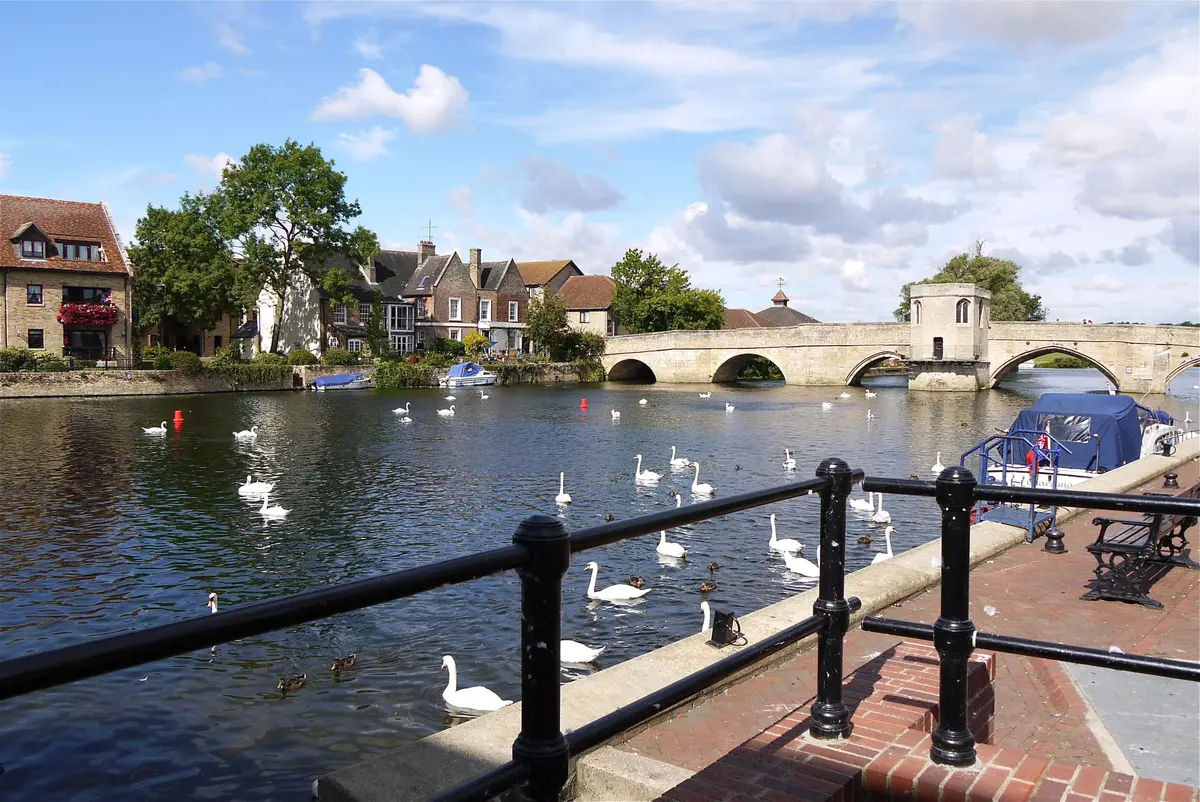
From the square the listed features can be seen: the central archway into the Inn Yard, which the listing describes as "now roofed over, but retaining elaborate cast iron balconies to galleries", and the figure of a golden lion on a bracketed stand at second-floor level. F. W. Pomeroy's bronze statue of Oliver Cromwell, erected in 1901, stands on the same square. The stone bridge over the Great Ouse was completed in 1426 and still carries its chapel. The Norris Museum, which reopened in August 2017 after a £1.5 million refurbishment, holds the town's local history collections.
The books disagree about which room is haunted: Room 14 for Antony Hippisley Coxe in 1973, Room 12 for Sarah Hapgood in 1993 and Room 13 for John Brooks in 1994. The bedroom count has changed since, from 25 in 2016 to 27 in 2026. Neither the hotel's home page nor its "About" page mentions the Green Lady, and nor does its guest information; all three were read on 24 September 2026.
Sources consulted
- Great Eastern Railway, «The Official Guide to the Great Eastern Railway: And the Harwich Route to the Continent» — Cassell, limited (404 pp.), p. 271, 1893 book
- Historic England, «Golden Lion Hotel, St Ives - National Heritage List for England, list entry 1128702 (Grade II, listed 24 March 1972)» — National Heritage List for England, 1972 report
- Antony D. Hippisley Coxe, «Haunted Britain: A Guide to Supernatural Sites Frequented by Ghosts, Witches, Poltergeists and Other Mysterious Beings (p. 117)» — Hutchinson / Book Club Associates, 1973 book
- Andrew Green, «Ghosts of Today» — Kaye & Ward, London, 1980 book
- Sarah Hapgood, «500 British Ghosts and Hauntings (Golden Lion, Market Place, St Ives, p. 158)» — Foulsham, London, 1993 book
- John Attwood Brooks, «The Good Ghost Guide» — Jarrold, Norwich, 1994 book
- Dennis William Hauck, «The International Directory of Haunted Places (Golden Lion Hotel, p. 18)» — Penguin Books, 2000 book
- Richard Jones, «Haunted Inns of Britain and Ireland (The Golden Lion Hotel, St Ives, p. 73)» — Barnes & Noble / New Holland, 2004 book
- Stuart Donald, «Haunted Taverns (Golden Lion Hotel, St Ives)» — Tempus, Stroud (ISBN 978-0-7524-4347-8), 2007 book
- Sarah Cliss, «Golden Lion St Ives marks 10 years with Coaching Inn Group» — The Hunts Post, 2026 newspaper archive
- Hannah Thompson, «Coaching Inn Group acquires Golden Lion St Ives for GBP 2m in GBP 20m expansion plan» — BigHospitality (William Reed), 2016 newspaper archive
- The Golden Lion Hotel, «Guest Information - The Golden Lion Hotel, St Ives (opening hours, breakfast, check-out, parking, access, pets)» — thegoldenlionhotel.co.uk, 2026 web
- Wikipedia contributors, «St Ives, Cambridgeshire - Public houses section (source of the misread 1893 citation)» — English Wikipedia, 2026 web
- The Golden Lion Hotel, «The Golden Lion Hotel — home, About, museum and bedrooms pages (consulted 25 September 2026: no mention of a ghost or the Green Lady)» — thegoldenlionhotel.co.uk, 2026 web
Reviewed by V. Serrano on 2026-08-14 · How we verify our content
💬 Field testimonies (0)
No testimonies yet. Add the first.
Add your testimony
🔒 Log in to add a testimony