👻 HAUNTED PLACE · EXP. Nº9476
ACTIVE
The Cloisters (Letchworth)
The Cloisters opened on the afternoon of Monday 28 January 1907 in Letchworth, the world's first garden city, built for £20,000 by the Quaker heiress Annie Jane Lawrence to a design she said had come to her in a dream.
Where is The Cloisters (Letchworth)?
- Location
- Hertfordshire, United Kingdom
- Type
- Public building
- Coordinates
- 51.968, -0.225
- Last updated
LOCATION
Why is The Cloisters (Letchworth) said to be haunted?
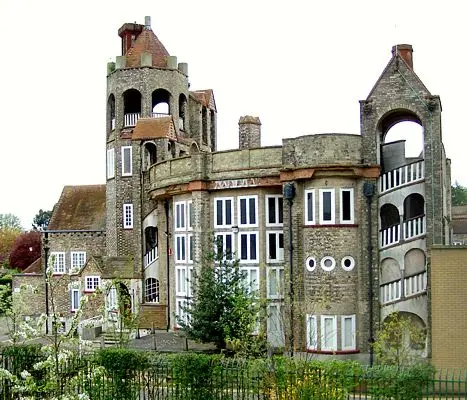
W. H. Cowlishaw gave her an octagonal tower, spiral-stair turrets and a half-oval open-air room walled with Swedish green marble, where twenty adult students slept in beds hung from the concrete vaulting and studied "how thought affects action". The carving was never finished; the school lasted about four years; the building became a Theosophical meeting place and a concert hall where a deaf woman with an ear trumpet drew audiences of a thousand. The Army wrecked it in the war, the council refused it as a gift, and in 1948 Lawrence gave it to the Freemasons, who still run it. One ghost story attaches to it, and only one: bar and kitchen staff have reported hearing a woman's voice calling out in greeting late at night, and think it is hers. The earliest printed version this page can date is from the winter of 1999.
What is the history of The Cloisters (Letchworth)?
The Cloisters is what happens when a Victorian heiress with a private income, a Quaker conscience and no architectural training decides to build the room she has seen in a dream.
Annie Jane Lawrence (16 April 1863 – 3 August 1953) was the third child of Alfred Lawrence, who with his brother ran Lawrence Brothers, smiths and founders, in the City of London. Her grandfather William Lawrence had walked to London from Cornwall in 1808 with two guineas and a bag of carpenter's tools and ended up Master of the Worshipful Company of Carpenters; her younger brother was the Labour politician Frederick Pethick-Lawrence, later Baron Pethick-Lawrence, who helped promote the garden city legislation. Annie did social work in the London slums, and it left her convinced that what the poor needed was not charity but fresh air and the habit of thinking.
She chose Letchworth because it was the world's first garden city — laid out from 1903 on Ebenezer Howard's blueprint of 1898 — and in 1905 she leased three acres south of the Baldock Road. She commissioned William Harrison Cowlishaw (1869–1957) to build what she had dreamed, and spent £20,000 on it, an enormous sum. What went up is grey brick with diaper patterning and Purbeck stone dressings, an octagonal tower and two open turrets with spiral staircases, and inside, an interior of painted brick with mass concrete vaulting. The heart of it is the Cloisters Garth, a half-oval open-air room with an arcade of Swedish green marble columns. Gifford, writing the centre's own history in 1999, recorded that the marble veining runs deliberately upward to signify growth, and that the two fireplaces are of red-veined marble to signify flame. An Art Nouveau fountain fed a drinking basin above and a hand-washing basin below, and the overflow ran out in two streams across the Garth floor.
It opened on the afternoon of Monday 28 January 1907 — the day before, on the Sunday, it had been dedicated. Kenneth Johnson's illustrated record of the town gives the date and the wording: Miss Lawrence dedicated her Adult Open Air School. Adult, not children's: twenty residential students studying, in the school's own formula, "how thought affects action and what causes and produces thought", along with Arts and Crafts skills. At night they slept in beds hung from the vaulting around the open Garth, with tarpaulins pulled across the arches in bad weather and the fireplaces lit in winter. A. Stuart Gray's biographical dictionary of Edwardian architects files it simply as a summer college.
The original scheme did not finish. The statutory listing is blunt about it: the rich symbolic carving — the doves and the bats — was "mostly uncompleted before the building project in its original form came to a halt in 1907". Residential summer schools ran only until about 1911, under the Rev. J. Bruce Wallace as resident warden, and the building turned into something else: the base of the Alpha Union, a meeting place for a small Theosophical community, and above all a concert hall. Lawrence, who was profoundly deaf and used an ear trumpet, filled it with music. An organ stood in the entrance hall and a system of pipes carried its sound around the building so that it seemed to come from nowhere. Audiences of a thousand came; on one occasion she hired the London Concert Orchestra, forty unemployed musicians, to play in the Garth. The Garth itself was eventually roofed over with a rotunda to serve as a concert hall, and the building also did a stint as a preparatory school. The last concert was given by the Brotherhood Orchestra in 1939, on the day war broke out.
In 1940 the War Department requisitioned it for the Army. It came back six years later so badly used that more than £2,500 was claimed in compensation and the organ was damaged beyond economical repair; for a while the British Tabulating Machine Company used it as a store. Lawrence offered it free to the County Council, with an annuity of £1,000 and the income from £20,000 after her death, and was turned down; other bodies refused it too. A chance remark by her solicitor, Mr T. Bainbridge, sent her to the Freemasons. They accepted the building on 22 May 1948, spent some £3,500 making it usable, and held the first Lodge meeting in October 1951. Lawrence had moved into St Catherine's Nursing Home in 1948 and died there on 3 August 1953, aged ninety. She is buried at All Saints, Willian.
The Cloisters was listed Grade II* on 7 September 1979. Until a minor amendment on 26 February 2024 the entry was headed "North Hertfordshire Masonic Lodge (The Cloisters)"; it now reads simply "The Cloisters". It has been on Historic England's Heritage at Risk register since October 2013.
Timeline: the documented record of The Cloisters (Letchworth)
- 1905 Annie Jane Lawrence leases three acres south of the Baldock Road in Letchworth, the world's first garden city, and commissions W. H. Cowlishaw to build the design she says came to her in a dream.
- 27–28 January 1907 Dedicated on the Sunday and opened on the Monday afternoon. Kenneth Johnson's record of the town names it an Adult Open Air School; the £20,000 building takes twenty residential students.
- 1907 The statutory listing records that the symbolic carving of doves and bats was mostly uncompleted "before the building project in its original form came to a halt" this year.
- c. 1911 The residential summer schools end, according to the centre's own history. The Cloisters becomes the base of the Alpha Union under the Rev. J. Bruce Wallace, a Theosophical meeting place and, above all, a concert hall.
- 1939 The Brotherhood Orchestra gives the last concert, on the day the Second World War breaks out. Lawrence, profoundly deaf, had drawn audiences of a thousand to the building for three decades.
- 1940 The War Department requisitions the building for the Army. It is returned six years later so damaged that over £2,500 is claimed in compensation; the organ is beyond economical repair.
- 22 May 1948 After the County Council and other bodies refuse the gift, the Freemasons accept the building. Some £3,500 of repairs follow; Lawrence enters St Catherine's Nursing Home the same year.
- October 1951 The first Lodge meeting is held. Cloisters Lodge No 7100 is formed to commemorate Lawrence's gift. She dies on 3 August 1953, aged ninety, and is buried at All Saints, Willian.
- 7 September 1979 Listed Grade II* as "North Hertfordshire Masonic Lodge (The Cloisters)". A minor amendment of 26 February 2024 renames the entry simply "The Cloisters".
- Winter 1999/2000 The earliest printed appearance of the ghost story I can date: Jack Gifford in Freemasonry Today, reporting that bar and kitchen staff have heard a woman's voice calling out in greeting, thought to be Lawrence's. His own building history, written that January, mentions no such thing.
- October 2013 The Cloisters goes onto Historic England's Heritage at Risk register over failing roof tiles. A repair grant follows in October 2022; the chimney is made safe in September 2025 and the Old Upper roof re-covered in October 2025.
- 9 February 2021 The ghost sentence enters the English Wikipedia, added by the editor Jack1956 citing Gifford. The same editor had put the article in the "reportedly haunted locations" category on 17 April 2014, with no text and no source. Spooky Isles repeats the sentence on 20 October 2022.
Is there a rational explanation for The Cloisters (Letchworth)?
There is exactly one ghost claim attached to this building, and it is not the one this page used to make.
The claim is that bar and kitchen staff, and others in the building late at night, have heard a woman's voice calling out in greeting, and that the voice is thought to be Annie Lawrence's. The source given for it is Jack Gifford, "The Cloisters, Letchworth", in Freemasonry Today, issue 11 (Winter 1999/2000), page 2. I have not been able to read that article, so I can report the claim and its provenance but not confirm its wording.
What can be checked is how it travelled, and the trail is unusually clean. The English Wikipedia article was placed in the category of reportedly haunted locations on 17 April 2014 by the editor Jack1956 — with no ghost text in the article at all, and no source. The sentence itself was added by the same editor on 9 February 2021, citing Gifford. Jay Hollis then repeated it, almost word for word, in a survey of haunted Letchworth published on Spooky Isles on 20 October 2022. Every later version I have seen descends from that sentence. The earliest datable printed appearance of the story is therefore Gifford's article: forty-six years after Lawrence died, and ninety-two after the building opened.
The control test matters here, because the version of this page published before August 2026 claimed four other things: caretakers hearing chanting and choral singing from the empty hall, a sudden chill in the cloister walk, a grey-robed figure at dusk, and Freemasons who avoid being last to leave. I looked for all four. The Paranormal Database's Hertfordshire file — 178 entries, about 84,000 characters, swept twice — returns zero hits for "Cloister", "Masonic", "Annie Lawrence" and "Barrington Road", while returning 56 for "ghost", 32 for "phantom", nine for Hitchin and two for other Letchworth sites. The building's own web estate, fourteen pages and about 30,000 characters of text across the Lawrence Cloisters Trust and the venue's wedding site, returns zero for ghost, haunt, apparition, séance, poltergeist, paranormal, choral and cold spot, against 110 for "Cloisters", 47 for "Lawrence" and 39 for "wedding". Most tellingly, Gifford's own 1,300-word history of the building, written for the masonic centre in January 1999 and preserved in the Internet Archive, contains the words ghost, haunt, voice and apparition zero times. The four claims are not attested anywhere. They were ours.
For the one surviving claim there are ordinary explanations, and they are unusually good ones. The bar is the old Garth: the half-oval, arcaded, marble-columned open-air room where students once slept in hanging beds, later roofed with a rotunda. A curved masonry room of that shape focuses sound and returns it from directions that do not correspond to its source. More pointedly, the building was designed to make music seem to come from nowhere — the owners' own history describes an organ in the entrance hall whose sound was carried by a system of pipes so that it "would waft around the building". A place built as an acoustic trick is a place where disembodied sound is the expected result, not the anomalous one. And Lawrence herself was profoundly deaf and used an ear trumpet: a deaf hostess greeting people is a loud memory to leave in a building.
One more honest caveat. Jay Hollis, who repeated the story, also wrote that the place "looks like a Hollywood set designer had been given a brief to build the sort of house you would imagine to be haunted and then got carried away". He is right, and that is a reason for caution rather than for belief. A paranormal group, Haunted Hitchin, filmed at the building in January 2018 and premiered the result there on 25 May 2018; the surviving promotion says only that "the results were stunning", names no phenomenon and names no witness, so it cannot be weighed as evidence either way.
Can you visit The Cloisters (Letchworth)?
The Cloisters stands on Barrington Road, Letchworth Garden City, Hertfordshire SG6 3TH, at national grid reference TL 22043 31427, and has been listed Grade II* since 7 September 1979 (National Heritage List entry 1102019). The building belongs to the Lawrence Cloisters Trust, whose published aims are its preservation and repair and "the provision and assisting in the provision of tours and educational events"; the Trust's telephone number is 01462 678059. Historic England's risk register describes it as the North Hertfordshire Masonic Lodge "but with much of the building unused". The nearest railway station is Letchworth Garden City.
Public access to the interior is by ticketed event. The Trust's events listing, read on 24 September 2026, offered an Afternoon Tea & Tour on Saturday 26 September 2026 from 12 noon to 5pm, at £10 for the building tour alone and up to £29 with the tea; the listing says the guided tour covers the building's history and architecture, "from old details to its recent restorations". The same listing carried an alternative market on 27 September and a charity quiz night on 14 October 2026. The venue website, run by the Trust, advertises weddings for 120 guests and, for other gatherings, a bar for up to 180 guests and free parking for up to 80 vehicles. The Trust's building updates mention a disabled toilet. None of the three events on the listing that day was a ghost tour.
The octagonal tower and the flat roof were once shown to visitors for the view over Letchworth. Jack Gifford, writing the centre's history in January 1999, recorded that access to them "had to be curtailed to obviate the heavy expense of roof repairs, not to mention severe damage to the tower caused by pigeons".
The building is on Historic England's Heritage at Risk register. The entry, in an archived copy of 25 March 2025, gives its condition as "Very bad" and its priority as A, "Immediate risk of further rapid deterioration or loss of fabric; no solution agreed", describes "internal and external deterioration due to rainwater penetration", and records that in October 2022 Historic England awarded a Repair Grant for Heritage at Risk for project development work. The Trust's own updates report that a steeplejack made the crumbling chimney stack safe (posted 30 September 2025) and that two volunteers laid a waterproof membrane over the roof of the Old Upper room (posted 21 October 2025).
Sources consulted
- Historic England, «The Cloisters, Letchworth Garden City — National Heritage List for England, list entry 1102019 (Grade II*, listed 7 September 1979; minor amendment 26 February 2024)» — National Heritage List for England, 1979 report
- Jack Gifford, «About The Cloisters — A Brief History (North Hertfordshire Masonic Centre website, written January 1999; archived capture)» — thecloisters.org.uk, via the Internet Archive, 1999 archive
- Kenneth Johnson, «The Book of Letchworth: An Illustrated Record» — Barracuda Books, 1976 book
- Standish Meacham, «Regaining Paradise: Englishness and the Early Garden City Movement» — Yale University Press, 1999 academic
- A. Stuart Gray, «Edwardian Architecture: A Biographical Dictionary» — Duckworth, 1985 book
- Lawrence Cloisters Trust, «Discover · About us · Sleeping at The Cloisters (the owners' own history, governance and building updates)» — lawrencecloisterstrust.org, 2026 web
- The Cloisters Letchworth, «History (the venue's published history of the building)» — cloistersletchworth.co.uk, 2026 web
- English Wikipedia contributors, «Revision history of "The Cloisters (Letchworth)" — haunted category added 17 April 2014, ghost sentence added 9 February 2021, both by the editor Jack1956» — Wikipedia, 2021 archive
- Jay Hollis, «Spooky Letchworth Garden City: Tales From Haunted North Hertfordshire» — Spooky Isles, 2022 web
- The Paranormal Database, «Hertfordshire county file (178 entries; no record for The Cloisters, Barrington Road or Annie Lawrence)» — paranormaldatabase.com, 2026 web
- Hitchin TV, «Haunted Hitchin: The Cloisters — investigation filmed January 2018, premiered at the building on 25 May 2018» — hitchintv.co.uk, 2018 web
Reviewed by V. Serrano on 2026-08-14 · How we verify our content
💬 Field testimonies (0)
No testimonies yet. Add the first.
Add your testimony
🔒 Log in to add a testimony