👻 HAUNTED PLACE · EXP. Nº0482
ACTIVE
The Grenadier
The Grenadier is a location reputed to be haunted in London, GB. Its reputation comes from reported apparitions, unexplained phenomena and eyewitness accounts gathered over time.
Where is The Grenadier?
- Location
- London, GB
- Type
- Other
- Coordinates
- 51.501, -0.155
- Testimonies
- 0
- Last updated
LOCATION
Why is The Grenadier said to be haunted?
The Grenadier stands at the closed end of Wilton Row, a Belgravia mews with no street frontage, and its ceiling is papered with banknotes left by customers to settle the card debt of a young officer said to have been beaten to death by his fellows and to walk the place each September. The pub calls him Cedric. No printed version gives him a surname, a regiment or a year, and the building underneath the story is younger than the story needs it to be: CAMRA dates the pub to 1843, Westminster's conservation surveyors date the yard beside it to the early 19th century, and the Survey of London has the Foot Guards barracks that stood alongside it given up in the mid-1830s and largely demolished in the early 1840s. The familiar claim that this was the officers' mess of the 1st Regiment of Foot Guards from 1720 turns out to have a traceable career of its own, running from a pub chain's marketing page in 2012 into an unsourced sentence on Wikipedia four weeks later. The pub is now run by INEOS, which says its Grenadier 4x4 was sketched here on a five-pound note pinned to that same ceiling.
What is the history of The Grenadier?
Wilton Row is a mews behind Belgrave Square, and the ground beside it was army ground before it was anybody's address. The Survey of London sets out the sequence for the enclosure next door: "The northern portion of Old Barrack Yard is all that remains of a large, irregularly shaped enclosure which was once the outer parade ground of an infantry barracks for some 500 men." The barracks, it goes on, "though said to date from as early as 1758, seems to have originated with stabling erected here under a lease of 1760 from Sir Richard Grosvenor, the ground landlord, to Samuel Thresher and Thomas Fisher". Those stables "had been completed by November 1762, when they were in the occupation of the 2nd Troop of Horse Grenadier Guards" — cavalry, holding the place on a sub-tenancy. Infantry came eighteen years later: "By October 1780 the buildings had been converted and newly fitted out for use by foot soldiers, and were in the occupation of the Coldstream Guards", and the refit was admired enough — "a treat to any military man" — to be put forward as the model for a national barrack-building campaign.
Then the army went. "The barracks was given up by the military in the mid-1830s, and the old buildings let as tenements", the Survey records, and "They were largely demolished in the early 1840s, when St Paul's Church was built on the site of the southern range and the soldiers' garden." The Survey also warns against reading soldiers into what is left standing: "A plausibly military-looking building in the south-east corner of Old Barrack Yard has been assumed to be part of the old barracks, but is of later date. It was probably erected as livery stables, and belonged formerly to the Alexandra Hotel."
The pub belongs to the phase after the demolition. CAMRA's National Inventory of Historic Pub Interiors, which gives it a two-star interior, calls it "An early to mid 19th century backstreet workers' pub, with some original features" and adds that it was "Originally known as the Guardsman, it was built in the early to mid 19th century to serve the needs of the staff from the neighbouring mansions as well as other local workers". CAMRA's pub database WhatPub is more precise and disagrees with that name: "this small mews pub was built in 1843 and called the New Grenadier until 1885". Westminster City Council reached the same period from the buildings themselves. The consultation draft of its Belgravia conservation area audit, dated 23 October 2013, describes Old Barrack Yard as "Small scale 2-3 storey early 19th century artisan's dwellings, many still retaining original features", with "the Grenadier Pub and the famous steps (historically associated with Wellington)" at the southern end, and lists Nos 17, 19, 21 and 28-36 there as Grade II. In the audit's shopfront gazetteer the pub has an entry of its own — "GRENADIER, No. 18 Wilton Row. Simple timber pub front to ground floor sub-divided by slim pilasters with sashes" — and, unlike 29 of the 72 numbered entries in that gazetteer, it carries no listing grade under its address. The Belgravia Neighbourhood Plan explains why a pub is down here at all: the area's historic pubs stand in the mews because "they were originally located to serve the armies of 'back-of-house' servants, grooms, and tradesmen who supported the wealthy residents of the principal squares and streets".
The account repeated everywhere else runs differently: built in 1720 as the officers' mess of the 1st Regiment of Foot Guards, opened to the public in 1818 as The Guardsman, renamed for the regiment's conduct at Waterloo. The oldest copy of it I have been able to date is a piece of pub marketing. The chain Taylor Walker carried it on its page for this pub, captured by the Wayback Machine on 4 August 2012: "Originally built in 1720 as the Officers Mess for The First Royal Regiment of Foot Guards, the Grenadier became a licensed premise in 1818 to serve as The Guardsman Public House; it was latter renamed The Grenadier." Four weeks later, on 1 September 2012, an editor created the Wikipedia article with the same three facts in the same order, and the two footnotes in that first draft hang on the celebrity clientele and on the ghost, leaving the origin sentence unsourced. A reference to CAMRA's Good Beer Guide 2013 was attached to it in June 2018, six years after the sentence was written.
The regiment's name is the one date in the story that is fixed. The Guards Museum puts it after the battle: "In 1815 the Prince Regent made the Regiment a Grenadier regiment, in honour of them defeating the Grenadiers of Napoleon's Imperial Guard at Waterloo on June 18. He renamed them The First or Grenadier Regiment of Foot Guards." Today the pub is run by the car company that borrowed the name back. WhatPub records that "In 2023 the operator became Ineos 123, a company manufacturing the Grenadier Ineos car marque; it is sub-leasing from Greene King", and that "At date of writing an Ineos property company also has a financial interest in other nearby Belgravia pubs".
Timeline: the documented record of The Grenadier
- 1760 Sir Richard Grosvenor, the ground landlord, leased the site next to what is now Wilton Row to Samuel Thresher and Thomas Fisher, who put up stabling on it. The Survey of London treats this lease, rather than the traditional date of 1758, as the origin of the barracks.
- November 1762 The stables were complete and occupied, on a sub-tenancy, by the 2nd Troop of Horse Grenadier Guards. The word Grenadier reaches this ground with a cavalry troop, half a century before Waterloo.
- October 1780 The buildings had been converted for foot soldiers and were occupied by the Coldstream Guards. The refit was praised as “a treat to any military man” and was to have served as the model for a country-wide barrack-building campaign that was never carried out.
- 1815 After Waterloo the Prince Regent made the 1st Regiment of Foot Guards a regiment of grenadiers and renamed it The First or Grenadier Regiment of Foot Guards. Any pub sign carrying that name postdates 18 June 1815.
- mid-1830s The military gave up the Knightsbridge foot-guards barracks and the old buildings were let as tenements. They were largely demolished in the early 1840s, when St Paul's Church took the site of the southern range and the soldiers' garden.
- 1843 CAMRA's pub record dates the building of the present mews pub to this year and gives its first name as the New Grenadier. CAMRA's own National Inventory entry says instead that it was originally known as the Guardsman; the two texts have not been reconciled.
- 1885 According to the same CAMRA record, the pub stopped being called the New Grenadier in this year.
- 4 August 2012 The Wayback Machine captured the pub chain Taylor Walker stating on its own page for this pub that it was “Originally built in 1720 as the Officers Mess for The First Royal Regiment of Foot Guards” and licensed in 1818 as The Guardsman. This is the oldest datable copy of that account located here.
- 1 September 2012 An editor created the Wikipedia article on The Grenadier with the same 1720, 1818 and Waterloo sequence. The two footnotes of that first draft support the celebrity clientele and the ghost; the origin sentence carried none until a reference to CAMRA's Good Beer Guide 2013 was attached to it in June 2018.
- 2023 CAMRA records that the operator became Ineos 123, the company behind the Grenadier car marque, sub-leasing from Greene King, and that an Ineos property company also holds interests in other nearby Belgravia pubs.
- 20 May 2026 Sir Jim Ratcliffe unveiled a solid aluminium World Origin Site plaque on an outside wall of the pub, marking it as the birthplace of the INEOS Grenadier, which its makers say was sketched here on a five-pound note pinned to the ceiling.
Is there a rational explanation for The Grenadier?
No printed version of the story gives the ghost a surname or a regiment or a year in which he died. Books call him a subaltern; the pub calls him Cedric and dates him by the month: "No one knows exactly when this ghastly deed occurred, but it is thought to have been in September as that is when ghostly happenings are rife." The whole of the operator's history page is that one paragraph, which also makes the pub take its name from the soldier — "Legend has it that Grenadier is named after young Cedric" — where the guidebooks derive it from the regiment.
The archive of the place is silent about him. The Survey of London gives 7,463 words to this stretch of Knightsbridge, from Hyde Park Corner to Wilton Place, and covers the barracks, the parade ground, the soldiers' garden and the men who used them. In that text "barrack" occurs 33 times and "Wilton" 19, while "ghost", "haunt", "murder" and "cards" occur no times at all. The London Gazette, searched across 1840-1900, returns nothing whatever for "Wilton-row"; the same search over the same sixty years returns 1,096 notices for "Belgrave-square" and 205 for "Wilton-crescent", so the corpus and the query both work.
The dates are the harder problem. An officer of the Foot Guards beaten to death in this building would need the building to have existed and to have been military, and the Survey has the barracks given up in the mid-1830s and largely demolished in the early 1840s, while CAMRA dates the pub itself to 1843 and Westminster's surveyors date the yard around it to the early 19th century. The regiment did not carry the word Grenadier until 1815 either.
The commercial reading of the ceiling is documented and recent. INEOS Automotive, which operates the pub, describes the banknotes as the origin of a vehicle: "It was here, over a pint with friends, that Sir Jim Ratcliffe conceived the idea for a new, purpose-built 4X4, which was then sketched on a £5 banknote and pinned to the ceiling." A plaque went up on the wall on 20 May 2026 to mark that, and the same ceiling is offered to customers as a way of settling Cedric's card debt.
One check stays open. Secondary ghost sites credit the earliest tellings to Joseph Braddock's Haunted Houses (1956) and to Guy Lyon Playfair's The Haunted Pub Guide (1987), quoting Playfair on "probably the most famous haunted pub in the world". Neither book has been read here. On 7 September 2026 the Google Books API answered HTTP 429, "Quota exceeded for quota metric 'Queries'"; HathiTrust full-text search answered 403 for the query and 403 for the control; archive.org's search-inside answered 403 for both titles, which are lending-only scans; and the Old Bailey Proceedings site returned an identical 1,261-byte page for the search term and for the control, which is a shell rather than a result. The date of the first printed telling is therefore undetermined here, and the 1956 and 1987 attributions are reported here as claims made by other websites and remain unverified.
Can you visit The Grenadier?
The Grenadier is at 18 Wilton Row, Belgravia, London SW1X 7NR, at the closed end of a mews reached on foot from Wilton Crescent; the pub has no frontage on any through road. A 2008 magazine piece cited by Wikipedia is titled "The Pub With No Street Entrance". Its own site listed its hours on 7 September 2026 as "Mon - Sat: 12:00 pm-11:00 pm" and "Sun: 12:00 pm-10:00 pm", with food served "Mon - Sat: 12:00 pm-9:30 pm" and "Sun: 12:00 pm-9:00 pm". The site gives two different telephone numbers, 020 3205 2905 on its Find Us page and 020 8071 1200 in its footer.
Getting to the door is regulated by the mews. CAMRA's entry records that "A notice outside states that the licensee is only allowed to serve customers who arrive by taxi or on foot", and that "The sentry box outside is a modern addition". The main entrance is reached by "stone steps up to the main entrance", so it is stepped rather than level; a second door opens on Old Barrack Yard, and CAMRA reads the pair as evidence that "small as the pub is, it would have had a couple of separate drinking areas". Hyde Park Corner and Knightsbridge, both on the Piccadilly line, are the nearest Underground stations. The two rear rooms "are usually reserved for diners".
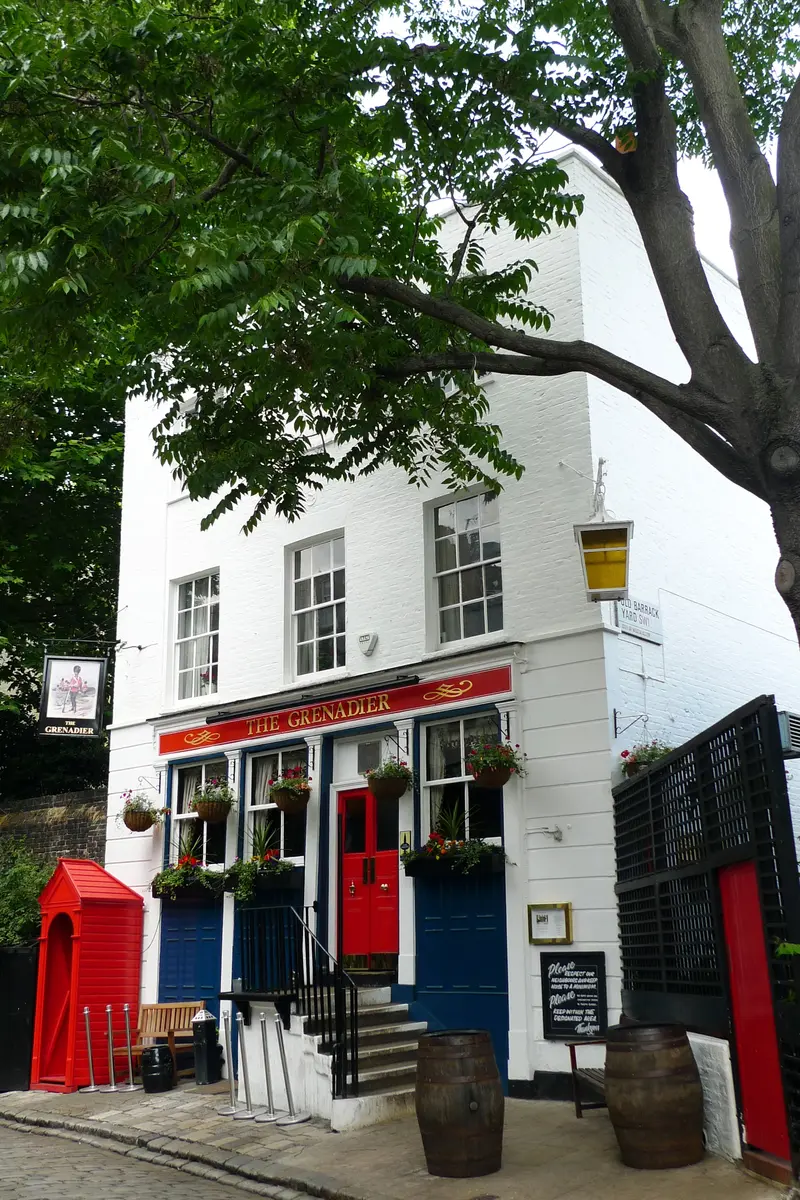
The fabric is the strongest reason to go in. The pub holds a two-star place on CAMRA's National Inventory, "an interior of very special national historic interest", with "a match-boarded dado round the walls, and an old bar-back with plain shelving and plain bevelled mirrors but with some wood carving at the top", and a counter that "has had a pewter top placed on it at some stage". The three-storey front "appears much as it did when originally built (apart from the thoroughly unnecessary application of white paint)". The photograph on this page was taken from that corner: the white brick elevation, the flight of steps with its handrail up to the red door, the red sentry box against the wall on the left, and the street sign reading OLD BARRACK YARD SW1 above the second door on the right. The building itself is unlisted: CAMRA states plainly that "this pub is not a listed building", and Westminster's Belgravia Neighbourhood Plan protects it by another route, naming "The Grenadier, Wilton Row" at the head of its list of Belgravia Historic Pubs covered by Westminster City Plan Policy 16.
Since 20 May 2026 an aluminium plaque on an outside wall records the pub as a World Origin Site for the INEOS Grenadier, unveiled by Sir Jim Ratcliffe. The banknotes are indoors, stapled across the ceiling above the bar.
Sources consulted
- John Greenacombe (ed.), «Knightsbridge South Side: East of Sloane Street, Hyde Park Corner to Wilton Place» — Survey of London: Volume 45, Knightsbridge (London, 2000), British History Online, 2000 book
- London Pubs Group, «Grenadier, Belgravia — National Inventory of Historic Pub Interiors entry» — CAMRA, 2024 web
- Campaign for Real Ale, «Grenadier, London — pub record» — WhatPub, 2026 web
- City Planning, Westminster City Council, «Conservation Area Audit: Belgravia (consultation draft, 23 October 2013)» — Westminster City Council, 2013 report
- Belgravia Neighbourhood Forum, «Belgravia Neighbourhood Plan 2023-2040, Submission Stage (Regulation 16) Consultation Version» — Westminster City Council, 2023 report
- Taylor Walker, «Grenadier, Belgrave Square — pub page (Wayback Machine capture of 4 August 2012)» — Internet Archive Wayback Machine, 2012 archive
- Wikipedia contributors, «The Grenadier — revision history, 1 September 2012 to 2026» — English Wikipedia, 2026 archive
- The Guards Museum, «Formation of the Regiments» — The Guards Museum, Wellington Barracks, 2026 web
- INEOS Automotive, «Birthplace of INEOS Grenadier officially recognised as World Origin Site» — INEOS Automotive Media, 2026 report
- Motoring Research, «Pub where Ineos Grenadier was born is now a World Origin Site» — Motoring Research, 2026 newspaper archive
- The Grenadier, «Paying off debt — history page» — grenadierbelgravia.com, 2026 web
Reviewed by V. Serrano on 2026-09-07 · How we verify our content
📎 Source: Wikipedia (CC BY-SA)
💬 Field testimonies (0)
No testimonies yet. Add the first.
Add your testimony
🔒 Log in to add a testimony