👻 HAUNTED PLACE · EXP. Nº9476
ACTIVE
The Skirrid Inn
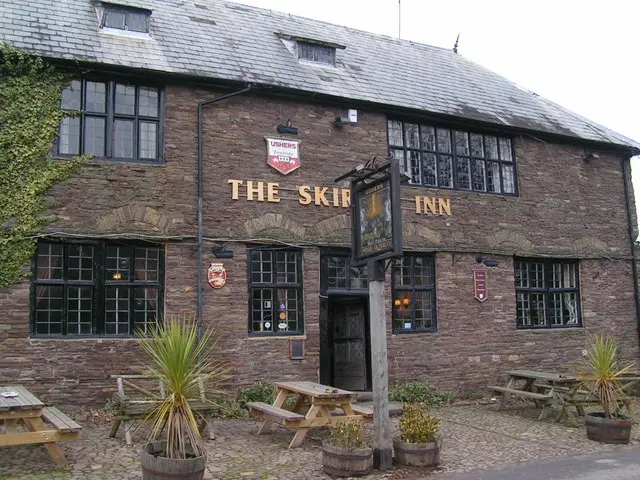
The Skirrid Inn, in the village of Llanvihangel Crucorney north of Abergavenny, advertises itself as Wales's oldest pub, over 900 years old, and is best known for a beam over its staircase said to have hanged 180 people condemned in a courtroom upstairs.
Where is The Skirrid Inn?
- Location
- Monmouthshire, United Kingdom
- Type
- Hotel / inn
- Coordinates
- 51.88, -2.981
- Last updated
LOCATION
Why is The Skirrid Inn said to be haunted?
The most useful document about the building rejects almost all of it. Cadw's listing record states that both the medieval origin and the "Oldest Inn in Wales" claim are unlikely, that the fabric is wholly mid to late 17th century, that the front was Victorianised to give it "a type of C17 appearance which it does not ever appear to have had", and that the aged interior is "probably a late C19 interpretation". The Bloody Assizes of 1685 never came near: Judge Jeffreys sat on the Western Circuit, while Monmouthshire alone among Welsh counties belonged to the Oxford circuit and held its assizes at Monmouth. In the Welsh newspaper archive to 1919 the inn appears only as a village house where farms were let. It is open today, run by Punch Pubs — and its old web address now belongs to someone else entirely.
What is the history of The Skirrid Inn?
The Skirrid Inn stands in the middle of Llanvihangel Crucorney, about fifty metres north-east of the parish church and some five miles north of Abergavenny. It was listed Grade II on 6 May 1952, and the single most interesting document about the building is the listing record itself — because Cadw's description opens by demolishing both the original listing and the pub's own advertising.
"This building was listed as a 'medieval stone house, well restored' and is advertised as the 'Oldest Inn in Wales'," the record states, "but a close inspection of the house suggest that both these claims are unlikely. The present building appears wholly mid to late C17 with major alterations in the late C19 and minor ones in the late C20."
The record then explains where the ancient look comes from. The main elevation "has been extensively altered in the Victorian period to give it a type of C17 appearance which it does not ever appear to have had". The four- and eight-light mullion-and-transom windows are reproductions; the continuous drip mould over the ground floor belongs to the Victorian work; the tall stacks are yellow brick that "might date from the 1880's", and Cadw suggests the whole revamp was part of the Old English Revival of that decade. A photograph in Sir Joseph Bradney's History of Monmouthshire, published in 1906, already shows the inn essentially as it looks today, which fixes the makeover as complete by then.
Inside, the verdict is the same: "The C17 character of the interior is probably a late C19 interpretation of public houses of the period." The main block is only four rooms — two bars, two bedrooms over. Genuinely old fabric survives: moulded ceiling beams with bar-and-scroll stops, a repaired seventeenth-century studded door with iron strap hinges, stone flag floors, a re-used upper cruck blade in the roof, and a fine oak staircase climbing to the attics with pierced splat balusters, carved corner posts, newels and pendants. Cadw notes that every stair beam is stopped and chamfered, "which is an unusual feature". The reason given for listing is craft, not romance: "Included as a fine C17 purpose built inn with interesting late C19 alterations."
The documented life of the inn is a good deal quieter than its reputation. In the National Library of Wales's digitised Welsh press, which runs to 1919, the Skirrid turns up steadily and unremarkably — in advertisements in the Glamorgan, Monmouth and Brecon Gazette in 1835, in the Monmouthshire Merlin across the 1840s, 50s and 60s, and in the Abergavenny Chronicle from 1909 through 1919 — as an ordinary village house where farms were let, notices were posted and local business was done.
Two glimpses of it survive from 1914, gathered from the Chronicle by Gill Wakley of the Abergavenny Local History Society. In August, days after war broke out, a labourer called Thomas Irons was fined ten shillings for chasing a cyclist along the road from Pontrilas shouting "Stop that man. He is a German"; a labourer helping at the inn took the cyclist for a fugitive and stopped him, and the police soon established that the victim was the son of a Macclesfield police sergeant. Two months later Charles Powell, of the Skirrid Mountain Inn, was one of three landlords fined £5 each for stealing a black spaniel from Mrs Attwood-Matthews of Llanvihangel Court; he sold his livestock and furniture and left the inn a few months afterwards. In the 1940s a prisoner-of-war camp stood opposite.
The other history — the one that fills the coach parties — holds that the first floor served as a court of law and that the condemned were hanged over the stairwell from an oak beam still marked by the rope. The number usually given is 180. Modern retellings add a founding case dated 1110, in which a sheep-stealer named John Crowther was hanged while his brother, tried for robbery, was spared; and, since at least 2002, they add the name of George Jeffreys, the Lord Chief Justice of the Bloody Assizes.
Timeline: the documented record of The Skirrid Inn
- 1543 The Court of Great Sessions is established for twelve Welsh counties. Monmouthshire alone is left outside it and attached to the Oxford circuit of the English assizes, with its assizes sitting at Monmouth — the jurisdictional fact that later makes the Judge Jeffreys story impossible.
- June–September 1685 The Duke of Monmouth lands at Lyme Regis on 11 June and is beaten at Sedgemoor on 6 July. George Jeffreys's special commission — the Bloody Assizes — opens at Winchester in late August and sits at Salisbury, Dorchester, Exeter, Taunton and Wells. Every one of those towns is on the Western Circuit; none is in Monmouthshire.
- Mid to late 17th century The present inn is built. Cadw's listing record concludes that the fabric "appears wholly mid to late C17" and that the advertised medieval origin is "unlikely" — the building was purpose-built as an inn, which is the reason given for listing it.
- 1880s The inn is remodelled in the Old English Revival taste. Cadw records that the main front was altered "to give it a type of C17 appearance which it does not ever appear to have had", with reproduction mullion-and-transom windows and yellow brick stacks, and that the seventeenth-century feel of the interior is "probably a late C19 interpretation".
- 1906 Sir Joseph Bradney publishes a photograph of the inn in his History of Monmouthshire showing it essentially as it stands today. Cadw cites it as evidence that the Victorian makeover was finished by then.
- August–October 1914 Two court cases put the inn in the Abergavenny Chronicle. In August a labourer, Thomas Irons, is fined ten shillings for assaulting a cyclist he had denounced outside the inn as "a German"; in October the landlord, Charles Powell, is one of three publicans fined £5 each for stealing a black spaniel from Mrs Attwood-Matthews of Llanvihangel Court. He leaves the inn a few months later.
- 6 May 1952 The building is listed Grade II (Cadw reference 1918) as a "medieval stone house, well restored" — a description the current listing text quotes only in order to reject it.
- 1993 Paul R. Davis surveys the inns of Wales and the Marches and singles the Skirrid out: dozens of Welsh houses boast a venerable age, the Skirrid best known among them, but the claims are rarely backed by evidence.
- 31 October 2002 The Morning Advertiser runs a Halloween piece headlined "Ancient inn has links with notorious hanging judge", tying the inn to Jeffreys and to "more than 180" hangings from a marked beam. It is the earliest datable print appearance of that whole package I have been able to fix — and it is a sales notice: £65,000 is being asked for the remainder of a twenty-year lease begun in 2000.
- 29 April 2003 Most Haunted broadcasts an episode filmed at the inn with Yvette Fielding and the medium Derek Acorah. Acorah leaves the programme in 2005 after its parapsychologist, Ciarán O'Keeffe, plants a fictitious spirit named "Kreed Kafer" — an anagram of "Derek faker" — which Acorah duly channels.
- 12 August 2022 The Wayback Machine captures the inn's own site, unchanged since at least 2018 and still claiming the building has stood "for over 900 years". Notably, it says only that the house was "used during the past as both a courtroom & an execution place": the pub's own account names neither Jeffreys nor any figure of 180.
- December 2023 A new site built by Punch Pubs first appears in the web archive, with opening hours, a food menu and three guest rooms. The old address is abandoned; by 2025 its lapsed domain is serving an adult-dating and gambling affiliate site, though directories and the building's own listing entry still link to it.
Is there a rational explanation for The Skirrid Inn?
Start with the superlative, because it is not a historical claim but a slogan, and it belongs to whoever is selling it. "At over 900 years old, The Skirrid Inn is Wales' oldest pub", says the pub's current website. Cadw, in writing, says the opposite: the claim is "unlikely" and the fabric is "wholly mid to late C17". Paul R. Davis, in Historic Inns and Taverns of Wales and the Marches (1993), put it drily — in Wales dozens of establishments boast a venerable age, the Skirrid is the best known, but the claims are rarely backed by evidence.
Judge Jeffreys is easier still, because the geography of the English assize system settles it. The Bloody Assizes of 1685 were a special commission on the Western Circuit: it opened at Winchester in late August and moved through Salisbury, Dorchester, Exeter, Taunton and Wells, in the counties where Monmouth's rebels had actually risen after his landing at Lyme Regis on 11 June and his defeat at Sedgemoor on 6 July. Monmouthshire was not on that circuit. Alone among the thirteen Welsh counties it had been left outside the Court of Great Sessions and attached to the Oxford circuit of the English assizes, and its assizes sat at Monmouth, in the county town's Shire Hall — not in a village inn twenty miles away, and not before a judge who was elsewhere. The company that runs the ghost hunts concedes the point on its own booking page: "There is no readily available documentary evidence to show that Jeffreys ever sat in judgement at the inn."
The number behaves like a rumour rather than a record. Most retellings say 180. Strangest Pubs in Britain (2002) says that after the first hanging "over 1,800 more people were hanged in The Skirrid" — a tenfold difference between two popular books about the same beam. The name drifts too: the sheep-stealer is John Crowther in Richard Jones's Haunted Inns of Britain and Ireland (2004) and in the Abergavenny Chronicle, James Crowther in Strangest Pubs, and the date slides between 1100 and 1110. Fanny Price, the inn's best-known ghost, is a Victorian landlady buried in St Michael's churchyard according to History Points and the Abergavenny Local History Society, and an eighteenth-century employee who died of consumption according to the Abergavenny Chronicle of 5 October 2022. Even the shape of the legend is unstable: History Points reports the local version as a court held "in medieval and Tudor times", with no Jeffreys in it at all.
The beam itself has a duller explanation. Cadw describes the staircase as fine seventeenth-century oak in which "all the stair beams are stopped and chamfered", ordinary structural joinery given a decorative finish — and reminds the reader that the seventeenth-century character of the interior is "probably a late C19 interpretation". A grooved and worn beam over a stair well in a building rebuilt to look old is not evidence of anything in particular.
Finally, the archive is silent where it should be loud. Searching the National Library of Wales's digitised Welsh newspapers returns the Skirrid Inn repeatedly across the whole run — 1835, 1844, 1850, 1859, 1864, 1909, 1914, 1915, 1919 — always in advertisements and parish notices, and the same searches paired with a court, a gallows or Judge Jeffreys return nothing of the kind. (The archive blocks direct access, so these searches were run through a public index of it and repeated before being reported.) The control is the point: the corpus knows this inn well, and through 1919 it knows it as a place where farms were let, not where men were hanged. The earliest datable appearance in print of the modern package — Jeffreys, "more than 180", and the marked beam — that I have been able to fix is a Halloween trade item in the Morning Advertiser of 31 October 2002, which was also, tellingly, an advertisement: £65,000 was being sought for the remainder of a twenty-year lease.
And there is money in it now. Ghost hunts at the inn are sold at £55 a head, £65 with supper, running from 9.30 p.m. to 3 a.m.; the Halloween and Friday-the-13th dates for 2026 are sold out. Most Haunted filmed there for its second series, broadcast on 29 April 2003, with the medium Derek Acorah — who left the programme in 2005 after the show's own parapsychologist, Ciarán O'Keeffe, fed him an invented spirit called "Kreed Kafer", an anagram of "Derek faker", and Acorah channelled it.
Can you visit The Skirrid Inn?
The Skirrid Inn is trading. Its own site, skirridinn.com, and CAMRA's WhatPub entry, updated on 4 June 2026, both list it as open at Llanvihangel Crucorney, Abergavenny NP7 8DH, telephone 01873 890258, and CAMRA gives Punch as the freehold owner.
On 23 September 2026 the inn's site gave the same hours as CAMRA: Monday 17.30–22.30; Tuesday to Thursday 11.30–14.30 and 17.30–22.30; Friday 11.30–23.30; Saturday 11.00–23.30; Sunday 12.00–22.30. Food is served Monday 17.30–21.00, Tuesday to Friday 12.00–14.00 and 17.30–21.00, Saturday 12.00–21.00 and Sunday 12.00–15.00. The site lists three en-suite rooms, two with four-poster beds and one cottage bedroom.
The inn's former address, skirridmountaininn.co.uk, still carried the pub's own site in an archived capture of 12 August 2022. On 23 September 2026 the domain served an affiliate site for adult dating, with links to gambling sites, and the British Listed Buildings page for the property still linked to it.
The village lies off the A465, about 7 km (4.4 miles) north-north-east of Abergavenny town centre in a straight line, inside the Bannau Brycheiniog (Brecon Beacons) National Park. The Cadw listing places the inn in the centre of the village, "about 50m north-east of the church". Skirrid Fawr, the split hill that gives it its name, has belonged to the National Trust since 1939; its 486-metre summit is 2.5 km (1.6 miles) south-south-east of the pin.
The building is Grade II listed (Cadw record 1918, listed on 6 May 1952). The listing describes two bars with stone walls and fireplaces, stone flag floors, beamed ceilings and "a Fine C17 staircase in oak". Ghost hunts at the inn are sold by Haunted Happenings, an events company: on 23 September 2026 its listing priced them at £55 a head from 21.30 to 3.00, or £65 to £69 with supper from 20.30, showed dates up to November as sold out and offered the next places on 11 December.
Sources consulted
- Cadw, «The Skirrid Inn, with attached barn, Crucorney — listed building record 1918, Grade II» — Cof Cymru / National Historic Assets of Wales, 1952 report
- National Library of Wales, «Welsh Newspapers Online (searches for the Skirrid Inn, 1804–1919)» — Llyfrgell Genedlaethol Cymru, 1919 archive
- Encyclopaedia Britannica, 11th edition, «Monmouthshire» — Cambridge University Press, 1911 book
- Morning Advertiser, «Ancient inn has links with notorious hanging judge» — Morning Advertiser, 2002 newspaper archive
- Paul R. Davis, «Historic Inns and Taverns of Wales and the Marches» — Sutton Publishing, 1993 book
- Richard Jones, «Haunted Inns of Britain and Ireland» — New Holland, 2004 book
- Portico / Strangest series, «Strangest Pubs in Britain» — Strangest Books, 2002 book
- Gill Wakley, Abergavenny Local History Society, «The Skirrid Mountain Inn, Llanfihangel Crucorney» — History Points, 2026 web
- CAMRA, «Skirrid Inn — pub entry (status, hours, operator)» — WhatPub / CAMRA, 2026 web
- Abergavenny Chronicle, «Monmouthshire is home to Wales' most haunted place — an inn crawling with ghosts» — Abergavenny Chronicle, 2022 newspaper archive
- Skirrid Mountain Inn, «Skirrid Mountain Inn — former official website, capture of 12 August 2022» — Internet Archive Wayback Machine, 2022 archive
- The Skirrid Inn, «The Skirrid Inn — official website (Punch Pubs & Co)» — skirridinn.com, 2026 web
- Haunted Happenings, «The Skirrid Inn ghost hunts — event listing and prices» — hauntedhappenings.co.uk, 2026 web
- South Wales Paranormal Research, «Haunted Newport and the Valleys» — The History Press, 2010 book
Reviewed by V. Serrano on 2026-08-14 · How we verify our content
💬 Field testimonies (0)
No testimonies yet. Add the first.
Add your testimony
🔒 Log in to add a testimony