👻 HAUNTED PLACE · EXP. Nº9476
ACTIVE
Theatre Royal, Drury Lane
Britain's most famous theatrical ghost walks a route that was first written down in 1945 — by the theatre's own publicist.
Where is Theatre Royal, Drury Lane?
- Location
- London, United Kingdom
- Type
- Theater
- Coordinates
- 51.513, -0.12
- Last updated
LOCATION
Why is Theatre Royal, Drury Lane said to be haunted?
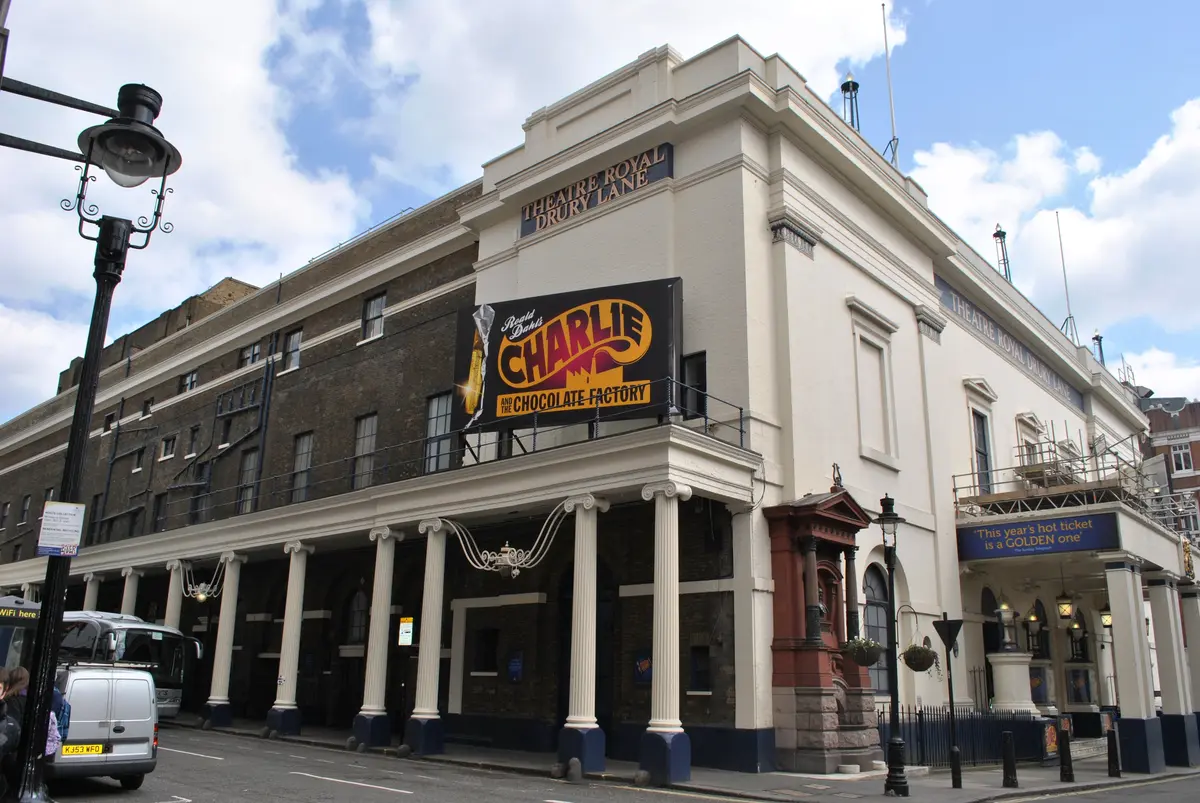
The Man in Grey, a figure in an eighteenth-century cloak, powdered wig and tricorne hat, is said to appear in daylight in the upper circle of the Theatre Royal, Drury Lane, and to vanish into the wall where, during works in 1848, builders are supposed to have found a skeleton with a dagger in its ribs. Neither half of that story appears in Walter Thornbury's 1878 chapter on the theatre, nor in the 119,000 words of recollections published in 1881 by Edward Stirling, who spent fifty years working in the building, nor in the Survey of London's archival history of it. The oldest first-hand account we have been able to date is W. J. Macqueen-Pope's, published in 1945 after twenty-one years running Drury Lane's publicity. The theatre's one documented killing needs no ghost: on 10 May 1735 the actor Charles Macklin drove a stick through the eye of a colleague, Thomas Hallam, in a quarrel over a wig, and answered for it at the Old Bailey.
What is the history of Theatre Royal, Drury Lane?
Drury Lane is not one theatre but four, raised one after another on the same rectangle of ground between Brydges Street — now Catherine Street — and Drury Lane itself. The Survey of London records that the plot was a riding yard until Thomas Killigrew, holder of one of the two patents Charles II granted in 1660, put a playhouse on it. It opened on 7 May 1663 with Beaumont and Fletcher's "The Humorous Lieutenant", and had cost £2,400, raised in thirty-six building shares of £66 13s 4d each. Samuel Pepys, who had walked past the shell while it was going up and thought it "will be very fine", came with his wife the day after the opening. On 5 June 1665 the Lord Chamberlain closed the house indefinitely because of the plague. In 1671/2 it burned down.
The second theatre, whose design is usually attributed to Christopher Wren, opened on 26 March 1674 with Fletcher's "The Beggar's Bush" and stood for 117 years, reconstructed by Robert Adam in 1775 and ruled for three decades by David Garrick. It was demolished in 1791. Henry Holland's far larger house opened in 1794 and burned on 24 February 1809 — the fire that produced the most repeated anecdote in the building's history, Richard Brinsley Sheridan leaving the Commons to watch his own property go up and refusing to let the House adjourn on his account.
The present building is Benjamin Dean Wyatt's: first stone 29 October 1811, opened to the public on 10 October 1812. Very little of its interior survives as he left it, and that matters for anyone told that a ghost has walked these rooms since the Georgian age. Samuel Beazley completely gutted the auditorium in 1822 for the manager Robert Elliston, at a cost of some £22,000; a portico was added to the Catherine Street front in 1820 and Beazley's cast-iron Ionic colonnade along Russell Street in 1831. The auditorium was redecorated for the impresario Frederick Gye in 1847, fitted with temporary box partitions for opera seasons in 1868, 1870 and 1871, and reconstructed with steel girders and concrete floors under Philip Pilditch in 1901. Finally, in 1921–2 the auditorium and the greater part of the original semicircular walls were demolished outright to make the present interior, designed by J. Emblin Walker, F. Edward Jones and Robert Cromie at a cost of £150,000. What Historic England's Grade I listing praises as unique — the Greek Doric vestibule, the oculus-galleried rotunda, the iron-balustraded double staircase, the first-floor rotunda foyer — is Wyatt's front of house, not his auditorium.
The theatre's one thoroughly documented killing is not a legend at all. On the night of Saturday 10 May 1735, in the scene-room where the players warmed themselves by the fire, the actor Charles Macklin quarrelled with a colleague, Thomas Hallam, over a stock wig needed for that evening's afterpiece. Witnesses at the Old Bailey — among them Thomas Arne, numberer of the boxes, father of the composer — described Macklin rising from his chair and driving a stick into Hallam's left eye. The surgeon, Coldham, opened the skull and found that the stick had passed through the thin bone behind the eye and into the brain. Hallam died the next day. At the December 1735 sessions Macklin was found guilty of manslaughter and branded on the hand. He went back to work and became one of the great actors of the century.
In the modern era the house belonged to spectacle: Augustus Harris from 1879 and Arthur Collins from 1896 built the Christmas pantomimes that made Dan Leno a national figure, and Ivor Novello staged his musicals here from 1931 to 1939. Between 1939 and 1945 the building was the headquarters of the Entertainments National Service Association and took some bomb damage; it reopened on 19 December 1946. Andrew Lloyd Webber bought the theatre in 2000, and from January 2019 to July 2021 it was closed for a £60 million restoration by the architects Haworth Tompkins.
Timeline: the documented record of Theatre Royal, Drury Lane
- 7 May 1663 The first theatre on the site, built by Thomas Killigrew on a former riding yard at a cost of £2,400, opens with Beaumont and Fletcher's "The Humorous Lieutenant". Pepys, who had watched it being built, attends the following day.
- 26 March 1674 After the first house burns down in 1671/2, the second theatre — its design usually attributed to Christopher Wren — opens with Fletcher's "The Beggar's Bush". It will stand until 1791.
- 10 May 1735 In the scene-room, the actor Charles Macklin drives a stick into the left eye of a fellow actor, Thomas Hallam, in a quarrel over a stock wig. The surgeon Coldham later found that it had passed through the bone into the brain; Hallam died the next day.
- December 1735 At the Old Bailey sessions, with Thomas Arne and five other witnesses testifying and nine theatre managers and actors speaking to his character, Macklin is found guilty of manslaughter and sentenced to be branded on the hand.
- 24 February 1809 Henry Holland's theatre of 1794 burns down. Sheridan, a proprietor and a sitting MP, objects to the Commons adjourning on account of his private loss and goes to watch the fire.
- 10 October 1812 Benjamin Dean Wyatt's theatre — the present building — opens, eleven months after the first stone was laid on 29 October 1811.
- 1847 The auditorium — already gutted and rebuilt by Samuel Beazley in 1822 — is redecorated for the impresario Frederick Gye, a scheme recorded in "The Builder" of 20 October 1847. It is the only documented work at the theatre anywhere near the date the legend gives for the skeleton.
- 1878 Walter Thornbury devotes a 6,798-word chapter of "Old and New London" to the theatre, thirty years after the supposed discovery of the walled-up skeleton. It contains no ghost, no skeleton and no apparition.
- 1881 Edward Stirling, fifty years an author, actor and manager at Drury Lane, publishes two volumes of recollections. Across 119,068 words he never mentions a haunting: his ghosts are all the Ghost in "Hamlet".
- 1921–22 The auditorium and the greater part of the original semicircular walls are demolished and rebuilt to designs by J. Emblin Walker, F. Edward Jones and Robert Cromie at a cost of £150,000. Any walled-up side passage went with them.
- 23 March 1939 Ivor Novello's "The Dancing Years" opens at Drury Lane and runs 187 performances before the war closes the London theatres in September. The sighting most often attributed to its company is variously dated 1935, 1938 and 1939 in print.
- 1945 W. J. Macqueen-Pope, who ran publicity for the theatre for twenty-one years, publishes "Theatre Royal, Drury Lane", describing a woman who saw "a figure of a man in grey, wearing a hat, gazing down at the stage". It is the oldest first-hand account of the ghost that this review could date.
- 24 February 1958 The theatre is listed Grade I, together with the Sir Augustus Harris memorial drinking fountain of about 1897 attached to its Catherine Street front. The listing was amended on 23 July 1991.
- July 2021 The theatre reopens after a £60 million restoration begun in January 2019 by Haworth Tompkins for LW Theatres, which reinstated Wyatt's front-of-house rooms and made the auditorium reachable from street level for the first time in almost a century.
Is there a rational explanation for Theatre Royal, Drury Lane?
The Man in Grey is the best known theatrical ghost in Britain, and the interesting question about him is not whether he exists but when people started telling the story. The answer, as far as it can be measured, is surprisingly late.
The legend has two halves. One is a discovery: during works in 1848, workmen breaking into a walled-up side passage near the upper circle are said to have found a skeleton with a dagger in its ribs. The other is the apparition: a man in an eighteenth-century cloak, powdered wig and tricorne hat who is seen in daylight, walks a fixed route through the upper circle and vanishes into the wall where the remains were found.
Neither half appears in the nineteenth-century literature on this theatre. Walter Thornbury's chapter on Drury Lane in "Old and New London" (1878) runs to 6,798 words and contains the words ghost, haunted, skeleton, spectre and apparition exactly zero times — with Garrick appearing twelve times, Killigrew six and fire seventeen, so the text is there and searchable. Edward Stirling's "Old Drury Lane" (1881), 119,068 words of reminiscence by a man who spent fifty years in the building as author, actor and manager, mentions no haunting at all: its fourteen ghosts are the Ghost in "Hamlet" and its one skeleton is a stage effect in "Der Freischütz". The Survey of London's volume on the theatre (London County Council, 1970), some 50,000 words of archival history covering every lease, every manager and every alteration, gives ghost, haunted, skeleton and walled-up a flat zero, while 1848, 1870 and Macklin all return hits. Three exhaustive accounts, two of them written by people who knew the building, and none of them has heard of any of it.
The oldest first-hand description we have been able to date is from 1945, in W. J. Macqueen-Pope's "Theatre Royal, Drury Lane", where a woman sees "a figure of a man in grey, wearing a hat, gazing down at the stage" at the centre gangway of the fourth row and takes him for an actor in costume. Macqueen-Pope is not a neutral witness: he ran publicity for Drury Lane for twenty-one years, was its air-raid warden during the war, remained its official historian until his death in 1960, and in 1951 published a book called "Ghosts and Greasepaint". The route he set out — first seat, fourth row of the upper circle, along the rear gangway, into the wall by the royal box — is reproduced almost word for word in a dozen later guidebooks and ghost anthologies, which is what a single source looks like when it becomes a tradition. A search of the Media History Digital Library's trade-press corpus for the phrase "man in grey" returns 410 pages, of which only eighteen predate 1943 and not one of those eighteen concerns this theatre (control search: "Drury Lane", 5,692 pages; a nonsense phrase, zero).
The retellings do not agree with each other, and the arithmetic catches them. The most cited sighting is the one in which the company of Ivor Novello's "The Dancing Years" saw the figure from the stage; published versions date it to 1935, to 1938 and to 1939. "The Dancing Years" opened at Drury Lane on 23 March 1939 and closed that September, so two of those three dates are impossible. The skeleton grows in the same way: a dagger between the ribs in one book, shreds of a grey cloak in another, playing cards and gold coins in a third, an inquest in a fourth.
And there is the building itself. The auditorium in which the Man in Grey is said to walk, together with most of the original semicircular walls that contained any side passages, was demolished in 1921–2. The tiers are now called Stalls, Royal Circle, Grand Circle and Balcony; the theatre no longer has a level called the upper circle. Whatever the ghost is, he is not walking through Georgian fabric.
Finally, the incentive is not hidden and does not need to be inferred. The theatre's own website describes the building as "said to be one of the most haunted buildings in the world", says its guided tour includes "even murder" and adds that "you may even get to see one of Drury Lane's famous ghosts", and it has sold late-night Halloween tours at £25 a head from 25 to 31 October, promising that "there may be sightings of the theatre's most famous ghost, The Man in Grey". That is not a reason to disbelieve anyone who says they saw something. It is a reason to notice that the person who first wrote the route down was on the payroll of the box office.
Can you visit Theatre Royal, Drury Lane?
Theatre Royal Drury Lane is at Catherine Street, Covent Garden, London WC2B 5JF, and trades as The Lane at thelane.co.uk. The building backs onto Drury Lane itself. The domain drurylanetheatre.com belongs to another house, the Drury Lane Theatre at 100 Drury Lane, Oakbrook Terrace, Illinois. Historic England lists the London theatre at Grade I together with the Sir Augustus Harris memorial drinking fountain on its Catherine Street front, under list entry 1357276, first listed on 24 February 1958, at grid reference TQ 30537 81017. Measured in a straight line from the pin, Covent Garden Underground station is about 280 m to the west, Holborn about 480 m to the north and Temple about 510 m to the south-east.
The front of house has been open to the public daily without a show ticket since the reopening that followed the £60 million restoration begun in January 2019. On 24 September 2026 the theatre's site listed afternoon tea in the Grand Saloon from Wednesday to Sunday and gave the Cecil Beaton Bar's hours as from midday Wednesday to Sunday; for Mondays and Tuesdays its opening-times page said from 2 p.m. and its what's-on page from 4.30 p.m.
Guided tours in English run from Wednesday to Sunday, last about an hour and a quarter and take up to twenty people. The tour page says that the route can change around other events in the building and involves numerous steps, and that with a few exceptions it does not go backstage, for security reasons. Its description promises "stars, innovation, Royal scandal and even murder" and adds that visitors "may even get to see one of Drury Lane's famous ghosts". The first late-night Halloween tours, announced on 17 October 2021, ran from 25 to 31 October at £25, with arrival at 9.15 p.m. and an end at about 10.45 p.m. The wall in which the skeleton of the Man in Grey is said to have been found belonged to the auditorium that was demolished and rebuilt in 1921–22, according to the Survey of London.
For performances, the access page lists step-free entry from Russell Street and four steps at the main entrance on Catherine Street, a passenger lift to all four levels, and non-transferable wheelchair spaces in the Stalls (four), the Royal Circle (one) and the Grand Circle (one); the Balcony has no step-free access. Accessible toilets are on three of the four levels and assistance dogs are admitted. On 24 September 2026 the theatre was playing Sting's The Last Ship from 22 September to 3 October, with Jesus Christ Superstar billed as coming soon and The Greatest Showman announced from spring 2027.
Sources consulted
- Old Bailey Proceedings Online, «December 1735, Trial of Charles Mechlin (t17351210-40)» — Old Bailey Proceedings Online, version 9.0, 1735 archive
- anon., «Charles Macklin, for the Murder of Thomas Hallam, May 10, 1735, pp. 441-442» — Celebrated Trials of All Countries, and Remarkable Cases of Criminal Jurisprudence, 1835 book
- F. H. W. Sheppard (ed.), «The Theatre Royal: Management; Site; Buildings» — Survey of London, vol. 35: The Theatre Royal, Drury Lane, and the Royal Opera House, Covent Garden (London County Council), 1970 book
- Walter Thornbury, «Drury Lane Theatre (chapter XXVIII)» — Old and New London, vol. 3, 1878 book
- Edward Stirling, «Old Drury Lane: Fifty Years' Recollections of Author, Actor and Manager» — Chatto and Windus, London (2 vols.), 1881 book
- Historic England, «Theatre Royal Drury Lane and attached Sir Augustus Harris Memorial Drinking Fountain, list entry 1357276» — National Heritage List for England, 1958 report
- W. J. Macqueen-Pope, «Theatre Royal, Drury Lane» — W. H. Allen, London, 1945 book
- The Guide to Musical Theatre, «The Dancing Years» — guidetomusicaltheatre.com, 1939 web
- The Lane (Theatre Royal Drury Lane), «Restoration Project: Theatre Royal Drury Lane, a star reborn» — thelane.co.uk, 2021 web
- The Lane (Theatre Royal Drury Lane), «Halloween Tours of Theatre Royal Drury Lane» — thelane.co.uk, 2021 web
- The Lane (Theatre Royal Drury Lane), «Accessibility; Tours and Experiences; Opening Times» — thelane.co.uk, 2026 web
Reviewed by V. Serrano on 2026-08-20 · How we verify our content
💬 Field testimonies (0)
No testimonies yet. Add the first.
Add your testimony
🔒 Log in to add a testimony